

GDPR Cookie Consent Requirements in 2026: 7 Live Checks Before You Trust the Banner
If you are reviewing gdpr cookie consent requirements in 2026, the main mistake is treating the banner as the whole compliance story.
The harder question is whether the live site actually gives people a fair first choice, blocks non-essential technologies until the right signal exists, explains each purpose clearly, and lets people change their mind without friction.
That is the more useful frame now. The European Commission still says valid consent must use “clear and plain language” and that withdrawal must be “as easy to use as giving consent.” In March 2026, the EDPB launched a coordinated enforcement action on transparency and information obligations. In April 2026, the ICO finalized its storage-and-access-technologies guidance and made clear that the review surface is broader than classic cookies alone. CNIL’s latest dark-pattern enforcement messaging is also blunt: rejecting cookies should be “just as easy as accepting them.”
If you want nearby context first, start with our guides to GDPR cookie consent, cookie consent banner examples, and GDPR consent management platform. This page stays narrower. It is the seven-check review I would use this week before telling a team their GDPR cookie layer is in good shape.
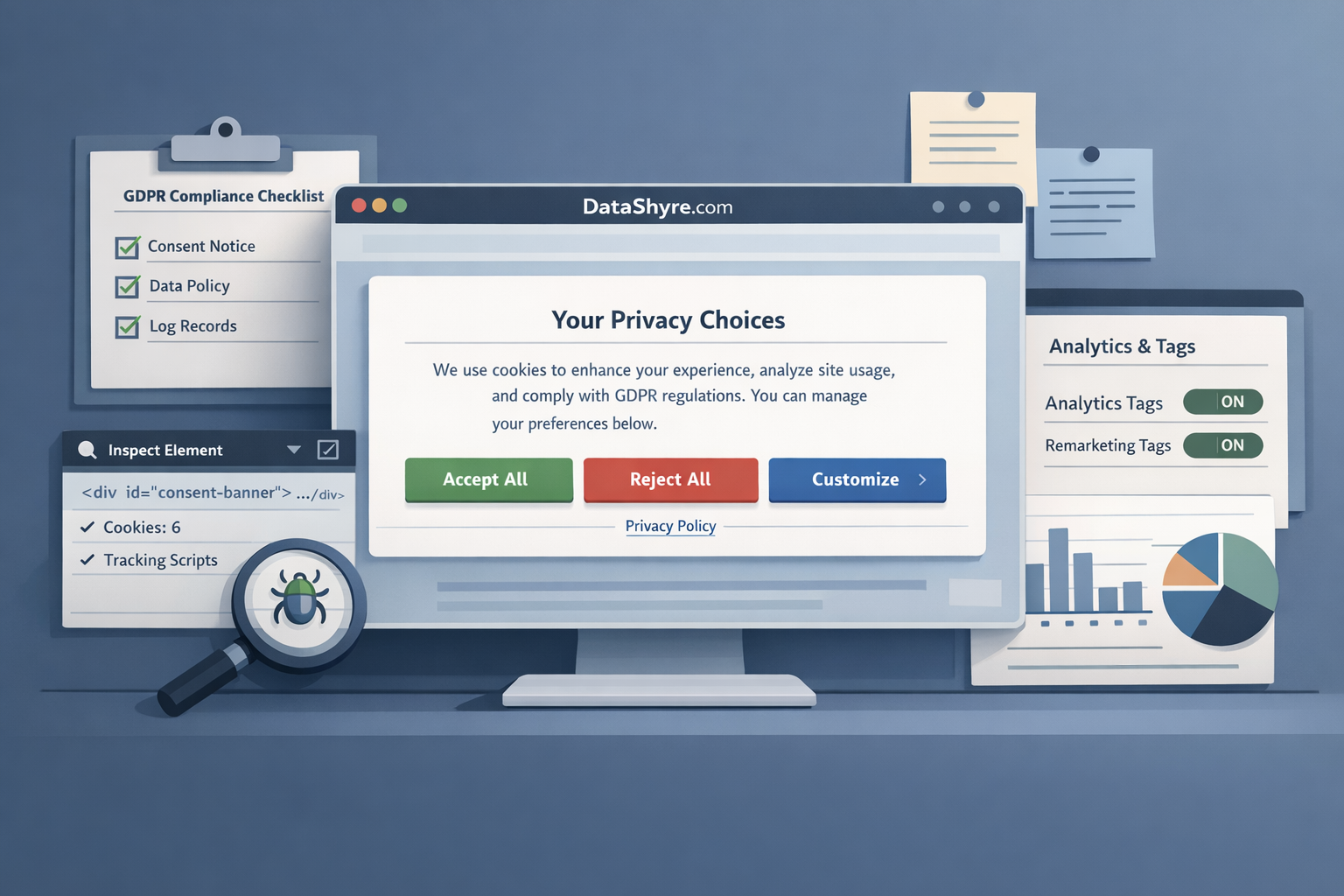
1. Check that non-essential technologies stay off until consent exists
The first live check is still the most important.
For GDPR cookie work, the real question is not whether the banner appears. It is whether analytics, advertising, personalization, social embeds, tracking pixels, fingerprinting scripts, and similar optional technologies wait for the correct signal before they do anything.
That matters even more in 2026 because regulator guidance now talks about storage and access technologies more broadly, not just old-fashioned browser cookies. If your stack uses pixels, local storage, link decoration, or device fingerprinting, the consent review should cover them too.
So test the pages most likely to leak:
- the homepage on a first uncached visit;
- product or pricing pages with more tags;
- article templates with embeds or video;
- landing pages that load ad or measurement scripts early;
- the return visit after refusal.
If optional technologies begin working before consent, the rest of the banner polish does not rescue the implementation.
2. Make refusal as easy and visible as acceptance
This is where many cookie layers still fail.
The European Commission’s consent guidance still points to free choice and visible withdrawal. CNIL’s 12 December 2024 enforcement note says rejecting cookies should be “just as easy as accepting them.” The ICO’s 2026 practical guidance likewise expects consent mechanisms to make refusal as easy as acceptance.
For gdpr cookie consent requirements, I would check whether:
Reject allis available on the first layer whenAccept allis;- the privacy-protective path is equally visible on mobile;
- font size, color, and placement do not push users toward one answer;
- refusal does not require extra steps that acceptance avoids.
If saying no takes more effort than saying yes, the implementation is already on weak ground.
3. Ask for consent by purpose, in clear language, without pre-enabled options
A compliant-looking banner can still fail on specificity.
The European Commission still describes valid consent as specific, informed, and tied to clear reasons for processing. The EDPB’s small-business guidance continues to describe consent as requiring genuine choice, sufficient information, granularity, and a clear affirmative action.
That means a useful banner usually separates optional technologies by purpose, such as:
- analytics;
- personalization;
- advertising or retargeting;
- social or embedded media where relevant.
It also means avoiding pre-ticked boxes, vague labels, or one bucket called something soft like experience improvements that hides several unrelated purposes underneath it.
The shortest test is simple: could a normal visitor understand what each category does and refuse one purpose without refusing everything else?
4. Remove fake signals like scrolling consent, browse-to-accept logic, or cookie walls
Some of the clearest regulator examples still live here.
The EDPB’s April 2026 practical examples say scrolling or swiping through a page is not a “clear affirmative action.” The same summary also gives a direct example of a cookie wall that blocks content unless the user clicks Accept cookies, and explains that this does not present a genuine choice, so the consent is not freely given.
That means gdpr cookie consent requirements should rule out:
- banners that treat continued browsing as acceptance;
- passive page interaction as consent;
- pre-enabled optional switches;
- cookie walls unless a narrow exception truly applies and has been separately validated.
If your stack still relies on passive behavior or pressure tactics, it is carrying old risk into a tighter enforcement climate.
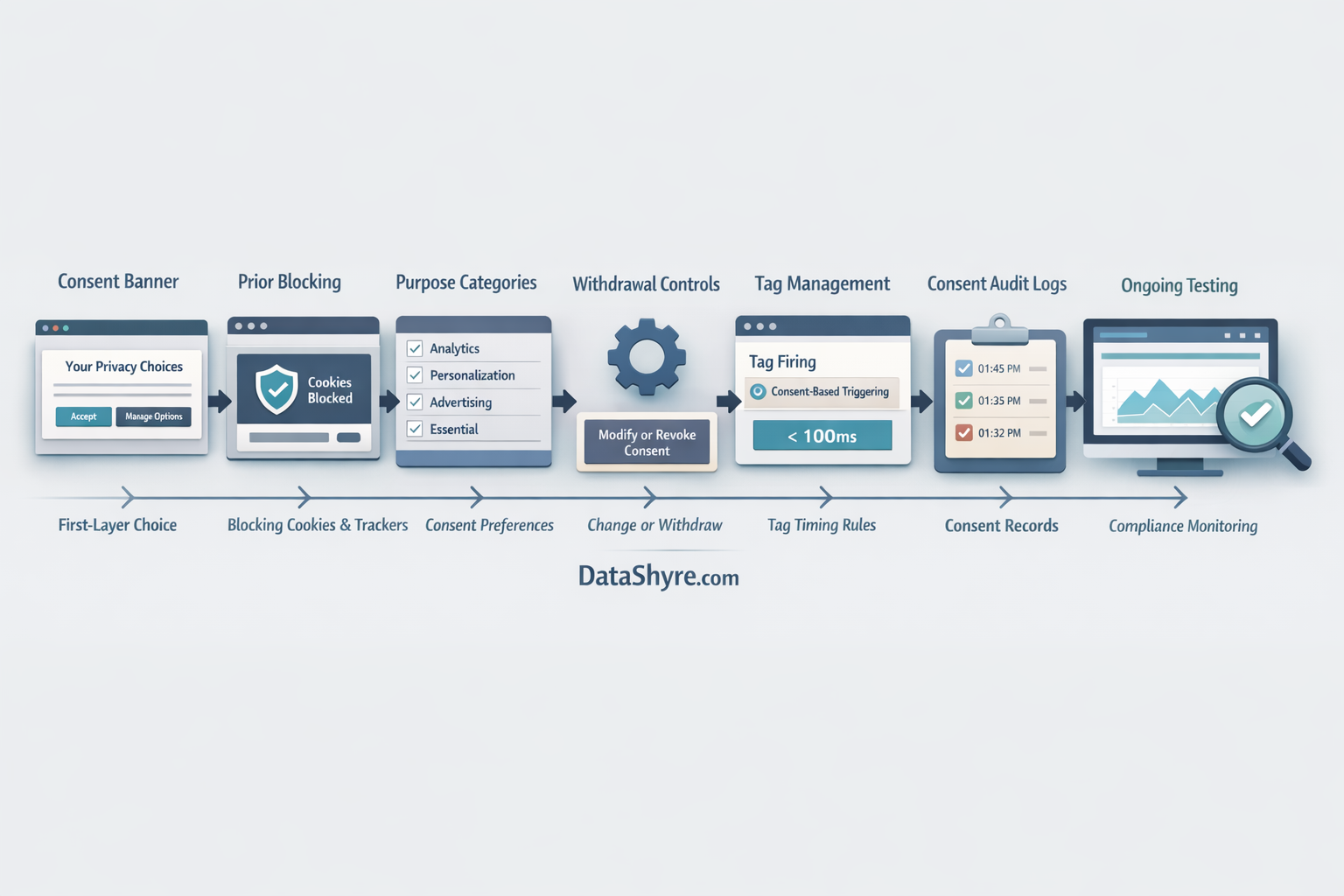
5. Make withdrawal persistent and genuinely easy after the first visit
Consent quality is not only about the first decision.
The European Commission still says withdrawal must be as easy as giving consent. The ICO’s 2026 guidance adds practical expectations after withdrawal too: stop using the technologies, stop the personal-data processing they support, and inform third parties where required.
So a serious gdpr cookie consent requirements review should ask:
- is
Cookie settingsor an equivalent control visible on every page; - can a user change their answer without hunting through account settings or policy pages;
- does withdrawal actually change runtime behavior on the next page view or immediately where appropriate;
- are vendor-side tags or scripts updated when the choice changes.
Many teams build a good first banner and a weak withdrawal path. Regulators will care about both.
6. Test tag timing, consent propagation, and Google-specific implementation details
This is the operational check that often catches the hidden failure.
If you use Google’s measurement stack, Google’s current setup guidance still says the default consent state should run “before any commands that send measurement data” such as config or event. That is not the whole legal test, but it is an important technical one.
For teams using GTM, gtag.js, GA4, or ad products, test whether:
- default denied states are set early enough;
- the banner updates consent on the page where the choice happens;
- downstream tags receive the updated state on the same page;
- return visits respect the stored preference;
- publisher-ad requirements are reviewed separately where Google-certified CMP rules apply.
This is also where regional branching matters. A team may need one runtime path for EU or UK consent collection and a separate publisher-specific path if personalized ads are served in Google’s publisher products in the EEA, the UK, or Switzerland.
7. Keep records that explain what the user saw and what the site did
The last check is proof.
Under GDPR, the controller must be able to demonstrate that valid consent was obtained. In practice, that means keeping enough evidence to explain not only what choice a person made, but also what the site showed and what the stack did in response.
For gdpr cookie consent requirements, I would want records that cover:
- the banner version or consent text shown;
- the categories or purposes presented;
- the timestamp and signal captured;
- the regional branch used;
- the tag or vendor configuration in effect at the time;
- the date of the last relevant site, CMP, or tag-manager change.
That level of proof matters because consent failures often show up after a redesign, script change, or vendor update, not on the day the banner was approved.
A quick review order for this week
If I were auditing gdpr cookie consent requirements today, I would do it in this order:
- test first-load prior blocking on the templates most likely to leak;
- compare
Accept all,Reject all, andCustomizeon desktop and mobile; - confirm categories and purposes are specific enough to understand;
- remove any passive-consent or cookie-wall logic that undermines free choice;
- verify that withdrawal is always accessible and actually changes behavior;
- inspect consent-mode timing and tag propagation;
- save proof another team can still verify next month.
That sequence reveals more than a visual banner review alone.
FAQ
Do GDPR cookie consent requirements apply only to cookies?
No. The current UK regulator guidance in this area explicitly addresses cookies and other storage-and-access technologies such as tracking pixels, device fingerprinting, web storage, and scripts or tags.
Is Reject all legally mandatory everywhere?
The more precise compliance question is whether refusal is as easy and clear as acceptance, and whether the banner design avoids misleading users. In practice, many teams use Reject all on the first layer because it is the cleanest way to meet that expectation.
Does Google Consent Mode by itself make a site compliant?
No. It can help with implementation, but it does not replace the broader legal review of valid consent, fair design, prior blocking where required, easy withdrawal, and accurate records.
Bottom line
The best answer to gdpr cookie consent requirements in 2026 is not a prettier banner.
It is a live system that gives people a fair first choice, keeps optional technologies inactive until the right signal exists, explains each purpose clearly, supports easy withdrawal, and leaves behind proof that the site did what the notice said it would do.
If those pieces line up, the cookie layer becomes easier to defend. If they do not, the banner is mostly decoration.
Sources
- European Commission, legal grounds for processing data: https://commission.europa.eu/law/law-topic/data-protection/information-business-and-organisations/legal-grounds-processing-data_en
- EDPB, practical examples on consent: https://www.edpb.europa.eu/system/files/2026-04/edpb-summary-consent_en.pdf
- EDPB, CEF 2026 on transparency and information obligations: https://www.edpb.europa.eu/news/cef-2026-edpb-launches-coordinated-enforcement-action-on-transparency-and-information_en
- ICO, guidance on the use of storage and access technologies: https://ico.org.uk/for-organisations/direct-marketing-and-privacy-and-electronic-communications/guidance-on-the-use-of-storage-and-access-technologies/
- ICO, how do we manage consent in practice: https://ico.org.uk/for-organisations/direct-marketing-and-privacy-and-electronic-communications/guidance-on-the-use-of-storage-and-access-technologies/how-do-we-manage-consent-in-practice/
- CNIL, dark patterns in cookie banners: https://www.cnil.fr/en/dark-patterns-cookie-banners-cnil-issues-formal-notice-website-publishers
- Google for Developers, set up consent mode on websites: https://developers.google.com/tag-platform/security/guides/consent
- Google AdSense Help, consent management requirements for publishers: https://support.google.com/adsense/answer/13554116?hl=en
—
Published: October 23, 2026. Updated using current official regulator, government, and platform materials available at publication time.