

Cookies Consent Management in 2026: 7 Live Checks Before You Choose a Platform
If you are searching for cookies consent management in 2026, the useful question is not which vendor ships the nicest banner fastest.
The useful question is whether the system can turn a person’s choice into real behavior across scripts, pixels, embeds, regions, and later withdrawal.
That framing matters because the rules and the enforcement signals still point in the same direction. The European Commission says consent requests should use “clear and plain language” and that withdrawal should be “as easy to use as giving consent.” On April 29, 2026, the UK’s ICO published its final storage-and-access-technologies guidance and made the scope explicit: cookies are only one part of the review. The guidance also covers tracking pixels, device fingerprinting, and similar technologies. That means cookies consent management should be judged as runtime control, not just banner design.
If you want the nearby context first, start with our guides to cookie consent, cookie consent manager, and consent management platform. This page is narrower. It is the seven-check review I would use this week before trusting any cookies consent management stack on a live site.

1. Start with whether the first-layer choice is actually fair
The first failure point in cookies consent management is often the most visible one.
The banner may look modern, branded, and polished while still pushing people toward yes.
CNIL’s public enforcement position remains blunt: refusing cookies should be “just as easy as accepting them.” California’s privacy regulator frames the same problem in more general interface terms. In its dark-pattern advisory, the CPPA warned that “Dark patterns aren’t about intent, they’re about effect.”
So before you compare feature grids or vendor scorecards, inspect the live first layer:
- does
Reject allappear whereAccept allappears; - is the refusal path equally obvious on mobile;
- are the words specific enough for a normal person to understand; and
- does the design avoid extra clicks, color bias, or shame-driven wording on the privacy-protective path.
If the answer is no, the rest of the platform is already starting from a weak position.
2. Review the whole tracking surface, not only named cookies
One of the biggest cookies consent management mistakes is acting as if the review starts and ends with the browser’s cookie table.
That is not how modern tracking stacks behave.
The ICO’s finalized 2026 guidance is useful because it broadens the operational scope beyond classic cookies. In practice, the consent review should cover:
- analytics and ad tags;
- tag-manager containers;
- tracking pixels and remote scripts;
- embedded video, maps, chat, and social widgets;
- local storage or device identifiers; and
- fingerprinting or similar access patterns where they are in play.
This is also why platform demos can be misleading. A vendor may show a clean category setup in the admin area while optional scripts, third-party calls, or embeds still wake up before the right choice exists. Good cookies consent management means inventorying what can run first, then testing the pages where it is most likely to leak.
3. Test the sequence of consent, not just the stored result
Many teams check only whether a platform records accepted or rejected.
For cookies consent management, that is too shallow.
The more important question is whether the sequence is correct in runtime:
- the site loads with the right default state;
- optional technologies stay off where prior consent is required;
- the user makes a clear choice;
- downstream tags and tools receive the change at the right moment; and
- later page loads still honor that choice.
The EDPB’s practical examples published in April 2026 are helpful here because they repeat a point many teams still miss: scrolling or swiping is not a clear affirmative action for consent. So if a platform relies on passive browse behavior, vague continuation language, or a banner that disappears without a real action, the flow is weak before deeper testing even starts.
4. Pressure-test categories and purposes the way a real person experiences them
Strong cookies consent management is not only about technical blocking. It also depends on whether the person can understand what they are choosing.
The European Commission’s baseline still works well for this review: the request should be specific, informed, visible, and written in language people can understand. That sounds obvious, but category design is where many implementations still fall apart.
At a minimum, most public-facing sites should be able to present choices that map cleanly to understandable groupings such as:
NecessaryAnalyticsAdvertisingPersonalization
Then the harder operational question begins: can the platform keep those labels aligned with the actual vendors, tags, and scripts running underneath them?
If category language looks simple but the technical mapping is messy, the platform is giving users a cleaner story than the runtime behavior can defend.
5. Treat regional routing as a core control, not a secondary setting
One cookies consent management setup may need to handle the EU, UK, California, and other U.S. state workflows at the same time.
That does not mean one banner path fits every audience.
For EU and UK traffic, the live question is often whether non-essential technologies stay off until valid consent exists. California adds a different branch where opt-out rights, sale or sharing, and browser-based privacy signals may matter. California’s Department of Justice still describes Global Privacy Control as a “stop selling or sharing my data switch” and says businesses that sell or share personal information must honor it where the law requires.
The most concrete current enforcement example is the California Attorney General’s February 11, 2026 settlement with Disney. The state said Disney failed to fully effectuate opt-out choices across devices and streaming services associated with a consumer’s account, including for users who exercised choice through GPC. That matters because it turns regional routing from a configuration detail into a proof problem.
So for cookies consent management, test separate branches on purpose:
- an EU or UK first visit with no stored preference;
- a California visit where sale or sharing logic is relevant;
- a browser with GPC enabled;
- a return visit after refusal; and
- any account-linked or cross-property experience the stack claims to support.
If the platform cannot explain what changes across those branches, it is not ready for serious multi-region use.
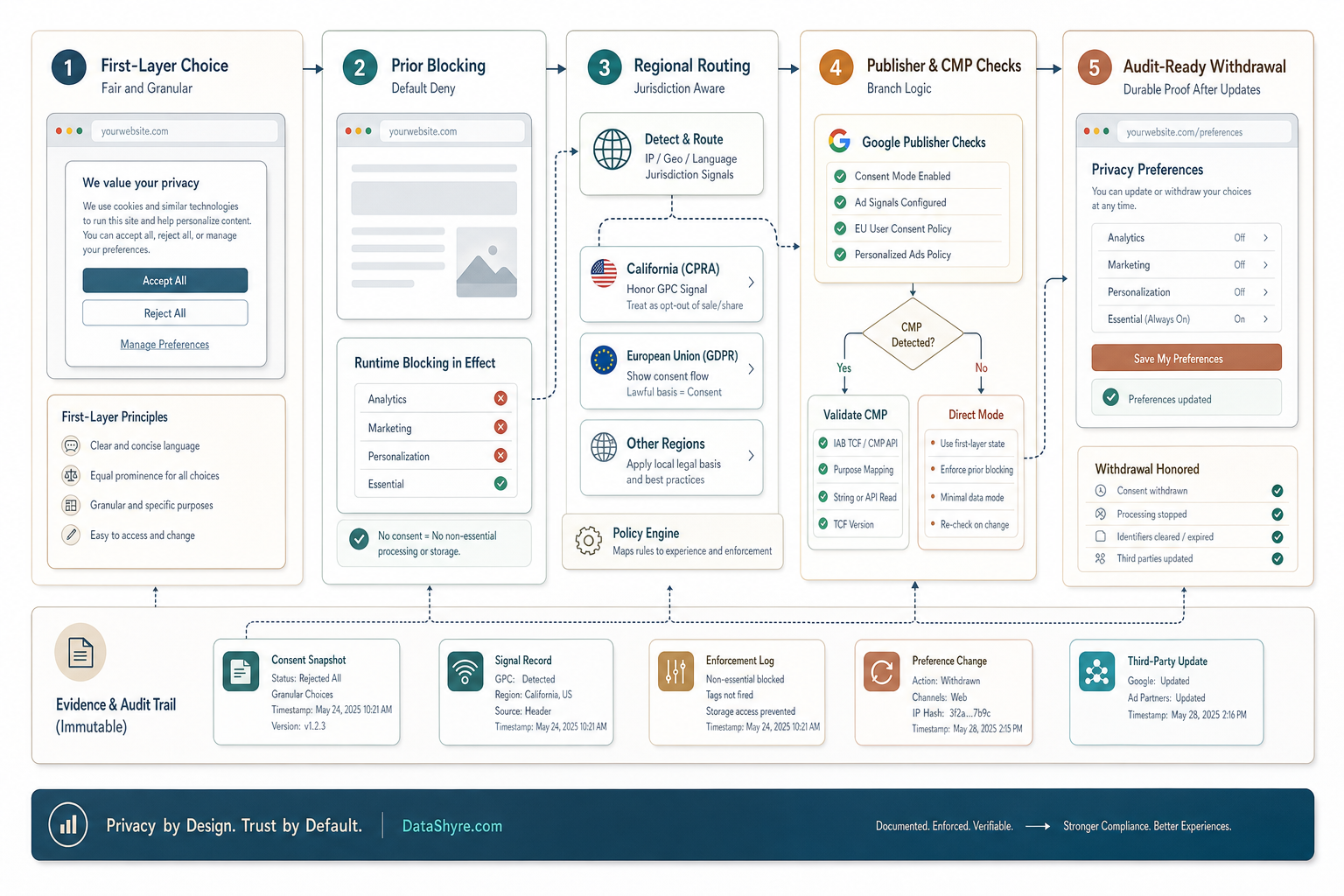
6. Keep Google’s publisher requirement separate from the general privacy review
This is one of the easiest ways to blur a cookies consent management review.
General consent quality and Google publisher eligibility overlap, but they are not the same check.
Google’s current publisher documentation still says partners using AdSense, Ad Manager, or AdMob must use a Google-certified CMP integrated with the IAB Transparency and Consent Framework when serving personalized ads to users in the EEA and UK as of January 16, 2024, and in Switzerland as of July 31, 2024. Google also says its CMP review does not check a product for full compliance with applicable privacy laws.
So the right order is:
- test whether the first-layer choice is fair;
- test whether runtime behavior matches that choice; and
- if publisher ads matter, test the separate Google-certified-CMP path as its own requirement.
A platform can pass one of those reviews and still fail another.
7. Ask whether withdrawal still works after ordinary site change
The final cookies consent management test is not whether the banner works on launch day.
It is whether the controls still work after the stack changes in ordinary life.
The European Commission’s withdrawal standard matters here because it makes the later path part of consent quality. A person should be able to revisit the setting, reverse an earlier choice, and see behavior change without opening a support ticket.
That means the platform should help your team answer questions like:
- what categories existed when the person chose;
- which scripts or vendors were tied to those categories;
- when the preference changed;
- whether the new state propagated into runtime; and
- who changed the rules when the site, app, or tag setup changed later.
In practice, I would treat these as automatic retest triggers:
- a new analytics or ad-tech deployment;
- a tag-manager update;
- a new embed or chat tool;
- a redesign that changes template order or script loading; and
- any region-routing change.
If the platform records consent but cannot survive routine change, the control model is thinner than it looks.
A short review order for this week
If I had ten minutes to pressure-test a cookies consent management platform before purchase or renewal, I would do this in order:
- inspect the accept and reject path on desktop and mobile;
- verify which technologies can run before choice exists;
- test the sequence of defaults, choice, update, reload, and withdrawal;
- simplify categories until a normal visitor could understand them;
- run a California and GPC branch separately from EU or UK prior-consent testing;
- split out the Google publisher branch if ads matter; and
- retest after the next routine change.
That review order usually tells you more than another vendor demo.
FAQ
Is cookies consent management just another name for a cookie banner?
No. A banner is only the visible front layer. Real cookies consent management is the control system behind it: the choice design, the blocking logic, the regional routing, the later withdrawal path, and the record of what happened.
Does scrolling count as consent?
No. The EDPB’s current practical examples still say scrolling or swiping is not a clear affirmative action for consent.
Can a Google-certified CMP still have privacy weaknesses?
Yes. Google’s own publisher documentation says its CMP review does not check a platform for full compliance with applicable privacy laws. Certification can matter for publisher ads without answering every legal or operational question.
Bottom line
Good cookies consent management in 2026 is not a banner beauty contest.
It is the system that gives people a fair first choice, keeps optional technologies aligned with that choice, handles regional differences deliberately, supports separate publisher checks when needed, and leaves behind proof your team can still trust after the next change.
That is the standard worth using before you buy, renew, or expand a platform.
Sources
- European Commission, legal grounds for processing data: https://commission.europa.eu/law/law-topic/data-protection/information-business-and-organisations/legal-grounds-processing-data_en
- ICO, final storage and access technologies guidance published, April 29, 2026: https://ico.org.uk/about-the-ico/media-centre/news-and-blogs/2026/04/final-storage-and-access-technologies-guidance-published/
- ICO, guidance on the use of storage and access technologies: https://ico.org.uk/for-organisations/direct-marketing-and-privacy-and-electronic-communications/guidance-on-the-use-of-storage-and-access-technologies/
- EDPB, practical examples on consent: https://www.edpb.europa.eu/system/files/2026-04/edpb-summary-consent_en.pdf
- CNIL, dark patterns in cookie banners: https://www.cnil.fr/en/dark-patterns-cookie-banners-cnil-issues-formal-notice-website-publishers
- California DOJ, California Consumer Privacy Act: https://oag.ca.gov/privacy/ccpa
- California DOJ, Global Privacy Control: https://oag.ca.gov/privacy/ccpa/gpc
- California DOJ, Disney settlement announcement, February 11, 2026: https://oag.ca.gov/news/press-releases/california-wont-let-it-go-attorney-general-bonta-announces-275-million
- CPPA, enforcement advisory on dark patterns, September 4, 2024: https://cppa.ca.gov/announcements/2024/20240904.html
- Google AdSense Help, consent management requirements for serving ads in the EEA, the UK, and Switzerland (for publishers): https://support.google.com/adsense/answer/13554116?hl=en
—
Published: October 21, 2026. Updated using current official regulator, government, and platform materials available at publication time.