

Cookie Consent in 2026: What Actually Makes a Banner Compliant
If you are searching for cookie consent in 2026, the useful question is not whether your banner looks modern.
The useful question is whether the live site gives people a real choice, keeps optional technologies quiet until the right moment, respects regional differences, and leaves behind proof your team can still trust after the next release.
If you want the closest companion reads first, start with our guides to cookie consent manager, GDPR cookie consent, and website consent management. This page is broader. It is the practical baseline I would use this week to evaluate cookie consent on a real site.

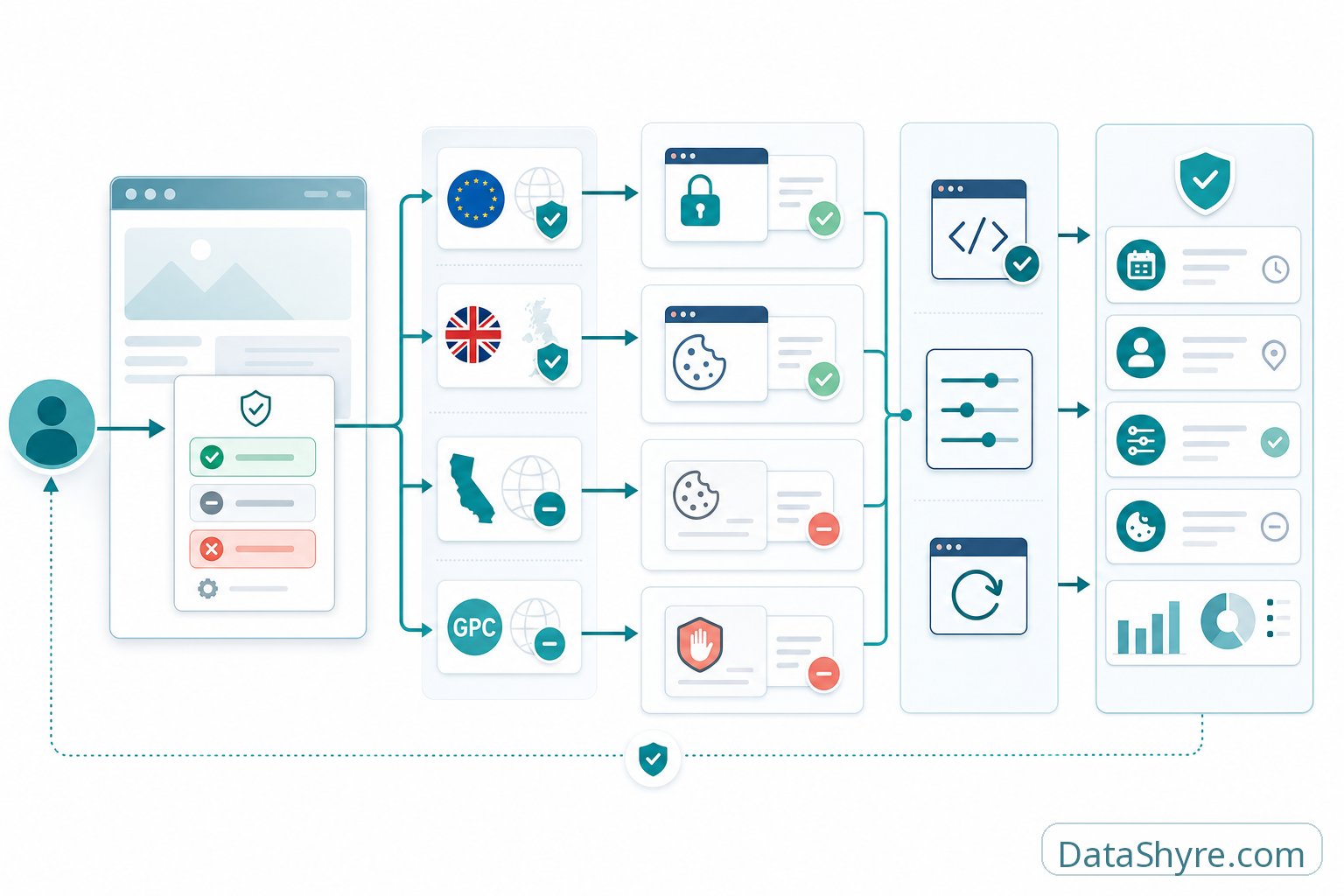
What cookie consent actually has to control
Strong cookie consent is not just a pop-up.
In practice, it sits between:
- the notice or preference center a person sees;
- the regional rule set that decides what standard applies;
- the scripts, pixels, tags, fingerprinting methods, embeds, and storage technologies that can activate on the site; and
- the records your team will need later.
That broader definition matters in 2026 because official guidance is still moving away from old cookie-only thinking. The European Commission still frames valid consent around being freely given, specific, informed, and unambiguous, with requests written in “clear and plain language.” The ICO’s final UK guidance, published on April 29, 2026, also makes the operational scope explicit by covering tracking pixels, link decoration, device fingerprinting, web storage, and scripts or tags, not just classic browser cookies.
So before you debate button color, start with the inventory. What can the site store, access, trigger, or share before and after a choice?
1. The first-layer choice has to be real
The first serious cookie consent test is whether the person is being asked for a genuine choice.
The European Commission’s current consent materials still say the request must be clearly visible, use clear language, and make withdrawal “as easy to use as giving consent.” The EDPB’s 2026 consent summary also repeats two points that still matter every day in banner reviews:
- scrolling or swiping is not a valid affirmative act; and
- a cookie wall that blocks content unless the person clicks accept does not produce freely given consent.
That means the usual weak patterns remain weak:
- consent implied from continued browsing;
- banners that hide refusal inside a second trip for no good reason;
- access conditioned on acceptance where the optional tracking is not necessary for the core service; and
- notices that blur operationally different purposes into one vague yes-or-no moment.
If the first layer is not a real choice, the rest of the stack is already on unstable ground.
2. Rejecting has to be easy enough to count as fair
This is where many cookie consent implementations still fail.
CNIL’s current enforcement messaging is direct: rejecting cookies should be “just as easy as accepting them.” In California, the CPPA’s dark-pattern advisory uses similar logic from a different legal direction. Its enforcement division says businesses should offer symmetry in choice, and the advisory explains that the path to a more privacy-protective option should not be longer, harder, or more time-consuming than the less protective path.
That is why I would review the live interface with these questions:
- Is
Reject allavailable at the same layer whereAccept allappears when prior consent is expected? - Is the path to saying no as short as the path to saying yes?
- Is refusal still obvious on mobile?
- Do wording, spacing, and button weight make one option meaningfully easier?
The CPPA’s September 4, 2024 announcement also captured the broader design risk with one short line: “Dark patterns aren’t about intent, they’re about effect.”
That is the right operating principle for banner reviews in 2026.
3. Optional technologies have to stay off until the right moment
The next cookie consent check is technical, not visual.
For EU and UK-style prior-consent paths, the question is not whether the banner exists. The question is whether optional technologies remain inactive before the user makes a valid choice.
This is where the ICO’s 2026 storage-and-access-technologies guidance becomes useful operationally. Because it covers tracking pixels, scripts, fingerprinting, web storage, and similar techniques, it pushes teams to test what the browser actually does rather than what the CMP marketing page claims.
So test at least these states:
- first visit with no saved preference;
- explicit reject;
- explicit accept;
- later withdrawal; and
- a fresh page load after each state.
You are looking for whether analytics, advertising, personalization, and social tools stay quiet until the right consent state exists. If optional calls begin first and the CMP catches up later, the live cookie consent control is not ready.
4. Treat California as a separate branch, not a copy of the EU banner
Many teams flatten cookie consent into one global pattern.
That is usually where legal logic and implementation logic start drifting apart.
For EU and UK traffic, the practical review often centers on prior consent for non-essential storage or access. For California, the review often turns on privacy choices, opt-out rights, and honoring browser-based signals where they apply. California’s Department of Justice still describes Global Privacy Control as a “stop selling or sharing my data switch” and says covered businesses must honor it as a valid consumer request to stop sale or sharing.
That means a serious cookie consent review should verify:
- whether the site uses a prior-consent branch where that model applies;
- whether California users get the right opt-out flow where sale or sharing is implicated;
- whether GPC is honored when it should be; and
- whether the on-screen wording still matches the technical behavior in each branch.
This is not just a legal drafting issue. It is an implementation issue. One site can serve several regions. One generic banner pattern should not erase the differences until the compliance logic stops making sense.
5. Keep the Google publisher branch separate if ads matter
Some cookie consent reviews stop once the site appears to handle analytics correctly.
That is not enough if the business serves personalized ads through Google publisher products. Google’s current publisher help still says partners using AdSense, Ad Manager, or AdMob must use a Google-certified CMP integrated with the IAB Transparency and Consent Framework when serving personalized ads to users in the EEA and UK as of January 16, 2024, and in Switzerland as of July 31, 2024. Google also says its CMP review does not check full compliance with privacy law.
So if ad monetization matters, split the review into two questions:
- does the site respect the user’s choice technically and fairly; and
- does the publisher stack satisfy Google’s product-specific CMP requirement where it applies?
Those are related, but they are not the same test.
6. Withdrawal has to change real behavior, not just a saved preference
Withdrawal is where weak cookie consent programs become obvious.
The European Commission still says it should be as easy to withdraw consent as to give it. The operational question is whether the live site behaves as though that sentence matters.
So check whether people can:
- reopen preferences without hunting through the site;
- reverse earlier choices in one session;
- see those new choices respected on the next page or route change; and
- stop downstream optional technologies after withdrawal, not just update a table row.
If the UI records a withdrawal but tags, pixels, or embeds keep acting as though consent still exists, the experience is not functioning as promised.
7. Keep evidence that explains what happened later
Good cookie consent records should let your team reconstruct what really happened.
At minimum, I would want to know:
- which banner or preference version was shown;
- which categories or purposes were offered;
- what the person chose and when;
- which regional branch applied; and
- what technical state followed from that choice.
That evidence becomes much more useful when it can be compared with browser traces, tag debugging, or network evidence, instead of living only as a single field that says accepted.
A short review sequence for this week
If I were reviewing cookie consent today, I would use this order:
- inventory every optional technology the site can trigger;
- test the first-layer choice for fairness and clarity;
- compare the path to reject against the path to accept;
- inspect live browser behavior before any choice;
- test reject, accept, and later withdrawal;
- verify the California and GPC branch separately where relevant; and
- run the Google publisher check separately if ads matter.
That process usually tells you more than another round of cosmetic banner edits.
FAQ
Is cookie consent the same everywhere?
No. In 2026, cookie consent still has to be reviewed by region and by use case. EU and UK paths often center on prior consent for non-essential storage or access technologies. California enforcement materials focus heavily on understandable choices, symmetrical paths, and valid opt-out mechanisms such as GPC where applicable.
Does scrolling count as cookie consent?
No. The EDPB’s consent materials still treat scrolling or swiping as insufficient because it is not a clear affirmative action.
Is a CMP enough by itself?
Not automatically. A CMP can help, but live cookie consent still depends on configuration, category mapping, script timing, regional logic, withdrawal behavior, and ongoing testing.
Bottom line
In 2026, strong cookie consent is not the site with the prettiest banner.
It is the site where the first-layer choice is real, refusal is genuinely usable, optional technologies stay off until the right moment, California handling does not get flattened into EU logic, publisher-specific Google requirements are checked separately where needed, and your team can still prove what happened later.
If those pieces line up, the banner is doing its job. If they do not, the interface may be finished while the cookie consent program is still leaking.
Sources
- European Commission, Information for individuals: https://commission.europa.eu/law/law-topic/data-protection/information-individuals_en
- European Commission, Legal grounds for processing data: https://commission.europa.eu/law/law-topic/data-protection/information-business-and-organisations/legal-grounds-processing-data_en
- EDPB, Practical examples on consent: https://www.edpb.europa.eu/system/files/2026-04/edpb-summary-consent_en.pdf
- EDPB, Guidelines 05/2020 on consent under Regulation 2016/679: https://www.edpb.europa.eu/sites/default/files/files/file1/edpb_guidelines_202005_consent_en.pdf
- UK ICO, Final storage and access technologies guidance published: https://ico.org.uk/about-the-ico/media-centre/news-and-blogs/2026/04/final-storage-and-access-technologies-guidance-published/
- UK ICO, Guidance on the use of storage and access technologies: https://ico.org.uk/for-organisations/direct-marketing-and-privacy-and-electronic-communications/guidance-on-the-use-of-storage-and-access-technologies/
- California Privacy Protection Agency, Enforcement Advisory No. 2024-02: https://cppa.ca.gov/pdf/enfadvisory202402.pdf
- California Privacy Protection Agency, CPPA Enforcement Advisory Stresses the Importance of Avoiding Dark Patterns: https://cppa.ca.gov/announcements/2024/20240904.html
- California Department of Justice, Global Privacy Control: https://www.oag.ca.gov/privacy/ccpa/gpc
- CNIL, Dark Patterns in Cookie Banners: CNIL issues formal notice to website publishers: https://www.cnil.fr/en/dark-patterns-cookie-banners-cnil-issues-formal-notice-website-publishers
- Google AdSense Help, Google consent management requirements for serving ads in the EEA, the UK, and Switzerland (for publishers): https://support.google.com/adsense/answer/13554116?hl=en
—
Published: October 20, 2026. Updated using current official European Commission, EDPB, ICO, CPPA, California DOJ, CNIL, and Google materials available at publication time.