

Consent Management Provider in 2026: How to Choose a CMP That Actually Keeps You Compliant
If you are evaluating a consent management provider on September 26, 2026, the question is no longer whether the platform can display a banner. It is whether the provider can enforce consent decisions across your entire data stack — and prove it when a regulator asks.
That matters because 2026 brought a fundamental shift. The European Data Protection Board’s 2026 coordinated enforcement action targets transparency and information obligations under Articles 12-14, and the UK ICO’s expanded PECR guidance now covers every storage and access technology, not just cookies. A CMP that only handles browser-level consent is already behind.
If you want adjacent detail before the broad overview, start with our guides to cookie consent manager, consent management platform best practices, and GTM consent mode. The CMP and the consent signals it enforces must tell the same story.
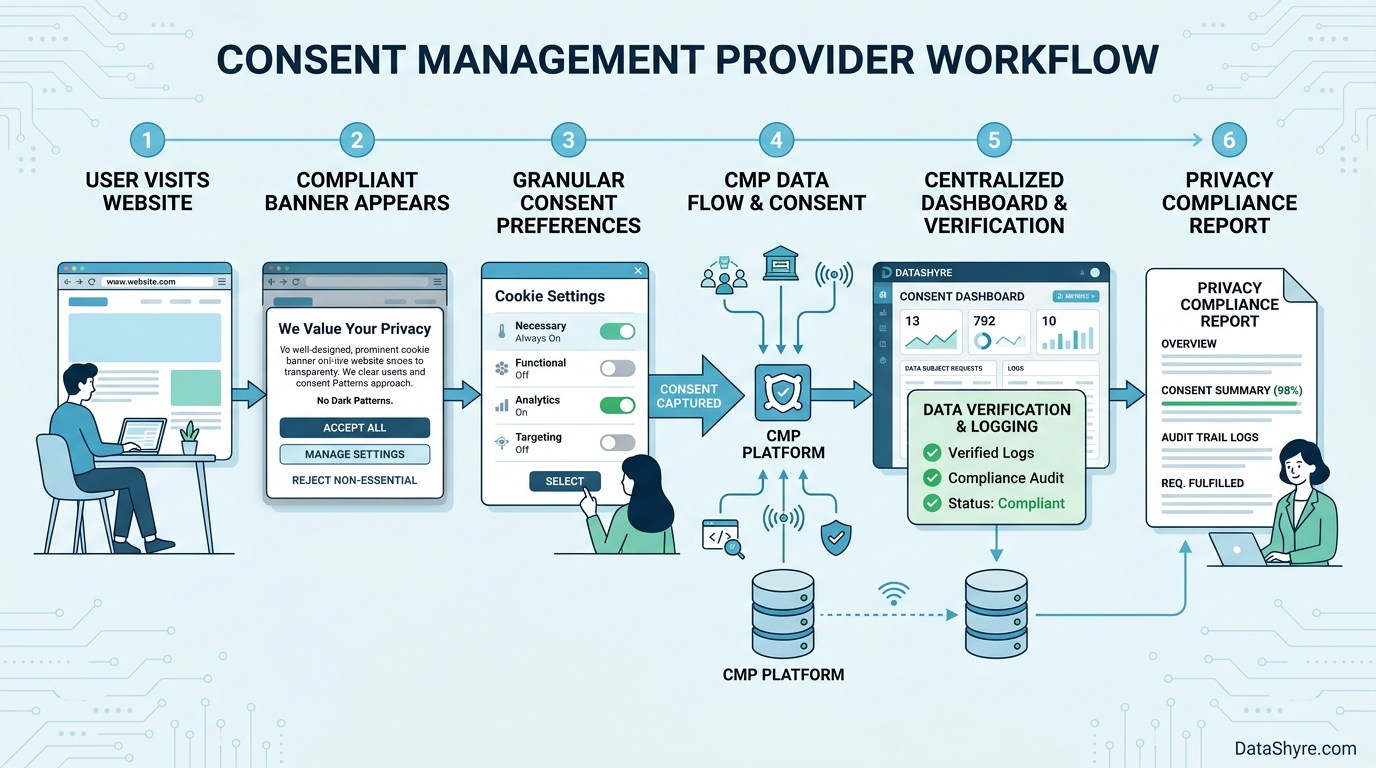
What a consent management provider must deliver in 2026
The legal baseline has not moved. GDPR still requires consent to be freely given, specific, informed, unambiguous, and easily reversible. What changed is the enforcement scope and the technical expectations regulators now hold CMPs to.
A compliant consent management provider must handle all of these obligations:
- Granular, category-level consent — bundled purposes like “analytics + marketing” are increasingly risky. Users need to understand why each category exists and who receives their data;
- Equal prominence for accept and reject — the ICO’s PECR guidance explicitly requires “Accept all” and “Reject all” to be equally easy on the first layer. Dark patterns are an enforcement target;
- Prior consent blocking — non-essential tracking technologies must be blocked until explicit consent is obtained, including scripts, tags, pixels, and fingerprinting tools;
- Auditable consent records — regulators expect time-stamped logs showing when consent was given, for what purpose, and how withdrawal was handled across devices and sessions;
- Server-side enforcement — modern CMPs must propagate consent signals into CDPs, ad pipelines, and AI infrastructure, not just block browser scripts;
- Easy withdrawal — consent must be as easy to revoke as it was to grant, ideally through a persistent privacy dashboard;
- Google Consent Mode v2 support — parameters
ad_user_dataandad_personalizationmust respect CMP signals for advertisers serving in the EEA.
The European Commission’s Digital Omnibus proposal adds another layer. It aims to simplify GDPR compliance and may reduce the need for consent for approximately 60% of cookies by establishing a list of low-risk purposes. However, it introduces a mandatory “single-click” accept-or-refuse mechanism and requires websites to honor a refusal for at least six months to combat consent fatigue. A CMP that cannot handle single-click flows and refusal persistence is not ready for 2026.
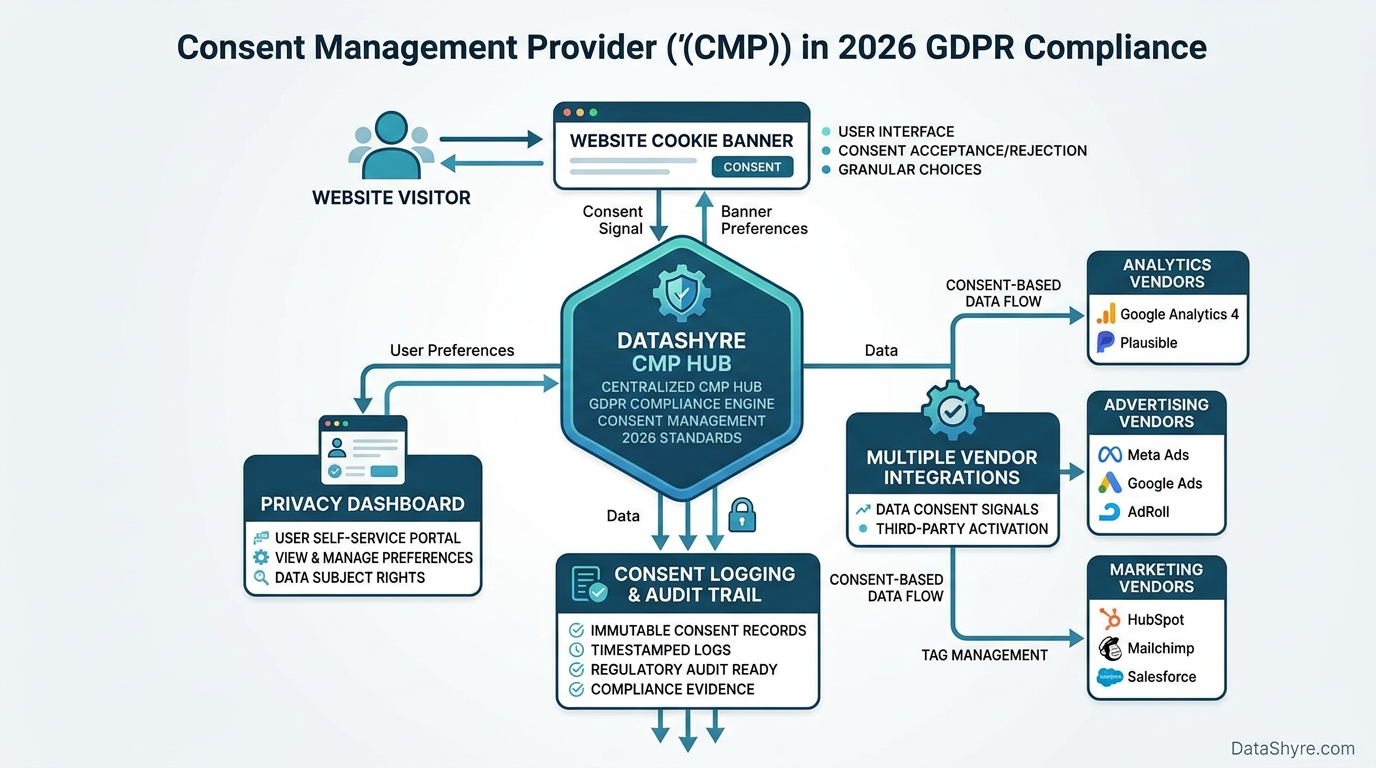
Where CMPs still fail in 2026
The most common failure is not missing a banner. It is a gap between what the CMP collects at the browser and what actually happens downstream.
In February 2025, CNIL fined Qwant for an inaccurate and incomplete privacy policy regarding data sent to Microsoft, including missing information on advertising purpose and legal basis. CNIL treated this as a transparency failure under GDPR Articles 12 and 13. The lesson for CMP selection is clear: if your consent platform collects choices but those choices do not propagate to every vendor, the gap is a compliance risk.
The second failure is weak consent context. CNIL’s 2025 enforcement summary noted that some tracker cases involved insufficient information, meaning consent could not be considered informed. If your CMP says it tracks “analytics” but the actual script sends data to an advertising network, regulators do notice.
The third failure is stale consent after product changes. The ICO says organizations should review notices regularly and bring new uses of personal data to people’s attention before the processing starts. This matters now for personalization, AI features, connected-device telemetry, and partner data sharing that were never mentioned in the original CMP configuration.
The 2026 enforcement landscape for CMPs
The European Data Protection Board has reinforced that the right to erasure remains a top enforcement priority in 2026. Organizations must ensure that their consent management provider clearly explains how individuals can exercise this right and that the process is not obstructed by unnecessary complexity.
The EDPB’s 2026 coordinated enforcement action specifically targets transparency and information obligations, meaning CMPs that cannot demonstrate clear, granular, and accurate disclosure will face heightened scrutiny. The EDPB also adopted Guidelines 1/2026 on scientific research (covering broad and dynamic consent) and Guidelines 02/2026 on anonymisation, both of which affect how consent data is handled post-collection.
The UK ICO’s expanded PECR guidance now applies to a wider array of storage and access technologies beyond traditional cookies, including tracking pixels, device fingerprinting, web storage, scripts, and tags. The maximum monetary penalties for PECR breaches have increased to align with UK GDPR, potentially reaching up to £17.5 million or 4% of annual worldwide turnover, whichever is greater. The ICO actively monitors compliance, having reviewed the top UK websites and indicating continued periodic testing.
There is a broader lesson here too. In January 2026, California Attorney General Rob Bonta said consumers “have the right to understand” how their personal information is being used. Different laws use different mechanics, but the expectation is converging: if a CMP’s consent choices do not match actual data flows, a vague disclosure is not enough.
The EDPB’s coordinated enforcement framework also highlights that consent must be freely given. The Digital Omnibus proposal reinforces this by making rejection as simple as acceptance, and organizations must honor a user’s refusal for at least six months. A CMP that makes opting out harder than opting in is not a CMP you should trust with your compliance.
How to evaluate a consent management provider
Before you sign with any CMP, run these checks:
- Verify server-side enforcement — ask how consent signals propagate to CDPs, ad servers, and AI infrastructure, not just browser scripts;
- Test the first layer on mobile — equal-prominence accept/reject buttons must work on small screens, not just desktop;
- Check audit log completeness — can you produce a time-stamped record of every consent decision, including withdrawal, across all devices?;
- Confirm granular category controls — are purposes individually selectable, or are they bundled?;
- Validate Consent Mode v2 integration — do
ad_user_dataandad_personalizationrespect CMP signals?; - Ask about refusal persistence — can the platform honor a user’s refusal for at least six months as the Digital Omnibus proposes?;
- Test the withdrawal pathway — is revocation as easy as granting consent, and does it actually stop data flows?;
- Check vendor transparency — does the CMP name real recipients and purposes people will understand, or hide behind generic categories?
One more thing: user testing is worth the hour it takes. Ask someone outside legal or engineering to interact with the CMP, give consent, then try to withdraw it. If they cannot complete both steps quickly and confidently, the platform is not finished.
The takeaway
The best consent management providers in 2026 are not the ones with the flashiest dashboards. They are the platforms that enforce consent decisions across every data flow, maintain auditable records, and make withdrawal as straightforward as enrollment.
If you are evaluating CMPs this quarter, do not start with pricing pages. Start with your actual vendor stack, your data flows, and the places where consent signals currently break. A CMP built against that reality is more likely to hold up with regulators and more likely to earn genuine user trust.
Sources
- European Data Protection Board: 2026 Coordinated Enforcement Action
- UK Information Commissioner’s Office: Storage and Access Technologies
- European Commission: Digital Omnibus Proposal
- CNIL: Enforcement Summary 2025
- California Department of Justice: Consumer Privacy
- EDPB: Guidelines 1/2026 on Scientific Research
- EDPB: Guidelines 02/2026 on Anonymisation
This post was updated on September 26, 2026 using current official regulator, government, and platform sources available at publication time.