

Microsoft Consent Mode in 2026: 6 UET Checks Before You Trust the Setup
If you are reviewing microsoft consent mode on September 12, 2026, the useful question is not whether the Microsoft tag is present.
It is whether Universal Event Tracking actually receives the right consent state early enough to change behavior before advertising identifiers are set.
That distinction matters because Microsoft’s own guidance has become more explicit. In a March 31, 2025 product post, Microsoft Advertising said advertisers needed to provide user consent signals by May 5, 2025 for site visits from the EEA, UK, and Switzerland if they wanted to avoid performance impact. Then on February 19, 2026, Microsoft published a more detailed Advanced Consent Mode explanation that turned the implementation into two core checks: load order and state updates.
If you want the adjacent context first, start with our guides to Google Consent Mode V2, cookie consent, and Google Tag Manager cookie consent. This article stays narrower. It is about what the Microsoft consent path has to do in a real UET deployment now.
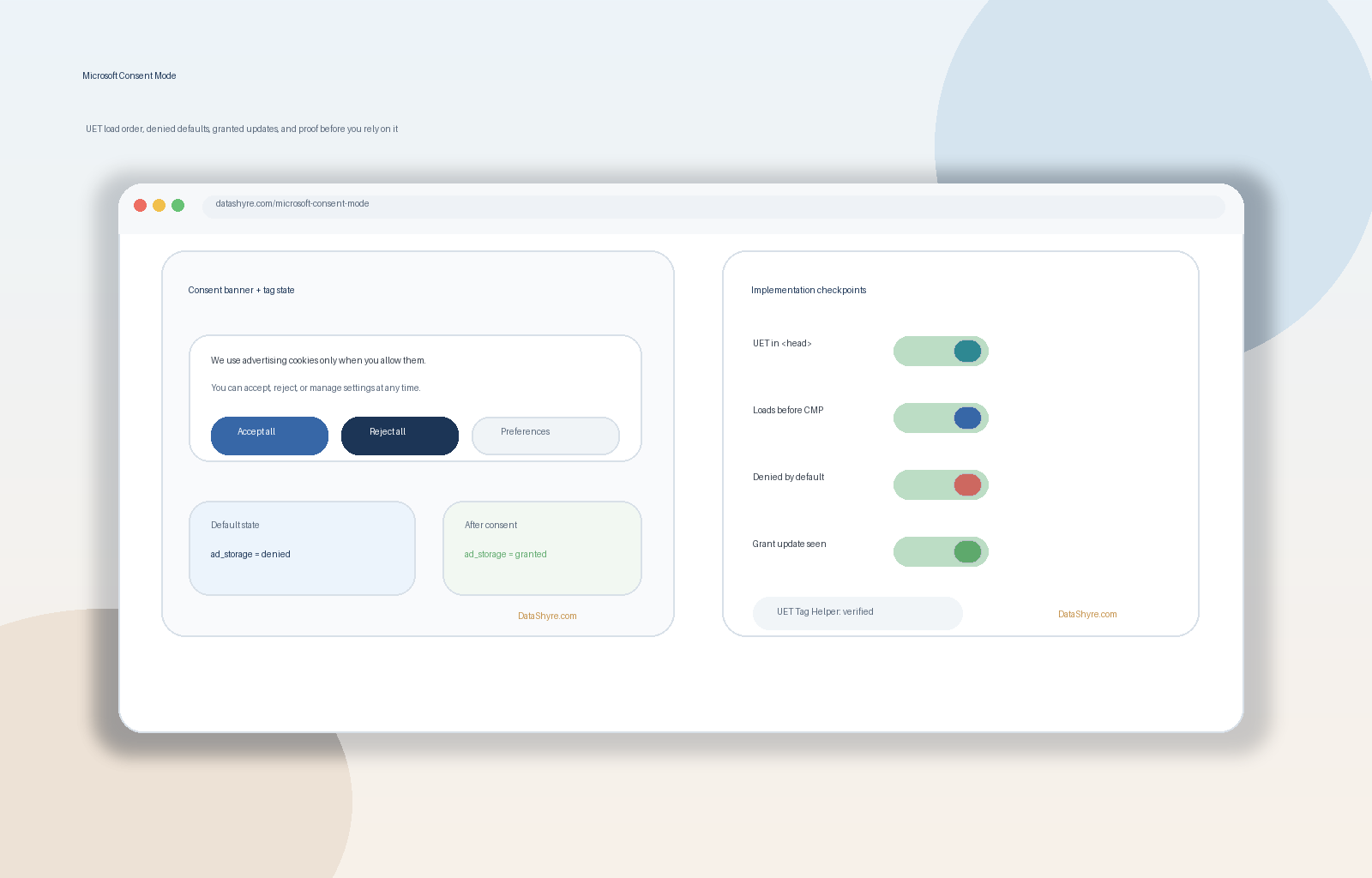
What the Microsoft consent path actually controls
Microsoft Advertising describes Consent Mode as the feature that communicates the user’s consent state to the UET tag so it can behave accordingly. In Microsoft’s current explanation, the core parameter is ad_storage, with a granted or denied state. Microsoft also says advertisers can pass consent signals through the IAB Transparency and Consent Framework directly or through a CMP.
That means this is not a cosmetic banner feature. It is the control path that tells UET whether advertising cookies can be stored and whether the setup should continue in a reduced, cookieless state until the user makes a choice.
1. Denied has to be the real default
This is the first check because it shapes everything after it.
Microsoft’s February 19, 2026 Advanced Consent Mode guidance says UET should be allowed to load early enough to read the default consent state from the first page view, and it says UET will respect a denied default state by not setting advertising cookies unless consent is granted. If your stack only sends a status after the user clicks, the first page view may already be wrong.
For teams working with this setup, this is the practical question:
- what state does UET see before the user interacts;
- is that state denied where consent is required;
- can you prove it from a fresh page load.
2. Load order matters more than banner design
Microsoft’s strongest implementation instruction in 2026 is short: “Load UET before the consent banner.”
The reason is mechanical. Microsoft says Advanced Consent Mode only works if UET loads before the CMP script executes, because otherwise the tag cannot read the default state from the very first page view. In GTM environments, Microsoft’s current guidance says to use the official Microsoft Advertising UET template, fire it on all pages, and make sure the GTM container loads in the before the CMP script.
This is where many deployments still drift. A CMP may be legally well designed and still block UET so aggressively that Microsoft’s own advanced measurement logic never gets the denied state in time.
3. The grant update has to fire every time consent is active
After default behavior, the next failure point is the positive update.
Microsoft says that when a user grants consent, UET must receive an explicit update to granted, and that this should happen every time consent is given and on every page where consent is active. Microsoft also says that if the update is not sent, UET will remain in denied mode and continue operating cookieless.
That can be privacy-safe, but it changes how much measurement depth you keep. So a functioning UET consent setup should answer:
- where the grant signal is generated;
- how it persists across navigation;
- whether it rehydrates correctly on the next page;
- whether withdrawal moves the state back the other way.
4. Advanced Consent Mode is about measurement continuity, not extra data collection
The 2026 Microsoft article is useful here because it explains the product intent more clearly than older implementation notes.
Microsoft says Advanced Consent Mode helps fill measurement gaps when consent is declined by using modeled conversions based on aggregate trends rather than by collecting more personal data. It also says correct setup is strongly recommended even if modeled conversions are not strictly dependent on ACM alone.
That means the Microsoft implementation should be reviewed as both a privacy control and a measurement architecture choice. The same setup can be privacy-safer than a broken tag deployment and still underperform if the load order, denied default, or grant update is inconsistent.
5. Verification should happen in UET Tag Helper and the network panel
This is the part teams skip because the configuration screen feels persuasive.
Microsoft’s February 19, 2026 guidance says to use the UET Tag Helper browser extension to confirm four things:
- UET loads before the consent banner;
- the default consent state is denied;
- the status updates to
grantedafter user approval; - “No advertising identifiers are attached to requests when consent is declined.”
Microsoft also says you can validate behavior directly in browser developer tools by inspecting network requests. That is the better audit habit. If the dashboard says the setup is compliant but the first request still carries identifiers after a denied state, the runtime evidence wins.
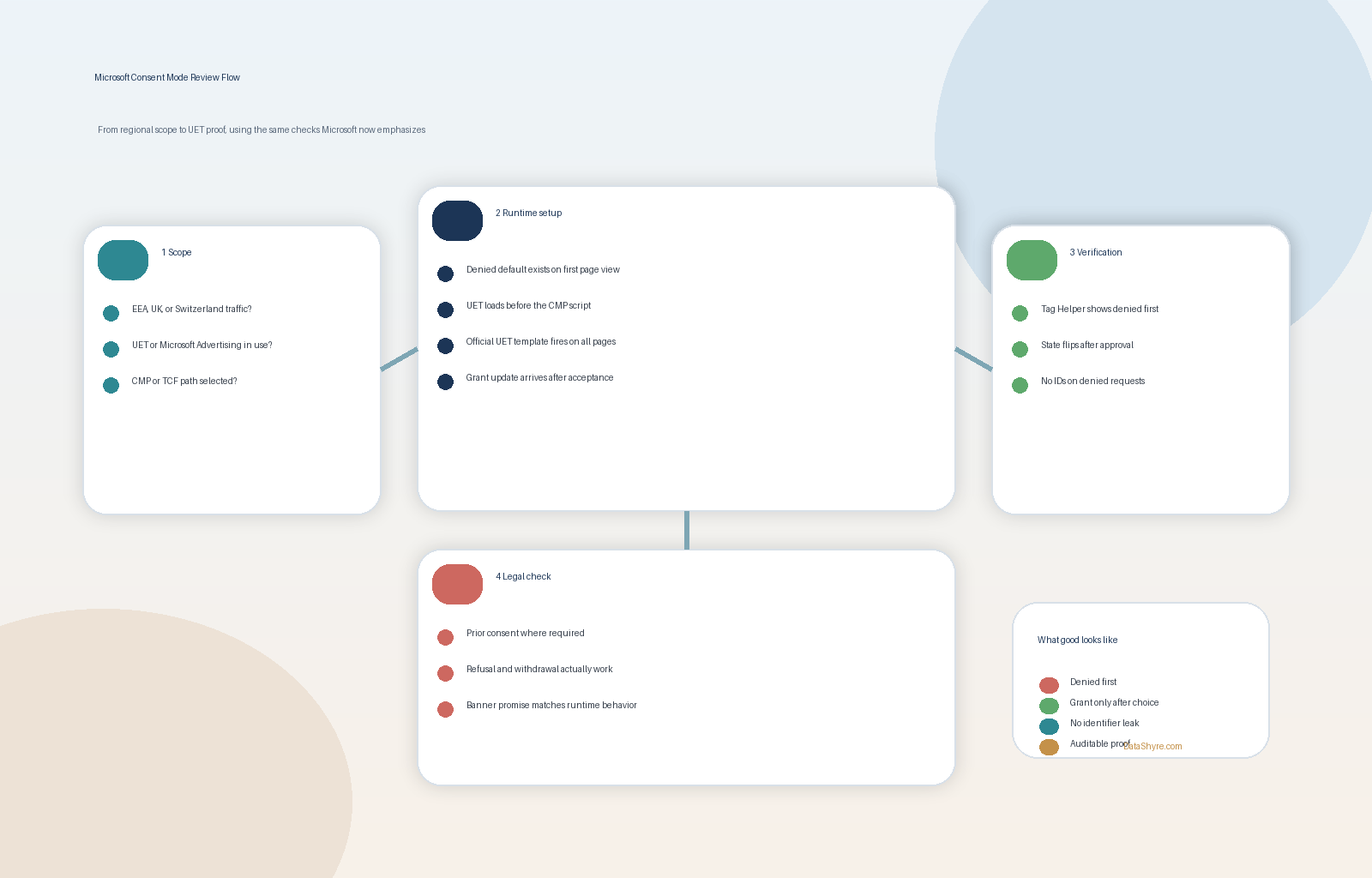
6. Legal review still sits above the tag review
A correct Microsoft implementation does not replace the underlying consent standard.
The ICO’s final Storage and Access Technologies guidance, published on April 29, 2026, says these rules apply to cookies, tracking pixels, device fingerprinting, and similar technologies. In the ICO’s detailed consent guidance, the regulator says any consent mechanism must “function as intended” so the choices made through it are respected, and that if no exception applies you must obtain prior consent.
Enforcement is still active too. On November 27, 2025, the CNIL announced a 750,000 euro fine against the company behind vanityfair.fr, including findings that cookies requiring consent were placed as soon as users arrived and that refusal or withdrawal mechanisms were ineffective.
So the right conclusion is not merely “the UET template is installed.” It is:
- consent is required where it should be;
- refusal is respected before identifiers are set;
- withdrawal changes later behavior;
- the implementation evidence matches the banner promise.
A short review sequence for this week
If I were auditing this implementation right now, I would use this order:
- confirm whether EEA, UK, or Switzerland traffic makes Microsoft consent signaling relevant;
- verify the default state is denied from the first page view where consent is required;
- confirm UET loads before the CMP or banner logic;
- test that
grantedis sent after acceptance and persists correctly; - inspect Tag Helper and network requests for denied versus granted behavior;
- re-check the legal layer so the technical setup still matches the real consent standard.
That sequence usually surfaces more risk than another round of tag-manager screenshots.
Bottom line
The practical answer to microsoft consent mode in 2026 is not “we installed UET.”
It is “we set a defensible denied default, loaded UET early enough to read it, sent a reliable grant update after a real choice, verified runtime behavior, and checked that the whole mechanism still satisfies the broader consent rules.”
When those pieces line up, Microsoft Advertising can keep useful measurement without turning the consent layer into fiction.
Sources
- Microsoft Advertising: Providing user consent signals on your Microsoft campaigns by May 5, 2025
- Microsoft Advertising: Advanced Consent Mode: Preserving accurate measurement while respecting user privacy
- ICO: Final storage and access technologies guidance published
- ICO: How do we manage consent in practice?
- CNIL: Cookies placed without consent: the company that publishes the website vanityfair.fr fined 750,000 euros by the CNIL
This post was updated on September 12, 2026 using current official Microsoft and regulator materials available at publication time.