

GDPR Cookies Requirements in 2026: 7 Checks Before You Set Anything Optional
If you are searching for gdpr cookies requirements on August 12, 2026, the useful question is not whether your site has a banner. It is whether anything optional gets stored, read, or triggered before the visitor makes a real choice.
That is still the core test in 2026. Article 5(3) of the ePrivacy Directive still requires consent before storing information or accessing information already stored on a user’s device, unless the activity is strictly necessary for the requested service. The European Commission still says valid consent must be “freely given, specific, informed and unambiguous.” Its current guidance also says people must be able to refuse or withdraw consent without disadvantage, and that withdrawal should be “as easy to withdraw as to give consent.”
If you want the adjacent setup context first, start with our guides to GDPR cookie consent requirements, cookie consent requirements, and GDPR cookie consent. This article stays narrower. It is the review I would run before calling a live website aligned with gdpr cookies requirements in 2026.
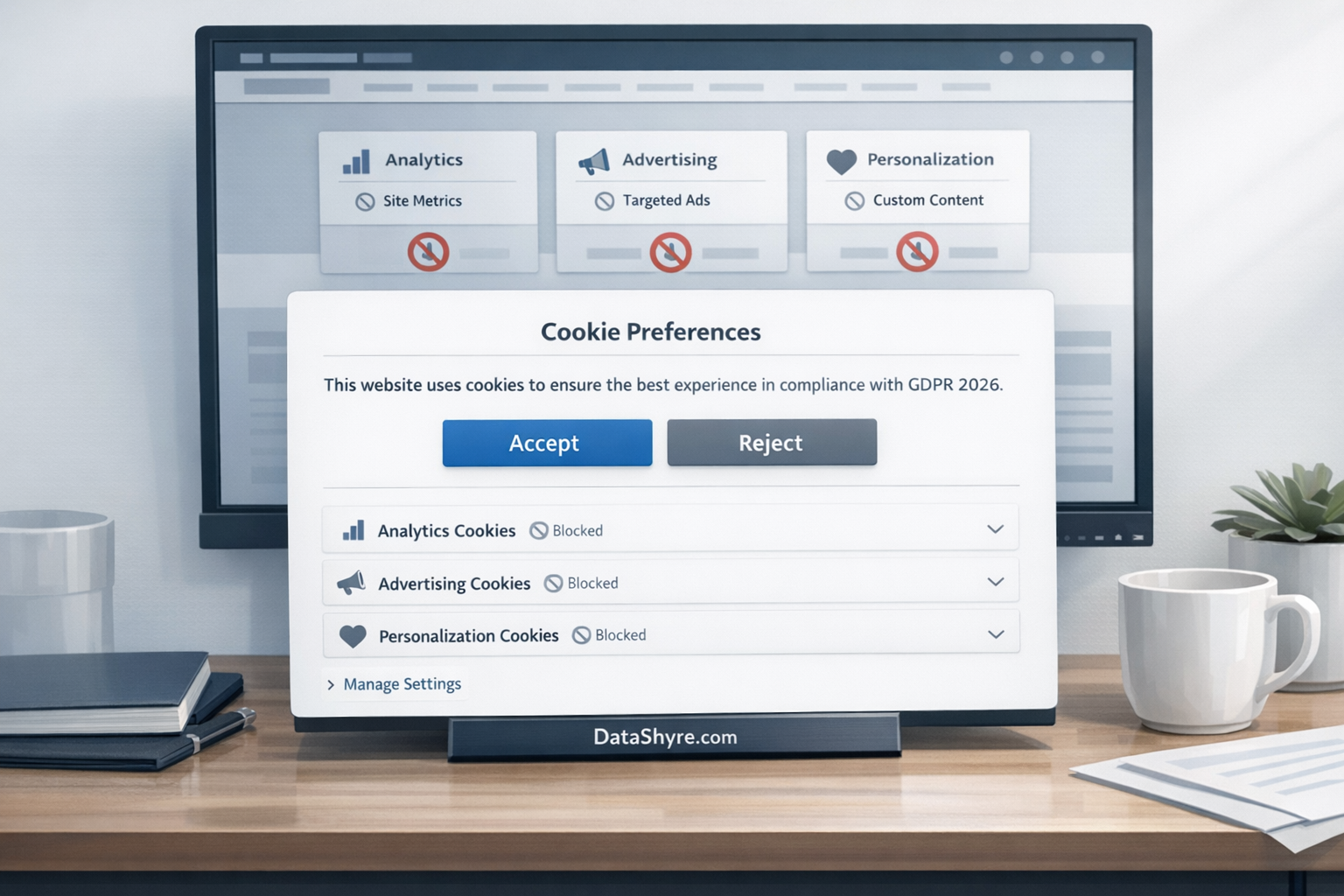
What the legal baseline still is
The easiest way to keep gdpr cookies requirements straight is to separate the legal baseline from the UI layer.
The legal baseline is still simple:
- optional storage or access on a device needs consent unless an exception applies;
- consent has to be real, specific, informed, and freely given;
- the site has to respect the user’s decision in actual runtime behavior.
What makes the topic messy is that modern sites rarely use one plain cookie and one banner. They use tag managers, pixels, scripts, SDKs, local storage, embedded players, chat widgets, analytics libraries, and third-party services that can all touch the browser in slightly different ways.
That is why the UK’s ICO guidance finalized on April 29, 2026 is still useful even for broader implementation thinking. It explicitly covers cookies, tracking pixels, device fingerprinting, scripts or tags, and web storage. The rule is not limited to whatever your scanner happens to label a cookie.
The enforcement climate still matters too. On July 14, 2026, the EDPB required the Belgian DPA to assess the merits of a cookie-banner complaint involving VRT instead of ending the case on a procedural theory. That does not create a new cookie rule by itself. It does underline that banner design and real runtime behavior are still active regulatory ground.
7 checks that matter before you trust a live implementation
1. Separate strictly necessary technologies from everything else
Many weak implementations fail before the banner even appears because the team never classified the stack properly.
Under gdpr cookies requirements, the first question is not whether a vendor calls something functional or low-impact. It is whether the technology is genuinely necessary to provide the service the user explicitly requested. The ICO’s current guidance is helpful here because it frames the test from the user’s perspective, not the site’s revenue model. It also states plainly that there are no advertising purposes that meet the strictly necessary exception.
That makes the first audit step very practical:
- identify every cookie, pixel, script, SDK, and storage call that can touch the device;
- mark which ones are truly essential to deliver the requested service;
- challenge anything categorized as essential because it helps marketing, attribution, profiling, or personalization.
If that inventory is vague, your banner logic is probably sitting on top of a classification problem.
2. Keep non-essential technologies off until the visitor chooses
This is the most important operational check in the whole article.
For gdpr cookies requirements, optional analytics, ad tech, personalization, and similar technologies should not be active on first load in consent-first regions. The ICO’s 2026 guidance says you must not pre-enable non-exempt storage and access technologies. Its consent section also says the mechanism has to “function as intended” so that the user’s choices are actually respected.
That matters because a site can look compliant while still failing the real test:
- a tag manager sets default states too late;
- a video embed loads before the CMP finishes;
- a custom script bypasses the consent layer;
- a returning-user optimization quietly re-enables tracking without a valid basis.
If optional technologies have already fired before the visitor chooses, the rest of the banner experience is mostly cleanup after the fact.
3. Ask for consent by purpose, not in one vague bundle
The EDPB’s current 2026 consent summary says consent must be granular. If data is processed for multiple purposes, organisations should propose separate consents so people can choose which purposes they accept.
That is one of the clearest ways to think about gdpr cookies requirements on a modern site.
A stronger banner does not just say “we use cookies to improve your experience.” It distinguishes between purposes people can understand, such as:
- measurement or analytics;
- advertising or remarketing;
- personalization;
- embedded social or media features that involve optional tracking.
Granularity is not only a copy choice. It forces the implementation to map each technology to a real purpose and stop bundling unlike activities into one convenient opt-in.
4. Make rejection as easy as acceptance
This is where many banners still drift into dark-pattern territory.
CNIL’s current notice on misleading cookie banners says, “Rejecting cookies should be just as easy as accepting them.” It also describes practices that drew formal notices, including low-visibility reject links, buried placement, and interfaces that repeated acceptance options while making refusal harder to find.
For gdpr cookies requirements, that means the first layer deserves an adversarial review:
- is
Reject allavailable without forcing users into a second maze; - is it visually comparable to
Accept all; - is the wording explicit and understandable on mobile as well as desktop;
- do the same runtime protections apply after rejection as after the user never consented at all.
If your design makes acceptance feel like the obvious path and refusal feel like work, the site is taking risk before any technical testing even begins.
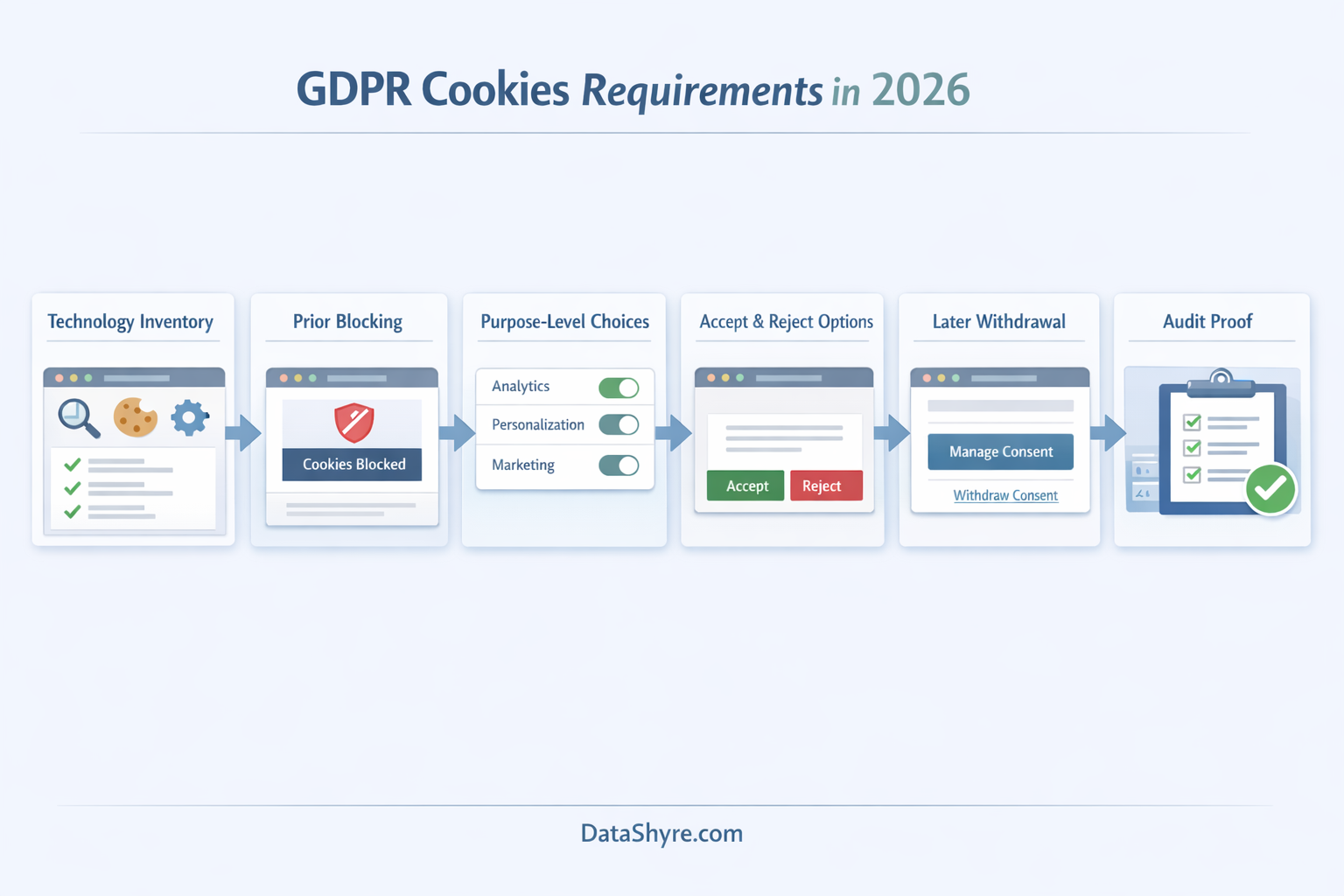
5. Give clear information about purpose, parties, and duration
The consent layer cannot be specific or informed if the explanation stays fuzzy.
The European Commission’s current consent guidance says people should be told what use will be made of their data, and the ICO’s guidance says storage-and-access information should cover the technologies used, the purposes, any third parties involved, and the duration. It also says you must not hide behind ambiguous references to “partners” or “third parties.”
That turns gdpr cookies requirements into a disclosure test as much as a banner test.
The banner and supporting notice should help a normal person answer:
- what is this optional technology for;
- who else receives or processes the information;
- how long the identifier or access persists;
- where to change the decision later.
If the explanation only makes sense to the implementer, it is probably not specific enough for the visitor.
6. Make withdrawal and later preference changes work in practice
This is where teams often overestimate themselves.
The Commission says withdrawal should be as easy as giving consent. The ICO’s current guidance goes further on implementation: users must be able to withdraw consent at any time, the mechanism needs the technical capability to do that with the same ease, and storage-and-access technologies that were already set must be removable.
For gdpr cookies requirements, the practical journeys to test are:
- first visit and immediate rejection;
- first visit and granular acceptance of one purpose only;
- later reopening of preferences and full withdrawal.
A withdrawal link that looks presentable but does not actually stop future optional reads, writes, or third-party calls is not doing the job.
7. Keep proof and retest when the stack changes
Good consent work is not finished when the banner ships.
The VRT complaint outcome published by the EDPB in July 2026 is a reminder that regulators still expect real review of how cookie-banner complaints map to conduct on the site. In practice, that means you should be able to reconstruct what happened:
- which banner or preference design version ran;
- which purposes and controls were shown;
- what the visitor chose;
- what technologies remained blocked or became active afterward.
For most teams, the more common risk is not malicious design. It is drift:
- a new analytics tag is added;
- a marketing platform changes its script;
- a CMP template update affects first-load timing;
- a product team adds a new embedded tool;
- a regional rule branch gets overlooked.
That is why gdpr cookies requirements should be treated as a release check, not a one-time design asset.
A practical review sequence for this week
If I were reviewing gdpr cookies requirements on a live property today, I would do it in this order:
- inventory every technology that can store or access information on the device;
- challenge the “strictly necessary” labels first;
- test first load in a clean browser and confirm optional technologies stay off;
- compare
Accept allandReject allfor equal ease and visibility; - test granular choice paths, not just full acceptance;
- withdraw consent later and verify the change propagates;
- save evidence of what the user saw and what the site actually did.
That sequence catches more real failures than reviewing banner copy alone.
Bottom line
gdpr cookies requirements in 2026 are still not mainly about banner aesthetics. They are about control.
If the technology is optional, keep it off until a visitor makes a real choice. Ask by purpose. Make refusal and withdrawal easy. Explain what is happening in plain language. Then keep proof that the runtime behavior matched the promise.
That is the version of compliance most likely to hold up when the next vendor, redesign, or regulator question arrives.
Sources
- European Commission: When is consent valid?
- European Commission: Information for individuals
- EUR-Lex: Consolidated ePrivacy Directive, Article 5(3)
- European Data Protection Board: Consent under GDPR – When to act and what to do
- European Data Protection Board: EDPB requires Belgian DPA to handle the merits of NOYB cookie banner complaint
- UK ICO: Guidance on the use of storage and access technologies
- UK ICO: How do we comply with the PECR rules?
- UK ICO: How do we manage consent in practice?
- UK ICO: What are the exceptions?
- CNIL: Dark Patterns in Cookie Banners: CNIL issues formal notice to website publishers
This post was updated on August 12, 2026 using current official regulator and government materials available at publication time.