

Privacy Compliance GDPR in 2026: 7 Checks That Still Matter
If you are searching for privacy compliance gdpr on August 12, 2026, the useful question is not whether your organisation has a privacy policy, a cookie banner, and a shared folder full of templates. It is whether the live business can still prove lawful, transparent, and controlled processing when a regulator, customer, partner, or internal team asks harder follow-up questions.
That is the right frame in 2026. The European Commission’s current GDPR guidance still points back to the same core principles: lawfulness, fairness and transparency, purpose limitation, data minimisation, storage limitation, accuracy, integrity and confidentiality, and accountability. The UK’s ICO also finalized updated storage-and-access-technologies guidance on April 29, 2026, and that matters because many GDPR programs still fail where privacy law meets real tracking behavior. On July 14, 2026, the EDPB required the Belgian DPA to assess the merits of a cookie-banner complaint involving broadcaster VRT instead of letting the case end on a procedural theory. That is a useful signal for anyone treating privacy compliance as paperwork alone.
If you want adjacent implementation context first, start with our guides to GDPR compliant privacy notice, best GDPR software, and cookie consent. This article is narrower. It is the practical review I would run this week if the keyword is specifically privacy compliance gdpr and the goal is to find the gaps that still create real exposure.
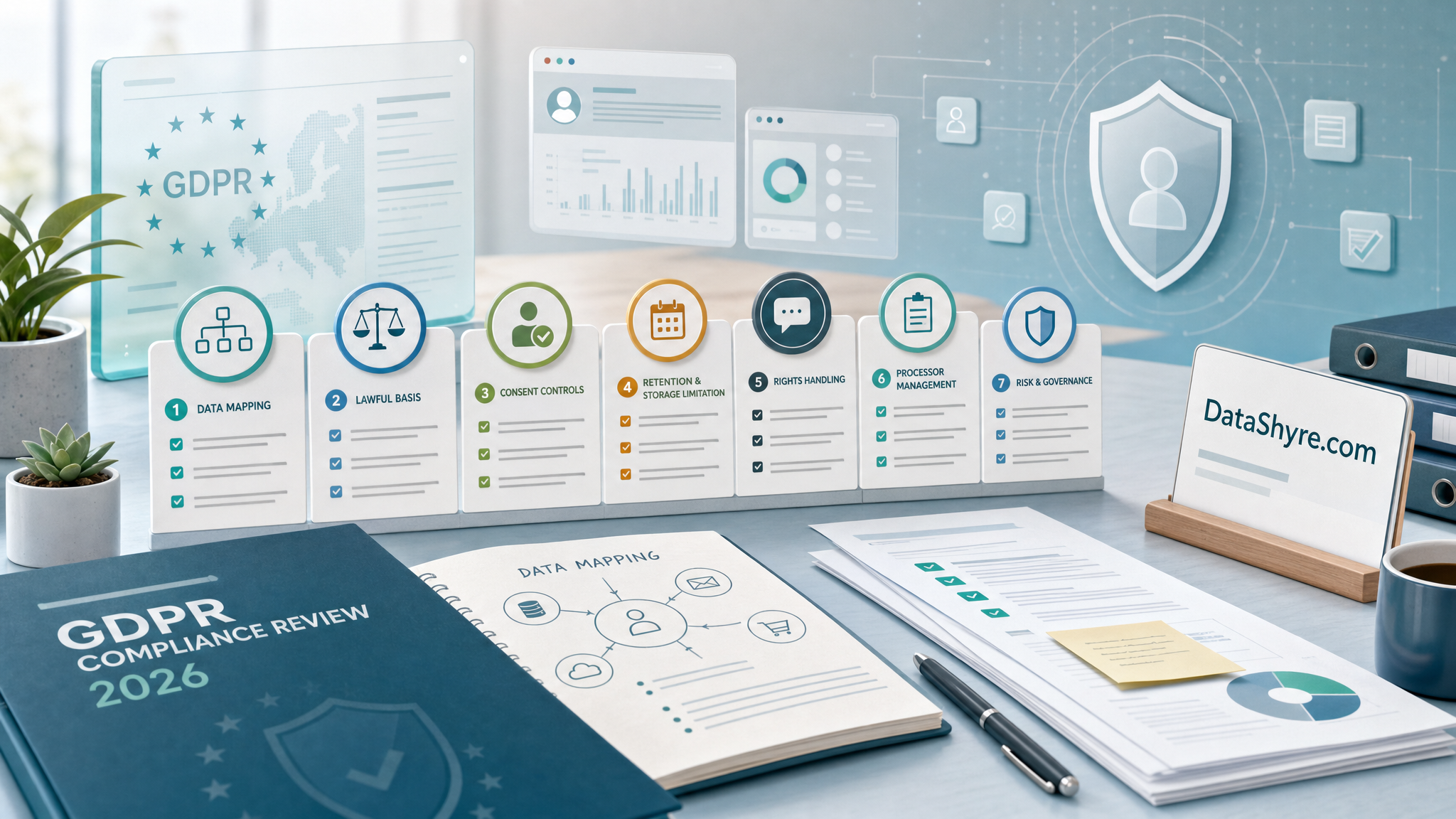
Why this keyword still matters in 2026
The companies that struggle with privacy compliance gdpr usually do not fail because they never heard of the GDPR. They fail because operational change outruns the control system.
Marketing adds a new tag. Product launches a new form. Sales buys another enrichment feed. Engineering moves scripts for performance. Support starts using a different workflow. None of those changes look dramatic in isolation, but together they can break the assumptions behind your notice, your legal basis table, your consent flow, your retention logic, and your response process for individual rights.
That is why current official guidance still matters. The European Commission says valid consent has to be “freely given, specific, informed and unambiguous.” The same guidance says it must be “as easy to withdraw as to give consent.” The ICO’s right-to-be-informed guidance says people must receive “clear and concise information” about what happens to their data, including purposes, retention periods, and sharing. And CNIL’s cookie-banner notice remains blunt that rejecting cookies should be just as easy as accepting them.
So the real test for privacy compliance gdpr is simple: can your organisation connect the words on the page to the behavior in the stack?
1. Map processing by real purpose, not by department
This is the first check because almost every other GDPR control depends on it.
The European Commission’s principles page still says personal data may only be collected and processed for a specific purpose, and individuals must be told what that purpose is. That sounds basic, but many teams still maintain privacy records in a way that hides the real processing model.
Do not map data only by system owner or business unit. Map it by real use:
- account creation and authentication;
- marketing email signup and preference handling;
- product analytics and experimentation;
- fraud prevention and security logging;
- customer support and case history;
- recruitment and hiring workflows;
- advertising, retargeting, and measurement where relevant.
That structure makes it much easier to see where your privacy compliance gdpr story becomes too vague. If one purpose depends on consent, another on contract, and another on legitimate interests, your records should make that visible instead of flattening everything into one privacy spreadsheet.
2. Match each purpose to the right legal basis
A lot of GDPR programs sound strong until this step.
The European Commission’s current legal-grounds guidance is still clear that organisations need a lawful basis for each processing activity. Consent is only one of those grounds. Contract, legal obligation, vital interests, public task, and legitimate interests may all be relevant depending on the use.
That matters because weak privacy compliance gdpr programs often use consent language for everything, even when the processing is actually contractual or operational. Others do the reverse and force legitimate-interests language onto activities that really need an active user choice.
The practical test is purpose-by-purpose:
- What exactly is happening?
- Which legal basis supports it?
- What evidence shows that basis really applies?
- What changes if the user objects, withdraws consent, or asks for deletion?
If your team cannot answer those questions without improvising, the legal-basis model is probably too thin.
3. Fix the notice where data is actually collected
This is where transparency becomes operational.
The ICO says individuals have the right to be informed about the collection and use of their personal data and that privacy information should be provided at the time data is collected from them. The Commission’s principles guidance says people should be told the organisation’s identity, purposes, categories of data, legal basis, retention period, recipients, transfers, rights, complaint path, and, where relevant, the right to withdraw consent.
For privacy compliance gdpr, that means the main privacy notice is only one layer. You also need to inspect the moments where data actually enters the business:
- sign-up flows;
- checkout or lead forms;
- account-profile pages;
- recruitment applications;
- newsletter forms;
- event registration journeys;
- cookie and tracking layers.
This is also where many teams discover that their notice is technically accurate in one place and misleading in another. A footer policy does not fix a misleading inline explanation or a form that expands processing without updating the user-facing text.
4. Treat consent as a runtime control, not a design element
If you rely on consent, the job does not end when the banner renders.
The Commission still says valid consent must be freely given, specific, informed, and unambiguous, and that withdrawal must stay as easy as giving it. The ICO’s current storage-and-access-technologies guidance adds a practical engineering test: the consent mechanism should function as intended, and non-exempt storage or access technologies should only be set when valid consent exists or an exception applies. CNIL’s current notice on dark patterns also reinforces that rejecting cookies should be just as easy as accepting them.
That is why a privacy compliance gdpr review should check:
- whether non-essential technologies stay off before consent where prior consent is required;
- whether granular choices are real or only cosmetic;
- whether
Reject allis as usable asAccept all; - whether withdrawal actually changes runtime behavior;
- whether the system can prove what happened later.
This is one reason privacy teams still need browser testing, not just policy review.
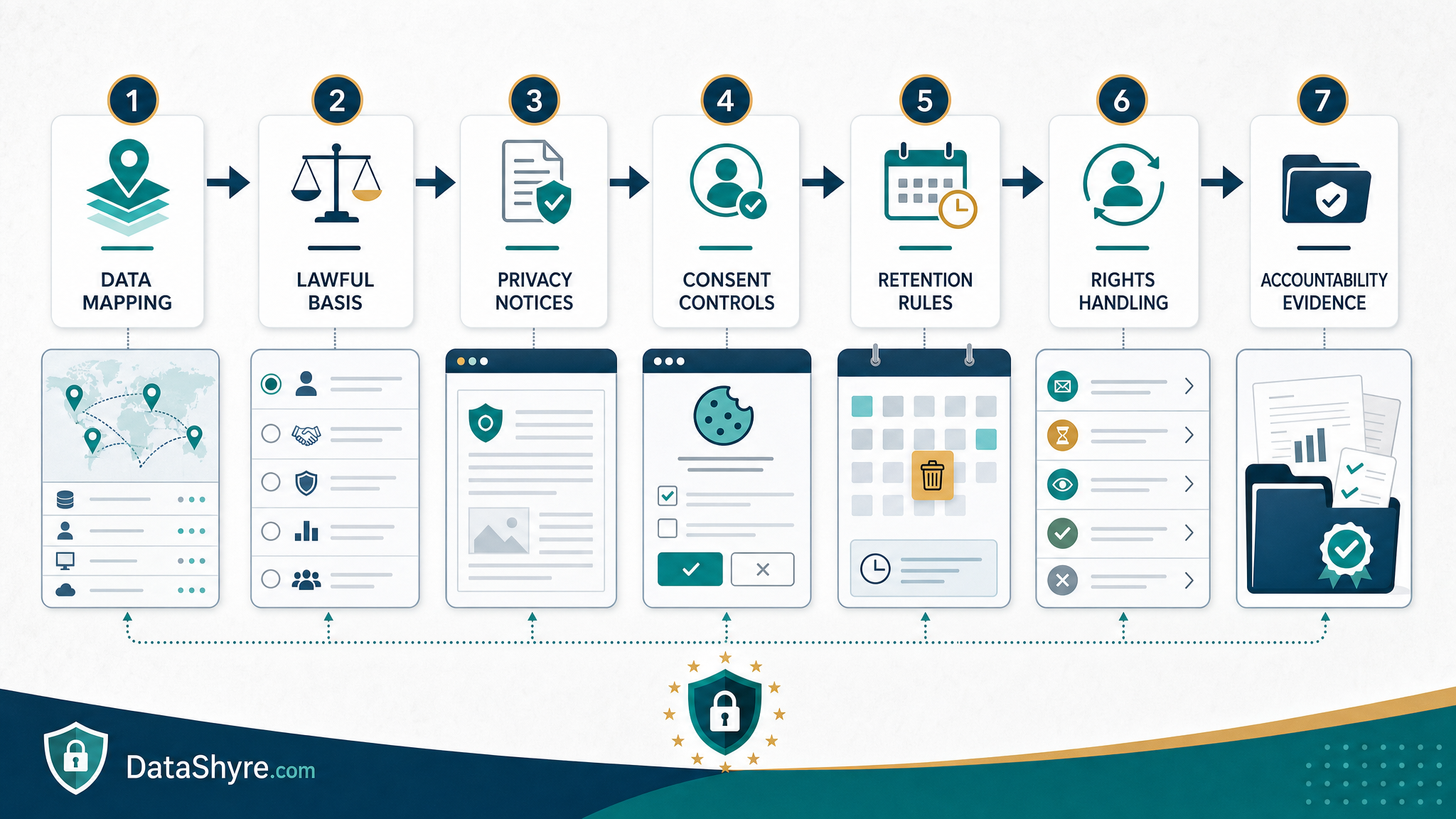
5. Re-check data minimisation and retention against current reality
This is one of the fastest ways to find stale compliance assumptions.
The European Commission’s principles guidance still says personal data should be adequate, relevant, and limited to what is necessary for the purpose, and that it should not be kept longer than necessary. The ICO’s right-to-be-informed guidance also expects you to tell people the retention periods for their data.
In practice, weak privacy compliance gdpr programs often show up as:
- form fields nobody can justify anymore;
- copied data across too many systems;
- archives with no review rule;
- analytics or support records kept indefinitely by default;
- deletion promises that depend on manual cleanup nobody performs consistently.
A good review forces each major dataset through two questions:
- Why do we still need this data?
- When does it get reviewed, deleted, anonymised, or archived?
If those answers are fuzzy, the policy language is probably covering a process gap.
6. Make rights handling match the live operating model
This is where a lot of respectable-looking privacy programs break.
The Commission’s current guidance on dealing with requests from individuals and the ICO’s rights guidance both point to the same operational truth: rights processes need to work across the actual systems holding the data. That includes access, rectification, erasure, restriction, objection, portability, complaints, and consent withdrawal where consent is the basis.
For privacy compliance gdpr, your rights workflow should answer:
- How does the request enter the business?
- Which systems have to be searched or updated?
- Who decides whether an exemption applies?
- How do you track deadlines and evidence?
- How do you make sure downstream systems do not quietly re-create the same issue?
This step is especially important if your organisation has grown by adding tools faster than it has updated its governance model.
7. Prove accountability after every meaningful change
Accountability is the principle that turns GDPR from a theory into an operating discipline.
The European Commission still describes accountability as responsibility for complying with all the data-protection principles and for demonstrating compliance when required. That means privacy compliance gdpr is not just about having the right documents once. It is about being able to show why your controls still reflect the current business.
Use every meaningful change as a trigger to re-check:
- new vendors or processors;
- new marketing or analytics tags;
- revised purposes or product features;
- new transfer patterns outside the EU;
- major retention-rule changes;
- new automated decisioning or profiling use.
The EDPB’s July 14, 2026 cookie-banner decision is a useful reminder here: disputes do not stay theoretical forever. When a complaint survives into a merits review, your organisation needs more than a compliance deck. It needs evidence.
A fast GDPR compliance review for this week
If I were auditing privacy compliance gdpr right now, I would do it in this order:
- map real processing purposes across the business;
- match each purpose to a lawful basis and evidence trail;
- compare the notice language to the real collection points;
- test consent and withdrawal in the live environment where relevant;
- check minimisation and retention against current system behavior;
- run a rights-request path across multiple systems;
- document what changed and what still needs remediation.
That short sequence usually finds more real risk than a high-level policy review alone.
Bottom line
Privacy compliance gdpr in 2026 is not mainly a documentation problem. It is a consistency problem.
If your lawful bases do not match your processing, if your notice does not match your forms, if your consent interface does not match runtime behavior, or if your retention and rights workflows lag behind the systems now using personal data, the program is weaker than it looks.
The strongest GDPR compliance work is usually the least theatrical. It maps reality, makes clear choices, and leaves proof behind.
Sources
- European Commission: Principles of personal data processing under the GDPR
- European Commission: When is consent valid?
- European Commission: What if somebody withdraws their consent?
- European Commission: Legal grounds for processing data
- European Commission: Dealing with requests from individuals
- UK ICO: Right to be informed
- UK ICO: Guidance on the use of storage and access technologies
- European Data Protection Board: EDPB requires Belgian DPA to handle the merits of NOYB cookie banner complaint
- CNIL: Dark Patterns in Cookie Banners: CNIL issues formal notice to website publishers
This post was updated on August 12, 2026 using current official regulator and government materials available at publication time.