

Opt-In Consent in 2026: When You Actually Need It and What Counts
If you are reviewing opt-in consent on August 8, 2026, the first thing to fix is usually the question itself. Many teams treat opt-in consent as the universal answer to privacy compliance. It is not. In some places, opt-in is mandatory. In others, another lawful basis or an opt-out framework is the real rule. And in a few high-risk cases, ordinary consent is not enough because the standard rises to explicit consent.
That is why opt-in consent keeps getting implemented badly. Teams add a checkbox everywhere, assume it solves the legal question, and then miss the harder parts: whether consent was even the right mechanism, whether the choice was specific enough, whether refusal was genuinely possible, and whether the system can prove what happened later.
If you want the surrounding context first, start with our guides on consent for data collection, GDPR cookie consent, and cookie consent. This article stays narrower. It is the practical review I would use before trusting an opt-in consent flow in 2026.
Why opt-in consent gets overstated
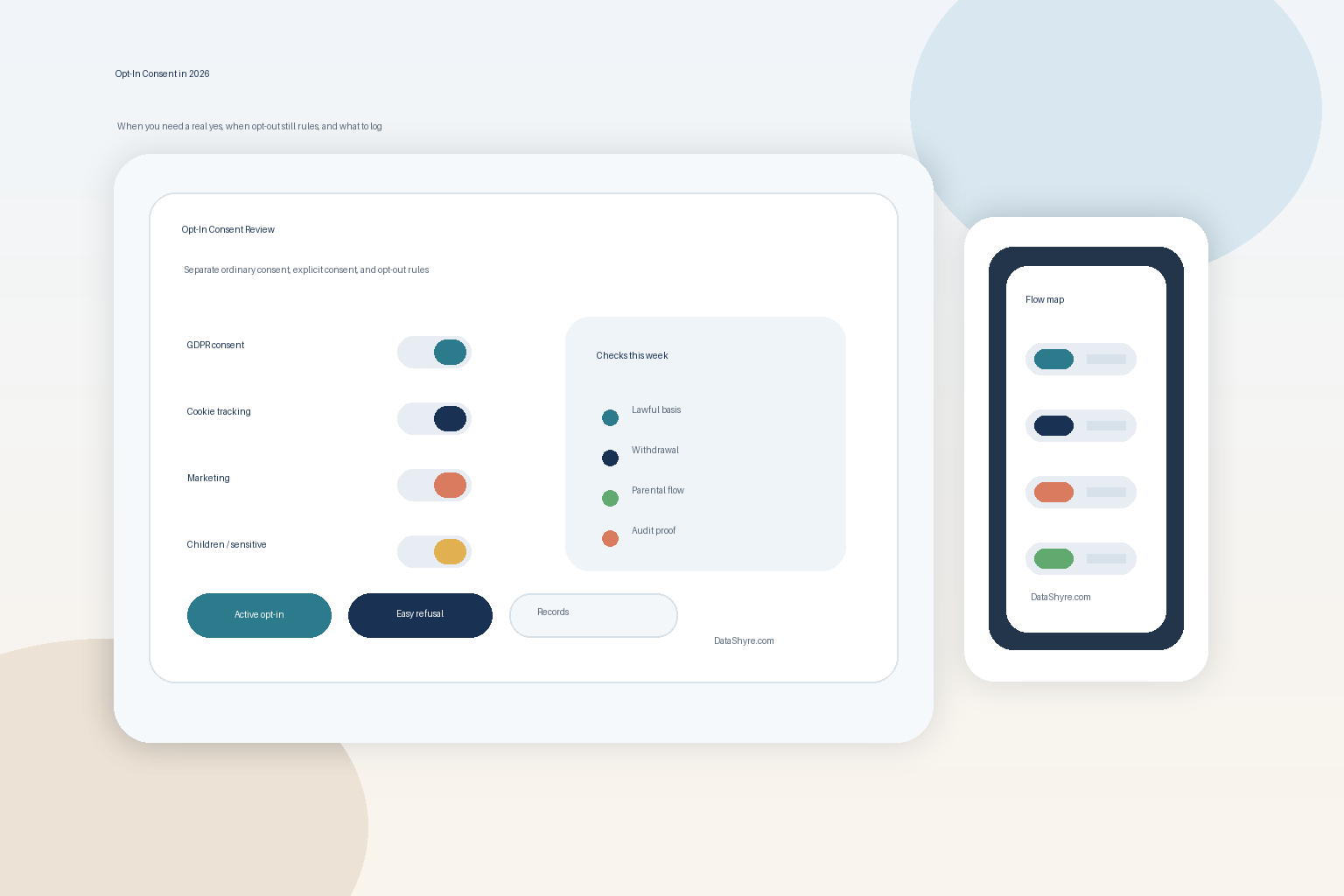
The phrase opt-in consent sounds precise, but it often gets used to describe four different things:
- a GDPR or UK GDPR lawful basis for processing;
- a cookie or tracking permission flow under e-privacy rules;
- a marketing permission flow for email or text;
- a higher-threshold permission for children, biometric data, or other sensitive uses.
Those are not interchangeable.
The ICO’s current guidance says consent is only one lawful basis among several, and that if you cannot offer people genuine choice, consent is not the appropriate basis. The European Commission’s current guidance still uses the familiar standard that consent must be freely given, specific, informed and unambiguous. So the first mistake in many opt-in consent programs is not the wording. It is choosing consent where the real-world relationship does not support a free yes-or-no choice.
1. Start by asking whether opt-in consent is required at all
This is the most important filter because it stops fake-consent design before it starts.
The ICO says you do not always need consent and should choose the lawful basis that reflects the true nature of the relationship and the purpose of the processing. It also says you are likely to need consent when no other lawful basis obviously applies, or when the use is particularly unexpected or intrusive.
For opt-in consent, that means the first review should ask:
- is consent actually the legal basis here;
- can the person say no without practical disadvantage;
- would the processing still happen anyway;
- does another lawful basis fit the activity more honestly.
If the answer is that the business would still process the data regardless, asking for consent may make the interface look safer while making the legal position weaker.
2. For GDPR and UK GDPR consent, the opt-in has to be active and specific
When you really are relying on consent, the standard is high.
The European Commission says the request must be clear and concise, easy to understand, and distinguishable from other information such as terms and conditions. The ICO says valid consent requires an unambiguous indication by clear affirmative action, which is why pre-ticked boxes and passive defaults stay such a poor fit.
In practice, solid opt-in consent under GDPR or UK GDPR usually means:
- one deliberate action by the user;
- purpose-by-purpose choices where the uses differ;
- plain language on who is processing the data and why;
- an easy way to withdraw later.
This is also where ordinary consent and explicit consent diverge. The ICO says explicit consent must be affirmed in a clear statement, whether oral or written. That higher bar matters when you are dealing with certain special-category or sensitive uses and cannot rely on another condition.
3. Cookies and online tracking still need opt-in consent in many cases
This is one of the places where teams most often confuse banner display with real compliance.
The ICO says consent is likely to be needed under e-privacy rules for website cookies and other online tracking methods, and its final 2026 storage-and-access guidance continues to treat refusal and re-prompting as practical compliance issues, not cosmetic ones. CNIL’s cookie-banner notice also restates the same basic direction: with certain exceptions, cookies require consent, and “rejecting cookies should be just as easy as accepting them.”
For opt-in consent, that means a cookie banner review should not stop at button labels. It should check whether:
- non-essential tags are blocked before consent;
- rejecting is equally easy;
- purposes are specific enough to understand;
- new tags or new purposes trigger fresh consent.
The ICO also says that if a user has declined consent, six months is a suitable general guideline before seeking fresh consent again for storage-and-access technologies, unless purposes or activities change sooner. That makes opt-in consent an ongoing controls question, not just a first-visit banner question.
4. Marketing often needs opt-in consent, but not always in the same way
This is where legal labels and operational design get mixed up fast.
The ICO says unsolicited electronic mail marketing to individual subscribers generally requires consent unless you can meet the requirements of a soft opt-in. It also says if PECR requires consent for the message, then consent is typically the right UK GDPR lawful basis in practice. That matters because some teams hear “marketing requires opt-in” and then apply one broad checkbox to every channel, audience, and message type.
A better opt-in consent review separates:
- email versus text versus other channels;
- new prospects versus existing customer relationships;
- individual subscribers versus corporate subscribers where rules differ;
- consent-based flows versus narrow soft-opt-in exceptions.
If you rely on consent, the permission should match the channel and the message type. If you rely on a soft opt-in, the exception has to be real, documented, and kept within its limits.
5. Special-category and biometric uses may need explicit opt-in consent
This is where teams often underestimate how much higher the bar can be.
The European Commission says special categories of personal data can only be processed if one of the Article 9 conditions applies, including the individual’s explicit consent. The ICO says explicit consent may be your only option in some cases, must be confirmed in a clear statement, and should be separate from other consents. Its biometric guidance also says that if you rely on consent for facial-recognition-type processing, people must have a fully informed and freely given choice, which is often difficult in practice.
So if your opt-in consent flow covers things like:
- health data;
- biometric identifiers or facial recognition;
- data revealing beliefs, ethnicity, or sexual orientation;
- other special-category processing without a better Article 9 condition;
then the right question is not “Do we have a checkbox?” It is “Do we have explicit consent, a genuine alternative, and a record that shows the person knew exactly what they were agreeing to?”
6. Children’s data is one of the clearest places where opt-in consent really is mandatory
This is one of the least ambiguous areas.
The FTC’s COPPA guidance says covered operators must provide direct notice to parents and obtain verifiable parental consent before collecting personal information online from children under 13, subject to limited exceptions. In January 2025, the FTC finalized COPPA changes that require parents to opt in to third-party advertising and other disclosures to third parties in covered contexts.
California keeps a separate minors rule. The California Attorney General’s CCPA guidance says a business can sell the personal information of a child it knows is under 16 only if it gets affirmative authorization. For children under 13, the opt-in must come from a parent or guardian. For those age 13 to under 16, the opt-in can come from the child.
For opt-in consent, this means child-related flows should be treated as a special program, not as a small variant of the adult banner or signup experience.
7. California is mostly opt-out, but there are still targeted opt-in moments
This is the part many teams get wrong when they generalize from GDPR.
California’s core sale/share framework is still built around the right to opt out, not a universal prior opt-in. The Attorney General’s guidance says businesses must stop selling or sharing personal information after an opt-out request unless the consumer later authorizes it again, and must wait at least 12 months before asking the consumer to opt back in.
California’s current statute, effective January 1, 2026, also says requests to opt back in to sale or sharing, and requests to opt back in to the use and disclosure of sensitive personal information after limiting it, must use a two-step opt-in process: the consumer first clearly requests to opt in and then separately confirms that choice.
That makes opt-in consent in California a narrower and more procedural concept than many teams expect. It is crucial in the specific places where the law calls for it, but it is not the same as saying California privacy compliance is broadly opt-in by default.
A practical review sequence for this week
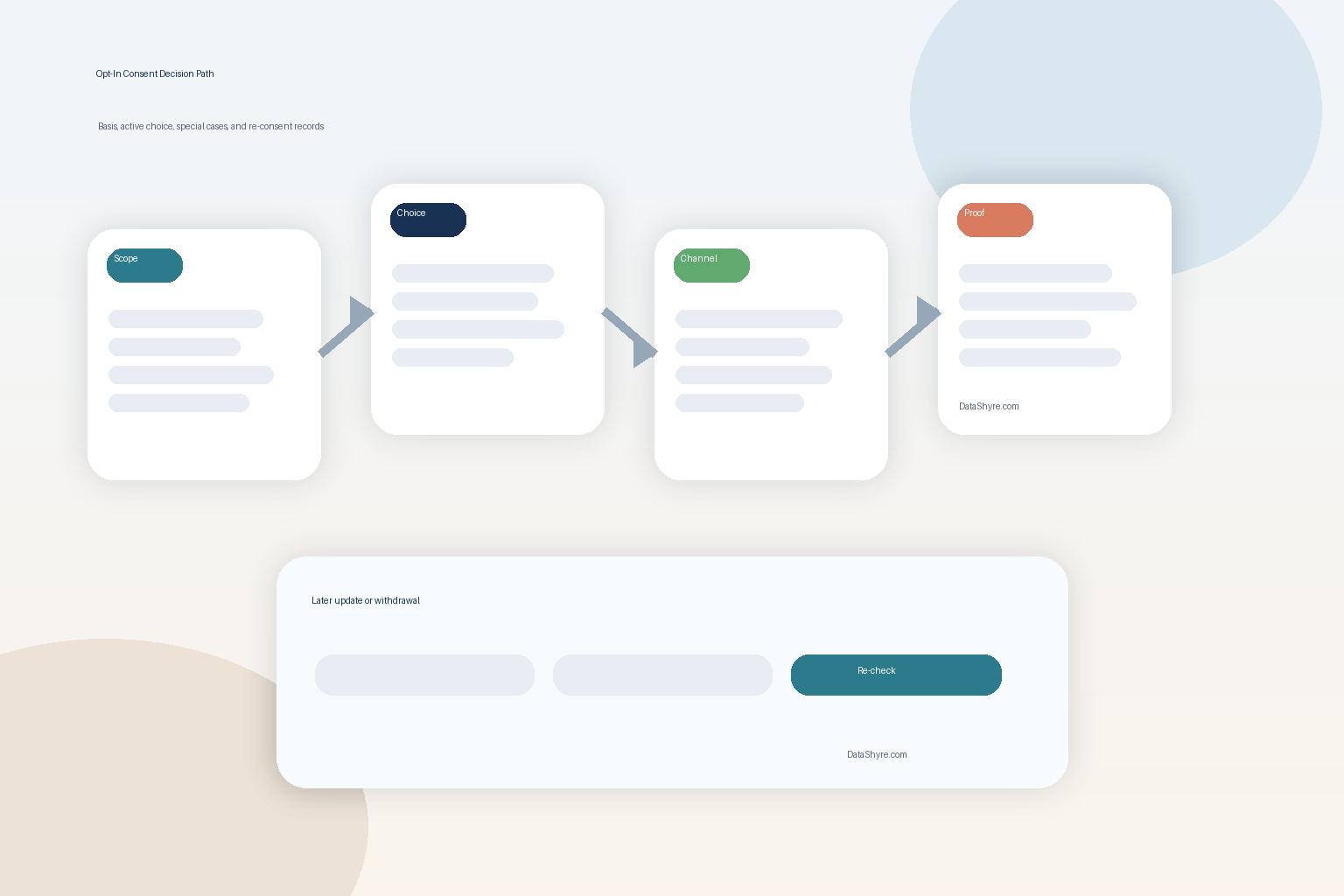
If I were checking an opt-in consent flow on a live site or app right now, I would use this order:
- Confirm whether consent is truly the right legal mechanism.
- Separate ordinary consent, explicit consent, child consent, cookie consent, and marketing consent.
- Check that the user takes a real affirmative step and that defaults are off.
- Test whether refusal and withdrawal are as usable as acceptance.
- Verify that records show what the person saw, chose, and later changed.
- Re-test when purposes, vendors, tags, or audiences change.
- For California opt-back-in flows, verify the two-step confirmation path.
That sequence usually finds more real problems than another round of banner copy edits.
Bottom line
The practical lesson of opt-in consent in 2026 is that it is not one thing.
Sometimes it is the right GDPR lawful basis. Sometimes it is a cookie requirement. Sometimes it is a marketing permission. Sometimes it rises to explicit consent. Sometimes California uses opt-out as the default and reserves opt-in for narrower cases. And with children’s data, the opt-in mechanics can become much stricter.
If your team can identify which kind of opt-in consent it is actually dealing with, match the right standard to that use, and keep records that still make sense after the interface changes, the program gets much more defensible very quickly.
Sources
- European Commission: Information for individuals
- European Commission: Legal grounds for processing data
- UK ICO: When is consent appropriate?
- UK ICO: What is valid consent?
- UK ICO: How should we obtain, record and manage consent?
- UK ICO: How do we manage consent in practice?
- UK ICO: Guidance on direct marketing using electronic mail
- UK ICO: What are the conditions for processing?
- UK ICO: How do we process biometric data lawfully?
- California Attorney General: California Consumer Privacy Act (CCPA)
- California Privacy Protection Agency: CCPA Statute Effective January 1, 2026 (PDF)
- Federal Trade Commission: Complying with COPPA FAQ
- Federal Trade Commission: FTC Finalizes Changes to Children’s Privacy Rule Limiting Companies’ Ability to Monetize Kids’ Data
- CNIL: Dark Patterns in Cookie Banners: CNIL issues formal notice to website publishers
This post was updated on August 8, 2026 using current official European Commission, ICO, California, FTC, and CNIL materials available at publication time.