

GDPR Compliant Privacy Notice: What Changed in 2026 and What Still Matters
If you are searching for gdpr compliant privacy notice on September 26, 2026, the practical question is no longer whether your notice exists.
It is whether a real person can actually understand what you collect, why you collect it, and what choices they still have.
That matters because 2026 has brought a new level of scrutiny around whether privacy notices are not only legally complete but also usable across forms, apps, cookie flows, and connected products. The European Data Protection Board continues to prioritize enforcement on data subject rights, and the European Commission’s Digital Omnibus proposal is shaping the next phase of GDPR compliance.
If you want adjacent detail before the broad overview, start with our guides to consent management platform, consent management platform best practices, and consent manager. The notice and the consent experience should tell the same story.
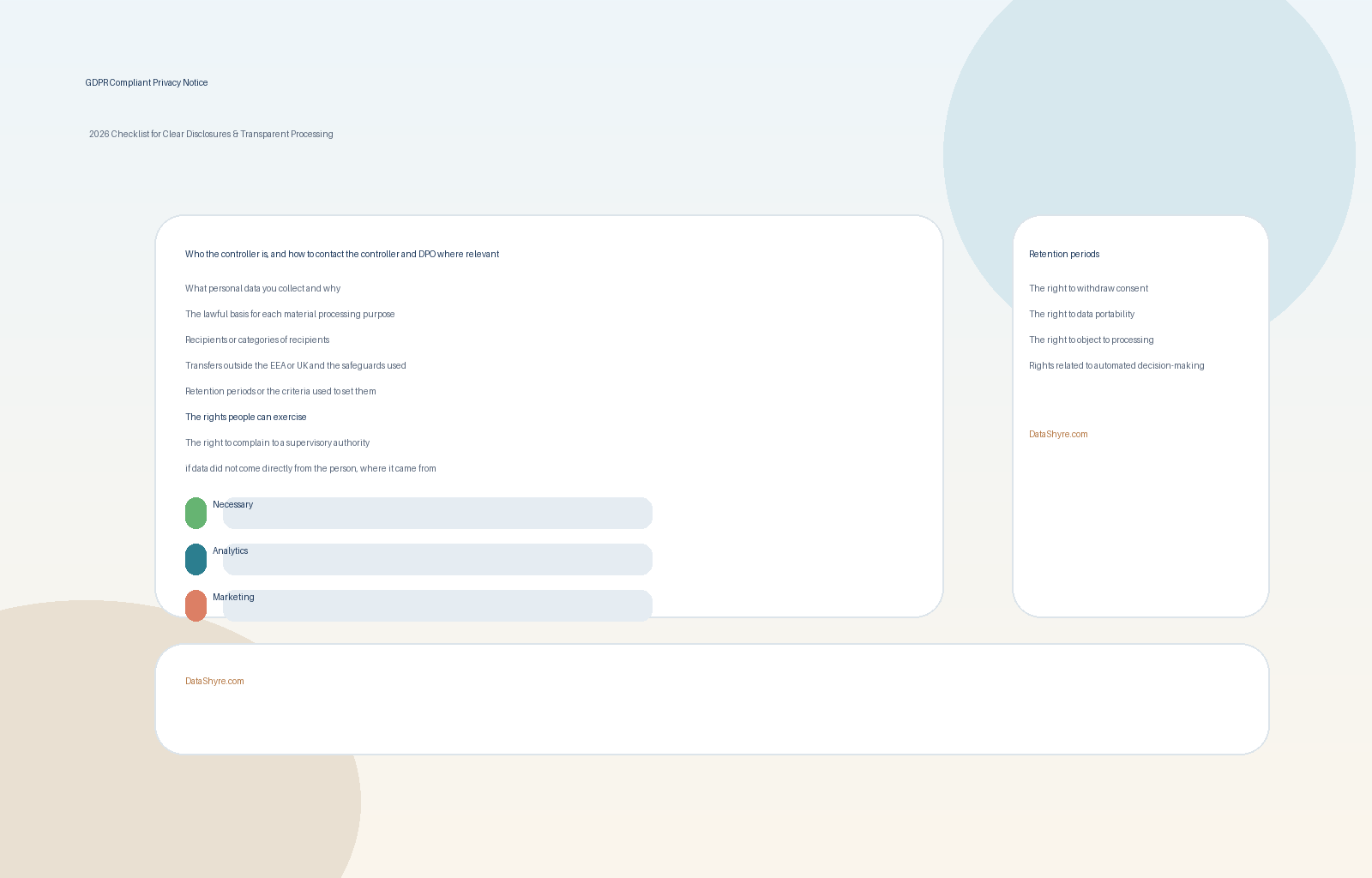
What a GDPR compliant privacy notice must include
The legal baseline has not moved. GDPR Articles 12, 13, and 14 still require information to be concise, transparent, intelligible, easy to access, and written in plain language.
A complete notice covers these core elements:
- Who the controller is, and how to contact the controller and DPO where relevant;
- What personal data you collect and why;
- The lawful basis for each material processing purpose;
- Recipients or categories of recipients;
- Transfers outside the EEA or UK and the safeguards used;
- Retention periods or the criteria used to set them;
- The rights people can exercise, including the right to withdraw consent when consent is the basis;
- The right to complain to a supervisory authority; and
- If data did not come directly from the person, where it came from and when the notice will be provided.
Timing matters too. If you collect data directly, the notice has to be provided when the data is obtained. If you get the data elsewhere, Article 14 generally requires notice within a reasonable period and no later than one month.
That sounds straightforward on paper. In practice, teams usually slip in three places: they blur purposes together, they bury important details in dense prose, or they forget to update the notice before launching a new use case.
Make the notice readable before you make it long
This is where strong teams separate themselves from checkbox compliance. The ICO says privacy information often works best as a blend of layered notices, dashboards, and just-in-time explanations. CNIL makes a similar point in its design guidance: give people a first layer with the essentials, then a clear path to the full policy.
That is the right instinct. If your notice reads like a contract appendix, people are not informed just because the words technically exist on a page.
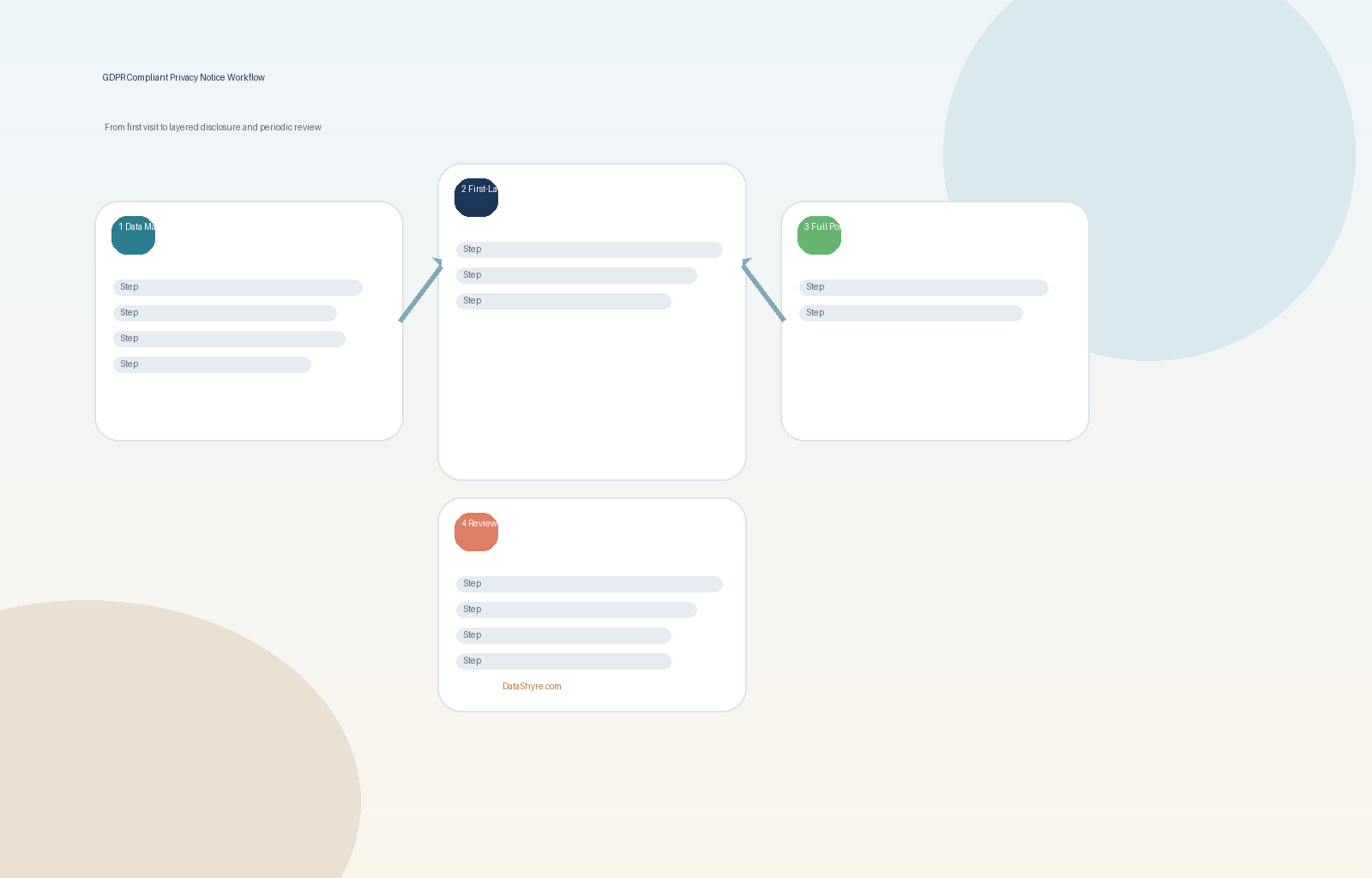
A simple structure usually works best:
- a first layer at collection with identity, purpose, and rights;
- a second layer with fuller legal detail, retention, transfers, and recipient information; and
- contextual prompts when a feature creates a new privacy expectation, such as location tracking, profiling, health data, or ad-tech sharing.
William Malcolm, the ICO’s Executive Director for Regulatory Risk, said the goal is to give people “meaningful control” over how their information is used. That is a useful test for drafts. If the only explanation lives on one legal page, the experience is probably too thin.
Where privacy notices still fail in 2026
The most common failure is not total absence. It is mismatch.
A GDPR compliant privacy notice has to match the processing that is actually happening in your product and vendor stack. In February 2025, CNIL said Qwant’s privacy policy about data sent to Microsoft was inaccurate and incomplete, including missing information on advertising purpose and legal basis. CNIL treated that as a transparency and information failure under GDPR Articles 12 and 13.
The second failure is weak consent context. CNIL’s 2025 enforcement summary said some tracker cases involved insufficient information, which meant consent could not be considered informed. If your banner says one thing and your privacy notice says another, regulators do notice.
The third failure is stale notices after product change. The ICO says you should review notices regularly and bring new uses of personal data to people’s attention before the processing starts. That matters now for personalization, AI features, connected-device telemetry, and partner data sharing that were never mentioned in the original draft.
There is a broader lesson here too. In January 2026, California Attorney General Rob Bonta said consumers “have the right to understand” how their personal information is being used. Different laws use different mechanics, but the expectation is converging: if a use of data would surprise a reasonable person, a vague privacy notice is not enough.
The 2026 enforcement landscape
The European Data Protection Board has reinforced that the right to erasure remains a top enforcement priority in 2026. Organizations must ensure that their privacy notices clearly explain how individuals can exercise this right and that the process to do so is not obstructed by unnecessary complexity.
The European Commission’s Digital Omnibus Package, introduced in late 2025, proposes targeted amendments to the GDPR. These aim to simplify compliance processes and potentially clarify the definition of “personal data” for entities lacking the means to identify individuals. The package also includes clarifications around automated decision-making and simplifying international data transfer requirements.
Organizations should monitor these developments closely, as the final text and implementation timeline will affect how privacy notices are drafted and maintained.
A practical review checklist
Before you publish or refresh your notice, run this quick pass:
- Map each processing purpose to a lawful basis instead of grouping everything under a single generic statement.
- Check that form copy, cookie controls, and in-product prompts do not contradict the full policy.
- Name real recipient categories people will understand.
- State retention in plain terms where you can, not only in abstract policy language.
- Add a visible change-management step so new features trigger notice review before launch.
- Test the first layer on mobile. Dense notices break there first.
- If children or teens use the service, simplify the language again.
- Confirm that withdrawal pathways in the notice align with what actually happens in the product.
One more thing: user testing is worth the hour it takes. Ask someone outside legal to find transfer details, retention periods, and opt-out steps. If they cannot do it quickly, your draft is not finished.
The takeaway
The best privacy notices in 2026 are not the longest ones. They are the ones that stay accurate, match the product, and explain data use in the moment people need the explanation.
If you are rewriting one this quarter, do not start with prettier wording. Start with the data map, the actual vendor flows, and the points where users make decisions. A notice built that way is more likely to hold up with regulators and more likely to earn trust.
Sources
- European Data Protection Board: Enforcement Priorities
- European Commission: Digital Omnibus Proposal
- UK Information Commissioner’s Office: Privacy Information
- CNIL: Design Guidance on Privacy Notices
- California Department of Justice: Consumer Privacy
- GDPR.eu: Privacy Notice
This post was updated on September 26, 2026 using current official regulator, government, and platform sources available at publication time.