

CCPA Consent in 2026: When You Need It, When You Don’t, and What California Still Expects
If you search for ccpa consent, you will find a lot of content that quietly imports GDPR logic into California. That is where teams get confused.
The CCPA is not a general opt-in law. In most cases, California gives consumers the right to know, opt out of sale or sharing, correct, delete, and limit certain uses of sensitive personal information. But there are still specific moments where consent matters, and they are important enough to drive product design, ad-tech setup, and enforcement risk.
If you want the broader rights-and-scope overview first, read our CCPA basics guide. If your question is specifically about banners, this companion guide on CCPA cookie consent requirements covers the website layer. This article focuses on the narrower operational question: when does ccpa consent actually require an affirmative yes?
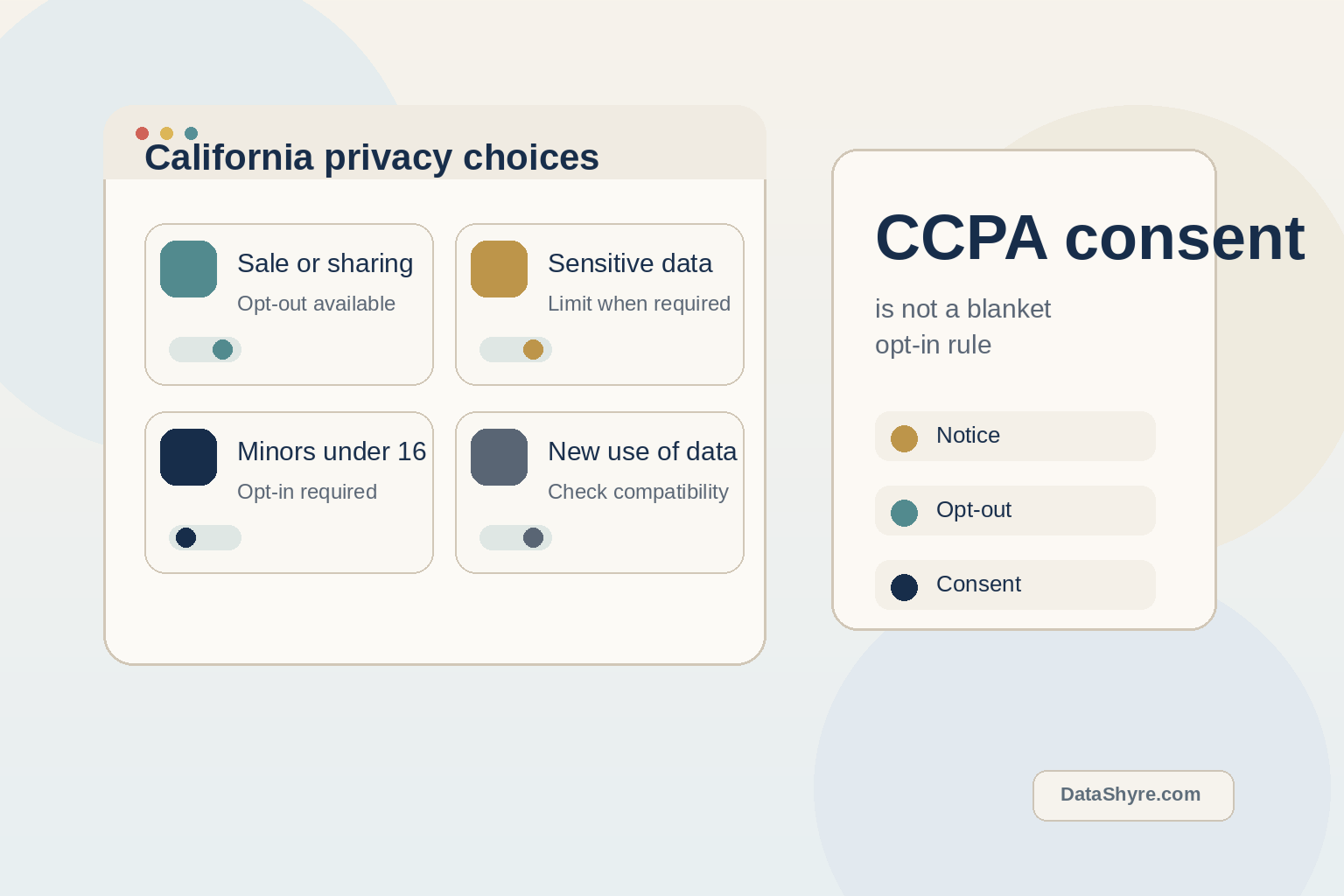
Consent is usually not the default rule under the CCPA
The California Privacy Protection Agency’s own consumer summary still frames the law around rights to opt out of sale or sharing and to limit certain uses of sensitive personal information, not a blanket opt-in requirement. The California Department of Justice’s Global Privacy Control page makes the same practical point from another angle: California expects businesses that sell or share data to honor a browser-level stop signal for sale or sharing.
That means many common California privacy tasks are about notices and working opt-outs, not about forcing a prior consent click. For many marketing and analytics setups, the real question is whether your disclosures are accurate, your opt-out path is easy to use, and your downstream sharing actually stops when a consumer says no.
When consent is required
There are four situations business teams should treat as the highest-value consent checkpoints.
1. Selling or sharing data of consumers under 16
This is the cleanest opt-in rule in the statute. If a business has actual knowledge that a consumer is under 16, it cannot sell or share that consumer’s personal information unless the minor, or a parent or guardian for a child under 13, affirmatively authorizes it.
That rule matters beyond account forms. California’s 2026 updates also treat the personal information of consumers under 16 as sensitive personal information for right-to-limit purposes in many cases. In practice, youth data now creates a double-check problem: teams need to think about both opt-in for sale or sharing and limit-right handling if the business uses that data beyond permitted purposes.
2. Financial incentive programs tied to data use
The CCPA allows financial incentives, but it does not let businesses slide consumers into them by default. California law requires a notice of financial incentive and voluntary opt-in consent when a program involves the sale or sharing of personal information in exchange for a benefit.
This is where loyalty programs, discounts, and rewards mechanics can become privacy design issues. If the value exchange depends on selling or sharing data, your enrollment flow needs to make that choice real and well explained.
3. Using personal information for a purpose that no longer fits the original disclosure
This is the part many teams miss. The current California regulations say a business must obtain the consumer’s consent before collecting or processing personal information for a purpose that does not meet the regulation’s compatibility test. A fresh notice alone is not always enough.
Operationally, this shows up when data first collected for service delivery later gets repurposed for ad targeting, model training, resale, or some other use a reasonable consumer would not expect from the original context. If your team says, “we already collected it,” that is exactly when you should stop and ask whether California now expects consent.
4. Any consent flow distorted by dark patterns
California’s regulations are blunt here: agreement obtained through dark patterns does not count as consumer consent. The CPPA’s 2024 enforcement advisory put it plainly. Deputy Enforcement Director Michael Macko said, “Dark patterns aren’t about intent, they’re about effect.”
That line matters because it closes a common loophole. A company cannot point to a clicked button if the interface made the privacy-protective path harder, longer, or more confusing than the permissive one. The Honda case in 2025 reinforced the same theme by criticizing privacy choices that were not presented symmetrically or equally.
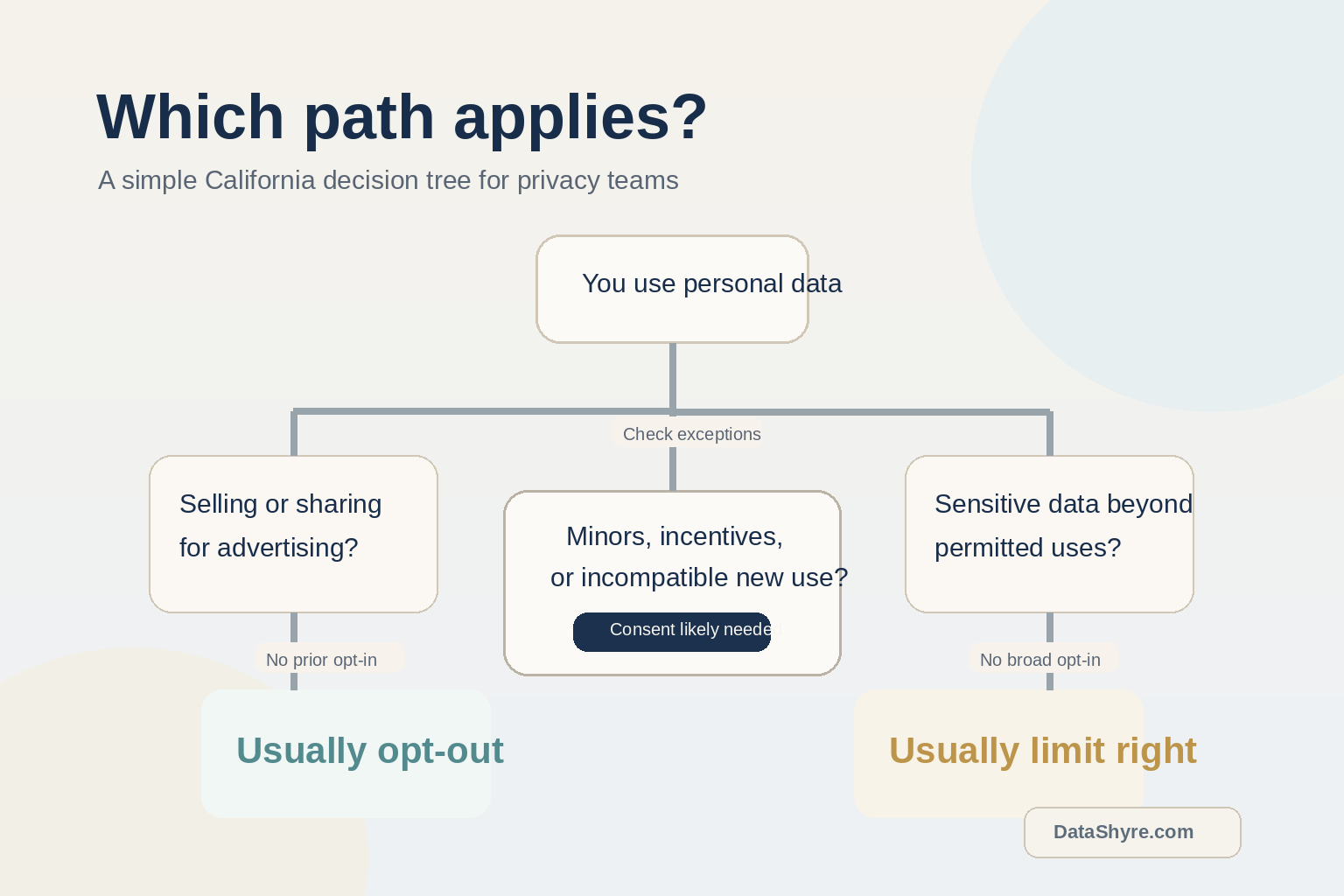
When opt-out or limit is usually the better frame
A lot of California compliance work gets cleaner once teams stop asking, “Do we have consent?” and start asking the more accurate question.
If the activity is sale or sharing for advertising, the usual rule is opt-out. If the activity involves sensitive personal information beyond the law’s permitted purposes, the usual rule is the right to limit. If the business wants to use data in a way that breaks the original expectations, that is where consent can re-enter the picture.
That distinction also explains why California enforcement keeps hitting user experience, not just policy language. In February 2026, Attorney General Rob Bonta said, “Consumers shouldn’t have to go to infinity and beyond to assert their privacy rights.” A few months later, his office announced the General Motors settlement and alleged the company sold drivers’ data “without their knowledge or consent.” Different facts, same message: rights must be real, and surprise reuse of data is dangerous.
A practical checklist
For most teams, this gets manageable if you test these five questions before launch:
- Are we dealing with users under 16 and any sale or sharing of their data?
- Does this rewards or discount flow depend on a financial incentive tied to personal information?
- Are we repurposing data beyond what a consumer would reasonably expect from the original notice?
- Would a regulator say our interface nudges the user toward the less private choice?
- If this is really an opt-out or limit scenario, do our product flows treat it that way across browsers, devices, accounts, and vendors?
If the answer to questions one through four is yes, you likely need a tighter consent design review. If the answer to question five is no, you may not have a consent problem at all. You may have an execution problem.
Bottom line
The simplest way to think about ccpa consent in 2026 is this: California is not asking for an opt-in wall for everything. It is asking businesses to know when consent is specifically required, when opt-out and limit rights govern instead, and when interface design quietly invalidates the choice altogether.
That is a narrower standard than GDPR. It is also more operational than many teams expect.
Sources
- California Privacy Protection Agency FAQ
- California Privacy Protection Agency regulations page
- California Privacy Protection Agency dark patterns enforcement advisory
- California Privacy Protection Agency 2026 CCPA updates overview
- California Department of Justice Global Privacy Control page
- California Department of Justice Disney settlement announcement
- California Department of Justice General Motors settlement announcement