What Is Cookie Consent in 2026? What It Means and When You Actually Need It
DataShyre StaffAug 6, 2026
8 min read
What Is Cookie Consent in 2026? What It Means and When You Actually Need It
If you are asking what is cookie consent on August 6, 2026, the shortest useful answer is this: cookie consent is the process of getting a visitor’s permission before using non-essential cookies or similar tracking technologies when the law requires that permission.
That still matters, but the phrase is also more misleading than it looks. In 2026, regulators are not only looking at named browser cookies. They are looking at broader storage and access technologies, interface design, timing, withdrawal, and whether the site actually changes behavior after the user makes a choice.
If you want the implementation detail next, our guides to cookie consent banner, GDPR cookie consent requirements, and website privacy checker are the best companion reads. This article is narrower. It answers the base question clearly: what is cookie consent, and what does it really require now?
What cookie consent means now
The official baseline is broader than old banner-language suggests.
On April 29, 2026, the UK ICO finalized its guidance on storage and access technologies. That guidance expressly covers cookies, tracking pixels, device fingerprinting, scripts, tags, and similar techniques. The European Commission’s current GDPR consent guidance still says valid consent must be freely given, informed, specific, and given through a clear affirmative act. France’s CNIL still says that, with certain exceptions, cookies require consent and that rejecting them should be just as easy as accepting them.
At the same time, California is not built on the same legal frame. The California Department of Justice still describes Global Privacy Control as a “stop selling or sharing my data switch,” and the CPPA’s law-and-regulations page still lists both the CCPA statute and the CCPA Regulations as effective on January 1, 2026.
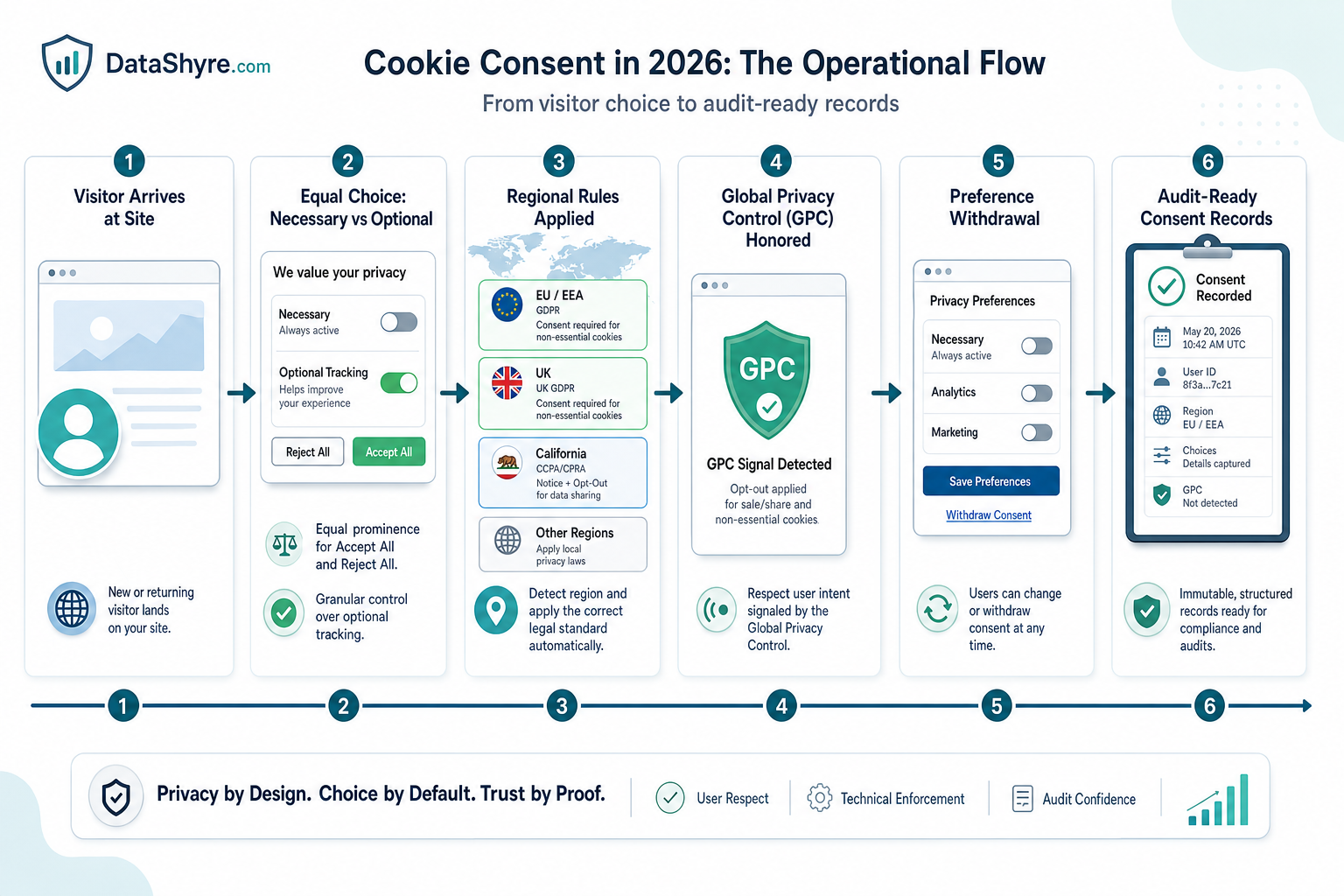
So the first thing to understand about what is cookie consent is that there is no single worldwide rule. The same site may need an opt-in consent flow in one region, an opt-out and GPC workflow in another, and a different notice model elsewhere.
In plain English, what is cookie consent?
In plain English, cookie consent is the user-choice layer that decides whether a website may place or read non-essential cookies or similar tracking technologies on a visitor’s device.
That usually involves:
telling the visitor what the site wants to use;
separating necessary functions from optional ones;
giving the visitor a real choice to accept, reject, or customize;
keeping optional technologies off until the right choice is made where prior consent is required;
making it possible to change that choice later.
That last point is easy to overlook, but it matters. The European Commission’s current guidance says:
“It should be as easy to withdraw as to give consent.”
>
European Commission
That line is one of the clearest ways to understand what is cookie consent in practice. It is not just a pop-up. It is a control that must remain usable after the first click.
6 things people usually mean when they say “cookie consent”
1. Prior choice before non-essential tracking in the EU and UK
In Europe and the UK, what is cookie consent usually starts with timing.
If the technology is not exempt, the practical rule is that optional analytics, advertising, personalization, or similar tracking should not activate until the user has given valid consent. The ICO’s current guidance also makes clear that consent is about more than a banner being visible. It is about whether the technology is actually used before the user chooses.
That is why a site can have a polished banner and still fail the real test.
2. Not every cookie needs consent
This is one of the biggest areas of confusion.
The ICO’s 2026 guidance now spells out five exceptions to the normal prohibition on storing or accessing information on a user’s device without consent. Those include the communication exception, the strictly necessary exception, and a statistical purposes exception that can apply only in limited circumstances and still requires clear information plus a simple way to object.
So when someone asks what is cookie consent, the honest answer is not “every cookie needs a yes.” The better answer is:
some technologies are exempt because they are truly necessary or fit a narrow exception;
many analytics, advertising, and personalization technologies are not exempt;
if you stretch an exception beyond its actual scope, you are back in consent territory.
This is one reason legal review and technical review have to stay connected.
3. It is about more than cookies now
The phrase survived, but the compliance question widened.
The ICO now frames this area as storage and access technologies, not just cookies. That matters because the real data flow may involve local storage, pixels, SDK behavior, fingerprinting techniques, scripts, or tags that do not show up neatly in a cookie table.
So if you are asking what is cookie consent in a modern stack, the more accurate question is:
“What technologies store information on, or read information from, the user’s device, and which of those need prior permission?”
That broader framing is much closer to what regulators are actually reviewing.
4. Rejecting and withdrawing must be genuinely easy
Consent is weak if refusal exists only in theory.
CNIL’s current dark-pattern notice says:
“rejecting cookies should be just as easy as accepting them.”
>
CNIL
That remains one of the best practical tests for what is cookie consent. If Accept all is bright, immediate, and obvious, while Reject all is hidden behind extra clicks, faint text, or awkward mobile behavior, the site is steering the outcome rather than collecting a fair choice.
The same logic applies after the first decision. If a visitor cannot easily reopen settings and reverse an earlier choice, the consent flow is incomplete.
5. In California, the workflow is often opt-out rather than classic cookie opt-in
California changes the shape of the question.
The California DOJ’s current CCPA page still explains that California consumers have rights to know, delete, and opt out of the sale or sharing of personal information, including through user-enabled Global Privacy Control. Its GPC page describes that signal as a “stop selling or sharing my data switch.”
That means what is cookie consent for a California-facing site may really be a different operational question:
does the site provide the required notices;
does it expose the right opt-out path;
does it honor GPC where sale or sharing is in scope;
do downstream ad-tech and sharing behaviors actually change when the opt-out signal is received?
That is not the same thing as a classic EU-style opt-in banner, even if the interface looks similar.
6. A banner only counts if it changes the site’s behavior
This is the most important operational point in the whole topic.
A consent layer is not meaningful if the site loads non-essential scripts before choice, keeps sending data after rejection, or stores a consent record without changing runtime behavior. The serious test is not what the banner says. It is what the page, tags, embeds, vendors, and downstream tools actually do.
For what is cookie consent, that means the live check should include:
what loads before any click;
what changes after Reject all;
what changes after Accept all;
whether category-level choices are honored narrowly rather than globally;
whether later withdrawal changes actual behavior, not just a preference screen.
A short review sequence if you are checking a live site this week
If I were answering what is cookie consent for a real website rather than as a definition, I would test it in this order:
Open the site in a clean browser session and see what fires before any interaction.
Identify which technologies are truly necessary and which are optional.
Reject optional choices and verify what stops loading or storing data.
Reopen the settings and test whether withdrawal works as easily as acceptance.
Compare the live behavior with the cookie banner, cookie table, and privacy notice.
If California rights are relevant, test whether opt-out flows and GPC handling change the behavior you would expect them to change.
That short sequence usually answers the practical version of what is cookie consent faster than a long policy debate does.
Common misunderstandings
The same mistakes keep coming up:
thinking cookie consent is only a design pattern instead of a live technical control;
assuming every cookie needs consent, when some narrowly defined exceptions may apply;
assuming a banner solves the problem even if scripts still run too early;
treating California and EU rules as the same workflow with different wording;
forgetting that rejection and later withdrawal have to be genuinely usable.
Most of those mistakes come from treating the banner as the product instead of treating user choice as the product.
Bottom line
So, what is cookie consent in 2026?
It is the mechanism that tells a site whether it may use non-essential cookies or similar tracking technologies, when the law requires that choice. In the EU and UK, that often means valid prior consent before optional tracking starts unless a narrow exception applies. In California, the more important workflow may be notice, opt-out, and honoring GPC rather than blanket cookie opt-in.
The key idea is simple: the user choice has to be real, easy to refuse, easy to withdraw, and reflected in what the site actually does.
If your setup cannot show those things, you probably do not yet have meaningful cookie consent. You have a banner.