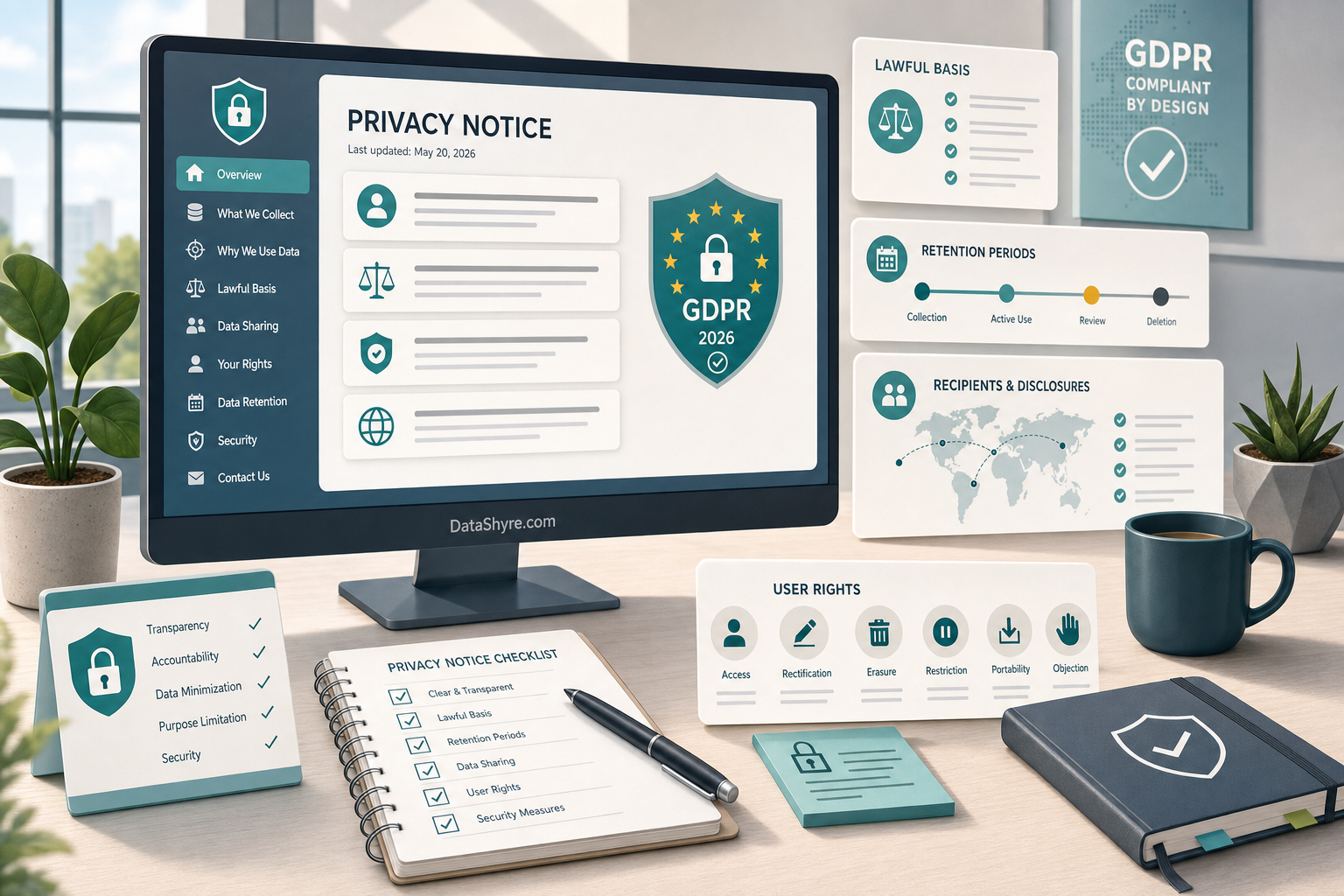
GDPR Compliant Privacy Notice in 2026: What It Must Actually Say
DataShyre StaffAug 3, 2026
8 min read
GDPR Compliant Privacy Notice in 2026: What It Must Actually Say
If you are searching for a gdpr compliant privacy notice on August 3, 2026, the useful question is not whether you have a policy page. It is whether your notice matches the way personal data is actually collected, used, shared, stored, and changed across the real business.
That is still the right frame in 2026. The European Commission’s current GDPR guidance still summarizes the core notice content in practical terms: identity, purposes, data categories, legal basis, retention, recipients, transfers, rights, complaints, withdrawal where relevant, and automated decision-making. The UK’s ICO right-to-be-informed guidance says privacy information should be provided at collection, or within one month if the data was obtained elsewhere, and it should be concise, transparent, intelligible, easy to access, and written in clear language.
If you are cleaning up the surrounding consent stack too, start with our guides to consent for data collection, cookie consent, and best GDPR software. This article is narrower. It is the review I would run before calling a gdpr compliant privacy notice ready for production.
Why the keyword still matters in 2026
A privacy notice is still one of the clearest places where legal theory meets operational reality.
On April 29, 2026, the ICO published final guidance on storage and access technologies covering cookies, tracking pixels, scripts, tags, and device fingerprinting. On July 14, 2026, the EDPB required the Belgian DPA to assess the merits of a cookie-banner complaint involving broadcaster VRT instead of ending the case on a procedural theory. And CNIL’s current dark-pattern notice still says cookie-banner information must be clear and complete and that rejecting cookies should be as easy as accepting them.
Those materials are not all privacy-notice checklists. They do show something important, though: regulators still care about what people are told, when they are told it, and whether the user-facing explanation matches the actual processing behavior underneath.
That is why a gdpr compliant privacy notice is not just a drafting task. It is a mapping task.
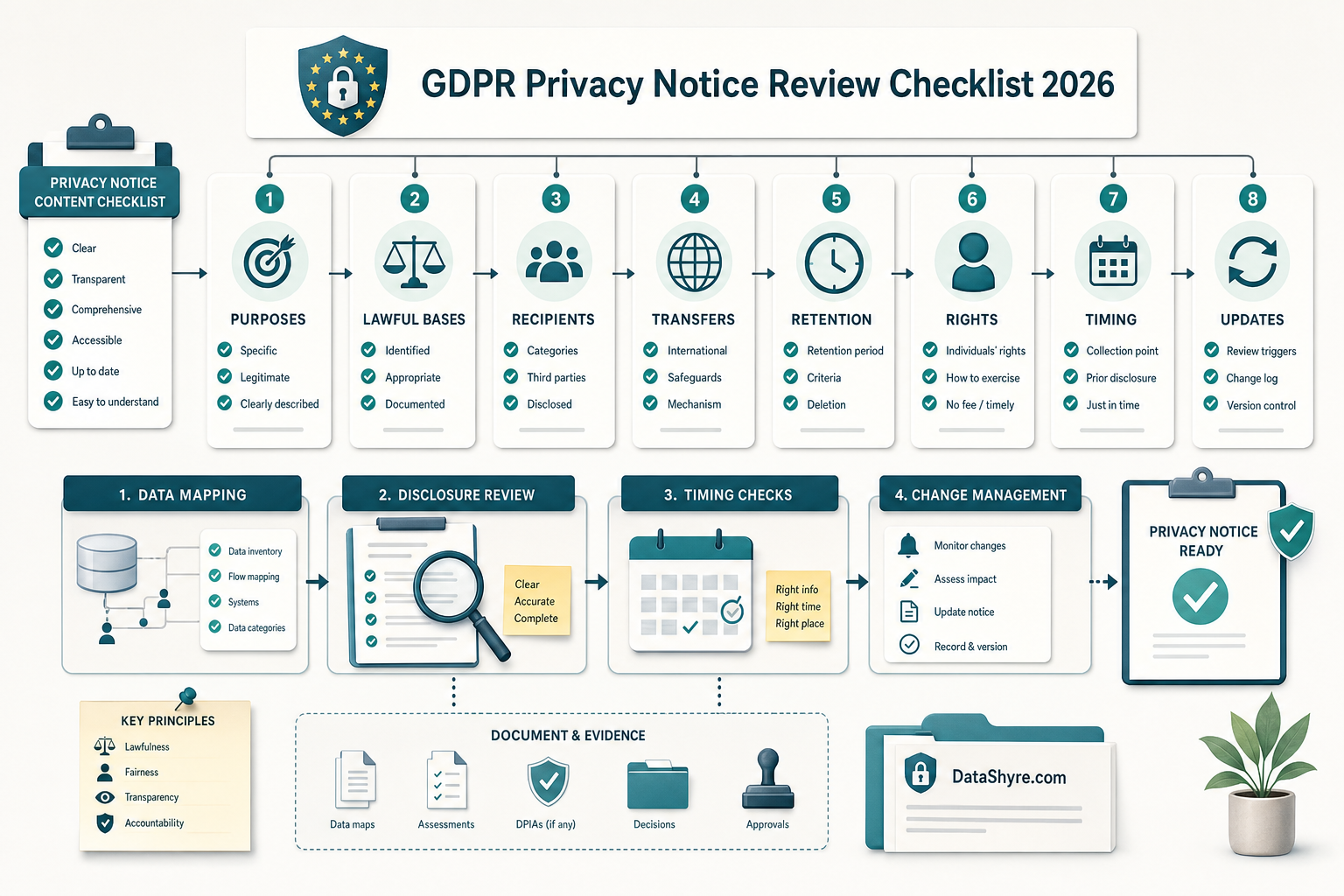
7 checks that make a privacy notice more defensible
1. Name the controller and the real contact points
Start with the basics, but do them properly.
The European Commission’s current guidance says individuals should be told who the organisation is, how to contact it, and how to contact the data protection officer where there is one. The ICO’s checklist says the same thing in slightly different language.
That sounds obvious, yet many notices still hide the actual controller identity behind a brand page, a generic contact form, or a regional structure nobody can decode.
A gdpr compliant privacy notice should let a normal person answer these questions quickly:
Which legal entity is using my data?
Which team or mailbox handles privacy questions?
Is there a DPO or representative I can contact?
If those answers require detective work, the notice is already weaker than it looks.
2. Separate purposes from lawful bases
This is where a lot of notices become vague.
The Commission’s current GDPR guidance says the purpose must be known and individuals must be informed about it. It also says:
“It is not possible to simply indicate that personal data will be collected and processed.”
>
European Commission
That is the easiest test to remember.
If the notice says you process data “to improve services” or “for business purposes” without explaining the actual use cases, the notice is too abstract. If it lists one lawful basis across unrelated activities, the notice is also likely doing too much compression.
For each meaningful processing activity, state:
what the data is used for;
which lawful basis supports that use;
whether consent can later be withdrawn;
what changes if the person says no.
That is the difference between a policy page and a usable notice.
3. Disclose categories, recipients, transfers, and sources in plain terms
The next failure point is hidden complexity.
The Commission’s current guidance says individuals should be told the categories of data involved, who receives the data, whether it is transferred outside the EU, and, when data was not collected directly from the person, where it came from. The ICO also says you can identify recipients by name or by meaningful categories, depending on what helps people understand the processing.
In practice, this means a gdpr compliant privacy notice should not stop at phrases like:
trusted partners;
service providers;
selected third parties;
publicly available sources.
Those labels are too thin on their own. The notice should make the categories meaningful enough that a reader can understand the data flow, the outside parties involved, and the reason they are in the chain.
4. State retention periods or the criteria behind them
Retention language is another common weak spot.
The European Commission’s current guidance says people should be told how long personal data will be stored, and the same page stresses the storage-limitation principle: data should be kept no longer than necessary. The ICO’s privacy-information checklist also includes retention periods as a standard item.
That means a notice should not default to fuzzy phrases like “we retain your data as long as necessary” unless it immediately explains what “necessary” means in practice.
Better patterns include:
a defined retention period for a category of records;
a clear rule for when deletion or review happens;
separate timing where legal retention duties override normal deletion cycles.
If the notice cannot tell the reader when review, deletion, or archiving decisions happen, it is probably reflecting a process gap, not just a writing gap.
5. Explain rights, complaints, withdrawal, and automated decisions
This is the part people often expect to find, and it still matters.
The Commission’s current guidance says individuals should be informed of their basic data-protection rights, their right to complain to a supervisory authority, the right to withdraw consent where consent is the basis, and the use and consequences of automated decision-making where it exists.
The ICO’s framing is still the clearest shorthand:
“clear and concise information”
>
ICO
Rights language should be short, but it should not be skeletal. A gdpr compliant privacy notice should tell people what rights exist, how to exercise them, and which workflows are actually relevant to the service.
If profiling or automated decisions have real effects, this part needs more than a one-line disclaimer.
6. Deliver the notice at the right time, not just on a footer page
Timing is part of compliance, not a distribution preference.
The Commission says that if data is collected directly from the person, the information should be provided when the data is obtained. If the data comes from another source, the person must be informed at the latest within one month, at first communication, or when the data is first disclosed, depending on the scenario. The ICO states the same timing rule in its right-to-be-informed guidance.
The ICO also recommends layered notices, dashboards, and just-in-time disclosures where they help people understand what is happening in context.
That matters because the most accurate footer-page policy can still underperform if:
a signup form collects more than the main notice suggests;
a recruitment workflow imports external data with no visible explanation;
a product feature introduces a new use before the notice is updated;
a cookie or tracking layer says less than the underlying behavior actually does.
Delivery is part of accuracy.
7. Review the notice whenever processing changes
The notice is not finished when legal signs off once.
The ICO says organisations should regularly review and update their privacy information, and they must bring new uses of personal data to people’s attention before the new processing starts. That is one of the most practical lines in the whole guidance set because it turns the notice into a living change-control artifact.
This is also where current enforcement climate matters. The EDPB’s July 2026 action and CNIL’s current banner-design notice are reminders that transparency is assessed against real behavior, not just archived text.
If your stack changes in any of these ways, the notice should be re-checked:
new analytics or advertising tools;
a new CRM or enrichment source;
international transfer changes;
a new retention rule;
new profiling or scoring logic;
a product flow that uses the same data for an additional purpose.
A practical review sequence for this week
If I were reviewing a gdpr compliant privacy notice today, I would do it in this order:
List each real processing activity, not just each data field.
Match every activity to its stated purpose and lawful basis.
Check whether recipients, transfers, and data sources are described in a way a user can understand.
Check whether retention is defined or whether the notice is hiding an unresolved process.
Confirm the rights section matches actual intake and case-handling workflows.
Check whether the notice is shown where data is collected or obtained, not just linked in the footer.
Compare the notice to the live site, product, forms, cookies, and downstream tools for drift.
That short review catches more real notice defects than most generic templates do.
Bottom line
A gdpr compliant privacy notice in 2026 is not the one with the most clauses. It is the one that accurately explains the real processing model in language people can understand, appears when it needs to appear, and keeps pace with operational change.
If your notice still reads like a placeholder, compresses several purposes into one sentence, hides recipients behind vague labels, or treats timing as an afterthought, it is probably overdue for a deeper review.
The best version is rarely the longest version. It is the clearest one that still matches the system behind it.