

GDPR Cookie Consent in 2026: What Valid Website Consent Still Requires
If you are reviewing gdpr cookie consent in 2026, the real question is not whether your banner looks current. It is whether optional tracking stays off until a person chooses, whether saying no is as easy as saying yes, and whether the choice still works later when that person comes back to change it.
That is still an active compliance issue on July 31, 2026. On July 14, 2026, the European Data Protection Board said the Belgian DPA must assess the merits of a NOYB complaint about a broadcaster’s cookie banner. A few months earlier, on April 29, 2026, the UK ICO finalized its storage-and-access technologies guidance and made clear that compliance review is broader than classic browser cookies alone.
The baseline itself is stable. The European Commission says valid consent must be freely given, informed, specific, and expressed through a clear affirmative act. It also says withdrawal must stay easy: “It should be as easy to withdraw as to give consent.”
If you want examples before the checklist, start with our GDPR Cookie Consent Examples: 8 Patterns That Still Work in 2026, Cookie Consent Message Examples: 7 Banner Patterns That Still Work in 2026, and Google Tag Manager Cookie Consent: 7 Checks That Still Matter in 2026. This article is narrower. It is the short audit I would run before trusting a gdpr cookie consent setup in production.

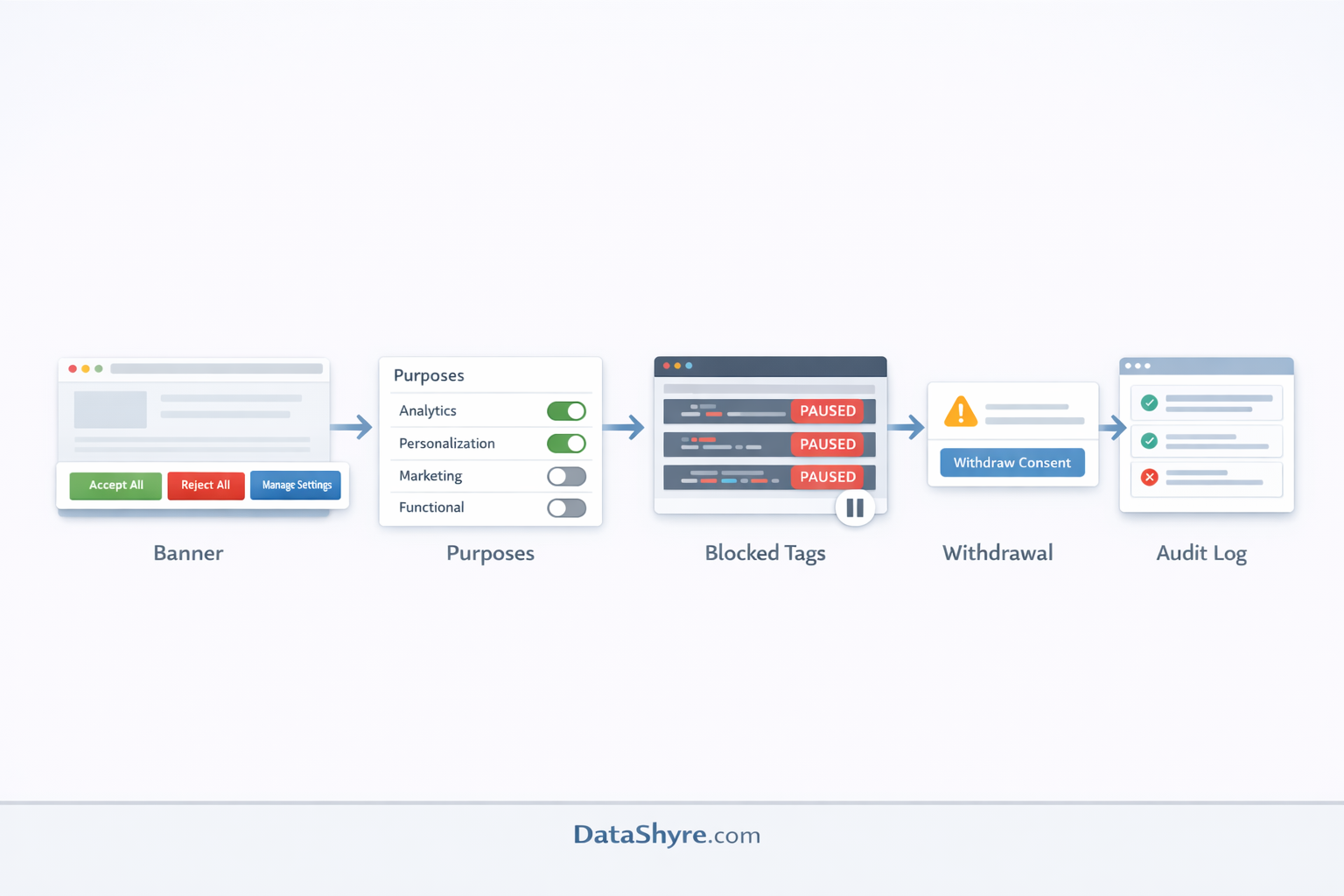
What GDPR cookie consent has to prove
For most teams, gdpr cookie consent has to answer five practical questions:
- Are non-essential cookies and similar tracking technologies blocked before the visitor chooses?
- Can the visitor refuse as easily as accept?
- Are purposes explained clearly enough that the person understands the choice?
- Can the person return later and withdraw or change consent without friction?
- Can the organization show what the banner said, what the visitor chose, and whether the systems respected that choice?
That is why consent is not just a design asset. It is a behavior that spans the banner, tag manager, scripts, embeds, analytics, ad tools, and whatever records the team keeps afterward.
6 checks that still matter in 2026
1. Verify prior blocking on the pages where tools actually fire
This is the first check because it still catches the biggest gap between policy and reality.
Many sites present a clean first-layer banner while analytics, ad pixels, personalization scripts, or embedded third-party tools already touched the browser before any choice was made. If that happens, the rest of the experience does not rescue the setup.
The ICO’s 2026 storage-and-access technologies guidance matters here because it widens the practical review. Do not test only cookie files. Test scripts, pixels, browser storage, fingerprinting-related techniques, and embedded tools that create equivalent tracking behavior.
2. Confirm that reject is as easy as accept
The CNIL put the design principle plainly in its December 12, 2024 notice on dark patterns in cookie banners:
“Rejecting cookies should be just as easy as accepting them.”
>
CNIL
This is still one of the fastest ways to screen a weak setup. If refusal is hidden behind a second layer, reduced to a low-contrast text link, or made harder on mobile than on desktop, then the interface is pushing choice rather than presenting it.
3. Check whether purposes are clear enough to support informed consent
The European Commission’s guidance is useful because it keeps the standard simple: consent must be informed and specific. A visitor should understand what they are agreeing to before optional tracking starts.
For most sites, that means categories such as:
- strictly necessary;
- analytics;
- advertising;
- functional preferences;
- embedded third-party content where relevant.
That structure is usually stronger than vague labels such as experience, partners, or improvements. The first layer can stay concise. The second layer still needs to explain what each purpose means and who is likely to receive the data.
4. Test withdrawal as a real product behavior
Withdrawal is where polished implementations often break apart.
You should be able to reject on first visit, reopen preferences later, withdraw previously granted consent, and confirm that the system behavior actually changes. If analytics or advertising continues after withdrawal, then the interface is performing compliance instead of delivering it.
The European Commission is explicit here: “It should be as easy to withdraw as to give consent.” For gdpr cookie consent, that means the return path should be visible and the technical enforcement behind it should be real.
5. Review the evidence, not just the interface
Sooner or later, somebody will ask what happened on a specific date.
A mature setup can usually show:
- the banner version that was live;
- the purposes and vendor disclosures shown at that moment;
- the visitor’s choice and timestamp;
- later withdrawals or changes;
- whether the downstream tools matched the stored choice.
That matters because a banner screenshot is not enough. Good gdpr cookie consent is partly a records problem. If the logs cannot tie the user action to the live configuration, the evidence is weaker than it looks.
6. Re-test after every meaningful stack change
Consent drift is common.
New tags are added. A CMP template is edited. A marketing team republishes a container. A third-party video appears on a landing page only. The banner still looks correct, but the underlying behavior no longer matches the promise.
That is why the EDPB’s July 2026 cookie-banner news matters beyond the specific Belgian case. It is a reminder that cookie banners are still active enforcement territory. Review should be continuous, not ceremonial.
Common failures that still create avoidable risk
The weak patterns have not changed much:
Reject allappears only in a second layer;- optional categories are enabled by default;
- mobile layout makes refusal slower or harder than acceptance;
- categories are too vague for a person to understand the real choice;
- preference changes do not flow into tag behavior;
- the consent log exists, but cannot be matched to the live banner version.
Those are not cosmetic flaws. They go directly to whether consent looks freely given, informed, and usable in practice.
A fast review sequence for GDPR cookie consent
When I review gdpr cookie consent, I use a short sequence:
- Open a fresh session.
- Click
Reject all. - Verify that non-essential tools did not run.
- Open settings and confirm optional categories are not enabled by default.
- Accept selected categories only and confirm the system changes accordingly.
- Reopen preferences later and withdraw consent.
- Confirm that the records reflect each change.
That short test usually surfaces the real problems much faster than a feature comparison sheet.
Bottom line
In 2026, strong gdpr cookie consent still comes down to the same practical standard: block optional tracking before choice, make refusal as easy as acceptance, explain purposes clearly, let people withdraw just as easily later, and keep records that connect the user action to actual system behavior.
If your setup can prove those points on live pages, you are much closer to a consent experience that works in production and reads credibly in a regulatory review.
Sources
- European Commission: When is consent valid?
- European Commission: What if somebody withdraws their consent?
- European Data Protection Board: EDPB requires Belgian DPA to handle the merits of NOYB cookie banner complaint
- European Data Protection Board: Report of the work undertaken by the Cookie Banner Taskforce
- ICO: Final storage and access technologies guidance published
- ICO: Guidance on the use of storage and access technologies
- CNIL: Dark Patterns in Cookie Banners: CNIL issues formal notice to website publishers
This post was updated on July 31, 2026 using current official regulator guidance and news available at publication time.