

Processor Consent Management Platform: What Buyers Should Verify in 2026
If you are searching for a processor consent management platform, the real question is usually not whether the banner looks polished. It is whether the platform can operate as a trustworthy processor or sub-processor once consent logs, tag controls, vendor lists, regional rules, and contract obligations all start interacting in production.
That matters because the legal and operational lines are easy to blur. The European Commission still explains the basic split in straightforward terms: a controller decides why and how personal data is processed, while a processor processes data on the controller’s behalf. The UK ICO makes the same point and adds the practical test: processors act under the controller’s authority, not for their own purposes.
For consent tooling, that distinction shapes vendor review. Some CMP vendors mainly act as processors for consent records and implementation support. Others may also define product-level means, bring in sub-processors, or use telemetry in ways that need closer scrutiny. So a processor consent management platform review should start with role clarity, not with a feature comparison page.
If you want wider context first, our guides to Consent Management Platform (CMP), CMPs Consent Management Platform GDPR, and Consent Management Platform cover the broader implementation baseline. This article is narrower. It is the due-diligence checklist I would use when the platform provider will sit in the processor chain.
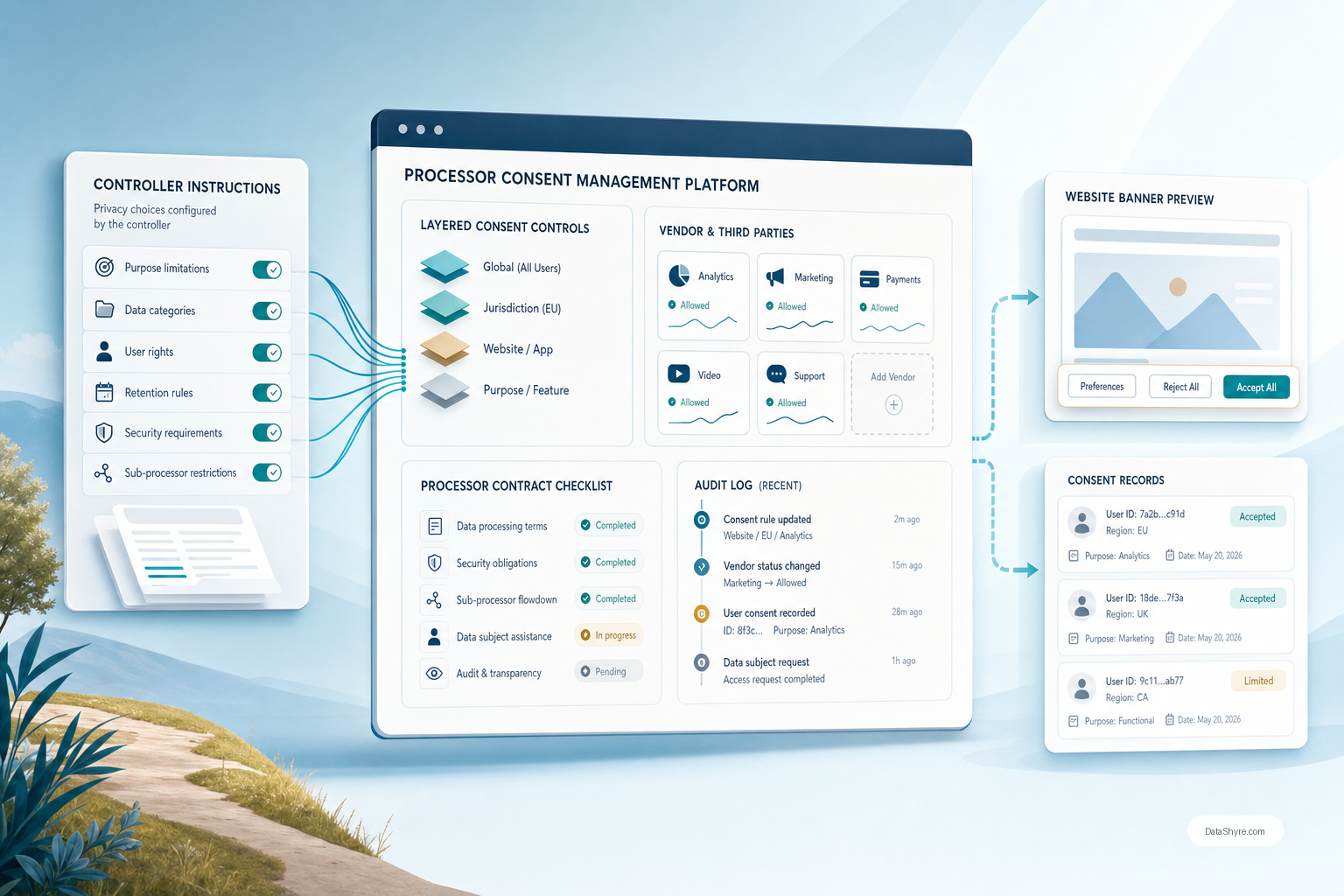
Why processor status changes the review
The moment a CMP vendor handles consent records, implementation data, or other personal data on behalf of the site operator, the review stops being a pure UX decision. It becomes a controller-processor governance decision too.
That has two immediate consequences:
- the controller still owns the legality of the consent setup;
- the processor relationship needs written controls that match Article 28-style expectations;
- sub-processors, international transfers, and security questions become part of product selection;
- records have to help the controller prove what the site did at a specific time.
There is also a fresh reminder that cookie-banner enforcement remains active. On July 14, 2026, the EDPB said the Belgian DPA must assess the merits of a complaint about a broadcaster’s cookie banner. That is a useful signal for procurement teams. Consent mechanics are still live enforcement territory, so the processor layer cannot be treated as back-office plumbing.
6 checks for a processor consent management platform
1. Confirm who is controller, processor, or joint controller in practice
Do not assume the sales deck has already answered this.
The European Commission says controllers decide the purposes and means of processing, while processors act on behalf of controllers. The ICO similarly says processors serve the controller’s interests rather than their own. In a CMP deal, that means you should ask:
- Which data does the vendor process strictly on customer instructions?
- Which product analytics, support data, or security logs does the vendor define for its own purposes?
- Are any functions shared with affiliates or other vendors in a way that changes the role analysis?
- Is any part of the service better described as a joint-controller arrangement?
If the answers stay fuzzy, the rest of the compliance story is usually fuzzy too.
2. Review the processor contract before you trust the feature set
A mature processor consent management platform should come with contract language that reflects the controller’s instructions, not just general SaaS terms.
The ICO’s controller-processor contract guidance says the contract must state that the processor may process personal data only on the controller’s documented instructions. The European Commission also explains that a processor must assist the controller in meeting GDPR obligations and provide sufficient guarantees.
For CMP review, that means looking for terms on:
- documented instructions and scope of processing;
- confidentiality and security measures;
- support for data subject rights and compliance assistance;
- return or deletion of data at end of service;
- audit rights or meaningful substitutes;
- sub-processor approval and notification.
If procurement is comparing vendors only on banner controls, this is usually the missing page.
3. Test whether consent signals match what the contract promises
Processor paperwork is not enough if the implementation fails on the page.
The ICO’s final storage-and-access technologies guidance, published on April 29, 2026, makes clear that the review is broader than browser cookies alone. It reaches technologies such as tracking pixels, link-decoration tracking, web storage, fingerprinting techniques, and scripts or tags. So when a CMP vendor says it supports compliant consent handling, you should test more than one tag category.
I would verify whether the platform can actually:
- block or condition optional technologies before consent where prior consent is required;
- pass choices into tag managers and downstream tools at the right time;
- preserve rejection and later withdrawal states;
- distinguish regional rules instead of applying one generic workflow everywhere.
The contract tells you who is responsible. The test tells you whether the platform behaves that way.
4. Check sub-processors, hosting, and transfer mechanics early
Processor risk often expands through the vendor’s own vendor chain.
The ICO notes that processors and sub-processors need the right contractual structure, and the EDPB’s controller-processor guidance continues to matter here because obligations are triggered when another processing link is added. In practical terms, a processor consent management platform review should ask for the current sub-processor list, hosting locations, transfer mechanism, and change-notification process before you sign.
This matters even more for consent data because the record set can include identifiers, timestamps, browser or device context, language or region signals, and proof of later preference changes. Even if that data set feels narrow, it still deserves a clean map.
5. Make sure the platform helps the controller prove valid consent
A CMP vendor does not reduce much risk if it cannot produce evidence the controller can understand later.
The European Commission’s consent guidance still says valid consent must be freely given, specific, informed, and unambiguous. The CNIL also said in December 2024 that rejecting cookies should be just as easy as accepting them. Those standards turn into operational questions for the processor:
- Can you reconstruct the first-layer banner shown on a given date?
- Can you show which categories or purposes were offered?
- Can you show what happened after rejection or later withdrawal?
- Can you demonstrate that optional tracking stayed off when it should have?
- Can you export records without needing the vendor’s services team to interpret them?
If the answer is no, the platform may be collecting consent data without giving you usable proof.
6. Check the implementation ecosystem, not only the CMP admin panel
Consent fails in the surrounding stack all the time.
WordPress guidance is useful here even outside WordPress specifically because it states the principle clearly: privacy should be the default setting, and consent for data sharing should not be assumed. For implementation teams, that translates into a simple warning. Your CMP processor relationship can still break if site code, analytics tools, ad tags, embedded media, performance optimizers, or regional overrides outrun the consent state.
So the final check is ecosystem realism:
- test homepage and landing-page templates;
- test embedded media and chat tools;
- test tag managers and custom scripts;
- test later preference changes;
- test after cache or optimization changes;
- test again when new vendors are added.
That is where a strong processor consent management platform separates itself from a banner layer that only looks organized.
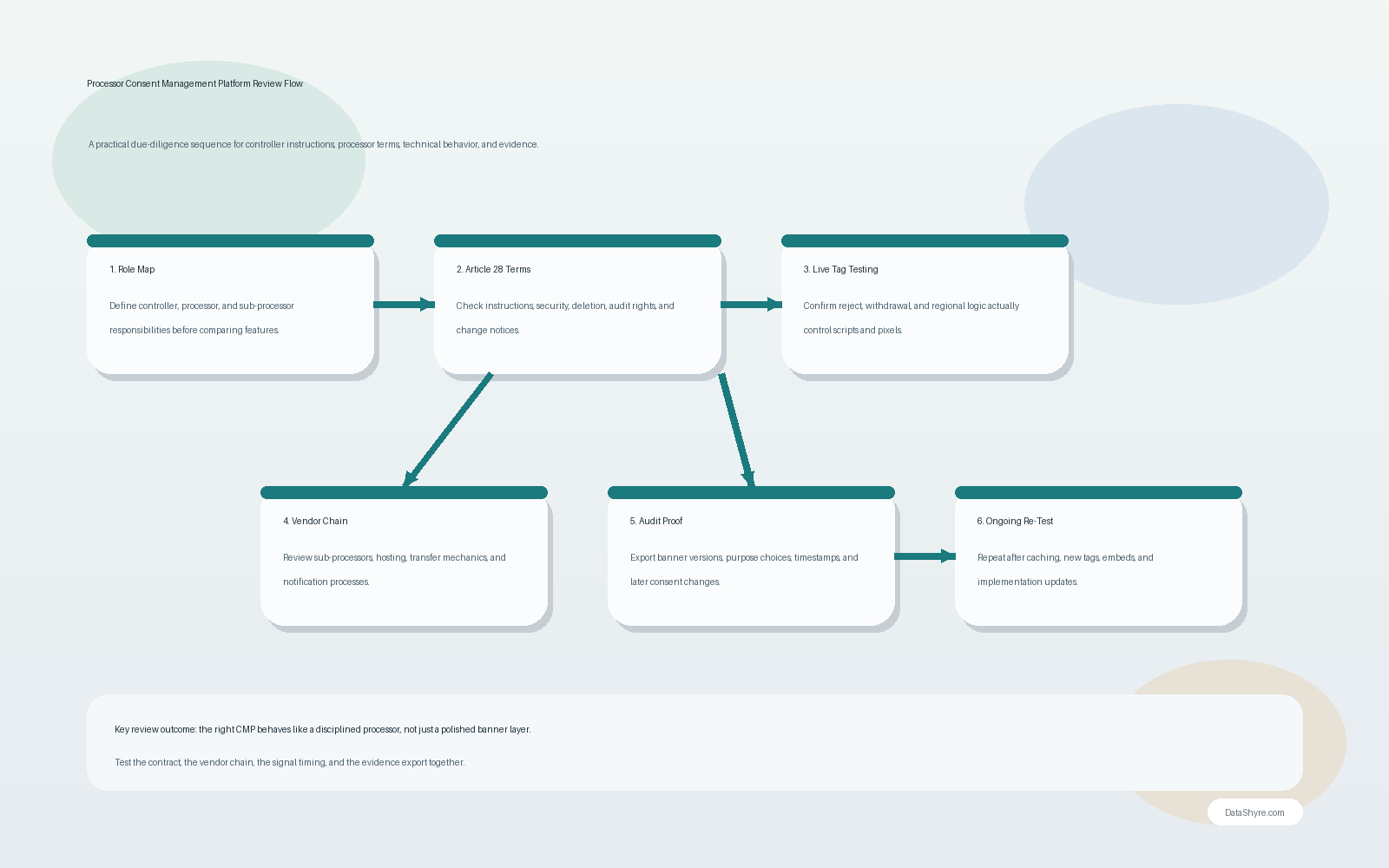
A short due-diligence sequence
If I were reviewing a processor consent management platform this week, I would use this order:
- Define the role map for the customer, CMP vendor, and any sub-processors.
- Review the processor terms and security commitments before implementation.
- Test consent behavior on live templates, not only in a demo.
- Inspect how the platform handles tag signals, rejection, and withdrawal.
- Review the sub-processor list, hosting locations, and transfer story.
- Export the records and decide whether they would answer a regulator, customer, or internal audit question cleanly.
That sequence usually reveals more than a long features table.
Bottom line
The best processor consent management platform in 2026 is not simply the one with the cleanest banner controls. It is the one that behaves like a disciplined processor: clear role boundaries, contract-ready terms, controlled sub-processors, reliable consent signals, and records the controller can actually use later.
If a vendor cannot explain those layers clearly, it is probably not reducing much operational risk. It is just relocating it.
Sources
- European Commission: What is a data controller or a data processor?
- European Commission: Can someone else process the data on my organisation’s behalf?
- European Commission: When is consent valid?
- UK ICO: What are ‘controllers’ and ‘processors’?
- UK ICO: What needs to be included in the contract?
- UK ICO: Guidance on the use of storage and access technologies
- UK ICO: What are storage and access technologies?
- EDPB: EDPB requires Belgian DPA to handle the merits of NOYB cookie banner complaint
- CNIL: Dark Patterns in Cookie Banners: CNIL issues formal notice to website publishers
- WordPress Developer Resources: Privacy – Plugin Handbook