

GDPR Compliance & Cookie Consent: 5 Checks That Still Matter in 2026
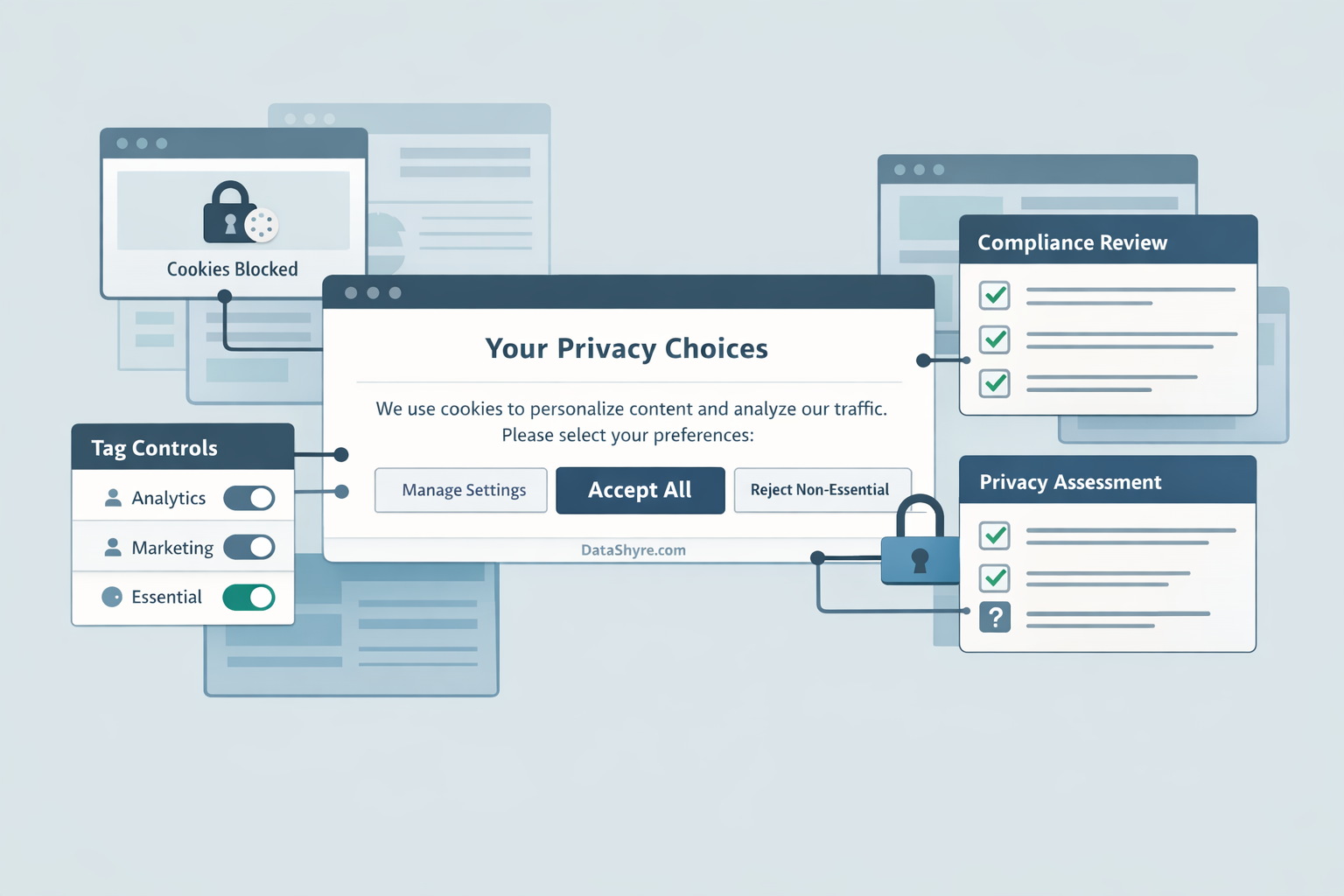
If your website still treats the banner as the whole job, it is time for a harder audit. GDPR compliance & cookie consent is not mainly a copywriting problem. It is a control problem. The language, the tag behavior, the withdrawal flow, and the proof trail all have to line up.
That baseline has not softened in 2026. The European Data Protection Board’s consent guidance still anchors the standard: consent must be freely given, specific, informed, and unambiguous. On July 14, 2026, the EDPB said it had published a binding decision requiring the Belgian DPA to handle the merits of a NOYB cookie banner complaint, which is a useful reminder that banner disputes are still active enforcement territory. In the UK, the ICO’s April 29, 2026 update on its final storage and access technologies guidance said cookies, tracking pixels, device fingerprinting, and similar tools remain in scope. France’s CNIL has kept the pressure on as well; its 2025 sanctions summary said cookies were one of the main subjects of enforcement that year, and the authority separately fined SHEIN in September 2025 over cookie failures.
If you want supporting detail after this read, our guides to GDPR cookie consent requirements, GDPR cookie consent examples, and GDPR cookie consent are useful companions.
What the standard looks like in practice
The fastest way to assess a setup is to ignore the design mockup for a minute and ask what actually happens before, during, and after a user makes a choice.
That question is where a lot of nice-looking implementations fail. William Malcolm of the ICO said the regulator’s 2026 guidance gives organizations “clear, practical guidance.” He is right. The rules are not mysterious anymore. The hard part is operational discipline.
Five checks worth running now
1. Nothing non-essential fires before the user chooses
This is still the first test because it invalidates almost everything else when it fails. Analytics, ad tech, personalization, and similar non-essential tools should stay blocked until a valid signal exists for the relevant jurisdiction.
Open the site in a fresh browser session. Reject optional categories. Watch the network requests and the browser storage. If non-essential tags still run, the implementation is broken no matter how polished the banner looks.
2. Reject is as easy as accept
This is one of the simplest tests and one of the most commonly missed. The ICO’s cookie guidance says users should have a way to enable or disable non-essential cookies and that you should make this easy. In a February 2024 speech, UK Information Commissioner John Edwards put it even more plainly: it must be “just as easy to reject all non-essential cookies” as it is to accept them.
That is why gdpr compliance & cookie consent work needs product review, not just legal review. If “Accept all” is bright and immediate while “Reject” is buried or delayed, the problem is already visible.
3. The first layer explains the real purposes
Vague language such as “improving your experience” still creates avoidable risk when the real use case is analytics, advertising, or cross-site tracking. People should be able to tell what kinds of technologies are involved and why they are there.
This matters even more for publisher stacks that depend on ad monetization. In a Google Ad Manager post, Peentoo Patel wrote that Google would “require all partners” using in-scope publisher products to adopt a certified CMP integrated with the IAB TCF for personalized ads in the EEA and UK. Google’s current help documentation still reflects that requirement in 2026, including the extension to Switzerland. That does not define GDPR by itself, but it does show how major platforms now expect structured consent signaling rather than fuzzy banner copy.
4. Withdrawal works after the banner disappears
Teams say this is implemented all the time. Fewer teams test it properly. A visible privacy link, floating icon, or footer control should let someone reopen preferences and change them later. Those changes then need to propagate to the tools that were relying on the original consent state.
The EDPB’s consent guidance is direct that withdrawing consent must be as easy as giving it. So test revocation like a real user would. Accept first. Reopen settings. Turn categories off. Refresh. Confirm the site stops reading or writing the same optional trackers.
5. Records hold up when someone asks for proof
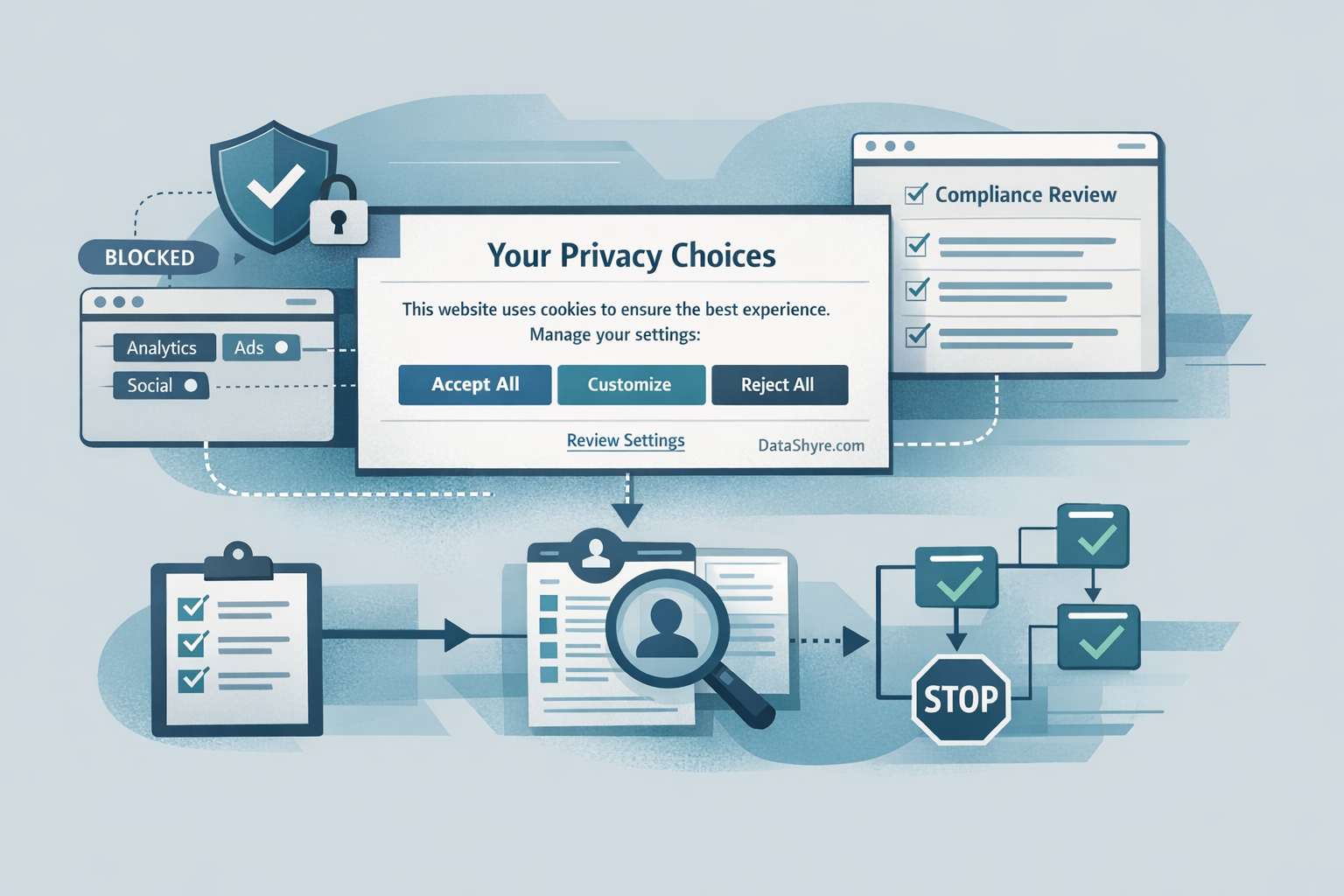
gdpr compliance & cookie consent falls apart quickly when the only evidence is a screenshot from a design file. A defensible setup should let your team show which banner version appeared, which categories were offered, what the user selected, when that choice was stored, and how the signal moved to downstream tags or vendors.
This is where a lot of businesses learn that a banner is not the same thing as a consent system. If privacy, engineering, and marketing cannot retrieve the same audit trail without manual reconstruction, the control is weaker than it looks.
A short audit workflow for business teams
Run one fresh EU visit on a staging or production environment. Capture the banner. Reject all. Confirm that non-essential requests stay blocked. Reopen preferences. Allow analytics only. Confirm the signal changes. Then export the record or view the audit log.
That single exercise usually tells you more than a week of policy review meetings.
If your stack touches Google advertising, add another check. Confirm that your CMP and consent string handling still match Google’s current requirements for personalized ads in the EEA, UK, and Switzerland. If you run multilingual sites or multiple domains, also test whether the same refusal and withdrawal behavior works across those variants.
Bottom line
The practical standard for gdpr compliance & cookie consent is still simple to describe even if it takes real work to enforce: block non-essential tracking before choice, make refusal easy, explain the purposes clearly, honor withdrawal, and keep proof that survives scrutiny.
This is operational guidance, not legal advice. If your current setup fails any of those checks, fix the controls before you spend more time polishing the banner text.
Sources
- European Data Protection Board
- UK Information Commissioner’s Office
- CNIL
- Google Ad Manager Help
- Google Ad Manager Blog