

Cookie Consent Managers: 8 Checks Before You Shortlist One in 2026
If you are comparing cookie consent managers, do not start with templates, logos, or price sheets. Start with behavior. Does the tool block non-essential tracking before consent, preserve a real reject path, and leave your team with records you can actually use later?
That matters more now because regulators keep moving from banner aesthetics to operational proof. The ICO published final storage-and-access technologies guidance on April 29, 2026 and said 99% of the UK’s top 1,000 websites now meet its cookie-banner compliance standards after direct intervention. CNIL also kept pressure on misleading designs in late 2024, and California teams still need practical opt-out handling where sale or sharing rules apply.
If you want the narrower background first, our guides to cookie consent manager, consent management providers, and cookie consent requirements cover adjacent buying and implementation questions. This article is about evaluation: how to compare several tools without buying a banner that creates a bigger cleanup project.

How to compare cookie consent managers without getting distracted
The fastest way to get misled is to treat a CMP as a design layer. It is really a control layer that touches front-end behavior, tag governance, regional rules, consent logs, and withdrawal flows.
That is why the UK’s Information Commissioner John Edwards said it must be “just as easy to reject all non-essential cookies” as accept them. It is also why EDPB Chair Anu Talus keeps stressing “real choice.” Different context, same lesson: if the interface nudges the answer, the product is weaker than the demo suggests.
Here are the checks I would use before any shortlist turns into procurement.
1. It blocks non-essential technologies before consent
This is table stakes. If analytics, ad tags, pixels, or fingerprinting tools fire before the user makes a choice, the rest of the feature list barely matters. The ICO’s 2026 guidance is explicit that non-exempt storage and access technologies need consent first.
2. Rejecting is visible on the first layer
CNIL’s December 12, 2024 formal notices are useful because they describe the exact failure patterns teams still ship: tiny reject links, buried placement, and banners that repeat the accept path while softening the reject path. A manager that forces users through extra clicks to say no is not a strong option, even if the dashboard looks polished.
3. It records what happened, not just that something happened
You want a log that shows categories offered, the user’s selection, timestamp, banner version, and region or ruleset in effect. The ICO’s consent guidance still expects proof of who consented, when, how, and what they were told. If a vendor only shows aggregate acceptance rates, that is marketing, not evidence.
4. It separates geography, language, and legal logic
Many tools still tangle these together. That causes weird outcomes fast: an English-speaking EU visitor gets one flow, a French-speaking California visitor gets another, and nobody can explain why. Strong CMPs let you control locale, jurisdiction, and banner text independently so one setting does not quietly override another.
5. It can honor California opt-out signals where needed
Not every CMP comparison article says this clearly enough. If your business sells or shares personal information under California rules, browser-level signals matter. The California Department of Justice says Global Privacy Control is one acceptable online method for opt-out requests and must be honored by covered businesses. If a tool treats that as an afterthought, keep looking.
6. It connects cleanly to your tag stack
A CMP that cannot pass state reliably into Google Tag Manager, analytics, advertising tools, or app SDKs becomes an operations tax. The right question is not “does it integrate?” Almost every vendor says yes. The better question is whether consent changes system behavior with minimal custom glue.
7. It helps you manage drift after launch
Websites do not stay still. New embeds appear. Marketing adds scripts. Product teams ship experiments. Good managers make rescanning, change detection, or at least recurring audits practical. This is where a cheap-looking implementation becomes expensive six months later.
8. It makes withdrawal and preference changes boring
That sounds unglamorous because it is. Users should be able to reopen preferences, reverse a choice, and have the change stick without hunting through a footer maze. William Malcolm from the ICO described the goal as “meaningful control” over how data is used. That is a better buying lens than feature-count comparisons.
A simple shortlist rule
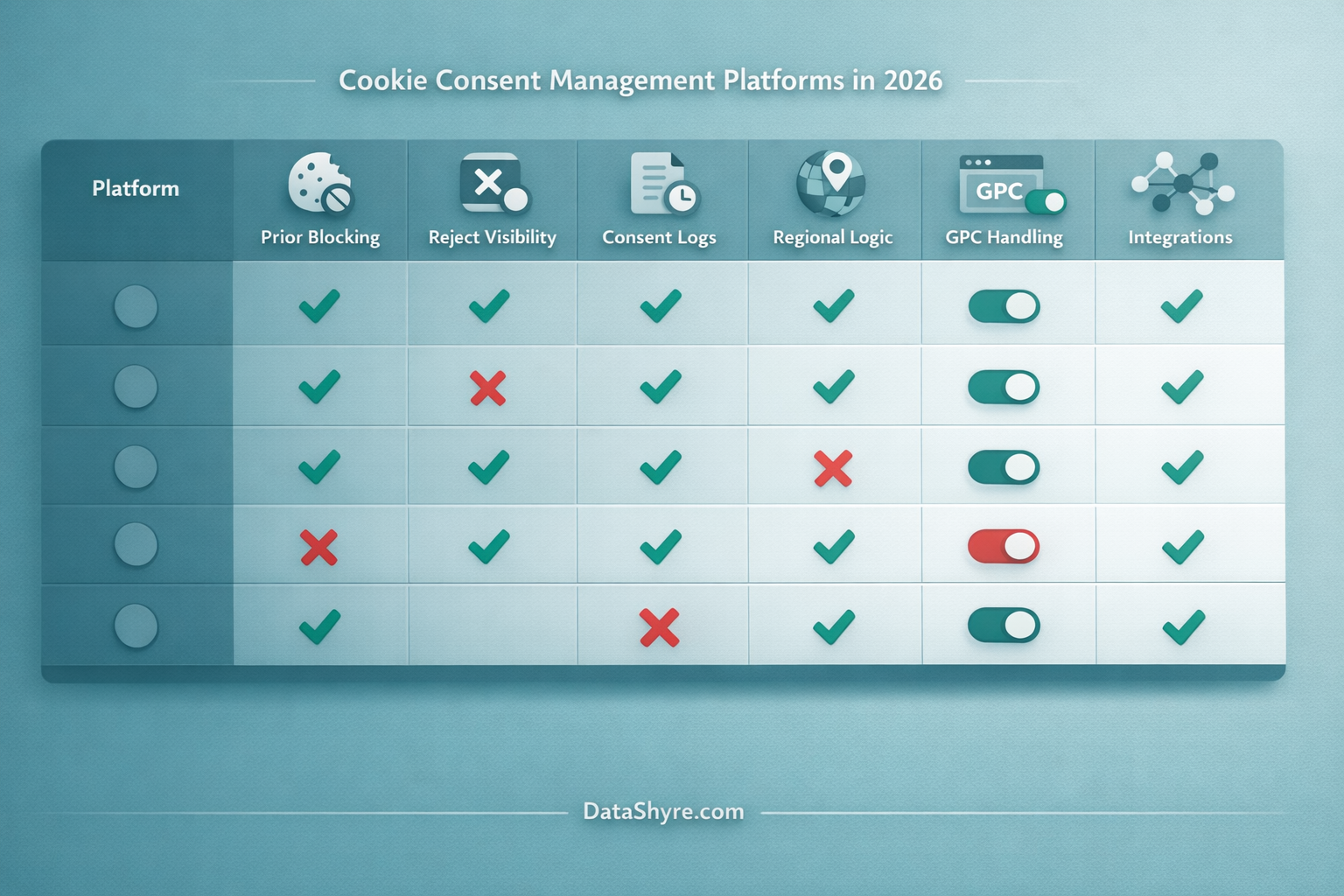
If a vendor can show prior blocking, equal reject and accept effort, usable proof, regional flexibility, and dependable integrations, it belongs on the list. If it cannot, it is probably selling a banner more than a consent control.
I would ask every shortlisted vendor for the same live demo:
- Show an EU flow where non-essential tags stay off until consent exists.
- Show the one-click reject or a clearly equivalent first-layer experience.
- Export a real consent log with versioning.
- Show how California opt-out signals, including GPC, are handled.
- Change the banner copy or tag setup and show how the system tracks that update.
cookie consent managers are worth comparing like infrastructure, not like decoration. The team that buys on proof will usually spend less time fixing production behavior later.
A light note: this is a practical buying guide, not legal advice. It is still a good way to pressure-test vendors before your implementation team inherits the fine print.
Sources
- UK Information Commissioner’s Office
- CNIL
- European Data Protection Board
- California Department of Justice
- California Privacy Protection Agency