

TrustArc Cookie Consent Manager Pricing in 2026: What Buyers Can Actually Confirm
If you are searching for trustarc cookie consent manager pricing, the short answer is frustrating but useful: TrustArc still sells this as a demo-led, quote-led product, not a self-serve banner you price out on a checkout page.
That does not mean buyers are flying blind. The live product pages, comparison pages, and review listings reveal enough to estimate where the money goes: implementation support, scanning depth, regional complexity, integrations, and whether you are buying only cookie consent or a broader privacy stack. If you need rollout context first, start with our TrustArc Cookie Consent Manager guide and broader cookie consent manager overview.
What is public right now
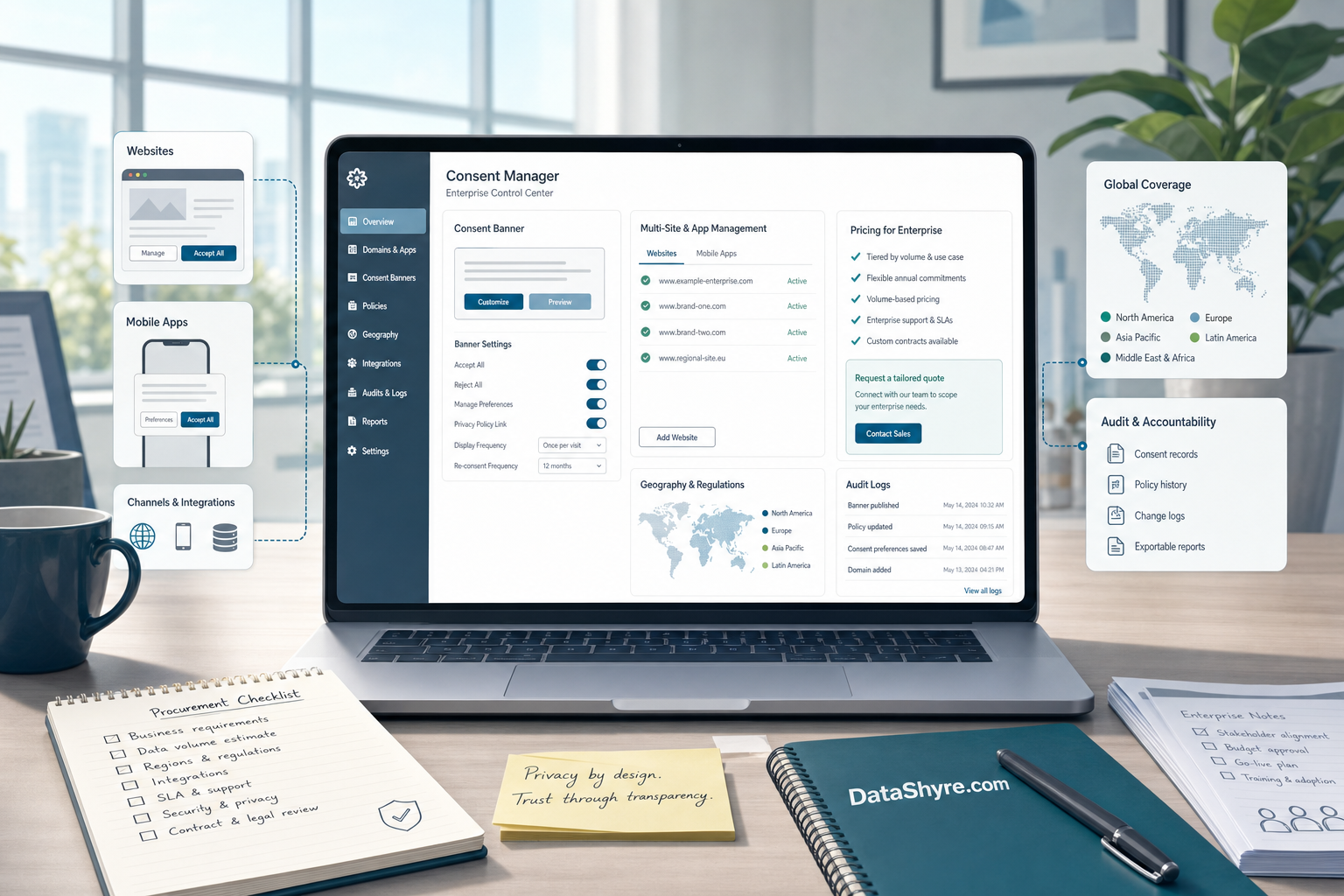
TrustArc’s live pages consistently point buyers to “Request a demo” or “send us a message” for pricing. On G2, TrustArc’s Privacy Studio is also listed as “Contact Us,” with pricing details available directly from the vendor. Put plainly, this looks like enterprise pricing with custom scoping, not a fixed public rate card.
TrustArc does offer a few clues. Its 2026 comparison pages describe pricing as predictable, flat-rate, and tied to program growth rather than a pure visitor-based model. The same materials say the Advanced Cookie Consent Manager tier includes a dedicated Technical Account Manager. That is not a minor detail. In enterprise CMP buying, support and implementation usually shape value as much as the banner itself.
That support angle comes through in customer language too. Daniel Ang of TELUS International said TrustArc “significantly expedited our cookie banner implementation.” Sean McInnis of the New England Journal of Medicine said the switch to TrustArc was “exactly as we hoped.” Those are not pricing disclosures, but they do hint at what TrustArc expects buyers to pay for: less do-it-yourself setup, more guided rollout.
What likely moves the quote
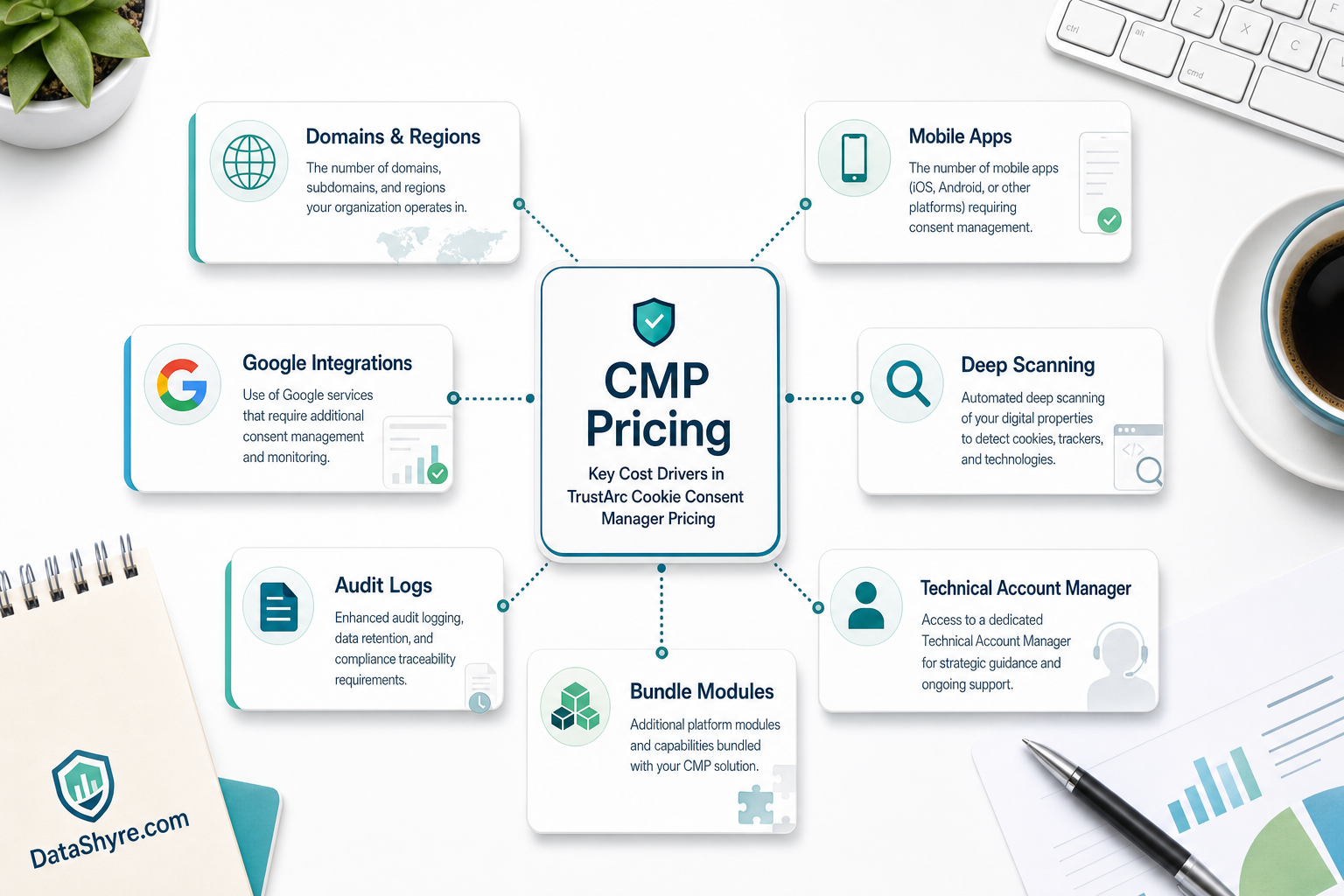
Even without a public menu of prices, the current product pages make the major cost drivers pretty visible.
- Scope of the estate.
The product is positioned for multiple sites, domains, languages, and regional rule sets. A single marketing site is one thing. A stack with several brands, mobile apps, and international traffic is another.
- Technical depth.
TrustArc highlights Google Consent Mode support, CMS and tag manager integrations, mobile SDK integrations, auto-blocking, and “zero-cookie load” use cases. The more of that you need, the less likely you are looking at a lightweight spend.
- Scanning and governance expectations.
TrustArc emphasizes frequent scans, tracker categorization, change alerts, and scanning behind login or HTML forms. Those are enterprise signals. They also tend to be budget signals.
- Audit and reporting requirements.
Real-time consent logs, dashboards, filtering, and proof of consent are part of the product story. Teams that need defensible records for legal, procurement, or partner review usually end up buying more than a simple front-end banner.
- Adjacent modules and services.
TrustArc repeatedly bundles the consent story with its Consent & Preference Manager, Individual Rights Manager, Trust Center, managed services, and broader Privacy Studio positioning. The moment you expand beyond website cookie consent, the quote can move quickly.
Why this category keeps getting more expensive
CMP pricing is not rising in a vacuum. Buyers are paying for cleaner controls because regulators keep pushing on cookie and tracking compliance.
The ICO said in December 2025 that 979 of the UK’s top 1,000 websites met its cookie compliance checks after focused intervention. Tim Capel said the goal was giving people “more meaningful control over how they were tracked online.” In France, the CNIL said cookies were one of the main subjects of its 2025 sanctions, and it fined Shein EUR150 million in September 2025 over cookie practices.
That matters for procurement. If your legal or privacy team is trying to avoid a brittle banner, they are not just shopping for UI polish. They are shopping for better blocking, cleaner regional logic, stronger logs, and fewer implementation mistakes.
Questions to ask before you book the demo
If you want a more useful pricing conversation, go in with a short list of direct questions:
- Is pricing based on domains, apps, traffic, or a flat program tier?
- What is included in the base package versus the Advanced tier?
- Does the quote include deep scanning, auto-blocking, and Google-certified CMP support?
- Are cross-domain consent, mobile SDK support, and multilingual banners included?
- Is a Technical Account Manager included, optional, or required for a successful rollout?
- Can we buy only cookie consent, or is the quote built around a larger Privacy Studio package?
- How are renewals handled, and what usually changes the renewal price?
Those questions do two jobs. They surface the real cost drivers, and they stop the buying conversation from collapsing into a vague “contact sales” loop.
When the price likely makes sense
If you run multiple brands, operate across the EU, UK, and U.S., need consent signals wired cleanly into Google and other downstream systems, or want better scanning than a basic plugin can offer, TrustArc’s quote-led model may be completely reasonable.
If you only need a banner on one low-complexity site, trustarc cookie consent manager pricing may feel heavy for the job. TrustArc is clearly marketing this as an enterprise-ready privacy product, not as the cheapest path to a cookie notice.
Bottom line
The honest read on trustarc cookie consent manager pricing is that TrustArc gives buyers enough public information to frame the purchase, but not enough to benchmark the cost without a demo.
That means your leverage comes from preparation. Walk in with a scoped inventory of sites, regions, apps, trackers, and support needs. Ask what is included, what is tiered, and what is bundled. If you do that, you will get a much clearer answer than “it depends,” which is where too many CMP pricing conversations begin and end.
Sources
- TrustArc
- G2
- Information Commissioner’s Office
- CNIL
- European Data Protection Board