

Cookie Consent Requirements in 2026: What Sites Still Need to Prove
If you are checking cookie consent requirements on August 6, 2026, the hard part is no longer finding a banner pattern. It is proving that your site asks at the right moment, gives a fair choice, honors different regional rules, and actually changes tracking behavior after the user decides.
That is the better way to frame the topic now because the official guidance is broader and sharper than a lot of older blog posts suggest. The European Commission still says valid consent must be freely given, informed, specific, and expressed through a clear affirmative act, with withdrawal as easy as giving consent. The UK’s ICO finalized its storage-and-access technologies guidance on April 29, 2026, and that guidance expressly covers cookies, tracking pixels, fingerprinting, scripts, and similar technologies. California still works from a different model, centered more on notice, opt-out rights, and honoring Global Privacy Control where sale or sharing is in scope.
If you want the neighboring implementation detail first, start with our guides to what is cookie consent, GDPR cookie consent requirements, and California consumer privacy. This article stays broader. It is about the live baseline behind cookie consent requirements in 2026.

What cookie consent requirements usually mean in practice
In real projects, cookie consent requirements usually combine four separate questions:
- which technologies are actually in use;
- which of them are exempt and which are not;
- which regional rule applies to the visitor;
- whether the live site behaves in line with the choice the interface records.
That last point is the one teams still underestimate. A screenshot of a banner is not evidence of compliance. The serious check is what loads before any click, what changes after Reject all, what changes after Accept all, and whether later withdrawal still works.
1. In the EU and UK, prior consent still does most of the work
For EU and UK traffic, the safest baseline is still that non-essential storage or access technologies should not be used until the user has given valid consent, unless a narrow exception applies.
The European Commission’s current consent guidance still says valid consent must be freely given, informed, specific, and given through a clear affirmative act. It also keeps the usability standard plain:
“It should be as easy to withdraw as to give consent.”
>
European Commission
The UK’s 2026 ICO guidance makes this even more operational. It now frames the area as storage and access technologies, not just cookies, and says consent mechanisms should make it as easy to refuse consent as to accept it. It also says non-exempt technologies should be set only when valid consent is gathered.
So for cookie consent requirements, the useful default question is not “do we have a banner?” It is “are optional analytics, advertising, personalization, and similar technologies still quiet until a valid choice is made?”
2. The UK ICO’s 2026 guidance changed the practical conversation
This is one of the most important 2026 updates.
On April 29, 2026, the ICO published its final guidance on the use of storage and access technologies. The guidance says it was finalized after two consultations and notes several changes, including a new chapter on exceptions and new sub-chapters such as what counts as “a simple means of objecting.”
That matters because many cookie-consent articles still act as if the only live question is traditional cookies. The ICO’s current guidance now speaks much more clearly to:
- pixels and scripts;
- device fingerprinting;
- broader storage and access techniques;
- consent design and refusal symmetry;
- limited circumstances where some technologies may be used without consent.
In other words, cookie consent requirements in the UK are less banner-shaped and more systems-shaped than many teams assume.
3. Not every technology needs consent, but the exceptions are narrower than people hope
This is where a lot of bad implementations start.
The ICO’s current exceptions guidance says not all storage and access technologies require consent. It now describes five circumstances where storage or access can happen without consent. But that does not create a broad free pass for convenience analytics, ad tech, or personalization.
The practical mistake is using “necessary” or “analytics” as a junk drawer label for anything the business wants to keep.
For cookie consent requirements, the safer approach is:
- identify each technology and purpose precisely;
- map it to the actual exception being relied on, if any;
- test whether that use really stays inside the exception’s scope;
- assume consent is needed when the justification is vague, stretched, or marketing-driven.
That is especially important in 2026 because the UK guidance is more detailed now, not less.
4. Rejecting optional tracking has to be genuinely easy
This remains one of the quickest filters for whether a banner is credible.
CNIL’s current cookie-banner notice still says:
“rejecting cookies should be just as easy as accepting them”
>
CNIL
The UK’s ICO now says similar things in its own way by showing that equal refusal is part of a good consent mechanism and by treating buried or asymmetrical controls as bad practice.
So when evaluating cookie consent requirements, check whether:
Reject allis available at the same layer asAccept all;- refusal works on mobile as cleanly as on desktop;
- category toggles for optional purposes are off by default where consent is required;
- a user can revisit preferences later without hunting through the site.
If the interface nudges acceptance through color, placement, extra clicks, or friction, it is not just a design decision. It is a consent-quality problem.
5. California often changes the workflow from opt-in to opt-out
This is where many global banners get sloppy.
California is not simply a lighter EU copy. The California Department of Justice still explains that consumers have the right to opt out of the sale or sharing of personal information and that a user-enabled Global Privacy Control can submit that request. Its GPC page still describes the signal as a:
“stop selling or sharing my data switch”
>
California DOJ
The CPPA’s current law-and-regulations page also shows both the California Consumer Privacy Act and the CCPA Regulations as effective on January 1, 2026.
That means cookie consent requirements for California-facing properties are often less about prior permission for every non-essential technology and more about whether the business:
- provides the right notices;
- offers a usable opt-out path;
- honors GPC when sale or sharing is in scope;
- changes downstream advertising or sharing behavior when that signal arrives.
The interface can still look similar to an EU banner, but the legal job being done is not identical.
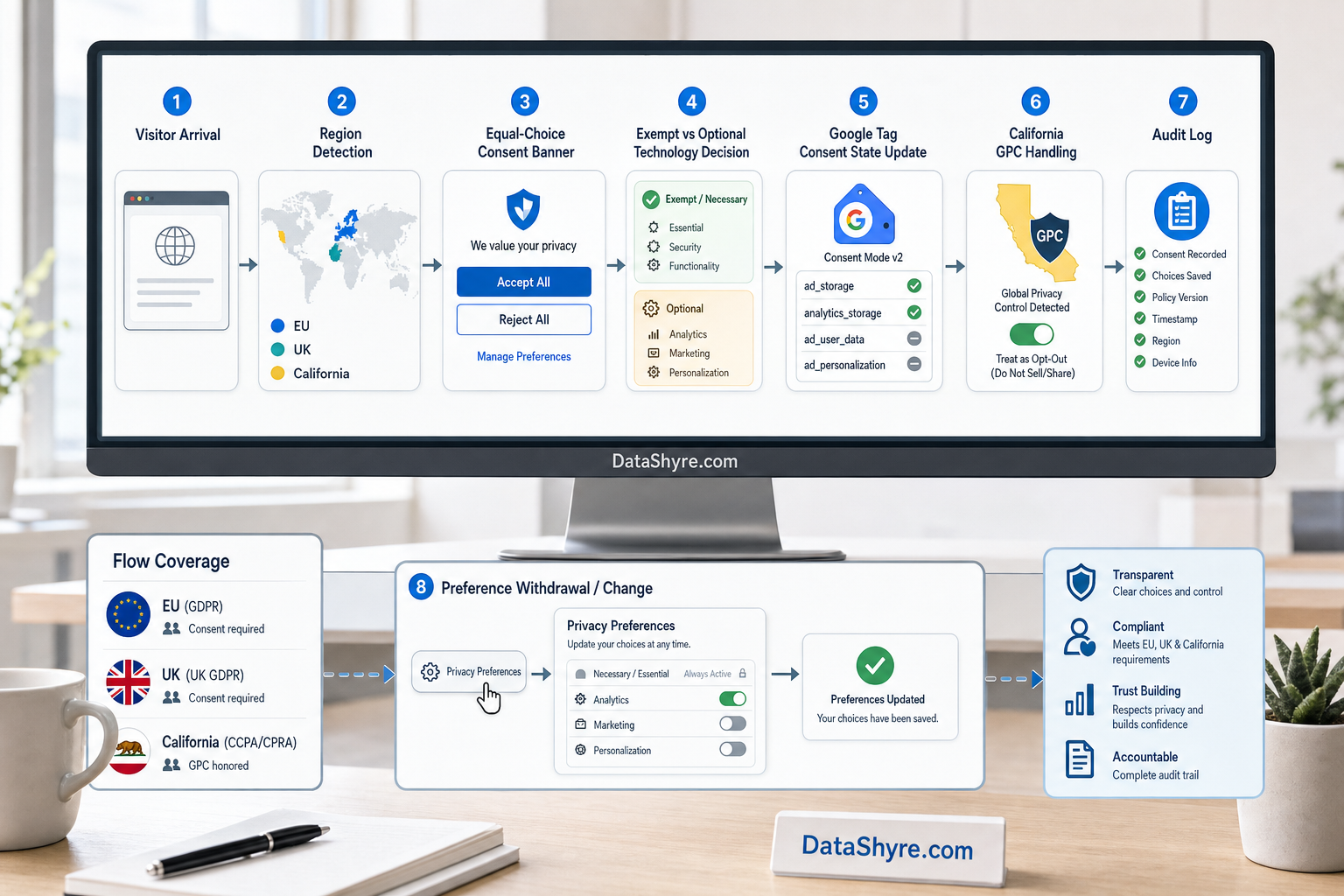
6. If you use Google tags, the runtime behavior still has to match the legal story
Many teams meet cookie consent requirements or fail them through their tag setup rather than their legal copy.
Google’s current consent-mode documentation still says you should set the default consent state before a user grants consent, then update it when the user interacts with consent controls. Google’s current consent-mode reference also says that when analytics_storage='denied', Google Analytics does not read or write first-party analytics cookies and instead sends cookieless pings for future measurement and modeling.
That does not answer the legal question by itself, but it does answer an engineering one: a consent layer has to reach the tag stack early enough to change what actually happens.
So if your site uses GA4, GTM, or Google Ads, one practical cookie consent requirements review is:
- what is denied by default in opt-in regions;
- whether those defaults land before measurement begins;
- whether updates happen on the same page where the user chooses;
- whether linked services behave differently after refusal, acceptance, and withdrawal.
That is why a site can have perfect banner copy and still fail the live test.
7. The proof matters as much as the policy
By this point, the core compliance pattern should feel familiar: interface, timing, and evidence all have to line up.
For a serious cookie consent requirements review, I would want to see:
- a current inventory of storage and access technologies;
- a clear list of which ones rely on an exception and why;
- region-aware banner or preference logic;
- network or tag evidence showing what fires before and after each choice;
- a simple way for users to reopen settings and reverse a choice;
- logs or release records tying the live behavior to the banner version that was deployed.
Without that, teams often end up defending screenshots while the runtime tells a different story.
A short live review sequence for this week
If I were checking cookie consent requirements on a live site today, I would use this order:
- Open the site in a clean browser session.
- Identify what loads before any user interaction.
- Separate truly exempt technologies from optional ones.
- Use
Reject alland verify which scripts, pixels, cookies, or storage events stay off. - Grant only one optional category, such as analytics, and verify the change is narrow rather than global.
- Reopen preferences and test withdrawal on the same page and the next page.
- If California traffic matters, test GPC handling and opt-out paths as a separate regional flow.
That sequence usually reveals whether the site actually meets the practical version of cookie consent requirements.
Bottom line
In 2026, cookie consent requirements are not just requirements for banner text. They are requirements for timing, scope, refusal symmetry, exceptions discipline, regional logic, and proof.
For EU and UK traffic, that often still means valid prior consent before non-essential technologies are used unless a real exception applies. In California, it often means reliable notice, usable opt-out rights, and honoring GPC when sale or sharing is involved. Across all of those models, the same truth holds: if the user’s choice does not change what the site actually does, the consent layer is not finished.
Sources
- UK ICO: Final storage and access technologies guidance published
- UK ICO: Guidance on the use of storage and access technologies
- UK ICO: What are the exceptions?
- UK ICO: How do we manage consent in practice?
- European Commission: When is consent valid?
- European Commission: What if somebody withdraws their consent?
- California Department of Justice: California Consumer Privacy Act (CCPA)
- California Department of Justice: Global Privacy Control (GPC)
- California Privacy Protection Agency: Law & Regulations
- Google for Developers: Set up consent mode on websites
- Google Tag Manager Help: Consent mode reference
- CNIL: Dark Patterns in Cookie Banners: CNIL issues formal notice to website publishers
This post was updated on August 6, 2026 using current official regulator, government, and Google platform materials available at publication time.