

GDPR vs. CCPA: The 2026 Differences That Change Your Privacy Program
If your team treats gdpr vs. ccpa as a terminology issue, it will build the wrong controls. These laws overlap on transparency and user rights, but they do not ask companies to run privacy the same way.
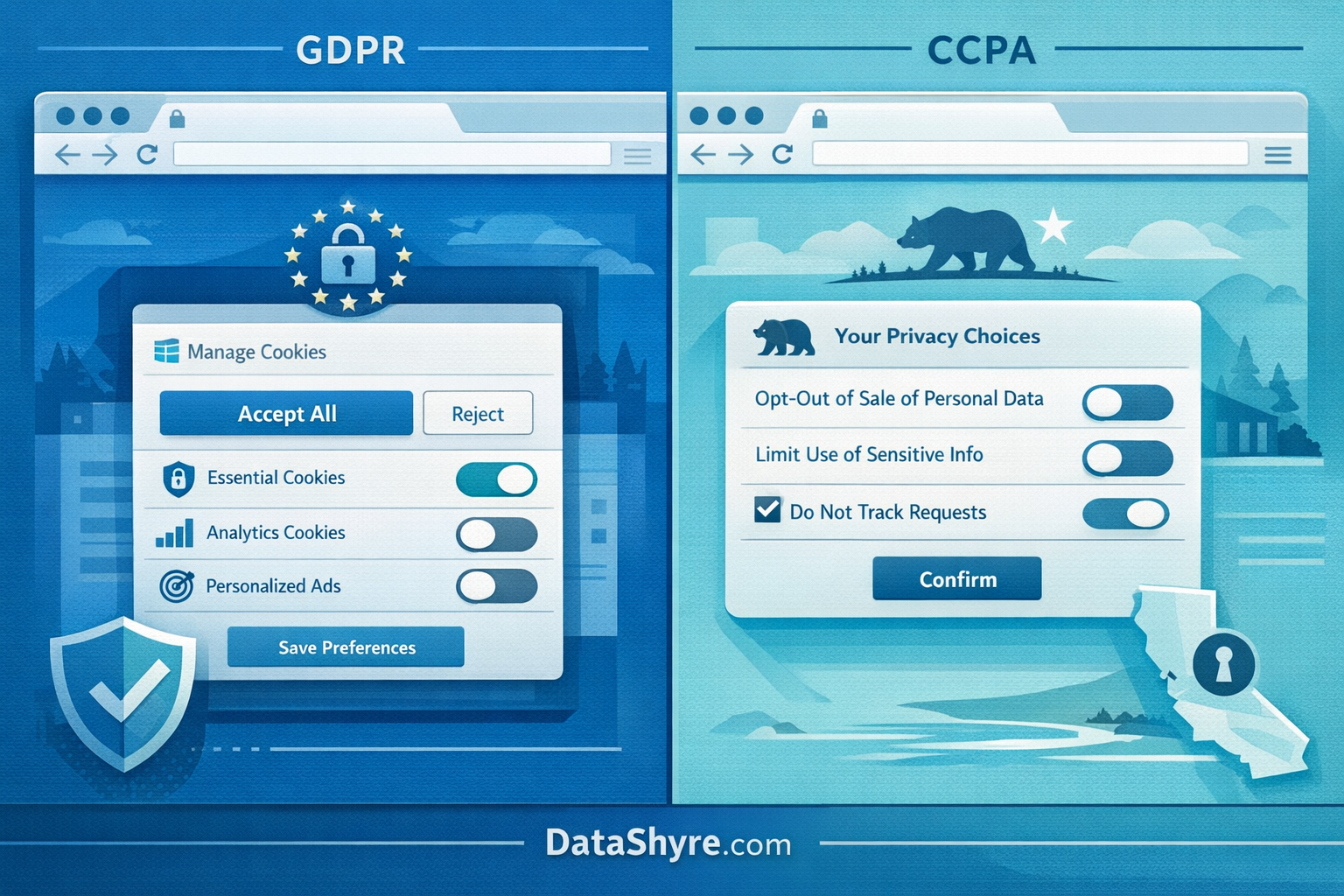
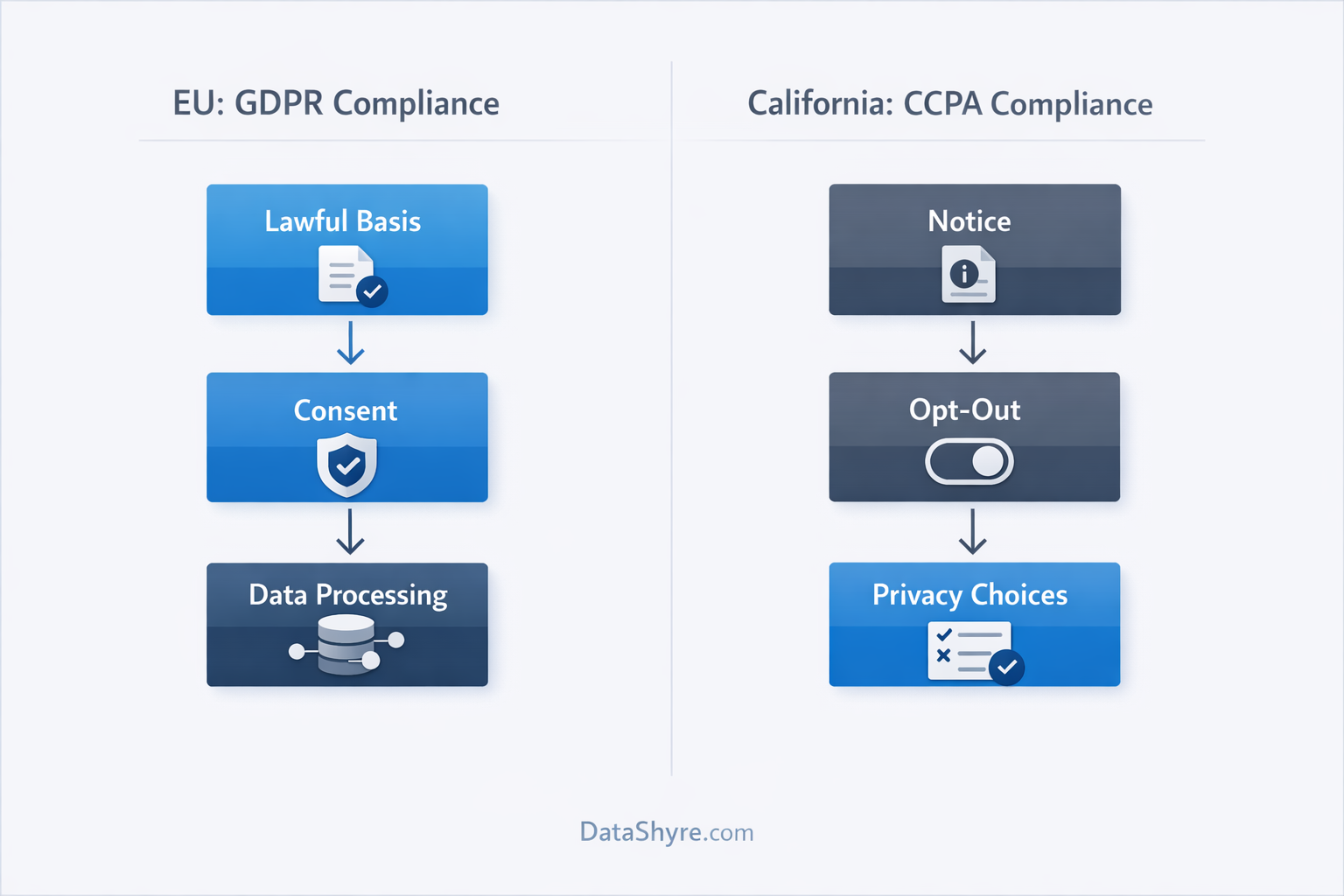
GDPR is a lawful-basis regime. Before you process personal data, you need a valid legal ground and a clear purpose. CCPA is closer to a consumer-rights regime. It focuses on notice, disclosure, opt-out rights for sale and sharing, and workflows that let Californians exercise those rights without friction.
If you are tightening your disclosures first, our guide to a GDPR compliant privacy notice is a good companion. If the work is really about trackers and banners, start with GDPR cookie consent. And if you are choosing tooling, this checklist for a GDPR consent management platform will help you avoid buying for the wrong requirement set.
gdpr vs. ccpa: the core operating difference
The cleanest way to explain gdpr vs. ccpa is this:
- GDPR asks, “Why are you allowed to process this data at all?”
- CCPA asks, “Have you told people what you do, and can they stop certain uses?”
Under GDPR, consent is only one lawful basis. Many teams forget that. You may also rely on contract, legal obligation, vital interests, public task, or legitimate interests depending on the use case. That is why GDPR projects usually start with a purpose map and a legal-basis decision, not with a banner design.
CCPA does not use the same lawful-basis structure. For most adult consumer data flows, the model is notice plus rights. Californians can ask to know, correct, or delete personal information, opt out of sale or sharing, and limit the use and disclosure of sensitive personal information in defined cases.
That difference changes the whole build. A GDPR-heavy program needs evidence for each processing purpose. A CCPA-heavy program needs strong notices, opt-out plumbing, rights intake, and reliable downstream enforcement across ad tech, analytics, and vendors.
Where each law applies
GDPR reaches any company established in the EU that processes personal data as part of its activities. It also reaches companies outside the EU if they offer goods or services to people in the EU or monitor their behavior there.
CCPA is narrower in one sense and broader in another. It applies to for-profit businesses doing business in California that determine why and how personal information is processed and meet statutory thresholds, such as revenue or data-volume thresholds. So the first gating question is not “Do we have California visitors?” It is “Do we meet the CCPA business test?”
This is where privacy programs drift. A company may be fully in scope for GDPR because it tracks EU visitors, while a smaller US company might not be in scope for CCPA at all. Another business can be the reverse.
Consent, cookies, and ad tech
This is where business teams usually feel the difference fastest.
GDPR often pushes you toward prior consent for non-essential tracking, especially when website tracking is paired with rules around cookies and similar technologies. That is why the EU and UK conversation keeps circling back to the same design question: did the user get a real choice before tracking started? William Malcolm of the ICO put the goal simply: users should have “meaningful control.”
CCPA usually does not require that same upfront opt-in model for ordinary adult data collection. Instead, it leans on disclosure and the right to opt out of sale or sharing. That is why California websites often need a visible “Your Privacy Choices” path even when the banner itself looks lighter than an EU one.
That lighter first impression should not fool anyone. California enforcement is getting more operational, not less. Current CCPA rules already require covered businesses to honor a valid opt-out preference signal. Separately, the California Opt Me Out Act’s browser requirement becomes operative on January 1, 2027. In 2025, CPPA Executive Director Tom Kemp described opt-out rights as a way for Californians to “assert control” over their personal information.
There is one important opt-in exception on the California side: if a business has actual knowledge a consumer is under 16, sale or sharing requires affirmative authorization.
The rights map is similar on paper, different in practice
Both laws give people meaningful rights, but the mechanics differ.
GDPR rights include access, rectification, erasure, restriction, portability, and objection. In practice, that means your backend has to support purpose-level reasoning. If you deny an erasure request because a legal obligation requires retention, you need to know that and explain it.
CCPA rights are easier to remember because California now explains them through “LOCKED”: limit, opt-out, correct, know, equal treatment, and delete. Attorney General Rob Bonta said in January 2026 that consumers “have the right to understand” how their personal information is being used. That line gets to the real issue. A privacy program that cannot explain data uses in plain English will struggle under either law.
What privacy teams should build in 2026
If you support both regimes, do not force one framework onto the other. Build a stack that can do both:
- map every material processing purpose and assign a lawful basis where GDPR applies;
- keep a California-specific notice and opt-out path for sale, sharing, and sensitive personal information use where relevant;
- connect consent and opt-out signals to the actual tools that fire tags, sync audiences, and pass data to vendors;
- honor browser-based preference signals and keep proof that the signal was received and enforced; and
- make sure your rights workflow can distinguish access, correction, deletion, objection, and opt-out requests instead of routing everything through one generic form.
That is the practical answer. The policies may sit in the same footer, but the controls behind them are not interchangeable.
The takeaway
When teams say GDPR and CCPA are “basically the same,” what they usually mean is that both are privacy laws. True, but not very helpful.
The sharper view is this: GDPR is built around justified processing. CCPA is built around notice and user control over specific downstream uses. If you understand that split early, your notices get clearer, your banner logic gets cleaner, and your engineering work stops fighting the legal model.
Sources
- EUR-Lex
- European Commission
- California Privacy Protection Agency
- California Legislative Information
- California Department of Justice
- UK Information Commissioner’s Office