

Cookie Consent Manager in 2026: 7 Live Checks Before You Buy or Renew
If you are searching for a cookie consent manager on September 12, 2026, the useful question is not whether the banner looks polished.
It is whether the tool can create a fair choice, hold optional tracking until the right signal exists, and prove later what actually happened.
That standard is sharper now because official guidance has become more operational. The UK’s ICO says its final 2026 storage-and-access-technologies guidance covers cookies, tracking pixels, device fingerprinting, and similar technologies. The same guidance says consent controls must be purpose-specific, disclose relevant third parties, support easy withdrawal, and “function as intended.” France’s CNIL is still using the clearest interface test available in one sentence: “rejecting cookies should be just as easy as accepting them.”
If you want the surrounding context first, start with our guides to cookie consent, consent management and GDPR, and Google Consent Mode V2. This article is narrower. It is the live review I would use before buying, renewing, or replacing a cookie consent manager this month.
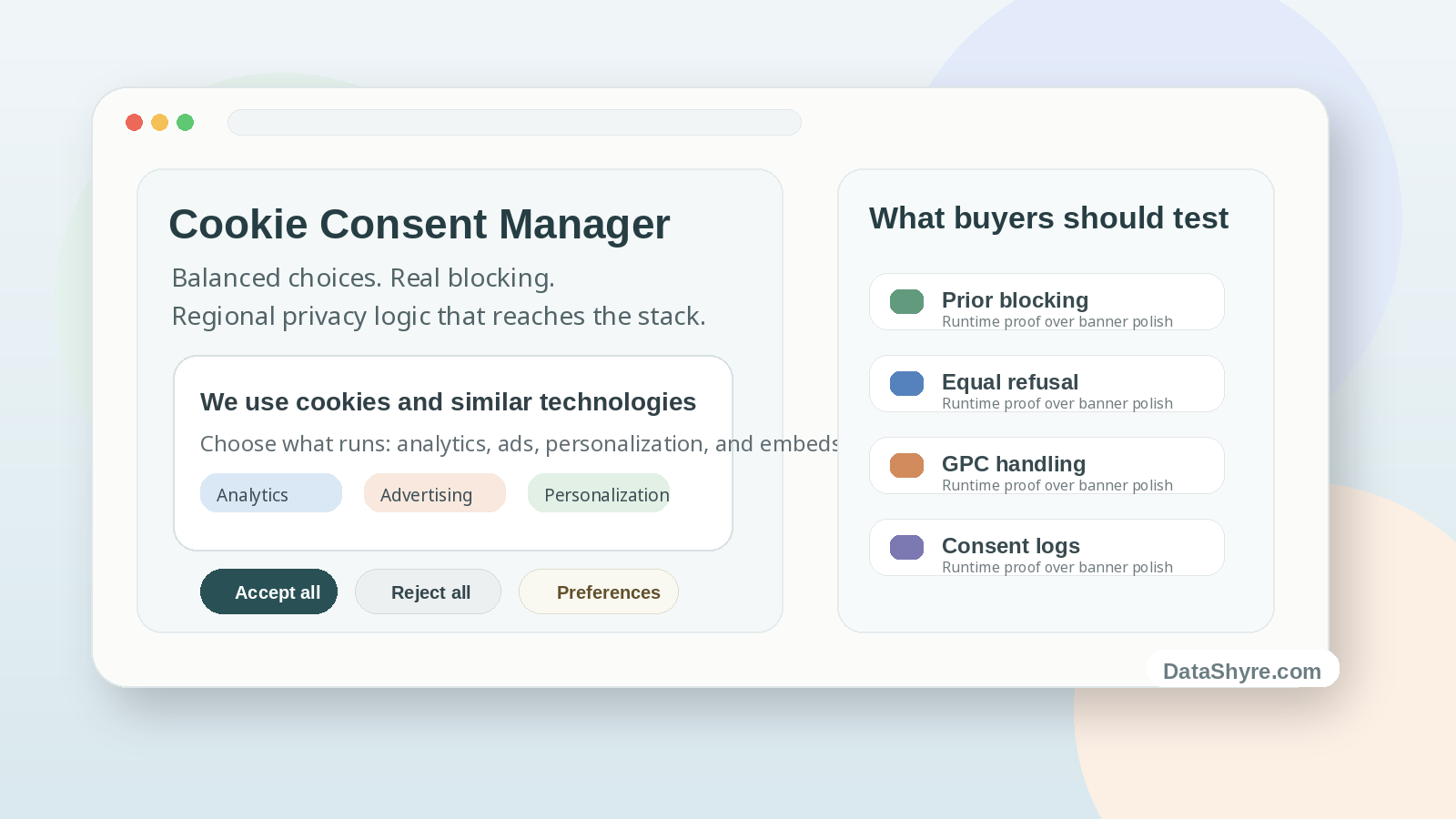
What a cookie consent manager has to do now
A real cookie consent manager is not just a banner template.
It is the control layer between user choice and the systems that want to collect data.
In practice, that means it has to coordinate at least five things:
- the first-layer choice;
- purpose-level controls;
- tag and script behavior before and after consent;
- regional branches such as EU prior consent and California opt-out handling;
- records that explain what users saw, chose, and changed later.
If a tool mainly changes colors, button labels, and the wording of the first layer, it is too small for the real job.
1. Check prior blocking on a clean visit
This is still the fastest way to expose a weak cookie consent manager.
The ICO says that if no exception applies, you must obtain prior consent. Google’s current consent setup documentation stays just as practical on the implementation side: set the default consent state before sending measurement data, then update consent on the page where the user interaction happens before any page transition.
That means you should test a clean session and ask:
- do analytics, ads, personalization, or heatmap tools fire before any choice;
- do embedded videos, chat widgets, or direct scripts set identifiers too early;
- does the tag manager receive a denied-by-default state where prior consent is required.
If optional technologies are already live, the banner is mostly cosmetic.
2. Check whether reject is as easy as accept
This remains one of the best buying filters.
On December 12, 2024, CNIL said it had issued formal notices to website publishers over dark patterns in cookie banners and repeated that “rejecting cookies should be just as easy as accepting them.” That is not just copy advice. It is a design and product requirement.
If Accept all is instant but Reject all is hidden, lower contrast, or pushed into a second layer, your cookie consent manager is steering the outcome instead of recording a fair choice.
3. Check purpose-level controls and third-party disclosure
The ICO says consent requests should generally provide granular options for each purpose. It also says users must be told about third parties and be able to access specific information about each one.
So a serious cookie consent manager should let you separate categories such as:
- analytics;
- advertising;
- personalization;
- social or embedded third-party content where relevant.
Just as important, those labels need to match the live stack. If your site still sends data to vendors that do not appear in the consent layer, or the disclosed vendors no longer match production, the tool is not giving users a real understanding of the choice.
4. Check the California branch separately
California is not just a relabeled EU banner problem.
The California Department of Justice says Global Privacy Control is a “stop selling or sharing my data switch” and that covered businesses must honor it as a valid request to stop the sale or sharing of personal information. The CPPA FAQ also says businesses must honor qualifying opt-out preference signals, such as Global Privacy Control, as valid requests to opt out of sale or sharing.
Enforcement is also getting concrete. On March 5, 2026, CalPrivacy announced a Ford settlement requiring the company to pay $375,703 and change practices because unnecessary friction in the opt-out process violated the CCPA.
That makes this a practical buying question: can the cookie consent manager handle California preference signals and low-friction opt-out logic itself, or cleanly pass that choice into the rest of your privacy stack?
5. Check whether consent signals reach the real stack fast enough
A cookie consent manager only works if the rest of the stack hears it in time.
Google’s current developer guidance says to set gtag('consent', 'default', ...) before commands that send measurement data and to track consent updates on the same page before a transition. In other words, timing is not an implementation detail. It is part of the control.
I would test whether the tool can actually coordinate:
- GTM or direct Google tag installs;
- analytics and advertising tags;
- embeds and chat widgets;
- later consent changes or withdrawal.
Many teams find the real weakness of a cookie consent manager here, not in the admin demo.
6. Check withdrawal and records, not just collection
The ICO says any consent mechanism must have the technical capability to let users withdraw consent with the same ease used to give it.
That means a trustworthy cookie consent manager should be able to answer:
- what the user saw;
- which purposes and third parties were disclosed;
- what the user selected, and when;
- whether the technical behavior changed after that choice;
- what happened if the user later changed or withdrew consent.
If support, legal, marketing, and engineering cannot reconstruct the decision later, the recordkeeping is too weak.
7. If you are a publisher, check platform fit separately
This does not apply to every buyer, but it matters a lot when it does.
Google’s current AdSense help says partners using AdSense, Ad Manager, or AdMob must use a Google-certified CMP integrated with the IAB Transparency and Consent Framework when serving personalized ads in the EEA and UK as of January 16, 2024, and in Switzerland as of July 31, 2024. Google also says only traffic from a certified CMP is eligible for personalized ads.
That creates two different questions:
- does the cookie consent manager fit your legal and operational privacy requirements;
- does it also satisfy the current publisher-platform requirement if monetization is in scope.
Those are related, but they are not the same test.
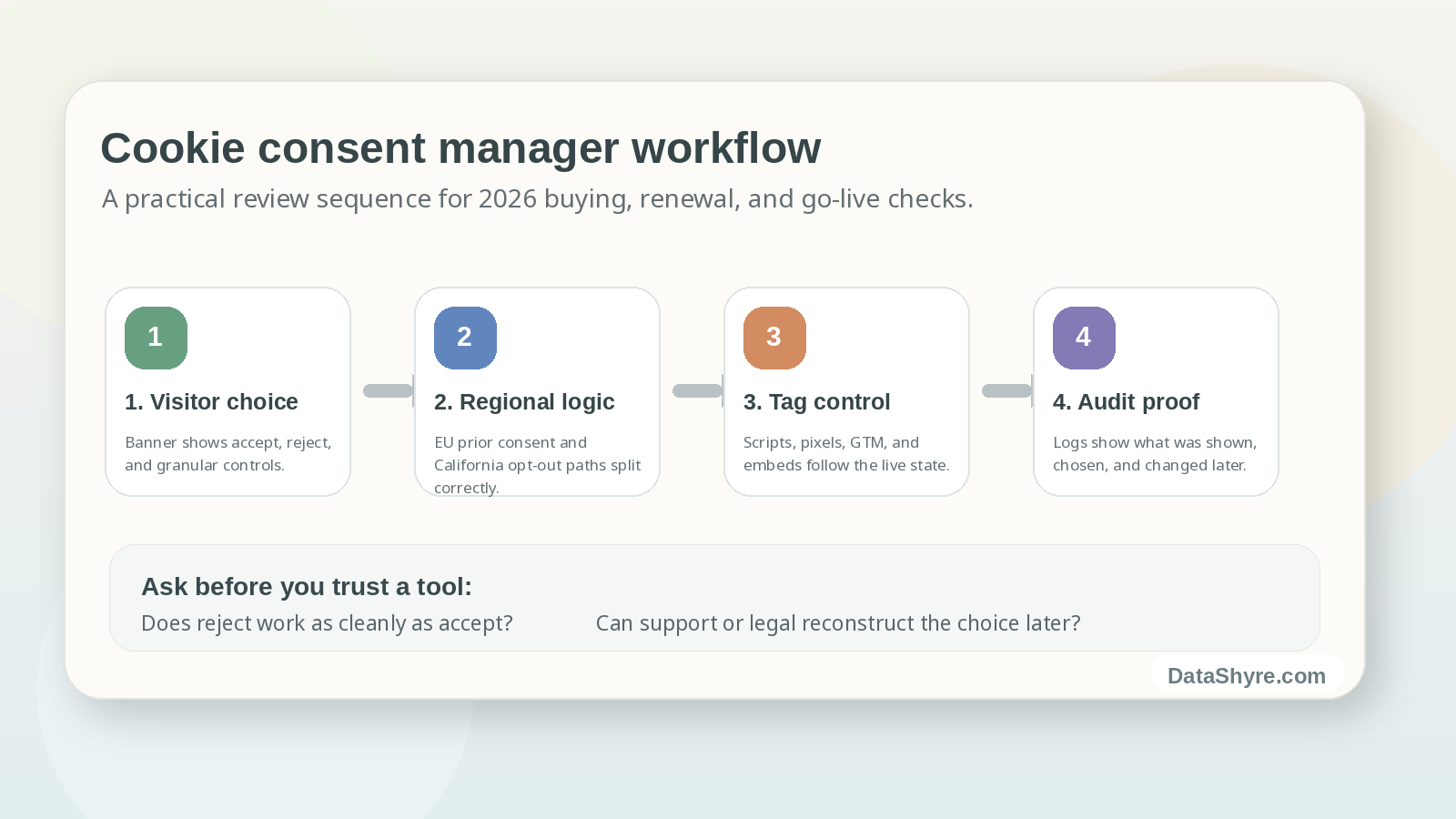
A short review sequence for this week
If I were reviewing a cookie consent manager today, I would use this order:
- start a clean browser session and inspect what fires before any click;
- test
Reject alland compare its friction withAccept all; - test granular choices and reopen the panel later to verify withdrawal;
- test the California branch, including GPC handling, if it applies;
- confirm consent signals reach GTM, tags, and embeds in time;
- export or inspect the records to confirm they are usable;
- if you are a publisher, run the Google-certified CMP branch separately.
That sequence usually tells you more than another feature matrix.
Bottom line
The right cookie consent manager in 2026 is not the one with the nicest banner preview.
It is the one that gives users a fair choice, holds optional tracking until the stack should run, respects California opt-out signals where relevant, and leaves behind records your team can actually use.
If those pieces are weak, the interface polish will not save the implementation.
Sources
- ICO: Final storage and access technologies guidance published
- ICO: How do we manage consent in practice?
- CNIL: Dark Patterns in Cookie Banners
- CNIL: vanityfair.fr fined 750,000 euros for cookies placed without consent
- California DOJ: Global Privacy Control
- CPPA: Frequently Asked Questions
- CalPrivacy: Ford to Change Practices, Pay Fine for Adding Unnecessary Friction to Opt-Out Process
- Google for Developers: Set up consent mode on websites
- Google AdSense Help: Google consent management requirements for serving ads in the EEA, the UK, and Switzerland (for publishers)
This post was updated on September 12, 2026 using current official regulator, government, and platform materials available at publication time.