

User Consent in 2026: 8 Live Checks for GDPR, GPC, and Audit-Ready Control
If you are reviewing user consent in 2026, the first mistake to avoid is treating it like one interface problem.
It is not only a checkbox problem, a cookie-banner problem, or a preference-center problem. It is a legal-basis decision, a runtime-control decision, and a proof problem all at once.
That is still the practical direction in current official materials. The European Commission says valid consent must be freely given, informed, specific, and based on an affirmative act, written in “clear and plain language,” and withdrawable in a way that is “as easy to use as giving consent.” The EDPB launched a coordinated enforcement action on transparency and information obligations on March 19, 2026. On April 29, 2026, the ICO finalized its storage-and-access-technologies guidance covering cookies, tracking pixels, device fingerprinting, and similar technologies. California regulators are also still pushing hard on operational controls, especially around opt-outs and Global Privacy Control.
If you want the closest companion reads first, start with our guides to user consent preference management, GDPR consent requirements, and cookie consent. This page stays broader. It is the eight-check review I would use this week before trusting a live user consent program.

1. Decide whether consent is actually the right legal basis
Strong user consent starts before the interface appears.
The European Commission still presents consent as one legal basis among several, not the default answer for every use of personal data. That matters because teams still ask for consent in workflows where the real question is contract performance, legal obligation, or another basis entirely.
So the first live check is simple:
- what data is being processed;
- for which exact purpose;
- whether consent is actually required for that purpose; and
- whether the person can realistically refuse without unnecessary disadvantage.
If the team cannot explain why consent belongs in the flow, the resulting user consent control is usually weaker than it looks.
2. Make sure the person has a real choice
This is the line between performative and defensible user consent.
The European Commission says consent is not freely given if there is a clear imbalance or if unnecessary personal data is made a condition of service. The EDPB’s 2026 practical examples make the same point in plain terms: a service cannot make unnecessary GPS or ad tracking a condition of using a core feature, and a cookie wall that blocks content unless a visitor clicks accept does not create valid consent.
In practice, test whether refusal still leaves the person able to:
- use the core service where consent is not actually necessary;
- continue without agreeing to unrelated purposes;
- understand what happens if they say no; and
- change their mind later without penalty.
If the answer is no, the user consent model is already on weak ground.
3. Split separate purposes instead of bundling everything into one yes
Bundling is still one of the fastest ways to ruin user consent quality.
The European Commission says the request must clearly state all the reasons for the processing. That means a single broad yes for analytics, email marketing, retargeting, partner sharing, personalization, and profiling is usually too blunt to be useful.
A better live review asks whether the person can separately understand and control:
- website analytics;
- advertising or retargeting;
- email or SMS marketing;
- personalization;
- partner or vendor sharing; and
- automated decision-making or profiling where relevant.
If one toggle silently covers multiple downstream uses, the system is collecting friction, not meaningful user consent.
4. Require a clear affirmative action and stop treating passive behavior as consent
The core standard has not softened.
The European Commission still says consent must be “clear and given via an affirmative act.” The EDPB’s 2026 practical examples say scrolling or swiping through a page is not a “clear affirmative action.”
That means a real user consent review should reject:
- pre-ticked boxes;
- default-enabled optional categories;
- browse-to-accept logic;
- scrolling or inactivity as consent; and
- vague buttons that do not make the effect of the action obvious.
This check sounds basic, but it still catches a surprising number of live failures once you leave the settings screen and watch what the product actually does.
5. Treat cookie and tracker consent as a runtime-control problem
This is where many user consent programs look polished and still fail.
The ICO’s final storage-and-access-technologies guidance, published on April 29, 2026, expressly covers cookies, tracking pixels, device fingerprinting, and similar technologies. In the same announcement, the ICO said its interventions had pushed 99% of the UK’s top 1,000 websites to cookie-banner compliance standards and that the goal is “meaningful control” for people online.
So if your user consent program touches the web, do not stop at wording. Test whether:
- non-essential technologies stay off until the required signal exists;
Reject allis as visible asAccept allwhere that comparison matters;- purposes are explained clearly enough to understand;
- withdrawal changes actual runtime behavior; and
- the same page behaves correctly on desktop and mobile.
If tags load first and explanations arrive later, the site is narrating consent after the fact rather than enforcing it.
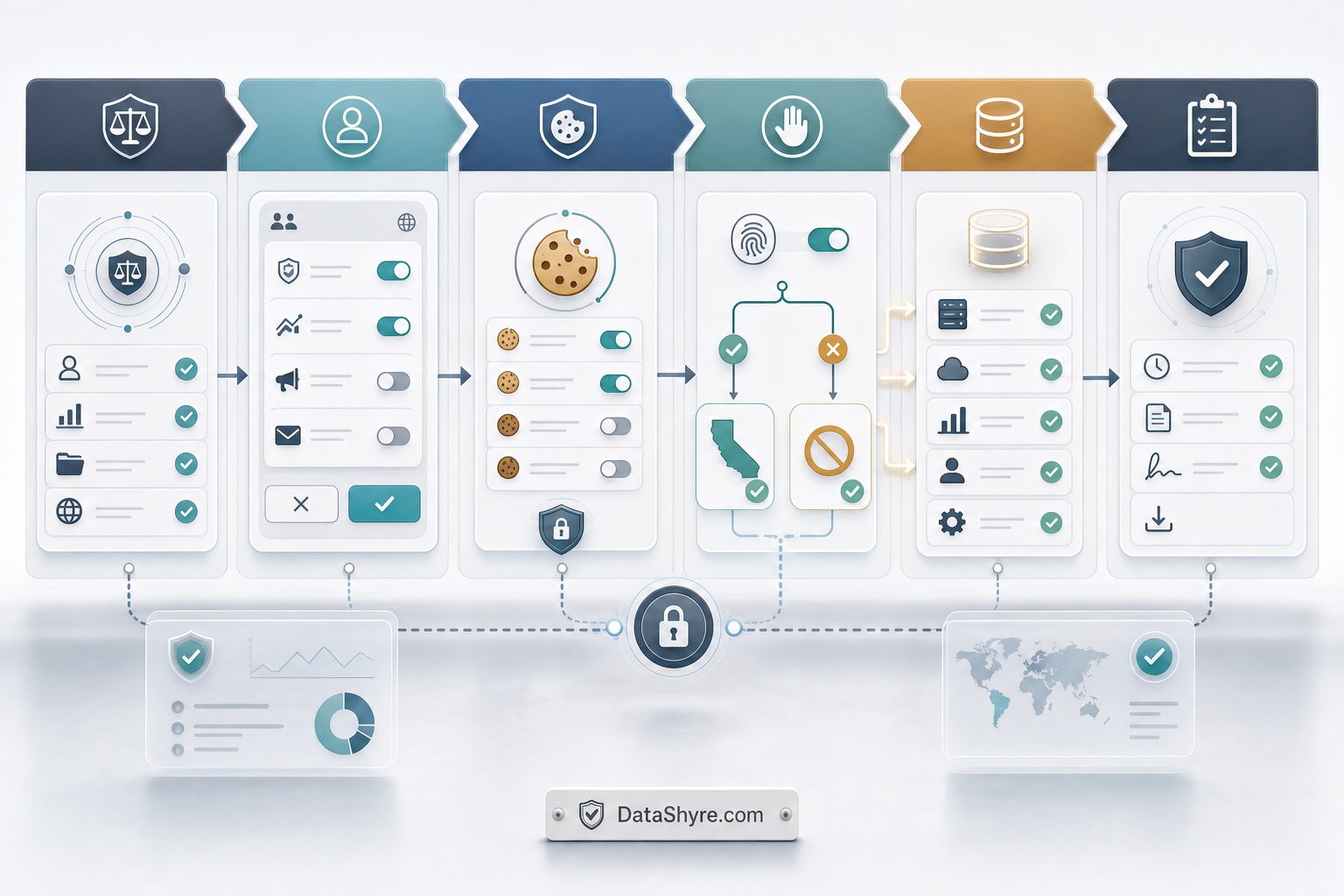
6. Keep California opt-outs and GPC on their own branch
One user consent model does not cover every regional rule set.
California’s Department of Justice still describes Global Privacy Control as a “stop selling or sharing my data switch.” The CPPA’s FAQ also says businesses must honor qualifying opt-out preference signals such as GPC as valid requests to opt out of sale or sharing, and in most cases they must still provide a clear link such as Your Privacy Choices. The CPPA’s 2025 rulemaking package took effect on January 1, 2026, which means the current California operating baseline is not last year’s draft assumptions.
So a serious user consent test should separate:
- an EU or UK opt-in for consent-based uses;
- a California opt-out request;
- a browser-level GPC signal;
- a later withdrawal or settings change; and
- the downstream systems affected by each branch.
When those events are flattened into one generic preference, the record becomes much harder to explain later.
7. Verify that choices propagate across devices, products, and vendors
This is the operational test that weak user consent stacks still miss.
On February 11, 2026, California Attorney General Rob Bonta announced a $2.75 million settlement with Disney over allegations that Disney failed to fully effectuate opt-out requests across devices and streaming services associated with consumers’ Disney accounts.
That lesson travels well beyond streaming media. For user consent, you should test whether the user’s choice actually reaches:
- account-linked websites and apps;
- tag managers and analytics tools;
- CRM and marketing automation systems;
- suppression or exclusion lists;
- embedded vendors; and
- connected advertising or sharing workflows.
If the control works on the first screen but not in the systems behind it, the privacy experience is incomplete.
8. Keep proof another team can still understand later
The final user consent check is evidence.
The European Commission says the organization must be able to demonstrate that the individual consented to the processing. The ICO’s consent guidance also says organizations should keep records of who consented, when, how, and what they were told.
For a durable user consent program, I would usually want the record to preserve:
- the notice or interface version shown;
- the purpose or category tied to the choice;
- the timestamp and source of the action;
- whether the event was consent, refusal, withdrawal, opt-out, or GPC;
- the regional branch applied; and
- the downstream systems expected to react.
This is what makes a privacy control explainable after a redesign, vendor swap, or enforcement inquiry instead of only on launch day.
A short review order for this week
If I were auditing user consent today, I would use this order:
- decide whether consent is the right legal basis at all;
- confirm refusal is genuinely possible without unnecessary detriment;
- split purposes into specific and understandable choices;
- remove any passive-consent shortcuts;
- test real browser and app behavior, not just admin settings;
- run a separate California opt-out and GPC branch where applicable;
- verify propagation across linked systems and devices; and
- save proof another team can still verify next month.
That sequence usually reveals much more than another round of banner-copy edits.
FAQ
Is user consent the same thing as a cookie banner?
No. A cookie banner can be one interface inside a broader user consent program, but it does not cover the whole legal-basis decision, the downstream system behavior, or the evidence you need later.
Does scrolling or continued browsing count as valid consent?
No. The EDPB’s practical examples still say scrolling or swiping through a page is not a clear affirmative action.
Is GPC the same thing as GDPR consent?
No. GPC is generally used as a browser-level opt-out signal for sale or sharing in California-style privacy programs. It should not be collapsed into the same bucket as a GDPR-style affirmative opt-in.
Bottom line
In 2026, strong user consent is not the one with the prettiest interface.
It is the one that uses consent only where it actually fits, gives people a real choice, separates purposes clearly, enforces runtime behavior on the live system, handles California opt-outs and GPC deliberately, and leaves behind proof another team can still trust later.
If those pieces line up, the consent layer becomes much easier to defend. If they do not, the business is usually left with attractive screens, weak records, and a privacy story that breaks as soon as someone tests it.
Sources
- European Commission, legal grounds for processing data: https://commission.europa.eu/law/law-topic/data-protection/information-business-and-organisations/legal-grounds-processing-data_en
- European Commission, information for individuals: https://commission.europa.eu/law/law-topic/data-protection/information-individuals_en
- EDPB, practical examples on consent: https://www.edpb.europa.eu/system/files/2026-04/edpb-summary-consent_en.pdf
- EDPB, CEF 2026 on transparency and information obligations: https://www.edpb.europa.eu/news/cef-2026-edpb-launches-coordinated-enforcement-action-on-transparency-and-information_en
- ICO, final storage and access technologies guidance published: https://ico.org.uk/about-the-ico/media-centre/news-and-blogs/2026/04/final-storage-and-access-technologies-guidance-published/
- ICO, guidance on the use of storage and access technologies: https://ico.org.uk/for-organisations/direct-marketing-and-privacy-and-electronic-communications/guidance-on-the-use-of-storage-and-access-technologies/
- California DOJ, CCPA and Global Privacy Control FAQ: https://oag.ca.gov/privacy/ccpa
- CPPA, FAQs: https://cppa.ca.gov/faq
- CPPA, CCPA updates effective January 1, 2026: https://cppa.ca.gov/regulations/ccpa_updates
- California DOJ, Disney settlement announcement: https://oag.ca.gov/news/press-releases/california-wont-let-it-go-attorney-general-bonta-announces-275-million
—
Published: October 25, 2026. Updated using current official regulator, government, and platform materials available at publication time.