

One Trust Cookie Consent in 2026: 7 Live Checks Before You Trust the Setup
If you are searching for one trust cookie consent on October 17, 2026, you are almost always trying to evaluate OneTrust rather than a separate product literally named One Trust.
That wording gap matters because the search is usually broader than a banner question. In practice, teams using this phrase are often asking some combination of:
- are we buying or configuring only website cookie controls, or a wider consent-management layer;
- does the live site actually block and signal choice correctly before optional tracking starts;
- can the setup survive GTM, SPA routes, embeds, publisher ads, and later withdrawal.
The official material still supports that broader frame. OneTrust’s current product and developer documentation covers cookies, tags, trackers, pixels, geolocation rules, GTM integrations, SPA handling, and cross-domain consent behavior. Regulators also keep pushing the runtime standard higher. The European Commission still says it should be “as easy to withdraw as to give consent.” The CNIL still says rejecting cookies should be “just as easy as accepting them.” The ICO’s finalized storage-and-access-technologies guidance, published on April 29, 2026, says the rules apply across cookies, tracking pixels, device fingerprinting, and similar technologies, and William Malcolm says people should have “meaningful control” over how their data is used.
If you want nearby context first, start with our guides to OneTrust cookie consent, OneTrust cookie consent Google Tag Manager, and OneTrust global privacy control. This page is narrower. It is the seven-check review I would use when a stakeholder types one trust cookie consent but the real implementation question is still fuzzy.

1. Decide whether the request is about Cookie Consent, CMP scope, or broader preferences
This is the first reset I would make in any one trust cookie consent conversation.
OneTrust’s public product pages still split the story into related layers:
- Cookie Consent for website tracking discovery and banner or preference-center control;
- the broader Consent Management Platform for consent orchestration across more digital properties; and
- wider consent or preference programs when teams also care about known-user and lifecycle use cases.
That means one trust cookie consent is not always a single-product question. Sometimes the team really means website cookie controls. Sometimes it means multi-property consent operations. Sometimes it means a mix of both plus downstream preference handling.
If you skip this clarification, you can easily over-buy, under-scope, or misconfigure the job before you ever test the banner.
2. Treat regional routing as the real first technical decision
Most weak implementations fail before the visitor clicks anything.
OneTrust’s current geolocation documentation says the platform uses configurable geolocation rules to decide which banner or preference center should appear, and says the default service uses a reverse IP lookup via Cloudflare to determine a general location at approximately city level for rule selection.
That matters because one trust cookie consent can point to very different legal and technical paths:
- an EU or UK path where optional technologies should stay off before valid consent;
- a California path where opt-out rights and Global Privacy Control may matter;
- a publisher-ad path where Google’s separate certified-CMP rules can apply;
- another regional path where your notice and choice design differ for legitimate reasons.
If those routes are blurry, the rest of the review becomes theater. A polished universal banner can still push the wrong visitors into the wrong compliance model.
3. Make first-layer refusal real, visible, and plain-language
This is still the fastest credibility test.
The European Commission’s business guidance still says consent needs a clear affirmative act and that withdrawal must be as easy as giving consent. The CNIL still says rejection should be “just as easy as accepting them.” OneTrust’s own current Google Tag Gateway guidance also says opt-in banners should present an “equally prominent way to decline data collection.”
For one trust cookie consent, that means I would check:
- whether
Reject allis visible on the first layer where prior consent applies; - whether category labels describe real purposes instead of vague marketing language;
- whether the mobile layout keeps rejection as usable as acceptance; and
- whether the banner text explains choices in plain language instead of legal fog.
If the decline path is hidden, weaker on mobile, or translated into a softer non-choice such as Manage preferences, the implementation deserves more skepticism no matter how complete the settings screen looks.
4. Verify GTM timing and consent updates as a sequencing problem
This is where a lot of banner reviews stop too early.
Google’s current Tag Manager consent documentation still says the Consent Initialization trigger fires “before all other tags.” The same help material warns that custom callbacks and gtag() commands are not guaranteed to beat the next trigger, which is why Google’s consent APIs matter. OneTrust’s GTM materials still rely on OnetrustActiveGroups and the OneTrustGroupsUpdated event for trigger logic and category-aware firing.
So for one trust cookie consent, do not just ask whether a banner appears. Ask whether the runtime sequence is right:
- default state exists before optional tags depend on it;
- OneTrust updates land on the same page where the user acts;
- GTM triggers wait for the right signal instead of racing past it;
- custom HTML and third-party tags are tested separately from Google tags.
That is the difference between a visible consent layer and a working one.
5. Pull SPAs, route changes, and cross-domain flows out of the default test
Homepage screenshots are not enough for one trust cookie consent in 2026.
OneTrust’s SPA documentation still says SPA support must be enabled in the publish flow and explains that OneTrustGroupsUpdated fires when the script loads and whenever consent changes. Its cross-domain and cross-device documentation also still says previously gathered consent can be returned when the relevant identity and property setup is in place.
That means a serious review should test more than the first anonymous page load:
- route changes inside an SPA;
- a later preference change without a full hard refresh;
- logged-in or identified-user states if you use them;
- another managed domain or subdomain if consent is meant to travel.
If the homepage works but the app shell, checkout flow, or second property drifts, the consent system is only partially real.
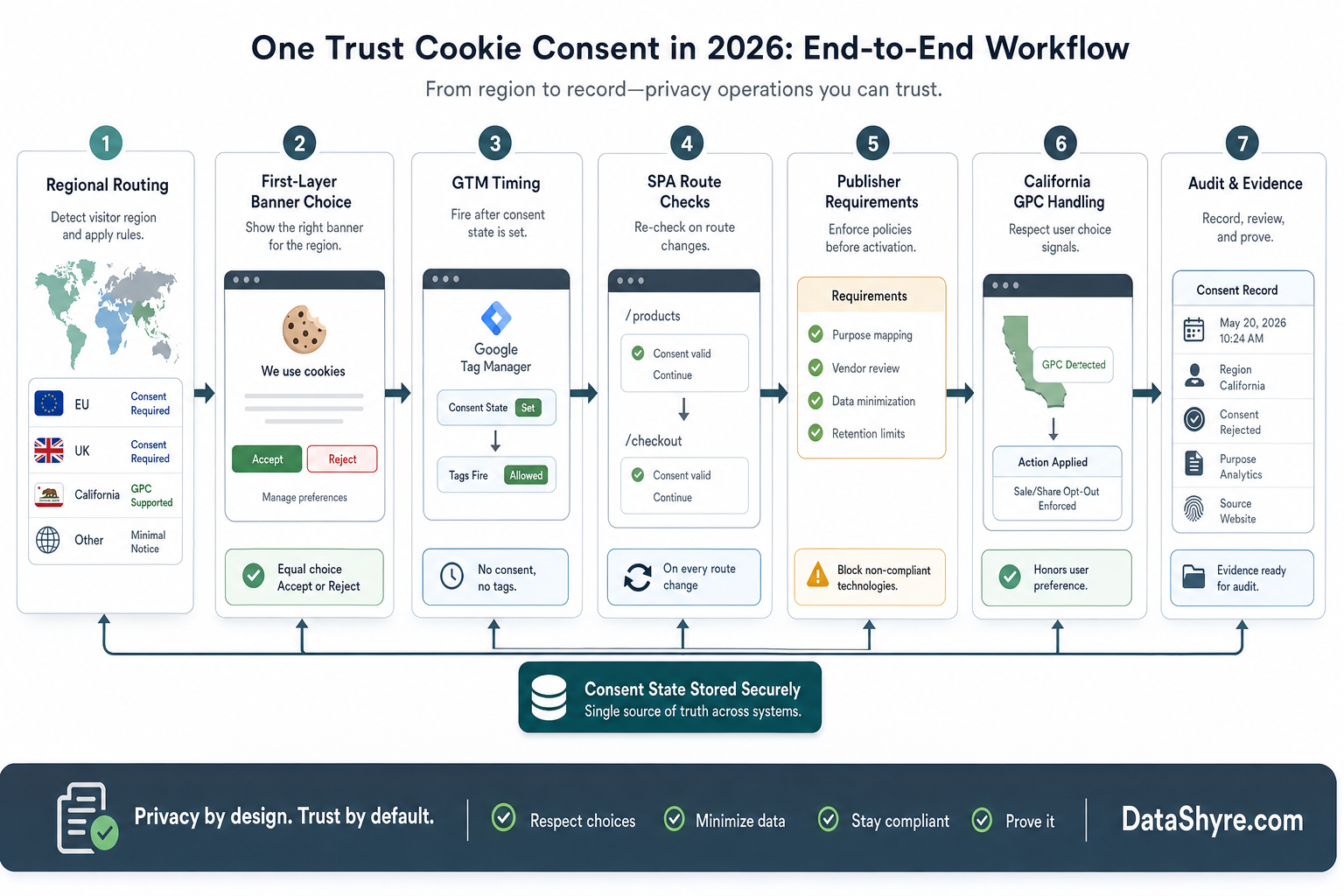
6. Split the publisher-ad branch out on purpose when Google requirements apply
This is one of the easiest places for teams to mix up product requirements and legal requirements.
Google’s current publisher help still says AdSense, Ad Manager, and AdMob partners serving personalized ads in the EEA and UK must use a Google-certified CMP integrated with the IAB Transparency and Consent Framework as of January 16, 2024, and says the same requirement applies in Switzerland as of July 31, 2024. Google also still says its CMP review does not check CMPs for full compliance with applicable privacy laws.
So when one trust cookie consent is tied to publisher advertising, keep two separate questions alive:
- does the implementation satisfy Google’s publisher-program requirement for the affected traffic; and
- does the live site still satisfy your broader consent and privacy duties outside that narrower Google requirement.
Those questions overlap, but they are not identical. Treating them as the same check creates blind spots.
7. Run a California branch if sale or sharing is in scope
Not every one trust cookie consent review ends with EU-style opt-in logic.
California’s Department of Justice still says covered businesses must honor a valid Global Privacy Control signal as a request to stop the sale or sharing of personal information, and still describes GPC as a “stop selling or sharing my data switch.” The DOJ’s current CCPA page, updated on August 28, 2026, also still lists the right to opt out of sale or sharing, including via GPC. And on February 11, 2026, Attorney General Rob Bonta said asking a business to stop selling data “should not be complicated or cumbersome.”
So if your stack touches remarketing, audience sharing, or ad-tech flows that raise California issues, test that branch deliberately:
- enable GPC in the browser;
- load the site fresh;
- verify that relevant sale-or-sharing behavior changes where it should;
- confirm the privacy notice and preference language match the runtime;
- reopen preferences later and confirm the control still works.
One clean CMP banner does not automatically solve California opt-out handling.
A short review sequence for this week
If I were translating a vague one trust cookie consent request into a real QA pass today, I would use this order:
- define whether the scope is web cookie control, CMP-wide operations, or broader preference management;
- verify the regional routing model before reviewing design;
- test the first-layer reject path on desktop and mobile;
- confirm defaults and updates land before GTM or tags depend on them;
- test SPA, logged-in, and cross-domain flows separately;
- branch into Google’s publisher rules when ads make them relevant;
- branch into California GPC and opt-out logic when sale or sharing is relevant; and
- save evidence that another team could understand later.
That sequence usually reveals the real weakness faster than another banner-copy revision.
Bottom line
The phrase one trust cookie consent usually means OneTrust cookie consent, but the useful response is not a spelling correction. It is a scope and runtime review.
The right 2026 question is whether your setup routes the right users into the right model, makes refusal and withdrawal genuinely usable, updates tag logic at the right moment, survives SPA and multi-property complexity, separates Google’s publisher rules from broader compliance, and honors California opt-out signals where they apply.
If your deployment can show that on a live site, the consent layer is doing real work. If it cannot, the banner may be live while the control system is still unfinished.
Sources
- OneTrust Cookie Consent
- OneTrust Custom Geolocation Integration
- OneTrust Web CMP Events Guide
- OneTrust Google Tag Manager
- OneTrust Single Page Applications
- OneTrust Cross Domain and Cross Device Consent
- Google Tag Manager Help: Tag Manager consent mode support
- Google for Developers: Set up consent mode on websites
- Google AdSense Help: Google consent management requirements for serving ads in the EEA, the UK, and Switzerland (for publishers)
- European Commission: Legal grounds for processing data
- ICO: Final storage and access technologies guidance published
- ICO: How do we manage consent in practice?
- CNIL: Dark Patterns in Cookie Banners: CNIL issues formal notice to website publishers
- California Department of Justice: Global Privacy Control
- California Department of Justice: California Consumer Privacy Act
- California Department of Justice: California Won’t Let It Go: Attorney General Bonta Announces $2.75 Million Settlement with Disney
—
Published: October 17, 2026. Updated using current official regulator, government, Google, and OneTrust materials available at publication time.