

Manage Consent Preferences in 2026: 7 Live Checks Before Your Preference Center Fails
If you are searching manage consent preferences on October 17, 2026, you are usually not asking for prettier buttons.
You are asking whether the choices on your site or app are real: whether people can say yes, no, or not now in a way that matches current regulator expectations and actually changes what your stack does next.
That is why the live official baseline matters. The European Commission still says consent must be specific, clear, and “as easy to withdraw as to give consent.” The UK’s ICO finalized its storage-and-access-technologies guidance on April 29, 2026 and says consent mechanisms must “function as intended.” The CNIL still says rejecting cookies should be “just as easy as accepting them.” California’s Department of Justice still describes Global Privacy Control as a “stop selling or sharing my data switch.” And the CPPA’s September 2024 enforcement advisory says dark patterns are judged by effect, not intent.
If you want adjacent context first, start with our guides to consent preference management, consent preferences, and consumer consent management. This page is narrower. It is the seven-check review I would use this week before trusting any live preference center.
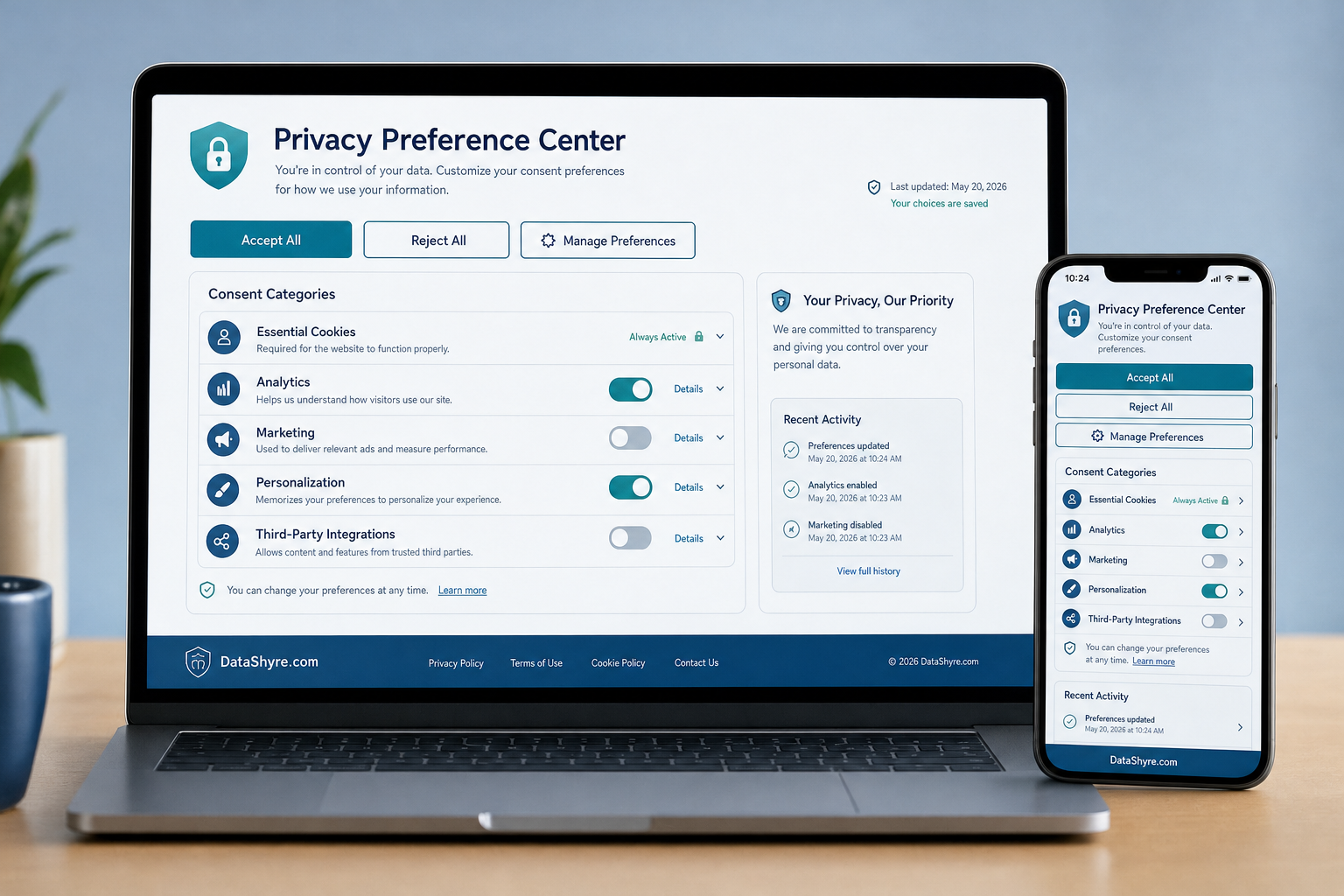
What “manage consent preferences” should mean in practice
Good preference management is not one modal. It is the operating layer that connects a person’s choice to real behavior across:
- website banners and second-layer preference centers;
- app privacy settings and embedded SDK behavior;
- analytics, advertising, personalization, and social widgets;
- browser-level signals such as GPC where they apply;
- records showing what the person saw, chose, and changed later.
That broader frame matters because weak setups often pass the design review but fail the runtime review. The first layer looks balanced, but optional scripts fire too early, a browser opt-out signal is ignored, or a later withdrawal never reaches the downstream vendors.
1. Separate consent, opt-out, and preference choices before you design the UI
This is the first filter for any manage consent preferences project.
The European Commission still frames valid consent around a specific purpose, a clear affirmative act, and real withdrawal. The ICO’s finalized 2026 guidance applies the same operational thinking to cookies, pixels, fingerprinting, scripts, and similar technologies. California often starts from a different decision path: consumers may opt out of sale or sharing, limit certain sensitive-personal-information uses, and exercise rights through recognized preference signals.
That means one preference center may need to support different kinds of controls:
- prior consent for non-essential tracking in EU or UK flows;
- California opt-out and sensitive-data controls when those rights are triggered;
- channel-specific marketing choices for email, SMS, or personalization layers;
- account-level or browser-level settings that need to stay consistent with each other.
If you mix all of that into one generic switch, the interface gets easier to build but harder to defend.
2. Ask by purpose, not in one convenient bundle
The easiest broken pattern is still the bundled choice.
The ICO’s current guidance says consent requests must stay specific to the purpose and generally require granular options. It also warns that a bundled request can make consent unlikely to be valid because it is not specific or informed. The European Commission likewise still says people should be told all the reasons for processing in clear terms.
So if you need to manage consent preferences well, make sure the live system distinguishes at least the purposes that matter in your stack, such as:
- analytics or measurement;
- advertising or remarketing;
- personalization;
- optional embedded media or social features;
- separate direct-marketing permissions where those are managed in the same experience.
One user may accept analytics and reject advertising. Another may allow product emails but reject cross-context behavioral advertising. A preference center that erases those distinctions is doing less than it appears.
3. Make refusal as usable as acceptance on the first meaningful layer
This is still the fastest trust test.
The CNIL’s current cookie-banner notices still say rejection should be “just as easy as accepting them.” The ICO now illustrates the same expectation with equally prominent Accept all, Reject all, and customization routes in its 2026 guidance. And California enforcement is moving in the same direction: the CPPA’s advisory says businesses should offer symmetrical choices, and the CPPA’s March 12, 2025 Honda settlement says the company used an online privacy management tool that did not offer Californians their privacy choices in a symmetrical or equal way.
For manage consent preferences, I would test:
- whether
Reject allor the relevant equivalent is visible where it should be; - whether mobile layouts preserve the same usability as desktop;
- whether the text is plain-language rather than evasive;
- whether the customization path is additive instead of replacing a fair refusal path.
If refusal is buried, softened, or visually downgraded, the rest of the preference center deserves more skepticism.
4. Make the saved choice change runtime behavior before optional data use starts
Preference storage is not the same thing as preference enforcement.
The ICO says a consent mechanism must “function as intended” and that non-exempt technologies should only be set when valid consent exists or an exception applies. It also says silence or inactivity does not qualify as consent. For California branches, the DOJ says a valid GPC signal must be honored by covered businesses as a request to stop sale or sharing.
That means manage consent preferences is partly a sequencing review:
- what loads on first page view or app open;
- what waits until acceptance;
- what stays off after rejection;
- what changes immediately when the person updates saved preferences;
- what happens when a browser-level opt-out signal arrives before any manual click.
If the preference center says one thing but the network trace says another, the trace wins.
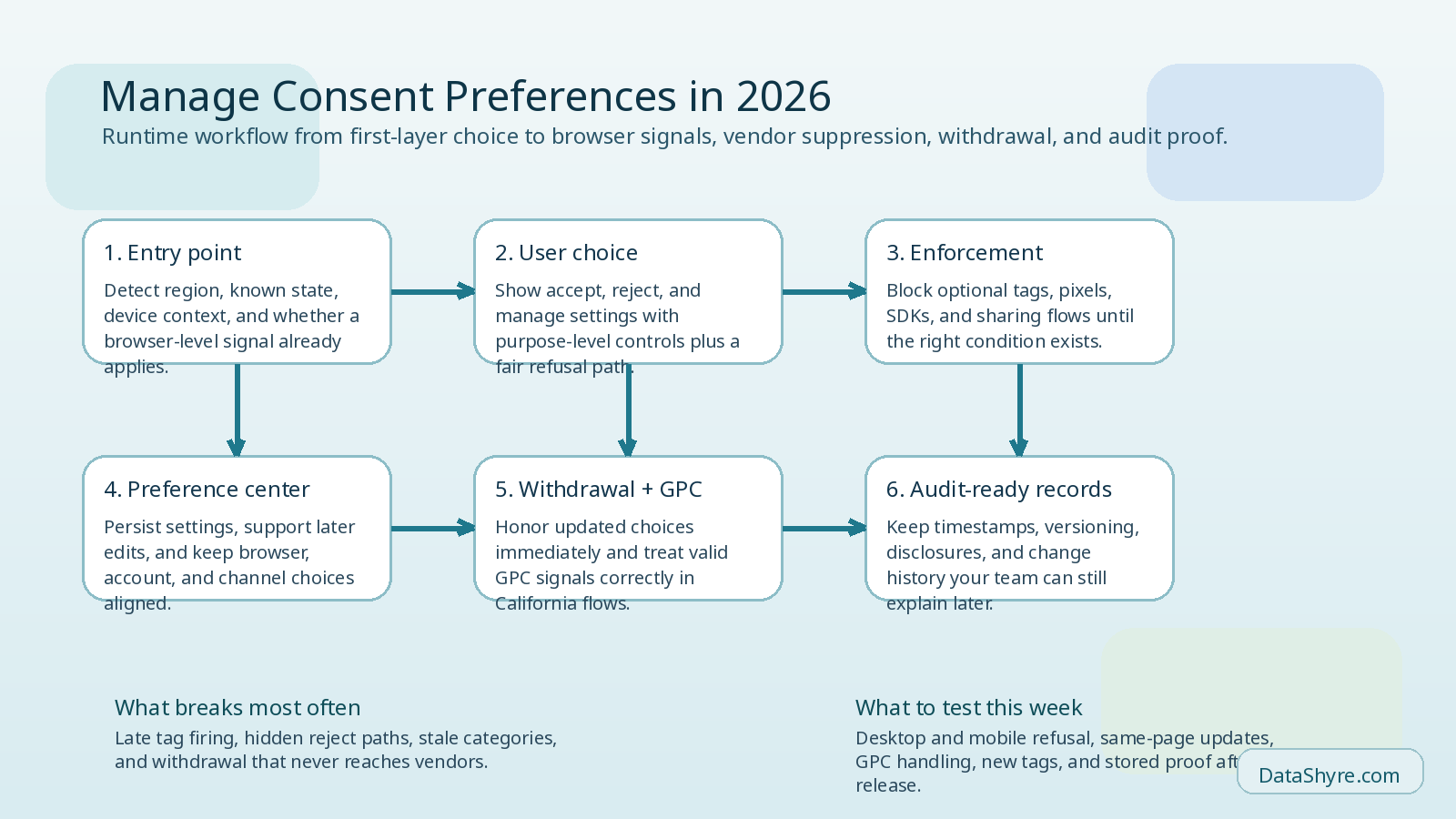
5. Make later withdrawal visible, easy, and technically complete
This is where many systems stop being real.
The European Commission still says withdrawal should be as easy as granting consent. The ICO goes further in its 2026 guidance: users must be able to withdraw at any time with the same ease, the mechanism must explain how to do that, and technologies already set should be removable.
So a serious manage consent preferences review should check:
- whether there is a persistent and understandable route back to settings;
- whether the saved state in the preference center matches reality;
- whether optional processing actually stops after withdrawal;
- whether third parties relying on the original permission are notified or suppressed where required;
- whether the organization treats withdrawal as more than a UI event.
If the banner is easy to find but the undo path is hidden in a footer maze, the preference center is incomplete.
6. Keep records that explain who saw what, when, and under which version
Proof matters more than screenshots.
The ICO says service providers must be able to demonstrate that someone provided consent and notes that CMPs are often used to store those records. Its 2026 guidance also says you should assess default expiration periods rather than blindly accept them, and offers six months as a general guideline before seeking fresh consent again after a refusal. If your purposes, activities, or third parties change, it says you must request fresh consent.
For manage consent preferences, I would want records that preserve:
- the interface or policy version shown;
- the timestamp and jurisdictional path;
- the purpose-level settings selected;
- the third-party disclosures tied to that version;
- later changes, withdrawals, and refreshes.
Without that history, a preference center becomes hard to explain during an audit, complaint, or vendor incident.
7. Re-test every time the stack, vendors, or regional rules change
Preference management drifts faster than teams expect.
The ICO’s guidance explicitly says fresh consent can be required when new purposes, new technologies, or new third parties are introduced. California’s current enforcement posture also makes the practical point that bad privacy UX is not a theoretical design issue. The CPPA’s advisory and Honda action both show that regulators are willing to look at how the choice actually works for the user.
So if you need to manage consent preferences reliably in late 2026, treat these as mandatory re-test triggers:
- new tags, SDKs, embeds, or chat tools;
- new ad-tech, analytics, or personalization vendors;
- new regions, brands, or language flows;
- updated category labels or privacy-copy rewrites;
- account-setting changes that could drift from browser or banner logic.
The preference center that passed once is not necessarily the preference center you are running now.
A short operating standard for this week
If I had to reduce manage consent preferences to one working standard, it would be this:
- separate consent, opt-out, and channel-preference logic first;
- present purpose-level choices clearly and symmetrically;
- block or reroute optional data use until the right condition exists;
- make later withdrawal genuinely easy;
- honor browser and account-level signals where they apply;
- keep records another team could still understand six months from now.
That is much closer to what regulators and enforcement teams actually care about than whether the first layer looks modern.
Bottom line
The phrase manage consent preferences sounds simple, but the real work is operational.
A defensible 2026 setup is one where the preference center asks for the right thing, by the right purpose, in the right region, with a fair refusal path, live enforcement, real withdrawal, and records that survive the next release.
If your system can show that on a live site or app, the preferences are doing real work. If it cannot, the interface may be polished while the control layer is still unfinished.
Sources
- European Commission: Legal grounds for processing data
- ICO: Guidance on the use of storage and access technologies
- ICO: How do we manage consent in practice?
- CNIL: Dark Patterns in Cookie Banners: CNIL issues formal notice to website publishers
- California Department of Justice: California Consumer Privacy Act
- California Department of Justice: Global Privacy Control
- CPPA: CPPA Enforcement Advisory Stresses the Importance of Avoiding Dark Patterns
- CPPA: Honda Settles With CPPA Over Privacy Violations
- CPPA: CCPA Updates, Cybersecurity Audits, Risk Assessments, ADMT, and Insurance Regulations
—
Published: October 17, 2026. Updated using current official regulator and government materials available at publication time.