

Consent Lifecycle Solution in 2026: 7 Checks for Collection, Change, and Withdrawal
If you are searching for a consent lifecycle solution on August 26, 2026, the useful question is not whether your site can show a banner or your app can log a checkbox.
It is whether the same system can collect a valid choice, pass it into the tools that actually process data, update that choice later, honor withdrawal or opt-out requests, and leave behind proof another team can still trust.
That matters more now because the live baseline keeps getting more operational. The European Commission still says consent must let people “refuse or withdraw consent without being at a disadvantage” and also says “It should be as easy to withdraw as to give consent.” The UK ICO’s final storage-and-access technologies guidance from April 29, 2026 makes clear the review now reaches beyond classic cookies into pixels, scripts, fingerprinting, and similar techniques. In California, the Department of Justice still describes Global Privacy Control as a “stop selling or sharing my data switch,” and recent enforcement has kept stressing the same point: a preference only matters if it changes the real downstream behavior.
If you want the neighboring platform context first, start with our guides to consent management provider, what is a consent management platform cmp, and GDPR vs. CCPA. This article is narrower. It is the seven-check operating review I would use before trusting this type of system on a live stack this week.
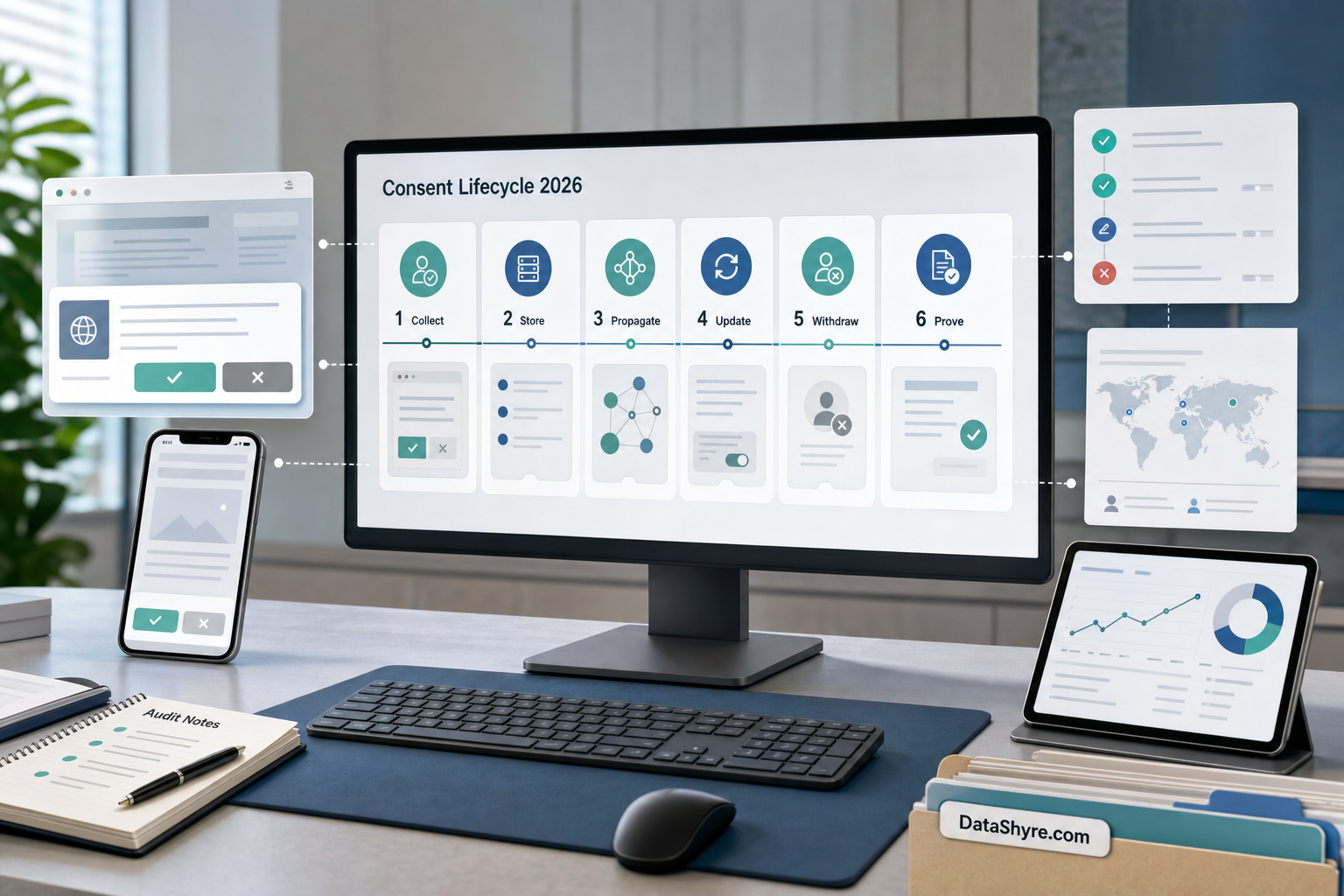
What a consent lifecycle solution should actually do
A real solution sits between the user’s choice and every system that wants to react to it.
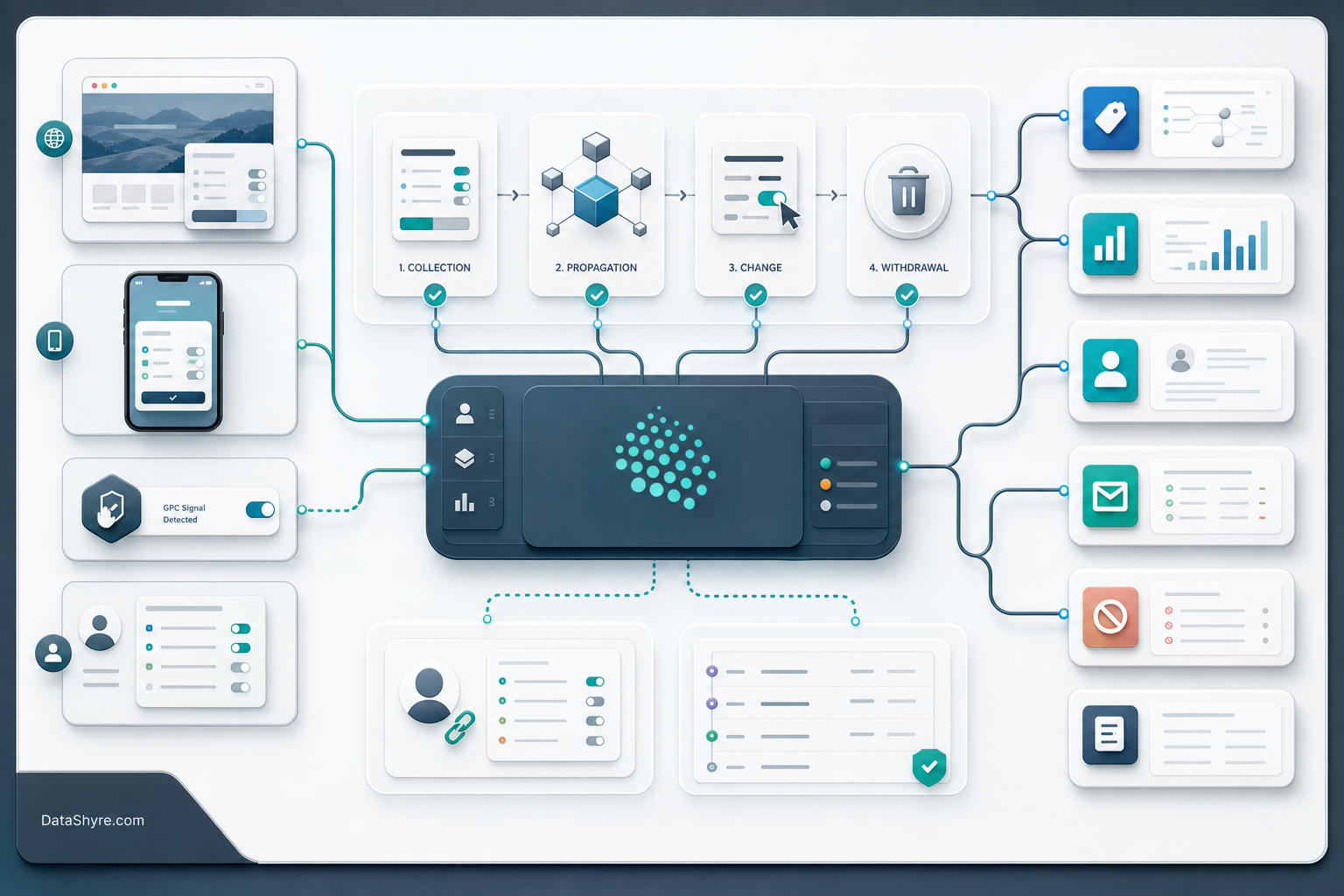
In practice, that means it should help your team manage:
- initial collection of consent or opt-out choices;
- purpose, category, or regional logic behind those choices;
- propagation into tags, SDKs, CRMs, email tools, ad systems, and warehouses;
- later changes such as withdrawal, objection, or updated preferences;
- records showing what happened, when, and why.
If the product only handles the first click and leaves the rest to manual clean-up, it is not a lifecycle solution. It is a front-end prompt with a database attached.
7 checks before you trust one
1. Model the whole journey, not just the first consent event
Many weak tools still treat consent as a one-time capture.
That is too shallow for 2026.
A strong system should account for the full path:
- collection;
- storage;
- propagation;
- later update;
- withdrawal or opt-out;
- suppression or deletion follow-through where required; and
- evidence that the state changed everywhere it needed to change.
If your current diagram ends at “user clicked accept,” the lifecycle is unfinished.
2. Separate region, purpose, and lawful-basis logic early
One preference flow rarely covers every jurisdiction cleanly.
In the EU and UK, teams often need to focus on whether non-essential storage or access stays off until the right consent exists. In California, the practical review often shifts toward notice quality, sale-or-sharing analysis, opt-out handling, and preference signals such as GPC. The CPPA’s current regulations pages also show January 1, 2026 as the effective date for the current CCPA regulations and related updates.
That means the system should let you distinguish at least:
- region;
- purpose;
- identity state such as anonymous visitor versus logged-in account holder; and
- downstream systems affected by each choice.
Without that separation, teams end up forcing California into an EU-style consent pattern or treating an EU withdrawal as if it were only a cosmetic settings change.
3. Make change and withdrawal as operational as collection
This is where the word “lifecycle” starts to matter.
The European Commission’s standard is not limited to the first yes. People must be able to withdraw consent as easily as they gave it, and once consent is withdrawn the organization can no longer keep processing on that legal ground. The operational question is whether your system turns that rule into real behavior.
For this kind of platform, I would test:
- first refusal;
- later preference change;
- full withdrawal after earlier acceptance;
- whether the runtime changes immediately or on the next relevant interaction; and
- whether downstream systems receive the updated state.
If users can change a toggle in the UI but the CRM, ad audiences, suppression rules, or tracking scripts keep behaving as before, the withdrawal flow is not real.
4. Push the state into every downstream system that acts on data
This is usually the hardest part.
A polished interface does not prove that the choice reached the tools that matter. The real stack may include a tag manager, web analytics, ad platforms, mobile SDKs, forms, chat tools, support platforms, a CDP, batch exports, and internal data pipelines.
That is why it should be reviewed as a control plane, not as a banner feature. Ask:
- Which systems receive the state in real time?
- Which systems receive it later through queues, APIs, or batch jobs?
- What happens when a user is recognized across devices or signs in after giving a choice anonymously?
- Which systems still need manual intervention?
The more handoffs you cannot explain, the more likely the privacy promise and the live data flow will drift apart.
5. Keep proof that someone outside the implementation team can read
Sooner or later, legal, security, product, or a regulator will ask the same basic questions:
- What did the user see?
- What did they choose?
- When did they change it?
- Which systems were affected?
- What version of the policy, banner, or preference center was live at that time?
A serious implementation should let a non-specialist reconstruct that story without combing through raw logs from five systems.
That matters even more now because the UK ICO’s 2026 guidance and recent European cookie-banner activity both reinforce the same theme: the review is about practical control, not polished claims.
6. Handle browser signals, account states, and cross-surface edge cases
Lifecycle failures often appear in the seams.
California’s DOJ still says a qualifying Global Privacy Control signal must be treated as a valid request to stop sale or sharing where the law applies. The DOJ’s enforcement materials also keep showing why narrow device-only handling can fail when the same user has an account-linked relationship with the business.
So for this setup, I would want to know:
- how GPC is recognized and stored;
- whether account login merges or overwrites prior anonymous choices;
- how mobile-app preferences map to web or connected-device experiences, if that is relevant;
- whether suppression and re-permission logic survive identity resolution.
Those details are where an apparently complete system often stops being complete.
7. Re-test after releases, not only at launch
Even a good system drifts if nobody retests it after changes.
That drift can come from a CMP update, new vendor integration, mobile release, tag-manager publish, identity-graph change, warehouse sync, or revised regional logic. Current public signals are a good reminder that this is not a solved problem you check once and forget. The ICO finalized its broader storage-and-access guidance on April 29, 2026. The EDPB required the Belgian DPA to handle the merits of a cookie-banner complaint on July 14, 2026. California’s current CCPA regulations are effective as of January 1, 2026, and DOJ enforcement keeps focusing on whether opt-out rights actually change behavior.
That is why a lifecycle review should end with a release discipline:
- identify the systems that can break consent behavior;
- define regression tests for rejection, acceptance, change, and withdrawal;
- rerun them after every material release; and
- keep the evidence where another team can find it later.
A short operating sequence I would use this week
If I were pressure-testing a consent lifecycle solution right now, I would do this in order:
- map every system that collects, stores, or reacts to a user preference;
- test the first uncached visit before any interaction;
- test refusal first, not acceptance first;
- change the preference later and confirm the state really propagates;
- test withdrawal, GPC, and account-linked edge cases;
- verify what proof is left behind; and
- rerun the same checks after the next release.
That short sequence tells you more than a long feature-comparison sheet.
Bottom line
The right consent lifecycle solution in 2026 is not the one with the nicest banner or the cleanest settings screen.
It is the one that can carry a privacy choice through collection, propagation, change, withdrawal, and proof without losing meaning along the way.
If your team can show that the choice stays coherent across regions, identities, and downstream systems, you have something defensible. If not, you probably have a consent interface, not a real lifecycle solution.
Sources
- European Commission: When is consent valid?
- European Commission: What if somebody withdraws their consent?
- UK ICO: Final storage and access technologies guidance published
- UK ICO: Guidance on the use of storage and access technologies
- European Data Protection Board: Belgian DPA must handle the merits of NOYB cookie-banner complaint
- California Department of Justice: Global Privacy Control
- California Department of Justice: California Won’t Let It Go: Attorney General Bonta Announces $2.75 Million Settlement with Disney
- California Department of Justice: Privacy Enforcement Actions
- California Privacy Protection Agency: Law & Regulations
- California Privacy Protection Agency: CCPA Updates
This post was updated on August 26, 2026 using current official regulator, government, and platform guidance available at publication time.