

Consent Choices in 2026: What Businesses Have to Offer and Prove
If your team still treats consent as a banner design problem, this is the useful reset: consent choices only matter when they change real behavior. A visitor needs a genuine way to say yes, no, or not now. Your stack then has to honor that answer quickly, keep honoring it later, and leave behind proof another person can review.
That standard looks sharper in mid-2026 than it did even a year ago. The ICO published final storage and access technologies guidance on April 29, 2026, the EDPB pushed a fresh cookie-banner complaint back onto the merits track on July 14, 2026, CNIL’s 2025 sanctions show trackers are still a live enforcement lane, and California continues to treat browser-level opt-out signals as valid requests where sale or sharing is in scope.
If you want adjacent reading first, our guides to cookie consent requirements, user consent, and online consent management cover the wider mechanics around policy, tooling, and governance.
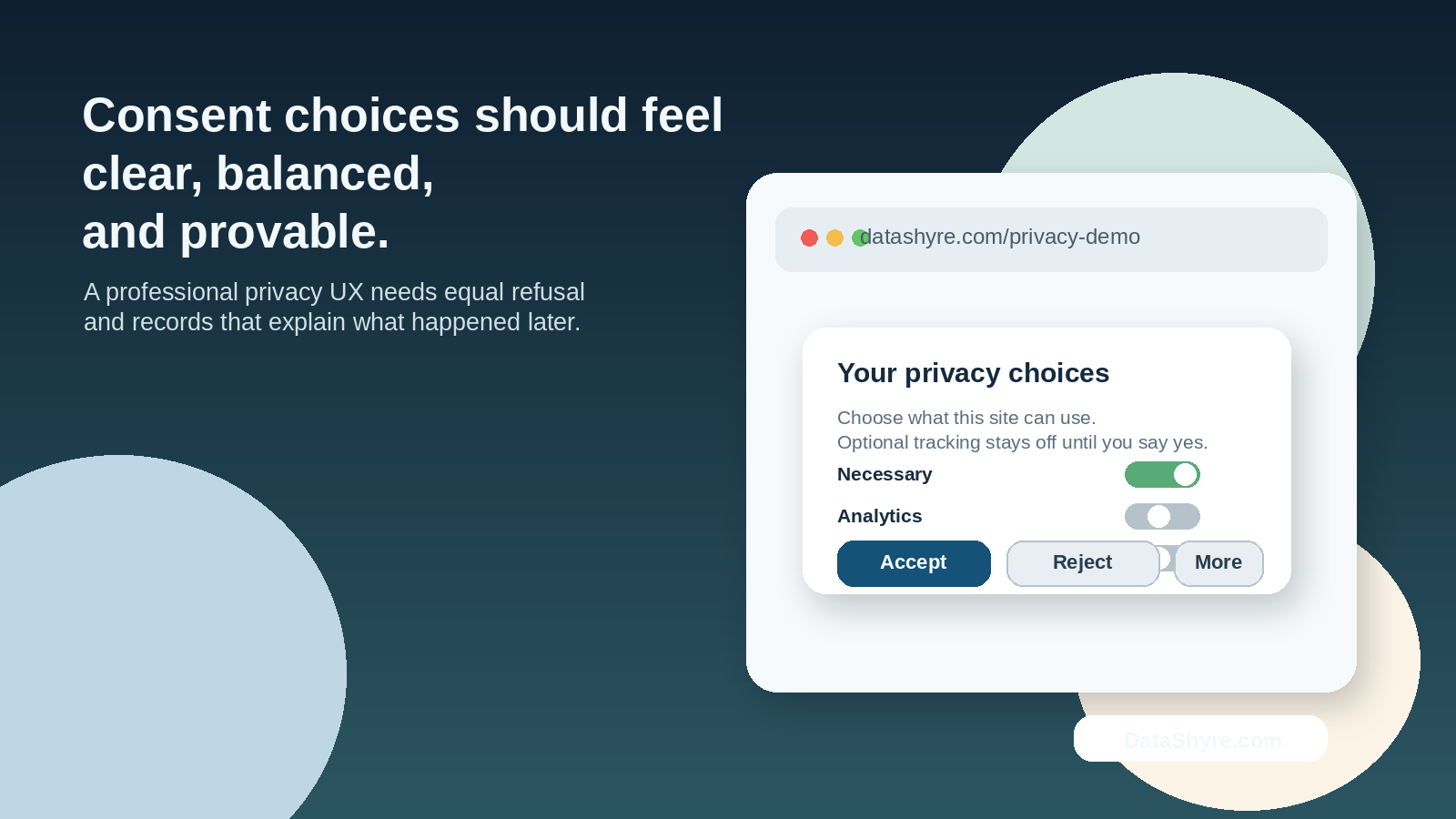
What consent choices have to do now
The simplest test is this: can a person understand the choice, make it without friction, and trust that the choice sticks?
William Malcolm of the ICO said the UK’s final 2026 guidance offers “clear, practical guidance.” That is a good frame for operators too. This is no longer a vague maturity discussion. The expectations are concrete enough to test in a browser and concrete enough to fail in enforcement.
Anu Talus, chair of the EDPB, put the principle even more plainly: users should have “real choice.” I like that wording because it cuts through a lot of vendor theater. If the interface nudges the outcome, or the backend ignores the outcome, the choice is not real.
Five checks worth running on your own experience
1. Refusing is as visible as accepting
This is still where plenty of teams wobble. A bright accept button paired with a buried reject path is not a neutral choice architecture. CNIL’s 2025 tracker sanctions included failures tied to insufficient information and failures to respect refusal or withdrawal. The EDPB’s latest cookie-banner dispute also underlines that banner complaints are not yesterday’s issue.
For most businesses, the practical review is boring on purpose: first layer, first visit, mobile and desktop. Can a user say no without extra hunting?
2. Non-essential tracking waits for the answer
This is the operational hinge. If analytics, ad tech, pixels, or fingerprinting tools load before the choice is made in a consent-first jurisdiction, the rest of the wording barely matters.
Scott Herman of Google described the technical goal as making tags “respect cookie consent choices.” That still holds up. A banner is not the control. The control is whether your tags, SDKs, and scripts behave differently after the choice is known.
3. Preference changes work after the banner disappears
Lots of teams test the first interaction and never test the second one. That is a mistake. The harder question is whether a visitor can reopen settings later, reverse a decision, and have the update travel through the stack without delay or weird leftovers.
This is where privacy choices stop being copy and become systems work. Preference centers, tag managers, embedded players, analytics tools, ad platforms, and suppression lists all have to agree on the current state.
4. Browser-level signals are part of the picture
California teams in particular should not treat browser signals as a nice extra. The California Department of Justice says Global Privacy Control is one acceptable method for online opt-out requests and that covered businesses must honor it as a valid request to stop sale or sharing. Rob Bonta called technologies like GPC a “game changer for consumers.”
That matters beyond California headlines. It means some privacy choices do not begin inside your banner at all. They may arrive through the browser, and your workflow still has to catch and enforce them.
5. Your records are usable when someone asks questions
If your proof is a screenshot in a slide deck, you do not really have proof. You want a trail that shows the banner or notice version, the options presented, the selection made, the time recorded, and the ruleset or region in effect.
California’s CPPA FAQ makes the operational side more concrete than many teams realize: requests to know, delete, or correct must be confirmed within 10 business days and answered within 45 calendar days, while opt-out requests must be handled as soon as feasibly possible and no later than 15 business days. If a consent or preference workflow breaks, those deadlines stop feeling theoretical fast.
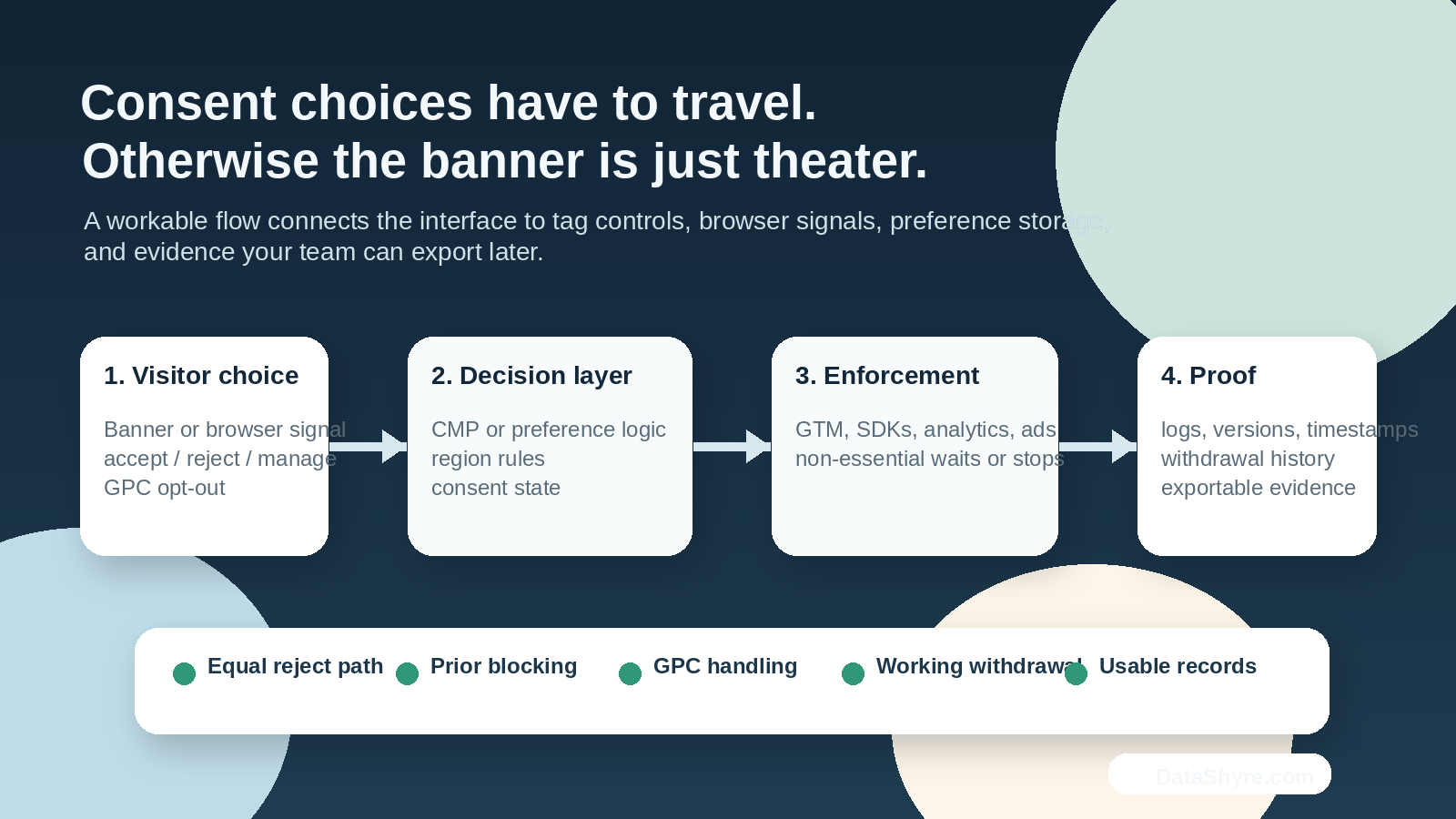
A better internal question
Instead of asking whether your site is “compliant,” ask whether a skeptical outsider could follow the choice from interface to enforcement.
Could they see how refusal works? Could they verify that optional technologies stayed off until allowed? Could they confirm that withdrawal actually changed downstream behavior? Could they export the evidence without a rescue project from engineering?
That is the standard I would use before launch, after redesigns, and whenever marketing adds a new vendor script. It is also the fastest way to separate polished banners from durable consent operations.
These controls are easy to talk about and surprisingly easy to fake. The teams that do this well are not the ones with the prettiest banner. They are the ones that make rejection simple, propagate the signal everywhere it needs to go, and keep records that survive scrutiny.
A light note: this is a practical operations guide, not legal advice. It is still a very good checklist for finding weak spots before a regulator, auditor, customer, or procurement team does.
Sources
- UK Information Commissioner’s Office
- European Data Protection Board
- CNIL
- California Department of Justice
- California Privacy Protection Agency
- Google Marketing Platform