

Cookie Policy Examples in 2026: 7 Patterns Worth Copying and 5 Red Flags
If you are searching for cookie policy examples on November 18, 2026, the useful question is not which policy page looks the most official.
It is which example still matches the site's real tracking behavior, consent path, and privacy promises.
That is the difference that matters now.
The current official guidance points in the same direction. The ICO says the information about cookies and similar technologies must be “clear and comprehensive” and must explain “what you use them for.” The CNIL says “rejecting cookies should be just as easy as accepting them.” California’s Department of Justice says a notice at collection should link to the privacy policy so people can get a “fuller description” of privacy practices and rights. The FTC keeps the operational point simple too: reread your privacy policy to make sure you are “honoring the promises you’ve pledged.” And if your stack relies on Google tags, Google’s current consent guidance still says default consent signals should be set “before any commands that send measurement data.”
That means strong cookie policy examples in late 2026 are not generic footer filler.
They are examples of alignment:
- the page matches the live technologies;
- the policy language matches the banner and settings panel;
- the consent path matches the runtime;
- the rights and contact path match the wider privacy notice; and
- the page gets updated when the stack changes.
If you want nearby companion reads first, start with our guides to cookie policy, cookie policy template, and cookie banner examples. This page stays narrower and more concrete. It is the cookie policy examples review I would use before borrowing wording or structure from another site.
If your team is trying to turn a decent example into a real operating page, DataShyre can help connect the policy text to the banner, tag behavior, vendor inventory, and disclosure workflow. That is where most good-looking policy examples quietly fall apart.
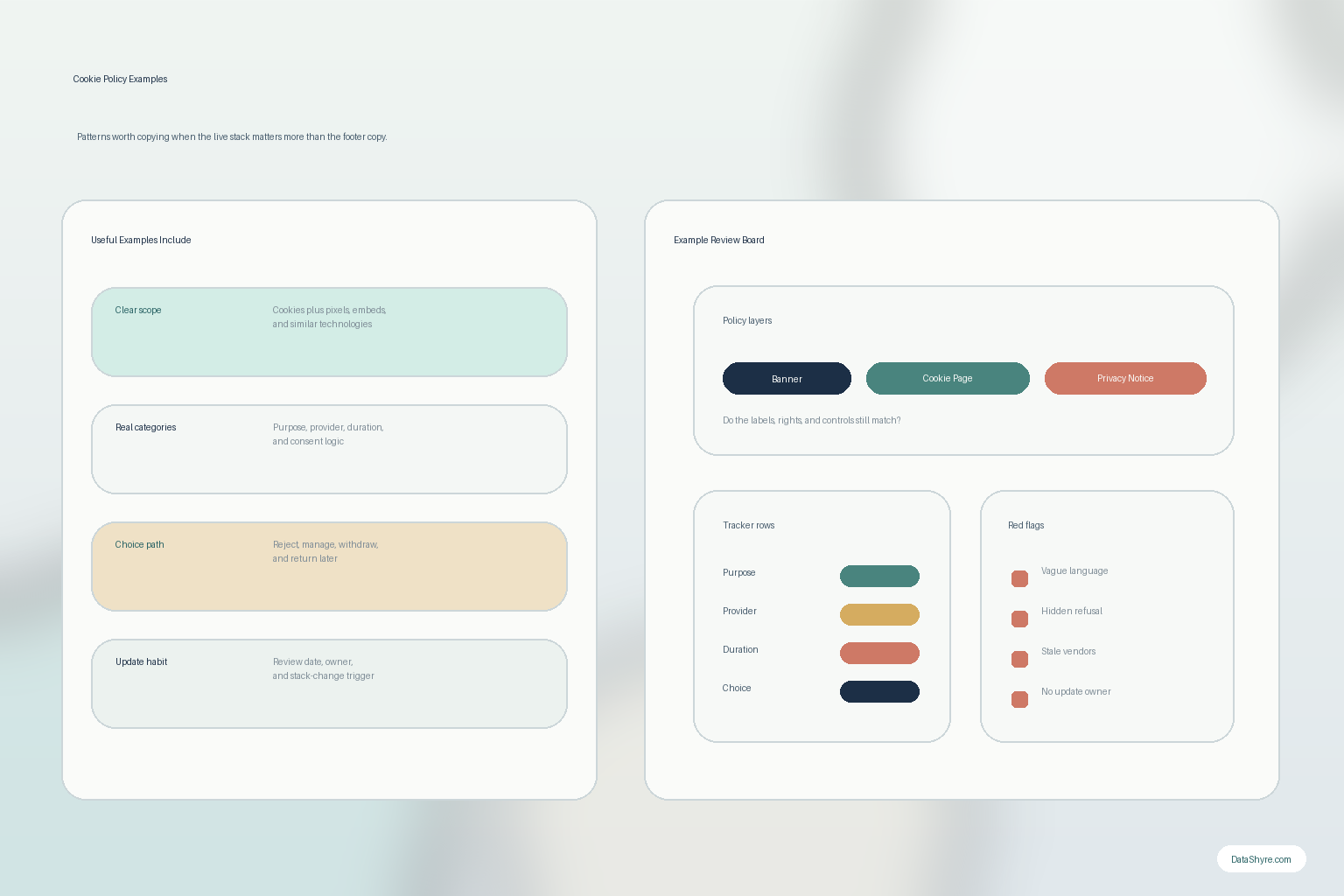
1. Example: a first section that names the real technologies, not only the word cookies
One of the best cookie policy examples starts with a plain statement about scope.
Not every site uses only classic browser cookies anymore.
The ICO’s current guidance explicitly covers cookies and similar technologies more broadly, including other ways of storing or accessing information on a device. So the better example is a page that says, in ordinary language, that the site uses cookies and similar technologies such as pixels, tags, embeds, or local storage where relevant.
That matters because a narrow example creates a wide blind spot. If the site runs video embeds, chat widgets, analytics tags, or advertising pixels, the page should not pretend the entire tracking story fits inside a neat cookie table.
The pattern worth copying is simple:
- define the scope up front;
- say the page covers cookies and related technologies where applicable;
- keep the wording readable enough for a normal visitor.
2. Example: category rows that explain purpose, provider, and duration together
Weak cookie policy examples often list categories and stop there.
That is not enough.
The ICO says users should get clear information about purposes, and its guide also points to third-party involvement and duration as part of the disclosure work. The stronger example is therefore not a vague paragraph about improving your experience. It is a structure that lets a visitor answer practical questions:
- what does this category do;
- who sets it;
- how long does it stay on the device; and
- does it depend on consent.
The easiest examples to reuse usually look more like a compact explanation matrix than a block of legal fog.
If your page cannot cleanly show purpose, provider, and duration together, the example is probably too thin for a live site review.
3. Example: a policy that matches the banner labels and refusal path
This is one of the most important cookie policy examples to copy because it checks whether the visible choice layer and the policy layer tell the same story.
The CNIL’s current enforcement posture is blunt. Rejecting cookies should be just as easy as accepting them, and misleading banner design can invalidate consent. That means your policy should not describe a user-friendly refusal path that the banner does not actually provide.
The better example is a page that mirrors the real labels and routes:
- the same category names used in the banner or preference center;
- the same
accept,reject, ormanagelanguage visitors actually see; - a clear note about how to revisit or change choices later; and
- a live link or instruction path that works on mobile as well as desktop.
If the banner says manage preferences but the page says visit cookie settings and no such path is easy to find, the example is already drifting away from reality.
4. Example: third-party services are named honestly instead of hidden behind generic labels
Many polished cookie policy examples become useless right here.
They use phrases like trusted partners, service providers, or marketing tools without giving a normal person enough context to understand what actually happens.
California’s Department of Justice says a notice at collection should link people to the privacy policy for a “fuller description” of privacy practices and rights. A useful cookie page should respect that same idea. It should offer more than decorative category names.
So the example worth copying is one that tells the truth about outside services:
- whether a third party sets the identifier or receives data;
- whether the service supports analytics, ads, video, chat, personalization, or security;
- whether the category is optional or necessary; and
- where the reader can learn more or manage the choice.
That does not mean every page needs an unreadable vendor dump. It does mean the example should be specific enough to be useful.
5. Example: the page tells users how to refuse or withdraw, not only how to accept
A lot of public cookie policy examples are written as if the important moment is the first click on Accept all.
That is the wrong emphasis.
The better examples explain:
- how a user can refuse optional technologies;
- how they can reopen the settings later;
- whether browser controls, in-product settings, or footer links are relevant; and
- what happens after preferences change.
This is also where implementation details matter. Google’s current guidance says consent defaults should be set before any commands that send measurement data, and asynchronous banners may need a short wait so updates land before tags fire. So one of the best cookie policy examples is a page that does not promise controls the runtime cannot actually honor.
If the site says you can change your preferences at any time, that statement should survive a live browser test.
6. Example: the cookie page and the wider privacy notice work as one system
A cookie page should not read like it was written by one team while the privacy notice was written by another team six months later.
The California DOJ says the privacy policy gives consumers a broader picture of collection, use, sharing, sale, and rights. The cookie page should fit cleanly inside that broader picture.
That means strong cookie policy examples usually align on:
- category names and tracking descriptions;
- third-party involvement;
- rights and contact routes;
- references to opt-out, correction, deletion, or other request methods where applicable; and
- links between the cookie page, the privacy notice, and the consent settings path.
If the cookie page says one thing, the privacy notice says another, and the banner says a third, you do not have three helpful disclosures.
You have one credibility problem in three places.
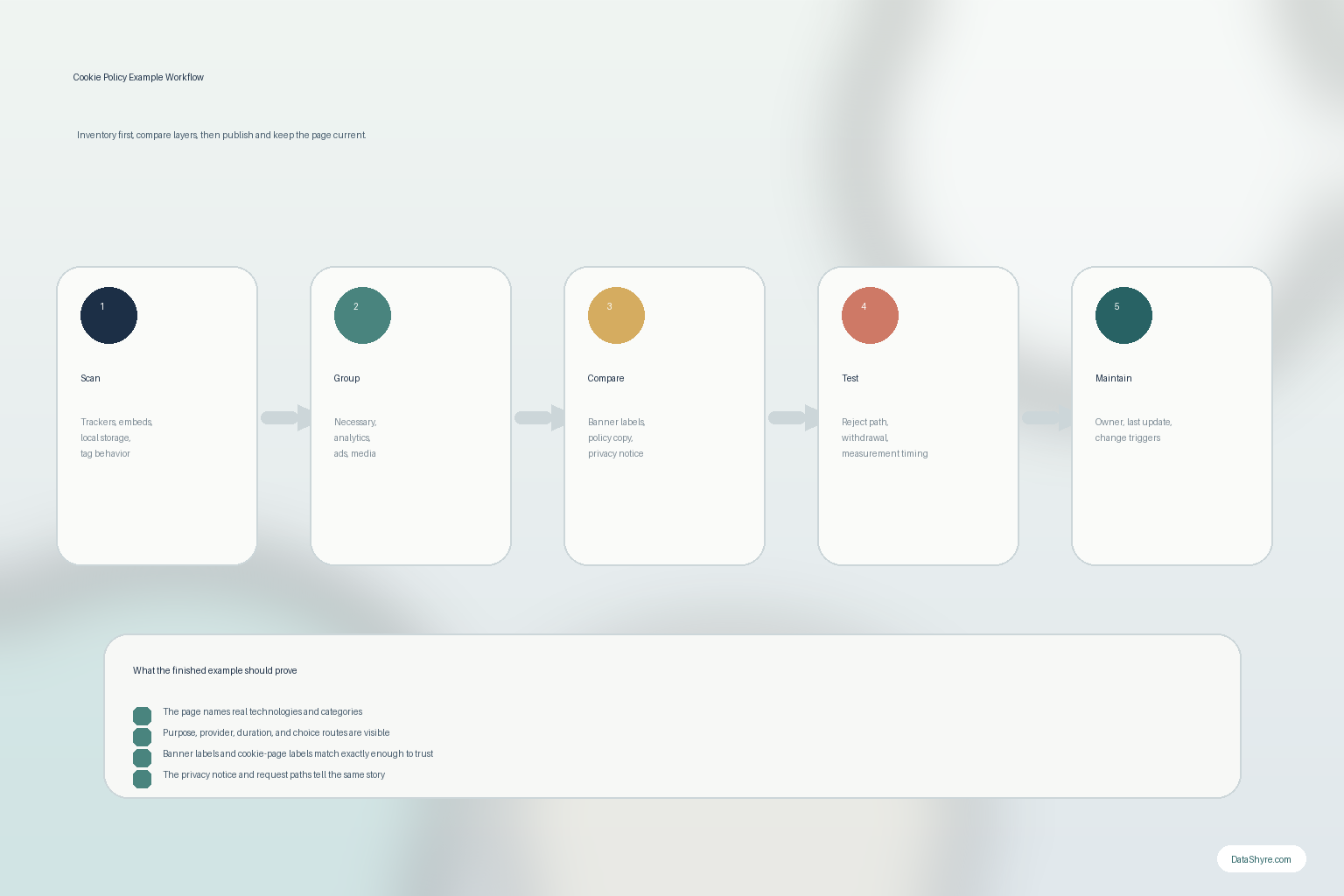
7. Example: a visible update habit instead of a frozen template
The best cookie policy examples look maintained.
Not flashy. Maintained.
That means the page shows signs that someone revisits it when the stack changes. The FTC’s reminder about “honoring the promises you’ve pledged” matters here because policy drift is one of the easiest ways to turn a harmless-looking page into a trust problem.
The best operational example usually includes some combination of:
- a visible last-updated date;
- a review trigger tied to vendor, plugin, embed, or tag changes;
- ownership by a team or workflow instead of no one;
- links that still resolve correctly; and
- language that reflects the current site, not last quarter’s stack.
If the example looks polished but nobody owns updates, it is not the example to copy.
5 red flags to avoid when you borrow cookie policy examples
Most weak implementations fail because they copy the page layout without copying the operating discipline behind it.
These are the five red flags I would screen first:
- the page only says
we use cookies to improve your experience; - the banner categories and the policy categories do not match;
- the page promises refusal or withdrawal paths that are hard to find;
- third-party services are hidden behind generic labels; and
- the policy has no clear update habit even though the stack keeps changing.
Those five issues explain why so many public cookie policy examples look respectable and still fail a live review.
The practical answer
If you want the shortest honest answer on cookie policy examples in 2026, it is this:
Copy examples that describe a real operating system, not just a legal page.
Copy:
- scope that covers similar technologies where needed;
- category rows with purpose, provider, and duration;
- banner and policy language that match;
- specific third-party descriptions;
- refusal and withdrawal instructions that really work;
- a clean handoff to the broader privacy notice; and
- an update habit tied to stack changes.
Everything else is decoration around those basics.
FAQ
What are the best cookie policy examples to copy?
The best cookie policy examples are the ones that still match the live site. Look for examples that explain categories, purposes, providers, duration, refusal, withdrawal, and third-party involvement in plain language.
Do cookie policy examples need to mention pixels or similar technologies?
Often, yes. If the site uses tags, pixels, local storage, embeds, or similar tools, the page should not pretend the disclosure begins and ends with classic cookies.
Is a banner enough without a strong cookie policy page?
No. The banner and the cookie page do different jobs. The banner handles the immediate choice. The page explains the categories, providers, duration, third-party involvement, and later control path.
Bottom line
The best cookie policy examples in 2026 are not the prettiest ones.
They are the ones that tell the truth about the live stack, the real choice path, the outside services involved, and the update discipline behind the page.
If you want help turning an example into a working disclosure flow, DataShyre can help audit the runtime, align the banner and policy layers, and keep the page synchronized with the stack that users actually encounter.
Sources
- ICO, Cookies and similar technologies: https://ico.org.uk/for-organisations/direct-marketing-and-privacy-and-electronic-communications/guide-to-pecr/cookies-and-similar-technologies/
- CNIL, Dark Patterns in Cookie Banners: CNIL issues formal notice to website publishers: https://www.cnil.fr/en/dark-patterns-cookie-banners-cnil-issues-formal-notice-website-publishers
- Google for Developers, Set up consent mode on websites: https://developers.google.com/tag-platform/security/guides/consent
- California Department of Justice, How to Read a Privacy Policy: https://oag.ca.gov/privacy/facts/online-privacy/privacy-policy
- California Department of Justice, California Consumer Privacy Act (CCPA): https://oag.ca.gov/privacy/ccpa
- FTC, Consumer Privacy: https://www.ftc.gov/business-guidance/privacy-security/consumer-privacy