

Cookie Policy Template in 2026: What to Include Before You Publish One
If you are searching for a cookie policy template on November 8, 2026, the most useful answer is not a block of boilerplate text.
It is a checklist for turning a template into something that still matches the live site.
That is the real problem.
The official sources still push in the same direction. The ICO says you must “tell people the cookies are there”, “explain what the cookies are doing and why”, and get consent for non-essential cookies. CNIL’s December 12, 2024 enforcement note says “rejecting cookies should be just as easy as accepting them” and warns against misleading banner design. California’s Department of Justice says a notice at collection must link to the privacy policy so people can get a “fuller description” of privacy practices and rights. The FTC’s consumer-privacy guidance keeps the operational point simple too: reread your privacy policy to make sure you are “honoring the promises you’ve pledged.”
That is why a cookie policy template is not the final deliverable.
It is a drafting tool.
If you want nearby context first, start with our guides to cookie policy, cookie policy generator, and privacy policy template. This page stays narrower. It is the cookie policy template review I would use this week before publishing one on a live website.
If your team is using a template because the stack has outgrown guesswork, DataShyre can help connect the published language to the underlying consent flow, vendor map, and runtime behavior through consent management, data mapping, and implementation support. The difficult part is usually not writing the first paragraph. It is proving the paragraph still describes the real site after the next plugin, tag, or campaign change.
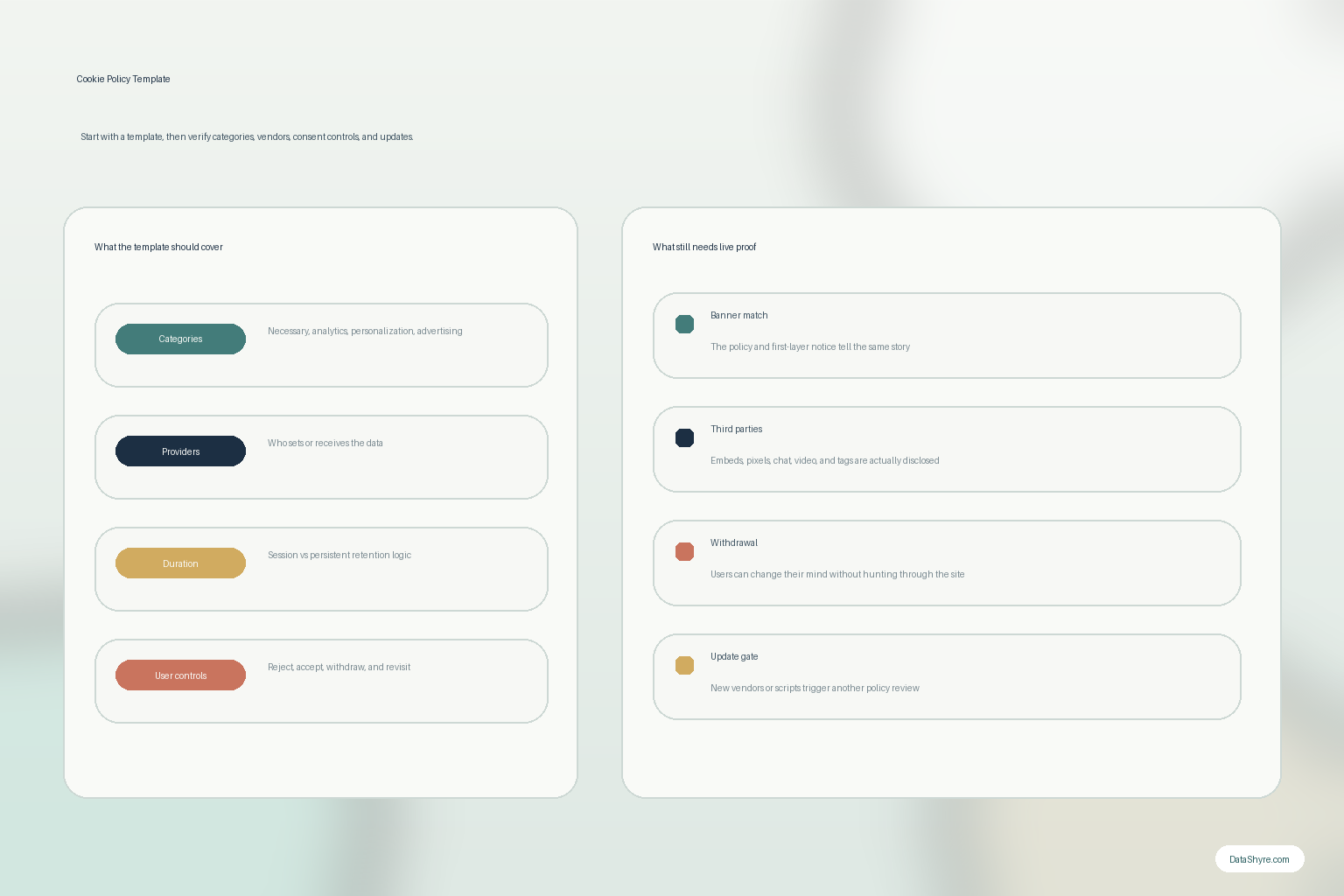
1. Treat the template as a draft, not the source of truth
The first cookie policy template mistake is assuming the template already knows your website.
It does not.
It only knows the generic sections someone thought most sites should have.
Your live site may have:
- analytics tools loaded through a tag manager;
- embedded video or maps that set third-party identifiers;
- chat or support widgets;
- advertising pixels or remarketing tags;
- consent-management scripts; and
- plugins that quietly change the tracking footprint over time.
So the template is the shell.
The live inventory is the truth.
2. Start by naming the actual categories and purposes
The ICO’s cookies guidance is still a useful discipline here because it says people should be told what the cookies are doing and why.
A working cookie policy template should therefore force the writer to identify, in plain language:
- necessary functions;
- analytics or measurement tools;
- personalization features;
- advertising or cross-site tracking;
- fraud, security, or session controls; and
- embedded third-party services that bring their own trackers.
A weak template collapses all of that into we use cookies to improve your experience.
That sentence is too vague to help a user, and too vague to help your own team keep the page accurate.
3. Add the provider, the duration, and the control path
This is where many cookie policy template pages stay incomplete.
Users do not only need category labels.
They also need the operational context around those labels.
For each meaningful category or named technology, the template should help you explain:
- whether your company or a third party sets it;
- what purpose it serves;
- whether it is session-based or persistent;
- whether it depends on consent; and
- where a person can manage the choice later.
That matters because a cookie policy template without provider, duration, or controls is closer to a glossary than a disclosure.
4. Make the template agree with the banner and settings panel
A cookie policy template cannot be accurate on its own.
It has to line up with the actual user journey.
CNIL’s current enforcement posture is clear: rejecting cookies should be just as easy as accepting them, and banner design should not steer people through misleading emphasis or placement tricks. The same practical standard should shape the page behind the banner.
So compare the template output against:
- the first-layer banner copy;
- the
accept allandreject allcontrols; - the category names in the settings panel;
- the later
manage preferencesorcookie settingspath; and - the real behavior after withdrawal.
If the page says the user can refuse or withdraw easily, that route should be easy to find on mobile as well as desktop.
5. Cover third-party embeds and similar technologies, not only classic cookies
The word cookie makes many teams write too narrowly.
But the live site often involves more than classic browser cookies.
The ICO’s cookie guidance covers storage and access technologies more broadly, and California’s notice-and-policy structure still expects the wider privacy picture to make sense when people move from collection notice to the main privacy disclosure.
That means a serious cookie policy template review should look beyond classic cookie rows and include:
- pixels;
- scripts loaded by tag managers;
- embedded video, maps, and social widgets;
- CAPTCHA or bot-detection tools;
- chat modules; and
- other third-party components that affect what data is placed on or read from the device.
If those branches are missing, the template may look complete while still omitting some of the live tracking story.
6. Keep the cookie page aligned with the broader privacy notice
California DOJ’s current CCPA guidance says the notice at collection should link to the privacy policy for a “fuller description” of privacy practices and rights.
That is a useful reminder.
The cookie policy template should go deeper on tracking technologies, categories, duration, and controls.
The broader privacy policy should cover the wider picture of collection, use, sharing, rights, and contacts.
Those two documents should not tell different stories.
In practice, check whether:
- third-party categories match across both pages;
- the consent or preference path is described consistently;
- the cookie page and the privacy page name the same choice routes; and
- the wider privacy notice still reflects the vendors and purposes mentioned in the cookie section.
If they drift apart, trust breaks faster than most teams expect.
7. Add update triggers so the template does not freeze while the stack changes
The biggest long-term cookie policy template risk is drift.
The page can be right on launch day and wrong a week later because:
- a new plugin adds tracking;
- a tag-manager container changes;
- a marketing team adds a new vendor;
- an embed changes providers;
- consent categories are renamed; or
- the banner logic changes without the policy being updated.
That is exactly where the FTC warning about “honoring the promises you’ve pledged” becomes practical. A policy page is not harmless filler if the live implementation no longer matches it.
That is also where DataShyre can help. If your cookie template is drifting away from the runtime reality, DataShyre can help audit the live scripts, the banner behavior, the vendor map, and the policy-to-runtime match before the discrepancy turns into a trust or compliance problem.
A practical cookie policy template review for this week
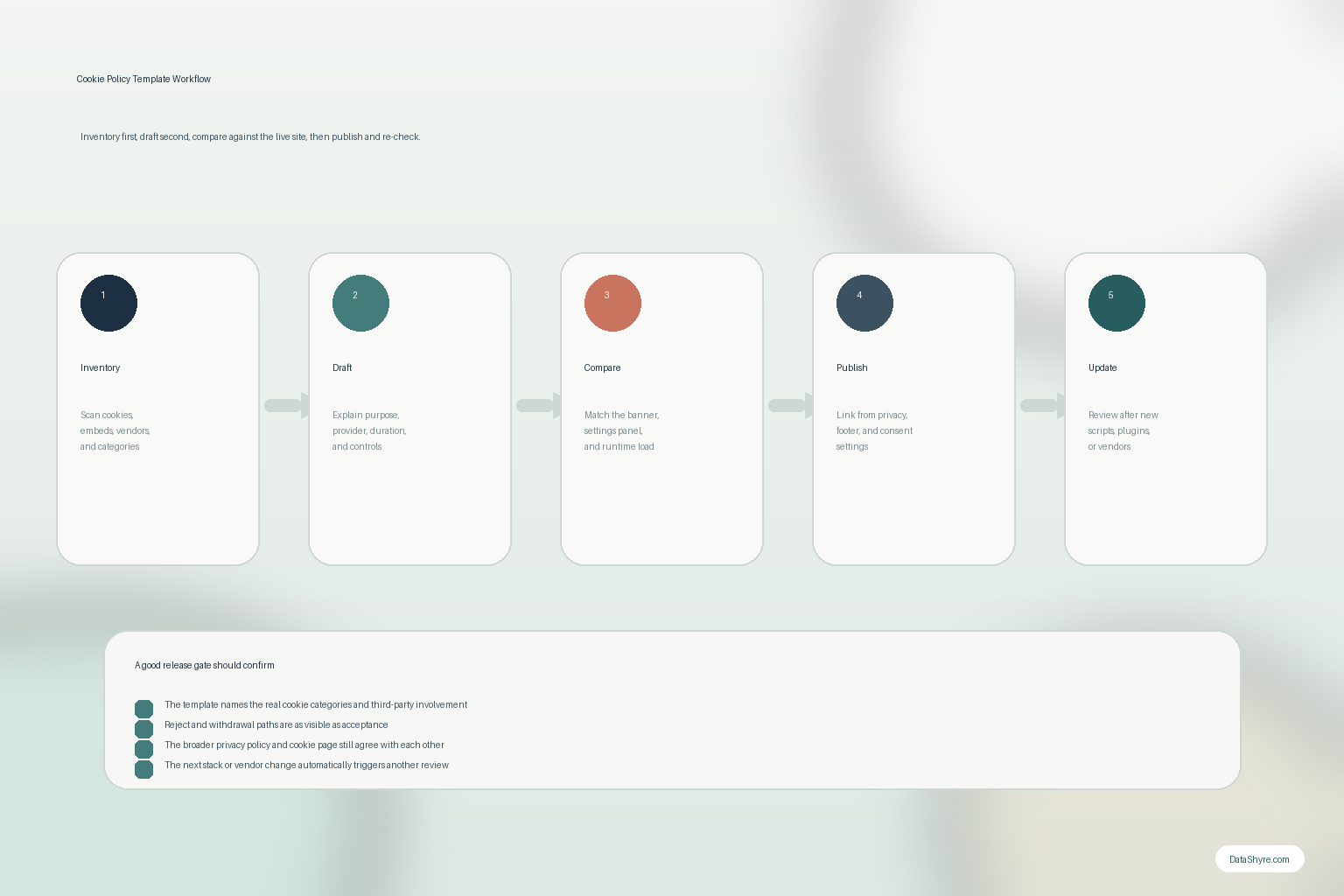
If I were reviewing a cookie policy template today, I would use this order:
- inventory the live cookies, related scripts, embeds, and vendors;
- classify them into categories a user can actually understand;
- add provider, duration, and control details;
- compare the page against the banner and settings panel;
- align the page with the broader privacy policy; and
- re-run the review whenever the stack or vendors change.
That order usually catches more real problems than polishing the wording first.
FAQ
Is a cookie policy template enough by itself?
No. A cookie policy template can speed up drafting, but it cannot verify what the live website actually loads, who receives data, or whether refusal and withdrawal really work.
What should a cookie policy template include?
At minimum, it should help you describe categories, purposes, providers, duration, third-party involvement, consent logic, and how users can refuse or later change their choices.
Is a cookie policy template the same as a privacy policy template?
No. A cookie policy template goes deeper on device-level technologies and consent controls. A privacy policy template covers the wider collection, use, sharing, retention, and rights picture.
Bottom line
The best cookie policy template in 2026 is not the one with the most boilerplate.
It is the one you treat as a structured draft while you verify categories, providers, duration, refusal, withdrawal, and third-party behavior against the live site.
If that verification step is weak, the template has not solved the problem.
It has only made the problem look more polished.
Sources
- ICO, Cookies and similar technologies: https://ico.org.uk/for-organisations/direct-marketing-and-privacy-and-electronic-communications/guide-to-pecr/cookies-and-similar-technologies/
- CNIL, Dark Patterns in Cookie Banners: CNIL issues formal notice to website publishers: https://www.cnil.fr/en/dark-patterns-cookie-banners-cnil-issues-formal-notice-website-publishers
- California Department of Justice, California Consumer Privacy Act (CCPA): https://oag.ca.gov/privacy/ccpa
- California Department of Justice, How to Read a Privacy Policy: https://oag.ca.gov/privacy/facts/online-privacy/privacy-policy
- FTC, Consumer Privacy: https://www.ftc.gov/business-guidance/privacy-security/consumer-privacy