

Cookie Compliance Solution in 2026: 7 Checks Before You Buy or Build One
If you are searching for a cookie compliance solution on November 17, 2026, the useful question is not only which banner tool has the nicest demo.
The useful question is whether the solution can control what your site actually does before and after a user chooses, whether it can explain those choices clearly, and whether it can keep up when your stack changes next week.
The official guidance is still blunt. The ICO’s final 2026 guidance frames the problem around broader storage and access technologies, not only classic cookies. Its consent guidance says the mechanism should make it as easy to refuse consent as it is to accept. CNIL still says rejecting cookies should be just as easy as accepting them. Ireland’s DPC still answers the analytics question directly: Yes. Analytics cookies need consent. And California’s Department of Justice still describes Global Privacy Control as a stop selling or sharing my data switch.
If you want the nearby companion reads first, start with our guides to cookie consent manager, website privacy checker, and cookie notice. This page stays narrower. It is the cookie compliance solution review I would use this week before approving a vendor, renewing a CMP, or building a lighter in-house layer.
If your team needs help beyond the demo environment, DataShyre can help with consent management, data mapping, and implementation cleanup across CMPs, tag managers, scripts, and privacy notices. The expensive failure is rarely we had no banner. It is the live site kept doing things the banner said it would not do.
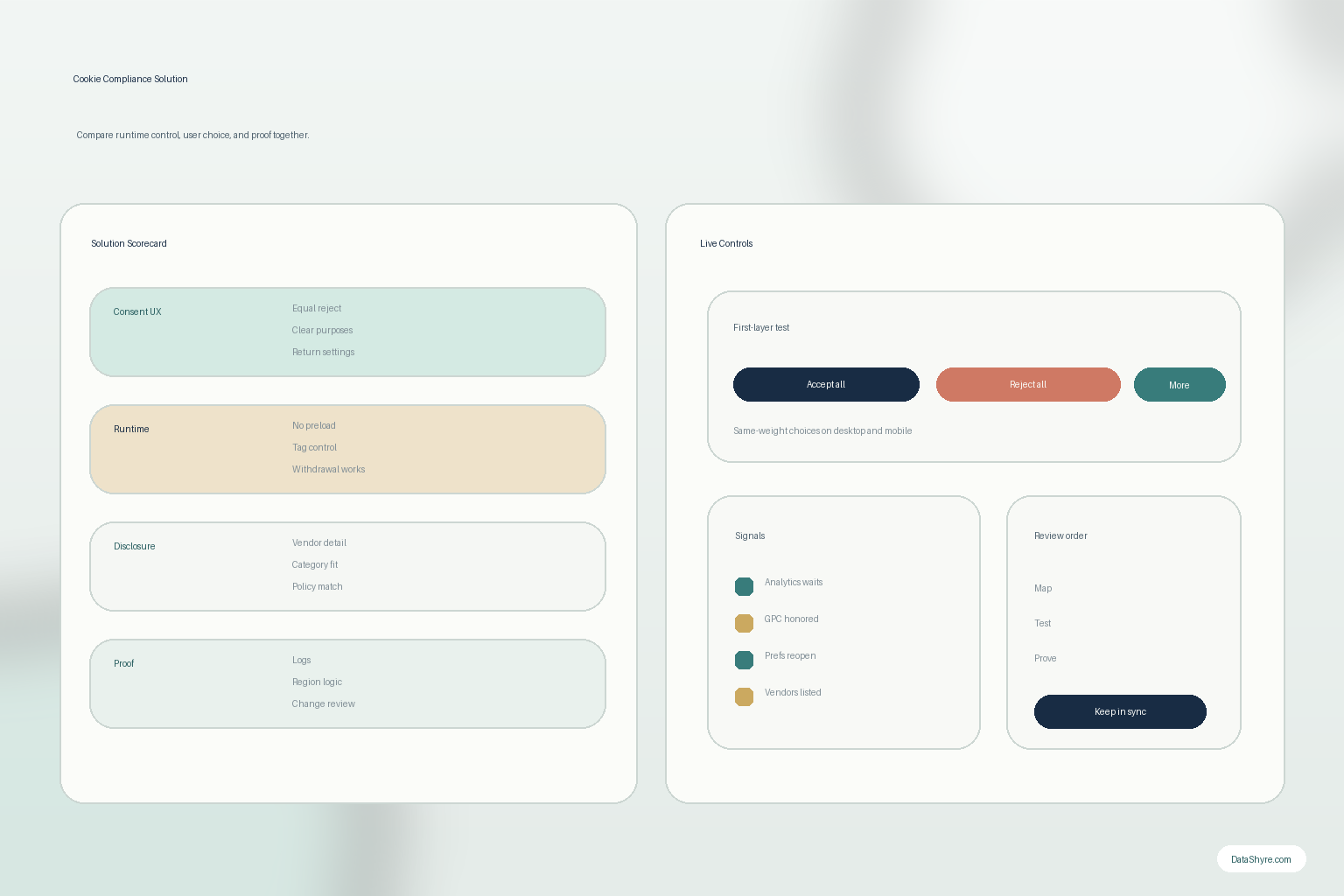
1. Start with the live technologies, not the purchasing page
The first cookie compliance solution mistake is shopping by UI screenshots.
A real solution has to govern the technologies that actually store or access information on the device and the downstream systems that react to the choice.
That means your review should start with:
- which scripts, pixels, tags, SDK-like embeds, or storage tools load on the site;
- which of them are necessary versus optional;
- which third parties receive data;
- which regions and legal models the site has to support; and
- which teams can change this behavior after launch.
If that inventory is missing, the cookie compliance solution comparison becomes theater. You end up comparing banners while the risky behavior sits in GTM, plugins, chat widgets, video embeds, analytics tags, and custom code.
2. Check whether it handles categories honestly, especially analytics
A weak cookie compliance solution uses broad labels like preferences or experience to hide what is really happening.
The DPC’s current answer on analytics cookies stays useful precisely because it is so direct: analytics cookies need consent. That matters because many teams still treat measurement as automatically harmless and therefore automatically exempt.
So when reviewing a cookie compliance solution, ask whether it can support a clean classification between:
- strictly necessary functionality;
- communication or transmission uses that may be exempt;
- analytics and measurement;
- advertising or cross-site tracking;
- personalization or recommendation logic;
- third-party embeds and support tooling.
If the solution cannot help your team keep those buckets accurate, it will slowly train the organization to publish vague labels that no longer match reality.
3. Make equal refusal and later withdrawal non-negotiable
This is one of the clearest live tests for a cookie compliance solution.
The ICO’s consent guidance says the mechanism should make it as easy to refuse consent as it is to accept. CNIL says the same idea even more plainly: rejecting cookies should be just as easy as accepting them.
That means a serious cookie compliance solution review should confirm:
Accept allandReject allare both visible when consent is required;- mobile layouts do not bury refusal behind an extra detour;
- silence or continued browsing is not treated as consent;
- preference-center toggles are not pre-enabled for optional purposes;
- users can revisit and withdraw choices later without hunting through the site.
If the tool looks compliant on desktop but nudges acceptance on mobile, or if withdrawal is technically possible but practically hidden, the control layer is weaker than the sales page suggests.
4. Test runtime enforcement, not only banner behavior
Many cookie compliance solution evaluations fail here.
The banner appears. The buttons work. The copy looks balanced. But optional analytics or advertising tags still fire before choice, or continue after withdrawal, because the runtime plumbing is incomplete.
So the useful question is not only does the banner show up.
The useful question is whether the solution can change what the browser and the downstream tag stack actually do when someone:
- lands on the page and does nothing;
- rejects optional technologies;
- accepts only selected categories;
- changes their mind later.
This is where vendor comparisons also get more realistic. If you are looking at a heavyweight platform, a lighter CMP, or a custom layer, the real difference is often not the first-layer design. It is how well the solution governs GTM, direct scripts, embedded tools, consent signals, and preference changes after launch.
That is also where DataShyre implementation help tends to matter. The practical cleanup usually sits between systems, not inside one product checkbox.
5. Require third-party visibility and purpose-level detail
The ICO’s guidance says users need clear and comprehensive information, including any third parties and specific information about each one. That requirement turns a cookie compliance solution into more than a consent-capture tool.
It needs to help the organization explain:
- who receives the data;
- why they receive it;
- which purposes rely on consent;
- where fuller vendor detail lives;
- how the site keeps those details current.
If your cookie compliance solution only generates generic category text but cannot keep vendor disclosures aligned with the live implementation, it creates one of the most common failure modes in privacy programs: polished first-layer choices backed by stale second-layer disclosures.
6. Make regional logic explicit instead of pretending one button solves everything
Another common cookie compliance solution mistake is flattening different legal actions into one vague interface.
In EU- and UK-facing contexts, the live question often turns on prior consent for non-exempt technologies. In California, the Department of Justice says Global Privacy Control is a stop selling or sharing my data switch, and covered businesses must honor it as a valid opt-out request for sale or sharing.
That means a mature cookie compliance solution should help your team separate:
- prior consent where required for optional technologies;
- California opt-out handling where sale or sharing rules apply;
- GPC signal handling;
- privacy-notice links and rights pathways;
- region-aware defaults and labels.
If the solution acts as if one generic banner captures all of those rights models automatically, it is overselling simplicity.
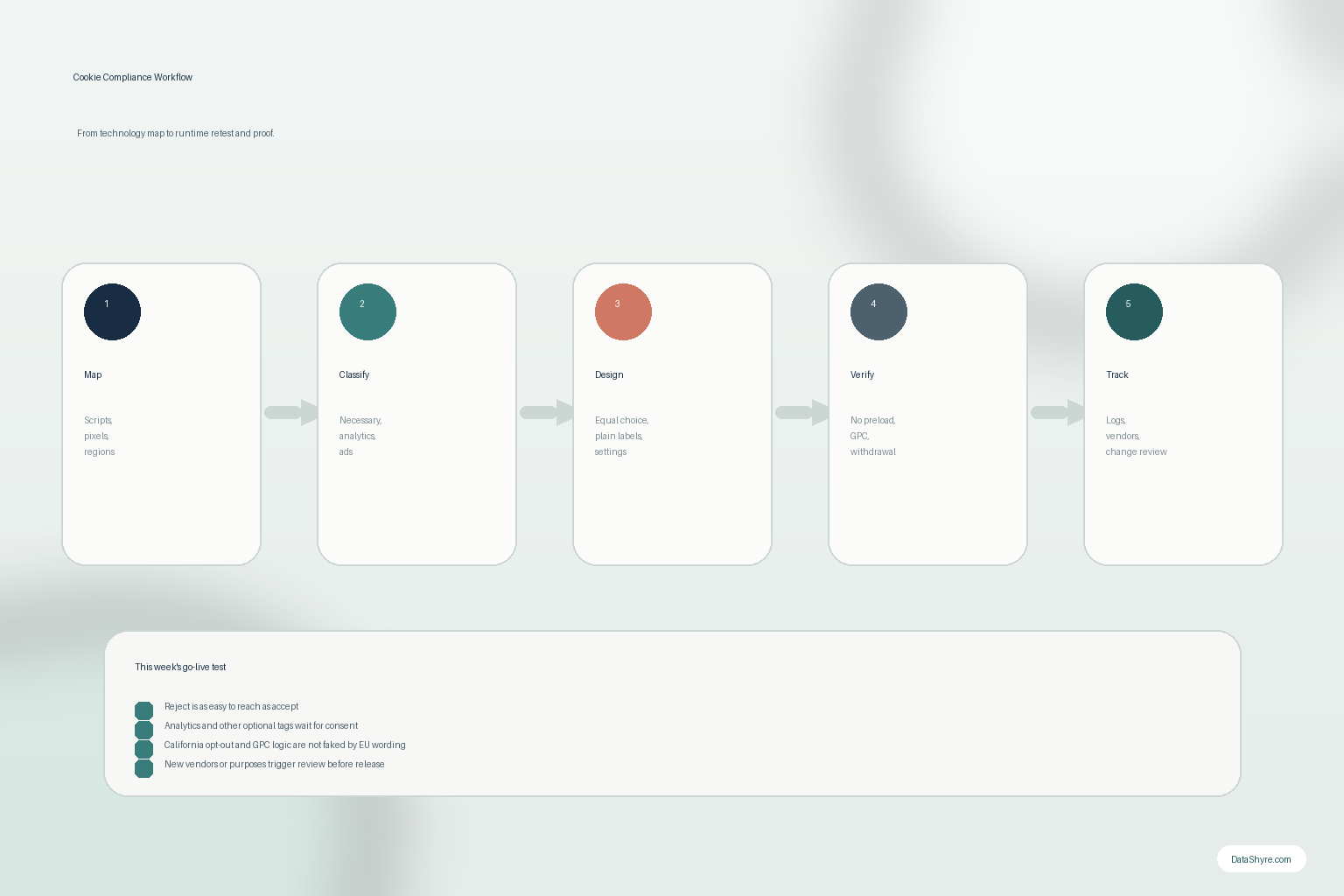
7. Buy evidence and change control, not only a launch asset
The biggest long-term cookie compliance solution failure is drift.
The ICO’s current guidance says that if you introduce new storage and access technologies for a different purpose than originally stated when consent was granted, you must obtain fresh consent for the new technology or purpose.
That means the right cookie compliance solution should support more than the first deployment. It should help your team prove what happened and detect when the setup no longer matches the story.
At minimum, I would want a cookie compliance solution to support:
- records of preference states and configuration changes;
- a usable way to revisit and update disclosures;
- trigger points for re-review when vendors or purposes change;
- testing across key templates, not only the homepage;
- clear ownership between privacy, marketing, engineering, and web operations.
If the tool gives you a banner but not an operating routine, it may reduce short-term friction while increasing long-term compliance debt.
A practical cookie compliance solution review for this week
If I were shortlisting a cookie compliance solution today, I would use this order:
- map the live technologies and jurisdictions first;
- verify how the solution classifies analytics and other optional uses;
- test equal accept and reject paths on desktop and mobile;
- inspect what fires before choice, after rejection, after acceptance, and after withdrawal;
- verify third-party and purpose-level disclosure support;
- check California opt-out and GPC handling where relevant;
- confirm how the team will keep the setup accurate after stack changes.
That order exposes more real risk than a side-by-side feature table alone.
FAQ
Is a cookie compliance solution the same as a CMP?
Often people mean something close to the same category. In practice, a cookie compliance solution may be a full CMP, a lighter consent layer, or a custom-built control stack. The real question is what it can govern and prove.
Can I build a cookie compliance solution in-house?
Yes, but only if your team can reliably handle runtime blocking, category logic, third-party disclosures, rights routing, regional variation, and ongoing change control. Building the banner is the easy part.
Do analytics cookies really need consent?
Ireland’s DPC still says yes. That is one reason any cookie compliance solution review should pressure-test how analytics are classified and when they are allowed to fire.
Bottom line
The best cookie compliance solution in 2026 is not the one with the nicest banner preview.
It is the one that:
- governs the real technologies in use;
- makes refusal and withdrawal genuinely easy;
- keeps analytics and other optional uses classified honestly;
- supports California opt-outs and GPC where relevant;
- proves what happened after the click; and
- stays aligned as the stack changes.
If those checks pass, the solution is useful.
If they do not, it is just a better-looking prompt to click Accept.
Official sources used
- ICO, How do we manage consent in practice?: https://ico.org.uk/for-organisations/direct-marketing-and-privacy-and-electronic-communications/guidance-on-the-use-of-storage-and-access-technologies/how-do-we-manage-consent-in-practice/
- ICO, Guidance on the use of storage and access technologies: https://ico.org.uk/for-organisations/direct-marketing-and-privacy-and-electronic-communications/guidance-on-the-use-of-storage-and-access-technologies
- CNIL, Dark Patterns in Cookie Banners: https://www.cnil.fr/en/dark-patterns-cookie-banners-cnil-issues-formal-notice-website-publishers
- Data Protection Commission, Do I need consent for analytics cookies?: https://www.dataprotection.ie/en/faqs/cookies/do-i-need-consent-analytics-cookies
- California Department of Justice, Global Privacy Control (GPC): https://oag.ca.gov/privacy/ccpa/gpc