

Cookie Disclaimer in 2026: Why a Warning Alone Is Not Enough
If you are searching for cookie disclaimer on November 14, 2026, the fastest useful answer is this:
A cookie disclaimer can help with notice, but it is not enough on its own.
If your site stores or reads non-essential cookies before a real choice, hides the reject path, or treats a vague footer warning as compliance, the setup is weak no matter how polite the wording sounds.
That is still the practical legal baseline in late 2026. The ePrivacy rules still require “clear and comprehensive information” and a right to refuse. The ICO still says you cannot set non-essential cookies before consent. The EDPB’s consent summary still says withdrawal must be “as easy as giving it”. And France’s CNIL still says rejecting cookies should be “just as easy as accepting them.”
If you want the closest companion reads first, start with our guides to cookie policy, cookie notice, and what is cookie consent. This page stays narrower. It is the cookie disclaimer review I would use this week before approving a banner, popup, or footer message on a live site.
If your team needs help turning a banner warning into a working control, DataShyre can help with consent management, data mapping, and DSR automation so the notice layer matches the runtime behavior behind it.

1. Separate the disclaimer from the consent mechanism
The first cookie disclaimer mistake is assuming the warning text is the control.
It is not.
At best, the disclaimer is one part of the information layer. The actual control is the combination of:
- what technologies are blocked before choice;
- how the choice is presented;
- whether refusal is genuinely available;
- whether users can change their minds later; and
- whether the site can prove what happened.
If the team keeps polishing the sentence but never tests the underlying behavior, the cookie disclaimer is doing branding work, not compliance work.
2. Check what the site really stores or reads before the disclaimer appears
The ePrivacy baseline is still about storing or accessing information on the user’s device, not only about classic banner aesthetics.
That means a serious cookie disclaimer review should begin with the live page:
- open the site in a clean browser;
- inspect first-load requests, tags, and storage behavior;
- check cookies, local storage, and similar technologies;
- identify which tools are strictly necessary and which are optional; and
- compare that list with what the disclaimer claims.
This is where many sites fail early. The message may say we value your privacy while analytics, ad tech, session-replay tooling, or personalization identifiers are already active.
3. Do not let the disclaimer stand in for prior consent
This is the biggest operational gap.
The ICO’s live guidance still says you cannot set non-essential cookies on the homepage before the user consents to them. The Planet49 judgment also remains the cleanest judicial reminder that pre-ticked boxes do not produce valid consent.
So when reviewing a cookie disclaimer, ask the blunt question first:
Did anything optional fire before the choice?
If the answer is yes, the text on the banner is not rescuing the implementation.
That check should include:
- analytics tools;
- advertising and retargeting tags;
- social embeds or video players that store identifiers;
- A/B testing or personalization tools; and
- third-party scripts that quietly write or read browser storage.
4. Make refusal as easy as acceptance
A weak cookie disclaimer often nudges people toward the accept path while burying refusal behind softer text, extra clicks, or second-layer friction.
That is risky.
CNIL’s position is still straightforward: rejecting cookies should be “just as easy as accepting them.” The EDPB’s cookie-banner taskforce also treated missing or obscured reject options as a serious consent problem.
So a practical cookie disclaimer review should confirm:
- the first layer clearly signals that this is about cookies or similar technologies;
Acceptis not visually privileged overReject;- refusal is available without hunting through a maze;
- the wording is specific enough for a normal person to understand the consequences; and
- the design does not imply that access depends on clicking yes when that is not actually necessary.
If the banner behaves like a sales funnel, the cookie disclaimer is likely hiding a design problem, not solving one.
5. Pair the disclaimer with a deeper policy page
A cookie disclaimer should not try to carry every detail by itself.
The short layer can introduce the issue, but the wider documentation still needs to explain:
- what categories of cookies or similar technologies are used;
- the purpose of each category;
- who sets them, including relevant third parties;
- how long they persist where that is relevant;
- how the user can withdraw or revisit choices; and
- how the cookie layer fits with the broader privacy notice.
That is why a cookie disclaimer works best when it routes into a credible policy and preference flow instead of pretending one sentence can do the whole job.
6. Test the return path, not only the first decision
Many banners look reasonable on first visit and then fall apart later.
The EDPB’s consent summary still says withdrawing consent must be “as easy as giving it.” That means the cookie disclaimer review should not end once the first-layer banner closes.
Check whether people can:
- reopen preferences from a visible link or icon;
- reverse an earlier choice without excessive friction;
- trigger real downstream changes after withdrawal; and
- do the same on mobile, logged-in, and localized versions of the site.
If the only easy action is the first acceptance click, the control is drifting out of shape.
7. Keep proof that the disclaimer matched the live behavior
This is where the topic becomes operational.
The right cookie disclaimer setup leaves behind evidence that still makes sense later:
- the banner version that was live;
- the categories and purposes shown at the time;
- the consent or refusal event recorded;
- the tag or storage state that followed; and
- the path for later withdrawal.
That record matters because complaints and regulator questions rarely focus on the elegance of the sentence. They focus on whether the site behaved the way the banner implied it would behave.
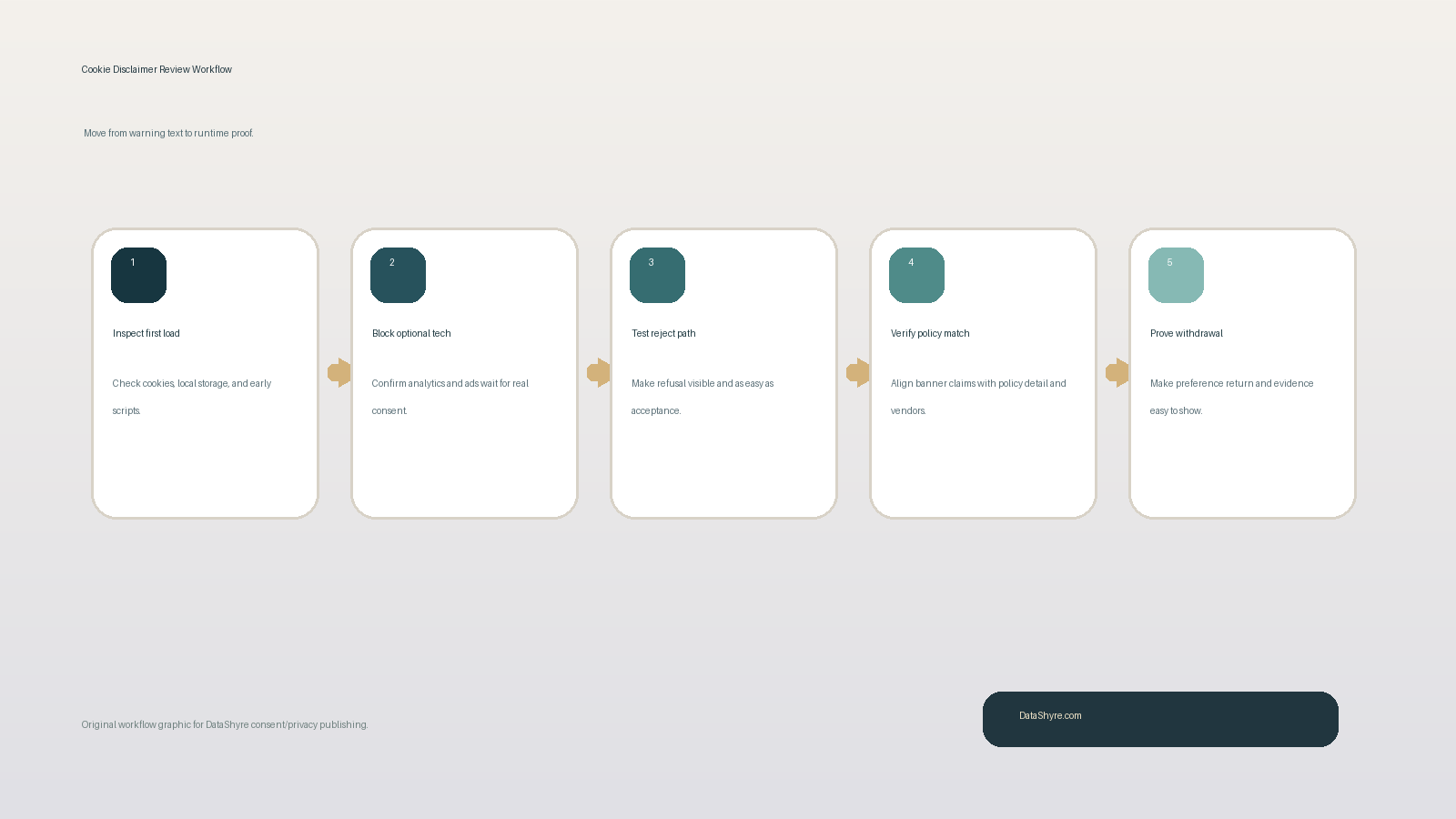
A practical cookie disclaimer review for this week
If I were reviewing a cookie disclaimer this week, I would use this order:
- inspect the live page to see what storage or access happens before choice;
- confirm which technologies are genuinely necessary and which need consent;
- test whether optional tools stay blocked until a real user action;
- compare the accept path and reject path for equal clarity and effort;
- verify that the disclaimer routes into a fuller cookie-policy and privacy layer;
- test the withdrawal or preference-return path on real devices; and
- save evidence that connects the wording to the runtime behavior.
That order catches more truth than banner copy review alone.
FAQ
Is a cookie disclaimer the same as cookie consent?
No. A cookie disclaimer is usually a notice or warning layer. Cookie consent is the actual legal and technical control for optional cookies and similar technologies where consent is required.
Can a website use only a cookie disclaimer without a preferences tool?
Sometimes a simple notice may be enough for strictly necessary technologies, but once optional analytics, advertising, personalization, or similar tracking enters the stack, a disclaimer alone is usually not enough.
What is the biggest risk with a cookie disclaimer?
The biggest risk is thinking the wording solved the problem while the site still drops non-essential cookies too early, hides refusal, or makes withdrawal harder than acceptance.