

Privacy Statement Template in 2026: 7 Checks Before You Publish
If you are searching for a privacy statement template on November 5, 2026, the practical question is not where can I copy a page.
It is how do I stop a template from turning into a false public promise.
That is the real job now.
Many teams use privacy statement and privacy policy almost interchangeably, but the operating problem is the same either way: the published statement has to match the live collection flow, the real vendor stack, the user-rights path, and the way tracking or sharing actually happens after launch.
Current official guidance still pushes in that direction. California’s Department of Justice says businesses post privacy policies on their website homepage, in stores, or on the download or landing page of a mobile app, and says the policy should be “updated at least once a year.” California’s effective January 1, 2026 CCPA regulations say the privacy policy must be posted online through a conspicuous link using the word privacy, must be printable, and must describe online and offline information practices plus the rights consumers have and the information they need to exercise them. On the EU and UK side, Article 12 GDPR still requires a notice to be presented in a concise, transparent, intelligible, and easily accessible form using clear and plain language, while Article 13 GDPR still expects the statement to explain key notice facts such as purposes, legal basis, recipients, retention, transfers where relevant, and rights. The ICO adds an important operating rule: if you plan to use personal data for a new purpose, you should update the privacy information and “proactively bring this change to their attention before you start any new processing.” The FTC’s business guidance puts the enforcement angle plainly: if your company makes privacy promises, it has to “live up to those claims.”
If you want nearby context first, start with our guides to online privacy policy, privacy policy template for website, and website privacy policy template. This page stays narrower. It is the privacy statement template review I would use this week before publishing one on a live site, app, or campaign flow.
If your team is trying to connect statement language to the systems behind it, DataShyre can help through data mapping, consent management, and DSR automation. The hard part is usually not drafting a statement. It is making sure the statement stays true after the stack, forms, or vendors change.
1. Start with the live collection map, not the template
The most common privacy statement template failure happens before anyone edits a sentence.
The team starts from generic language instead of the live collection map.
That usually creates a page that sounds careful and is still wrong.
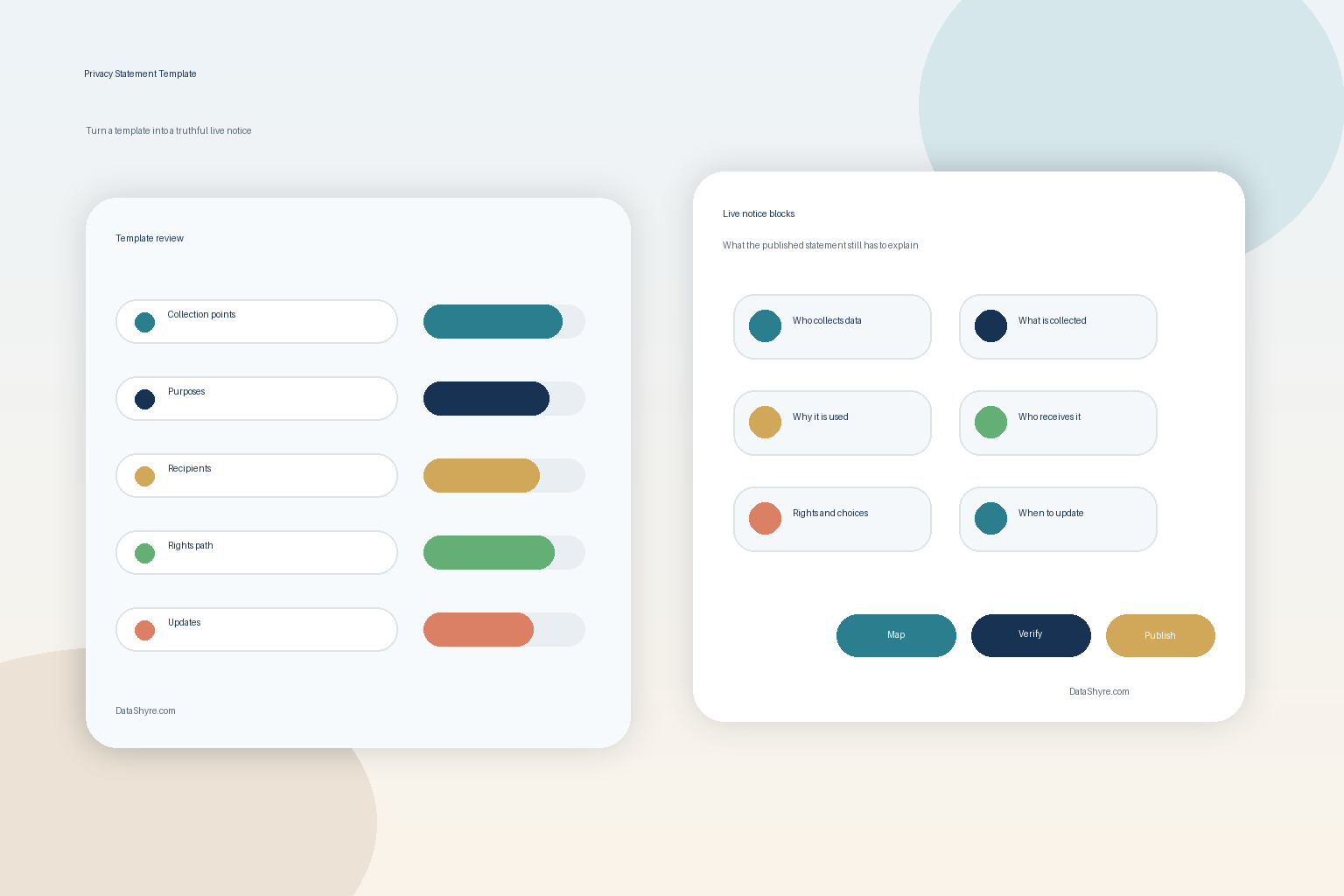
Before reviewing any privacy statement template, map the real collection points first:
- contact, demo, signup, and checkout forms;
- mobile-app registration or download paths;
- analytics, advertising, and consent tools;
- support widgets, schedulers, or chat tools;
- account areas and product telemetry; and
- third-party embeds, plugins, or integrations.
California DOJ’s consumer guidance still frames the practical questions well: what is collected, how it is collected, why it is collected, how it is used, who gets access, and what choices the person has. That is a useful template-review standard because it begins with the system, not the prose.
So the live map should become the source material.
The template is only the structure you use to explain it.
2. Check whether the template covers the disclosure blocks regulators still expect
A polished privacy statement template can still omit the sections people and regulators need most.
That is why structure matters more than tone.
The current California rules say the privacy policy must give consumers a comprehensive description of the business’s online and offline information practices, explain the rights they have, and provide the information necessary to exercise those rights. GDPR notice duties still add the blocks many generic templates miss, including purposes, legal basis, recipients, retention, and transfer information where relevant.
So a working privacy statement template usually needs clear sections for:
- who operates the site, app, or service and how to contact them;
- what categories of personal data are collected;
- where that data comes from;
- why each category is used;
- the legal basis where GDPR or UK GDPR applies;
- who receives the data or what categories of recipients receive it;
- how long the data is kept or how retention is decided;
- what rights or choices people have; and
- how they actually submit a request or change a setting.
If the template cannot support those sections without turning vague, it is probably too thin for 2026.
3. Treat the statement page and the collection points as one disclosure system
One reason a privacy statement template fails in production is that the final page is drafted in isolation from the places where people actually hand over the data.
California’s DOJ still says notice at collection must appear at or before the point of collection and must link back to the privacy policy for the fuller explanation. California’s broader privacy-policy guidance also points users to website homepages, app landing or download pages, and app settings as the places where these disclosures should be reachable.
That means a serious privacy statement template review should test whether the disclosure layer works across:
- the full statement page;
- form-level or point-of-collection notices;
- mobile-app landing or download screens;
- logged-in privacy settings; and
- any other collection surface where the person needs context before choosing.
The question is not only did we publish the statement.
It is can a user reach the right explanation at the moment the data journey begins.
4. Give cookies, tracking, and third-party tools their own honest section
Many weak privacy statement template pages still hide all runtime tracking inside vague phrases like usage information or trusted partners.
That is rarely enough now.
If the site or app uses cookies, pixels, SDKs, embedded video, chat, analytics, or ad-tech, the statement should explain in plain language:
- what technologies are in use;
- whether they are necessary, analytics, advertising, personalization, or support-related;
- whether another party receives information through them;
- how consent, opt-out, or browser-based controls affect them; and
- where the person can review or change those settings later.
This does not mean turning the privacy statement template into a giant tracker export.
It does mean the published statement should not pretend the business only collects data through visible forms if the live environment is also collecting through browser or app-level tools.
5. Make the rights and opt-out section operational, not decorative
This is where many polished privacy statement template pages still fail.
Listing rights is easy.
Showing people how to use them is harder.
California’s guidance still points consumers to the privacy policy for instructions on how to submit requests to know, delete, or correct personal information, and for how to use opt-out choices. GDPR and ICO transparency guidance still push toward a notice that is easy to understand and easy to act on.
That means the final privacy statement template should explain:
- which rights apply in the relevant jurisdictions;
- how a person submits a request;
- where opt-out, consent, or privacy-choice controls appear;
- whether account holders have an in-product settings path;
- whether browser-based controls such as Global Privacy Control are honored where applicable; and
- what the person should expect after the request is submitted.
The rights section should work like wayfinding.
If the user has to guess where to go next, the disclosure is incomplete where it matters most.
6. Reconcile the statement with the real vendor stack and the promises you are making
A risky privacy statement template is often not the one with the fewest words.
It is the one that describes a business that no longer exists.
The FTC’s business guidance says that if a company makes privacy promises, it must “live up to those claims.” The FTC’s March 30, 2026 action involving Match and OkCupid is a useful reminder because the agency said the company shared personal information with an unrelated third party contrary to its privacy promises.
That is the practical review standard for a privacy statement template in 2026:
- compare the published statement against the live vendor stack;
- compare it against the tracking and sharing that really happen;
- compare it against app behavior and settings paths; and
- compare it against the rights workflow the person actually experiences.
Generic lines like we may share information with trusted partners are not very helpful.
Concrete recipient categories are better because they are easier to test and easier to keep current.
7. Treat template updates as product-change work, not a yearly chore
California DOJ says the policy should be “updated at least once a year.”
That is a floor, not a workflow.
The ICO’s drafting guidance is the more useful operating rule because it says organizations should update privacy information before a new purpose begins and bring the change to people’s attention first.
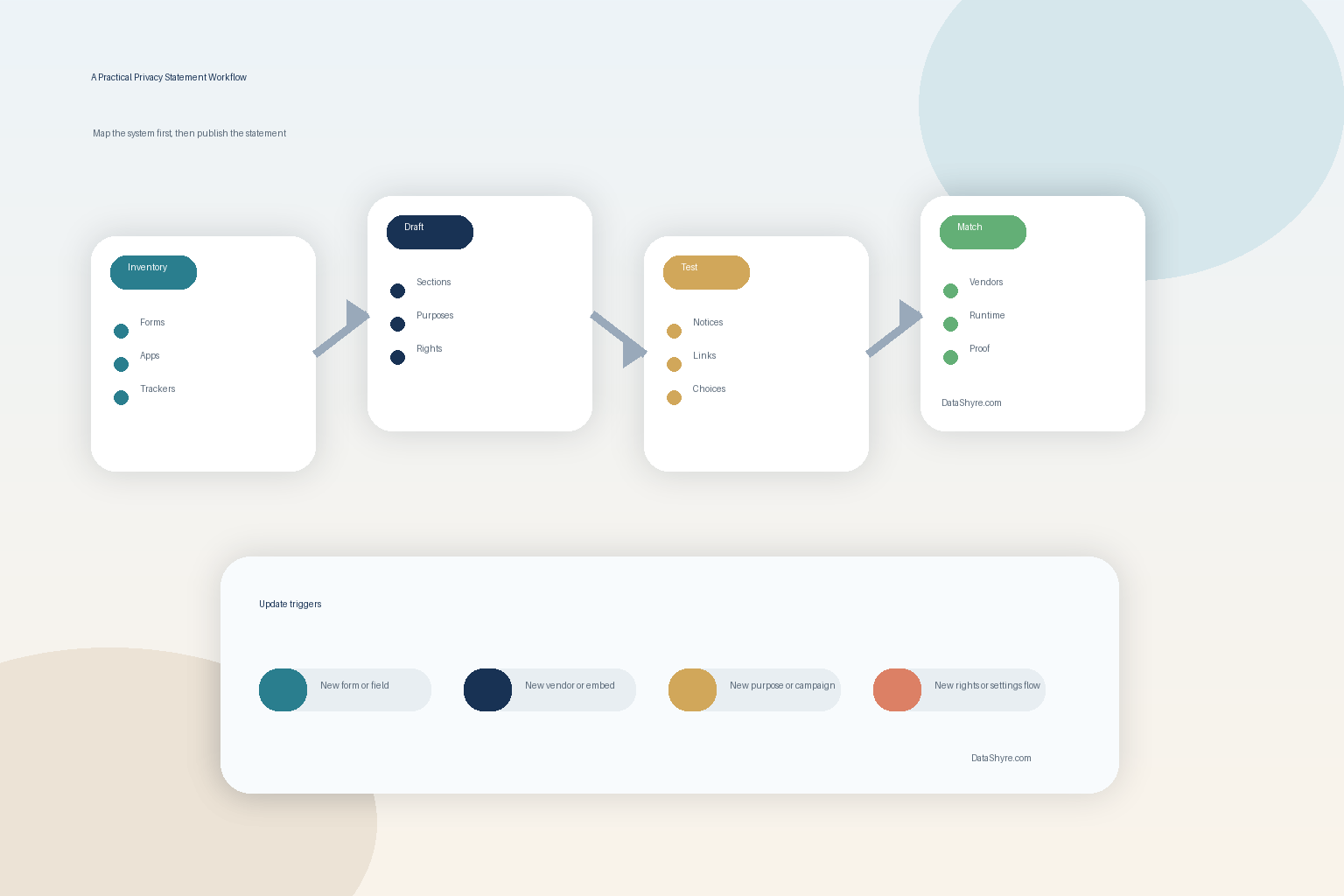
So a better privacy statement template workflow is to trigger review whenever:
- a new form or field is added;
- a new plugin, SDK, pixel, or embed goes live;
- a new vendor or processor is onboarded;
- a new marketing, analytics, or personalization purpose begins;
- a new rights or settings flow is launched; or
- a retention rule changes.
That is how the statement stays aligned with the product instead of becoming stale legal copy.
A practical 7-step review for this week
If I were approving a privacy statement template this week, I would use this order:
- map the real collection points and vendors first;
- fill the core sections for collection, purposes, recipients, retention, rights, and contacts;
- connect point-of-collection notices and app or website entry points back to the full statement;
- add an honest branch for cookies, tracking, and third-party tools;
- test whether the rights and opt-out paths described in the statement actually work;
- compare the statement against the live site, app, or campaign behavior; and
- tie future product or vendor changes to a required statement review.
That order produces a stronger result than polishing template language before anyone has checked the actual system.
FAQ
Is a privacy statement template the same thing as a privacy policy template?
Often yes in practice, but teams may use privacy statement when the notice covers a broader digital or cross-channel experience instead of only a public website page. The important issue is not the label. It is whether the notice matches the real data use.
Is a privacy statement template enough on its own?
No. It is the disclosure layer, not the whole privacy program. The runtime tracking behavior, vendor controls, consent choices, and rights operations still have to match what the statement says.
When should I update a privacy statement built from a template?
Update it whenever the underlying processing changes, especially after new forms, vendors, purposes, settings flows, or collection technologies are introduced.
Bottom line
The best privacy statement template in 2026 is not the one that sounds the most official.
It is the one that still matches the real collection flow, the real rights path, the real vendor stack, and the real runtime behavior after the page goes live.
Sources
- California Department of Justice, How to Read a Privacy Policy: https://oag.ca.gov/privacy/facts/online-privacy/privacy-policy
- California Department of Justice, California Consumer Privacy Act (CCPA): https://oag.ca.gov/privacy/ccpa
- California Privacy Protection Agency, FAQs: https://cppa.ca.gov/faq
- California Privacy Protection Agency, CCPA effective January 1, 2026 regulations PDF: https://cppa.ca.gov/regulations/pdf/ccpa_statute_eff_20260101.pdf
- EUR-Lex, GDPR text (Articles 12 to 14): https://eur-lex.europa.eu/eli/reg/2016/679/
- European Commission, information for individuals under the GDPR: https://commission.europa.eu/law/law-topic/data-protection/information-individuals_en
- ICO, how to draft privacy information: https://ico.org.uk/for-organisations/uk-gdpr-guidance-and-resources/individual-rights/the-right-to-be-informed/how-should-we-draft-our-privacy-information/
- FTC business guidance, Privacy and Security: https://www.ftc.gov/business-guidance/privacy-security
- FTC, Match and OkCupid privacy action: https://www.ftc.gov/news-events/news/press-releases/2026/03/ftc-takes-action-against-match-okcupid-deceiving-users-sharing-personal-data-third-party