

Consent Manager in 2026: 7 Live Checks Before You Trust One
If you are searching for the right consent manager in 2026, the real question is not which tool has the nicest banner template.
The real question is whether the consent manager turns a person’s choice into actual behavior across scripts, tags, embeds, regional rights, and later withdrawal.
If you want companion reading first, start with our guides to cookie consent manager, consent management platform, and consent management platform best practices. This page is narrower. It is the seven-check review I would use this week before trusting any consent manager in production.
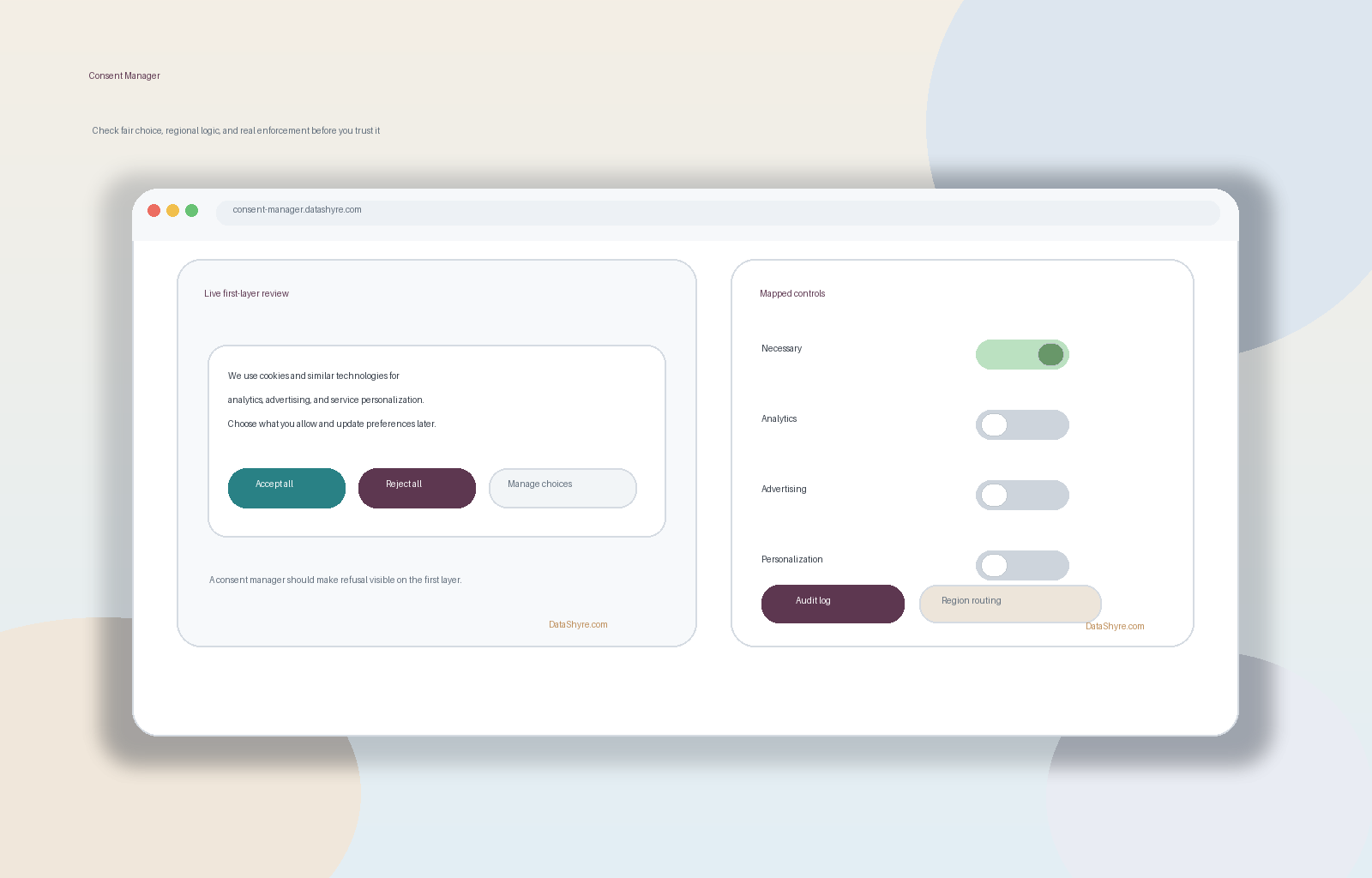
Why a consent manager now has to be more than a banner
A strong consent manager now acts like runtime control, not decoration.
The current official materials all push in that direction. The European Commission still says valid consent should be presented in “clear and plain language” and that withdrawal should be “as easy to use as giving consent.” The UK’s ICO published its final storage-and-access-technologies guidance on April 29, 2026 and made clear that the review is broader than classic browser cookies by covering tracking pixels, device fingerprinting, web storage, and similar technologies. So a serious consent manager review has to test what the stack actually does, not just what the banner says.
1. Start with whether the first layer gives a fair choice
The first test for any consent manager is whether a person sees a fair choice immediately.
That sounds basic, but it is still where weak deployments fail.
The European Data Protection Board’s practical examples continue to say consent needs a “clear affirmative action.” CNIL’s current banner enforcement language is even more direct: rejecting cookies should be “just as easy as accepting them.” California’s privacy enforcement uses different words but lands in the same place. The CPPA warns that “Dark patterns aren’t about intent, they’re about effect.”
So before you compare feature checklists, test the live interface:
- Is
Reject allavailable whereAccept allis available? - Is the privacy-protective choice equally visible on mobile?
- Are the labels explicit instead of evasive?
- Does rejection take the same number of steps as acceptance?
If the answer is no, the consent manager is already asking the user to carry the compliance gap.
2. Verify that optional technologies stay off before choice
The next question is whether the consent manager controls optional technologies before they start where prior consent is required.
This is where many teams over-trust dashboards.
The ICO’s finalized 2026 guidance is useful because it pushes the review beyond cookie names alone. A live test should include the pages most likely to leak first:
- landing pages with analytics and ad tags;
- article templates with video, chat, or social embeds;
- signup and checkout flows with personalization tools;
- cached or edge-served pages; and
- tag-manager paths that change more often than legal review does.
If optional technologies still run before a person acts, the consent manager is recording preference after the fact instead of enforcing it beforehand.
3. Test the sequence, not only the saved preference
Many implementations look healthy because the admin view stores accepted or rejected.
For a serious consent manager review, that is not enough.
The better question is whether the sequence works correctly:
- default states land before optional measurement starts;
- the person takes a valid action;
- consent signals update downstream tools on the same page;
- later page loads honor the stored state; and
- withdrawal changes behavior after the user changes their mind.
The EDPB’s examples still reject two shortcuts that weak deployments keep reviving. Scrolling is not valid consent, and a cookie wall that blocks the core service until the person accepts optional tracking does not create freely given consent.
A consent manager that depends on passive browsing, delayed updates, or hidden fallback paths is weaker than the UI suggests.
4. Make regional branching part of the product review
One consent manager may handle visitors from the EU, UK, California, and other U.S. states at the same time.
That does not mean one branch is enough.
For EU and UK traffic, the usual question is whether optional storage and access technologies wait for valid prior consent. In California, the review may shift toward opt-out handling, sale or sharing analysis, and browser-based privacy signals where they apply. California’s Department of Justice still describes Global Privacy Control as a “stop selling or sharing my data switch” and says covered businesses must honor it as a valid consumer request. The Attorney General’s February 11, 2026 Disney settlement also made the friction problem concrete: Disney agreed to pay $2.75 million and implement opt-out methods that fully stop sale or sharing across associated devices and services.
That is why the live consent manager review should deliberately test:
- an EU or UK first visit with no saved preference;
- a California visit where opt-out rights apply;
- a GPC-enabled browser;
- a return visit after refusal or acceptance; and
- whether the text shown to the person still matches the branch they are actually in.
If a vendor demo cannot explain those branches clearly, the consent manager is not ready for a multi-region production role.
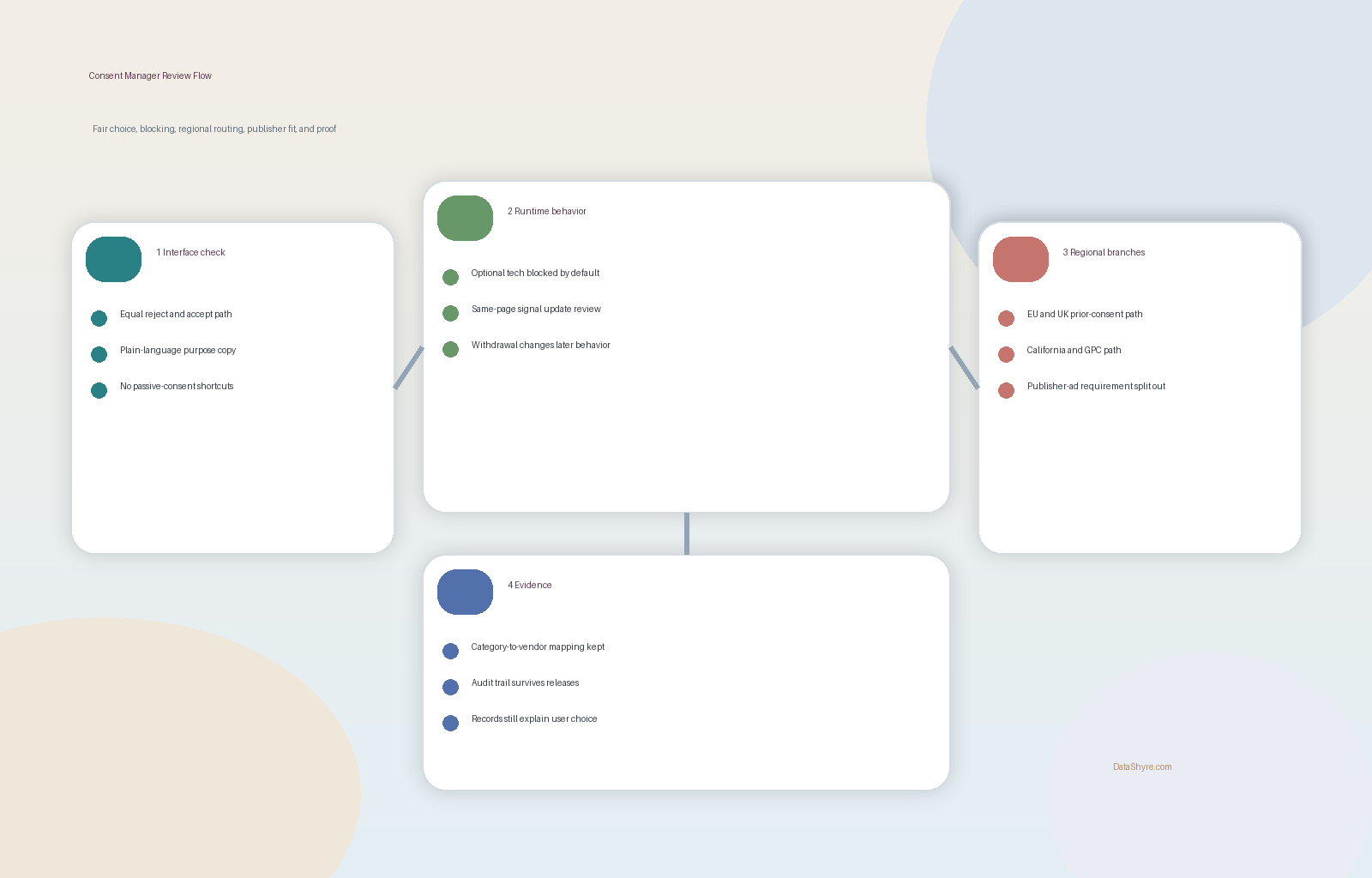
5. Separate publisher-ad requirements from general website review
This is one of the most missed consent manager checks for ad-supported properties.
General website consent quality and Google’s publisher requirements overlap, but they are not the same review.
Google’s current publisher guidance still says partners using AdSense, Ad Manager, or AdMob must use a Google-certified CMP integrated with the IAB Transparency and Consent Framework when serving personalized ads to users in the EEA and UK as of January 16, 2024, and in Switzerland as of July 31, 2024. Google also says its CMP assessments do not check a tool for full compliance with applicable privacy laws.
So if publisher ads matter, ask two separate questions:
- does the consent manager satisfy the relevant Google publisher-program requirement; and
- does the broader deployment still satisfy your legal, UX, and operational review.
Passing one does not automatically answer the other.
6. Inspect how the categories map to the technologies underneath
Another useful consent manager check is whether the plain-language layer and the technical layer still tell the same story.
The European Commission’s baseline remains practical here: the request should be specific, informed, and presented in language normal people can understand.
In practice, that means your consent manager should let you present direct categories such as:
NecessaryAnalyticsAdvertisingPersonalization
Then it should let you map vendors, scripts, and tags into those categories without contradiction.
If the front-end says Analytics while the underlying branch also enables ad-tech or unrelated third-party sharing, the category language is doing less legal and operational work than the interface implies.
7. Keep records that still explain what happened after the stack changes
The long-term version of a good consent manager is record quality.
Your team should be able to explain a specific user journey after a redesign, vendor swap, script-order change, or policy update.
That usually means keeping enough evidence to answer:
- what notice or banner version was shown;
- what categories or purposes were available;
- what the person chose and when;
- what region or rule set applied; and
- whether runtime behavior matched the recorded state.
If the consent manager keeps a row in a consent table but cannot connect that row to actual behavior, the proof is thinner than it looks.
A short review order for this week
If I were reviewing a consent manager today, I would use this order:
- compare
Accept allandReject allon desktop and mobile; - test prior blocking on the pages most likely to leak;
- confirm the consent-signal sequence on first load, update, and withdrawal;
- run separate EU or UK and California or GPC branches;
- split out the Google publisher requirement if ads matter;
- inspect category wording against the actual tools underneath it; and
- keep records that another teammate can still explain later.
That usually tells you more than another vendor demo.
FAQ
Is a consent manager the same thing as a CMP?
Often people use the terms interchangeably, but the useful review question is narrower: does the product actually manage the notice, the signal, the regional branch, and the resulting runtime behavior in a way your team can verify.
Can one consent manager cover both GDPR-style consent and California opt-out handling?
Sometimes, yes, but only if it supports separate legal and technical branches instead of flattening everything into one banner path.
If a consent manager is Google-certified, is that enough?
No. Google’s own publisher help says certification is tied to Google’s criteria and does not check the tool for full compliance with applicable privacy laws.
Bottom line
The most useful way to evaluate a consent manager in 2026 is to treat it like infrastructure.
Test whether the first choice is fair, whether optional technologies really wait when they should, whether regional differences are handled deliberately, whether publisher requirements are reviewed separately, and whether the records still explain what happened after the next change.
If those pieces line up, the consent manager is doing real work. If not, it is just decorating a privacy gap.
Sources
- European Commission: Legal grounds for processing data
- EDPB: Practical examples on consent
- ICO: Final storage and access technologies guidance published, April 29, 2026
- ICO: Guidance on the use of storage and access technologies
- CNIL: Dark Patterns in Cookie Banners: CNIL issues formal notice to website publishers
- California Department of Justice: Global Privacy Control
- California Department of Justice: Attorney General Bonta Announces $2.75 Million Settlement with Disney
- California Privacy Protection Agency: Enforcement Advisory Stresses the Importance of Avoiding Dark Patterns
- Google AdSense Help: Google consent management requirements for serving ads in the EEA, the UK and Switzerland (for CMPs)
- Google AdSense Help: Certified CMP list for publishers
—
Published: October 21, 2026. Updated using current official regulator, government, and platform materials available at publication time.