

Cookie Consent Message Examples in 2026: 7 Patterns That Still Hold Up
Most teams looking for cookie consent message examples are not really asking for prettier banner text.
They are asking for copy that survives legal review, product review, and browser testing at the same time.
That is the right question in 2026. A message can sound polite and still fail because the purposes are vague, the refusal path is weaker than acceptance, or the live tags do not obey the choice the banner promises.
If you want adjacent context first, start with our guides to cookie consent message, cookie consent requirements, and CCPA cookie consent requirements. This article is narrower. It focuses on cookie consent message examples you can adapt this week without pretending every site has the same legal branch.
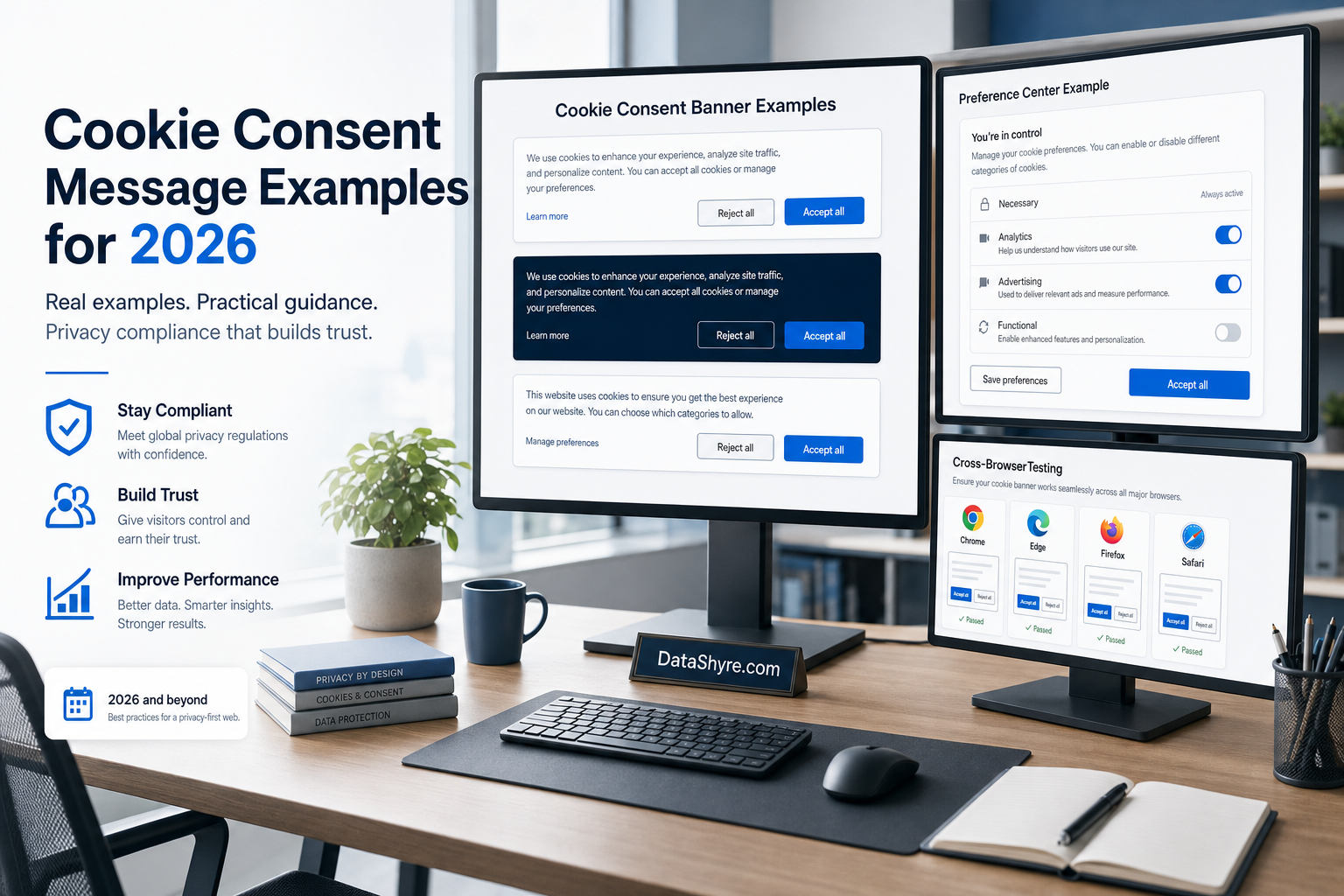
What the message has to do now
In practice, a strong cookie consent message example has to do four things at once:
- explain real purposes in plain language;
- offer a fair choice, not a nudged one;
- fit the region-specific privacy model the visitor is actually seeing; and
- match the technical behavior behind the banner.
That is why the official language still matters. The European Commission says consent information should be presented in “clear and plain language” and that withdrawing consent must be “as easy to use as giving consent.” The UK’s ICO also widened the practical review on April 29, 2026 by finalizing guidance that covers cookies, tracking pixels, device fingerprinting, and similar storage-and-access technologies. So a modern message cannot be written as if the only risk is one analytics cookie.
Pattern 1: the short first-layer message for opt-in markets
For many EU and UK-facing sites, the cleanest cookie consent message example is still the short version:
We use cookies and similar technologies to measure traffic, remember settings, and support advertising where you allow it. You can accept all, reject optional technologies, or manage preferences. You can change your choice any time in Cookie Settings.
Why this holds up:
- it names actual purposes instead of saying only “improve your experience”;
- it gives the user three clear paths;
- it points to later withdrawal; and
- it avoids passive-consent language like “By continuing to browse…”
This pattern works best when the site also presents Accept all, Reject all, and Manage preferences with equal visibility on the first layer.
Pattern 2: the balanced message when categories matter
Some sites need one more line because the stack is more complex. In that case, a better cookie consent message example looks like this:
We use necessary technologies to keep the site working, plus optional analytics, advertising, and personalization tools if you allow them. Choose
Accept all,Reject all, orManage preferencesto decide by category.
This version is useful because it separates necessary functions from optional ones right away.
That distinction matters in real reviews. If the message blurs everything into one bundle, the visitor cannot tell what is required for the site and what is only there for measurement or monetization.
Pattern 3: the fairness test for button language
Many cookie consent message examples fail because of the controls around the copy, not the sentence itself.
France’s CNIL still states that rejecting cookies should be “just as easy as accepting them.” California enforcement language pushes the same direction. The CPPA’s dark-pattern advisory says the review is about the effect of the interface, and the CPPA summarized the point in a short line: “Dark patterns are not about intent, they are about effect.”
So your button set should read like this:
Accept allReject allManage preferences
Avoid softer refusal labels like Maybe later, Continue without, or Decline some if they make the refusal path less explicit than the acceptance path.
The wording should describe the action, and the layout should not quietly tell a different story.
Pattern 4: the California branch that says what is actually happening
A California-facing flow often needs a different cookie consent message example because the legal question is not always prior opt-in for all optional technologies.
When sale or sharing is in scope, the clearer pattern is:
We use cookies and similar technologies for analytics, advertising, and site features. California residents can ask us to stop selling or sharing personal information. You can use
Your Privacy Choicesor a recognized browser privacy signal to make that choice.
This pattern works because it reflects the actual California rights frame more honestly.
The California Department of Justice still describes Global Privacy Control as a “stop selling or sharing my data switch.” And on February 11, 2026, Attorney General Rob Bonta said that asking a business to stop selling data “should not be complicated or cumbersome” in the Disney settlement announcement. That should influence the message design, not just the privacy policy.
If the site does not sell or share personal information, do not force this California branch into the banner anyway. Match the copy to the actual data flow.
Pattern 5: the preference-center microcopy people can decode fast
A lot of cookie consent message examples look acceptable on the first layer and then fall apart inside preferences.
The category labels should be readable by a normal visitor:
NecessaryAnalyticsAdvertisingPersonalization
Then give each category a one-line explanation:
Necessary: Keeps core site functions, security, and session stability working.Analytics: Measures traffic and page use to improve performance and content.Advertising: Supports ad delivery, audience building, or cross-site campaign measurement.Personalization: Remembers settings or tailors content based on your choices.
This is better than abstract internal labels or vendor names. The user needs to understand the effect of saying yes or no.
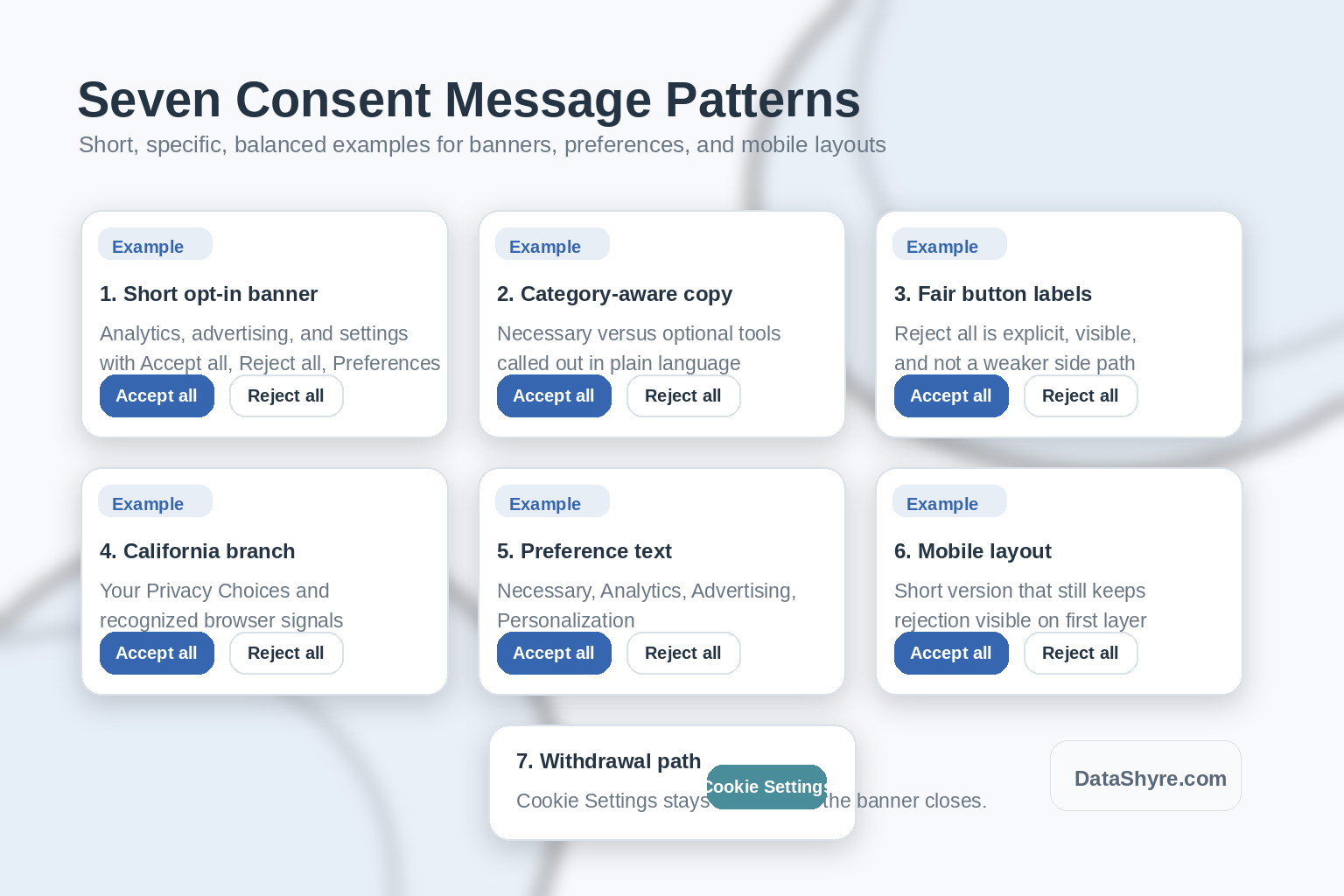
Pattern 6: the mobile version that stays explicit
Mobile is where otherwise decent cookie consent message examples often get weaker.
Teams shrink the copy until it becomes vague, or they hide refusal behind a second view because the screen is small.
A safer mobile pattern is:
We use cookies and similar technologies for analytics, advertising, and settings. Choose
Accept all,Reject all, orPreferences.
That is short, but it still preserves:
- real purposes;
- equal first-layer choice; and
- a clear path to granularity.
If the design can only fit Accept on the first layer, the problem is not the wording. The problem is the layout.
Pattern 7: the withdrawal message that proves the first promise was real
The best cookie consent message examples do not end after the first click.
They also give people an easy way back:
You can change your cookie choices at any time in Cookie Settings.
That sentence is small, but it matters because it connects the banner to a persistent control. The European Commission’s current guidance still says withdrawal must be as easy as giving consent. If the site accepts consent in one tap and hides the return path in a policy footer nobody can find, the message overpromised.
The cleaner pattern is to keep one persistent label available after the banner closes:
Cookie Settings
Or, for California-specific branches where relevant:
Your Privacy Choices
What to remove from weak examples
If you are reviewing existing cookie consent message examples, remove these patterns first:
By continuing to browse, you agree...- first-layer banners with only
OKorAccept - purpose descriptions that say only
improve your experience - category labels that use product or vendor jargon
- any path where refusal takes more taps than acceptance
The EDPB’s practical consent examples still say scrolling or swiping through a page is not a clear affirmative action. That means the message cannot turn passive movement into permission.
A quick review order before you publish
If I were reviewing cookie consent message examples on a live site this week, I would use this order:
- read the first-layer copy out loud and cut vague language;
- compare the path to reject against the path to accept;
- test the category labels with a non-specialist;
- verify that regional copy matches regional behavior;
- check that settings can be reopened later; and
- watch the network and tag behavior before and after each choice.
That sequence usually finds the real problem faster than arguing over whether the banner feels friendly enough.
FAQ
Do cookie consent message examples need a Reject all button?
Where prior-consent rules apply and Accept all is offered on the first layer, a missing or buried refusal path is a major risk. CNIL’s current position remains that rejecting cookies should be just as easy as accepting them.
Can one message work for EU, UK, and California visitors?
Sometimes, but only if the routing and behavior stay honest. One global banner can still be misleading if the user sees one set of words while the site applies a different privacy model underneath.
Is short copy better?
Short copy is better only when it stays specific. A shorter message that names real purposes is stronger than a longer message full of vague privacy language.
Bottom line
The strongest cookie consent message examples in 2026 are not the ones that sound the most polished.
They are the ones that tell people what optional technologies do, present refusal as a real choice, fit the regional branch the visitor is actually on, and keep working after the banner disappears.
If your message can do those four things, you are much closer to something that will hold up in production, not just in a mockup.
Sources
- European Commission: Legal grounds for processing data: https://commission.europa.eu/law/law-topic/data-protection/information-business-and-organisations/legal-grounds-processing-data_en
- EDPB: Practical examples on consent: https://www.edpb.europa.eu/system/files/2026-04/edpb-summary-consent_en.pdf
- ICO: Final storage and access technologies guidance published, April 29, 2026: https://ico.org.uk/about-the-ico/media-centre/news-and-blogs/2026/04/final-storage-and-access-technologies-guidance-published/
- ICO: Guidance on the use of storage and access technologies: https://ico.org.uk/for-organisations/direct-marketing-and-privacy-and-electronic-communications/guidance-on-the-use-of-storage-and-access-technologies/
- CNIL: Dark Patterns in Cookie Banners: CNIL issues formal notice to website publishers: https://www.cnil.fr/en/dark-patterns-cookie-banners-cnil-issues-formal-notice-website-publishers
- California Department of Justice: CCPA overview and Global Privacy Control: https://oag.ca.gov/privacy/ccpa
- CPPA: Enforcement Advisory No. 2024-02, Avoiding Dark Patterns: https://cppa.ca.gov/pdf/enfadvisory202402.pdf
- California Department of Justice: Disney settlement announcement, February 11, 2026: https://oag.ca.gov/news/press-releases/california-wont-let-it-go-attorney-general-bonta-announces-275-million
- Google AdSense Help: Google consent management requirements for serving ads in the EEA, the UK, and Switzerland (for publishers): https://support.google.com/adsense/answer/13554116?hl=en
—
Published: October 21, 2026. Updated using current official regulator, government, and platform materials available at publication time.