

Consent Preferences in 2026: 7 Live Checks Before You Trust the Choice
If you are reviewing consent preferences in 2026, the useful question is not whether your site saved a single accept or reject value.
The useful question is whether the preference the user expressed still controls what the website, app, tag manager, vendors, and downstream systems actually do after the next release, new vendor install, or regional rules update.
That is the right frame because current official guidance keeps moving away from banner theater and toward operational proof. The European Commission still says consent must be freely given, informed, specific, and as easy to withdraw as to give. The ICO still says valid consent requires a “clear affirmative action.” California’s Department of Justice still describes Global Privacy Control as a “stop selling or sharing my data switch.” And CNIL still says “rejecting cookies should be just as easy as accepting them.”
If you want nearby context first, start with our guides to consent preference management, what is consent management, and cookie consent requirements. This article stays narrower. It is the seven-check review I would use before trusting consent preferences on a live property this week.
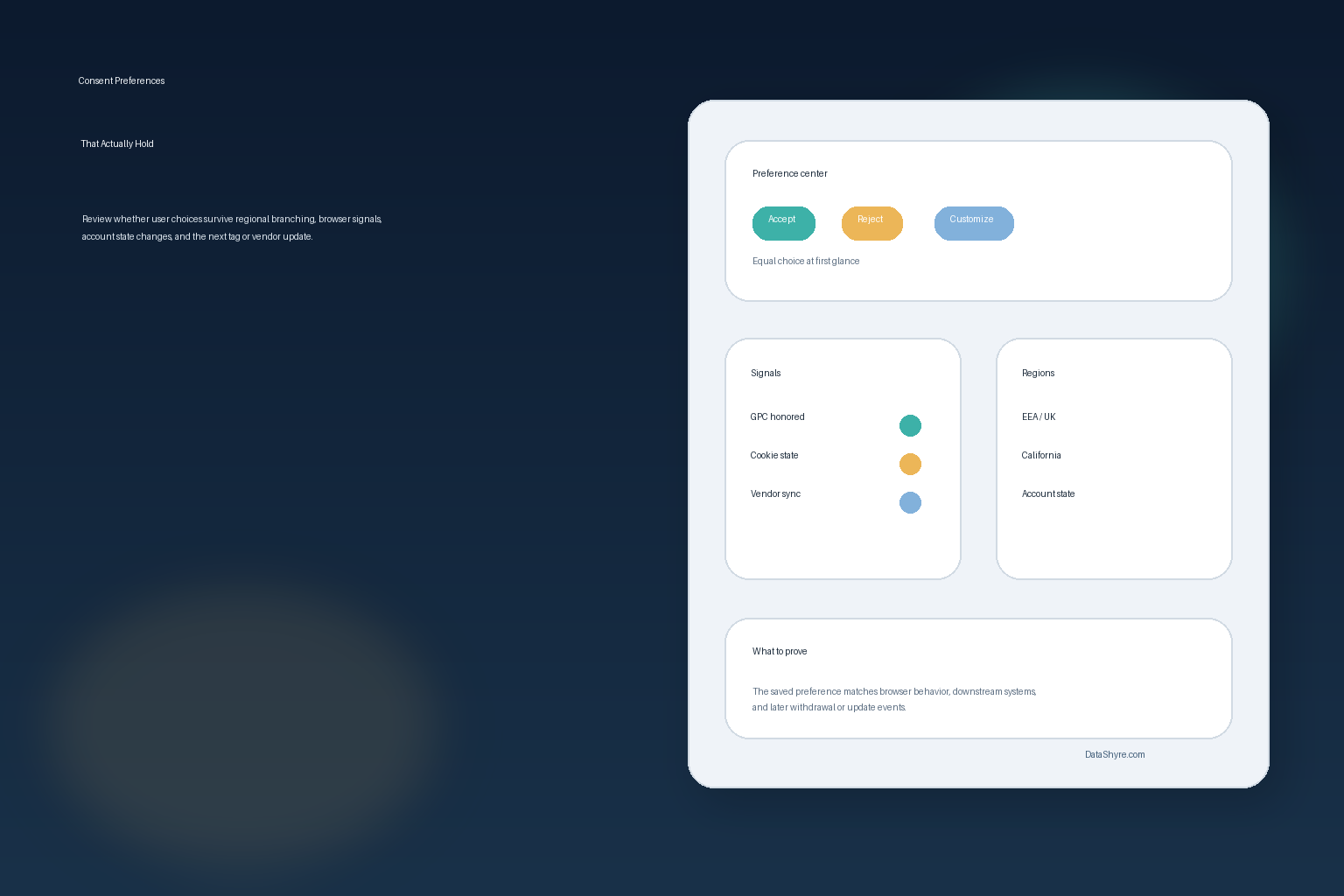
1. Start by defining what each preference is supposed to control
The first weakness in many consent preferences setups is not technical. It is definitional.
Teams often group unlike things together under one settings panel:
- cookie choices for storage and access technologies;
- marketing permissions for email or SMS;
- California opt-out rights for sale or sharing;
- account-level communication settings;
- special handling for children or sensitive data.
Those are not all the same choice.
The European Commission’s current GDPR guidance still says consent must be specific to the purpose and presented in clear and plain language. So before you test a preference center, ask whether each setting corresponds to a real purpose, a real legal rule, and a real technical effect.
If a single preference label is standing in for several unrelated outcomes, consent preferences will be hard to explain and harder to enforce.
2. Make sure the user gives an active choice and can refuse just as easily
This is still the front-door test.
The ICO’s consent guidance says consent must be an unambiguous indication given by “clear affirmative action.” Its examples include selecting from equally prominent yes or no options and using preference-dashboard settings. CNIL’s current dark-pattern notice says “rejecting cookies should be just as easy as accepting them” and criticizes banners that visually bury refusal.
For consent preferences, that means checking whether:
- the user takes a deliberate action rather than being defaulted into agreement;
- refusal appears at the same layer as acceptance where required;
- the wording is explicit enough to understand what will happen next;
- the interface avoids repeated nudges toward acceptance.
If the preference panel only looks balanced after the second click, the choice is weaker than it looks.
3. Separate regional logic instead of forcing one global meaning onto every preference
One of the most common failures in consent preferences is pretending one setting means the same thing everywhere.
For the EU and UK, the practical issue is often prior consent for non-essential cookies and similar technologies. For California, the question may be whether opt-out rights and browser-based signals are honored. The California Privacy Protection Agency’s current law and regulations page lists the CCPA Regulations as effective on January 1, 2026, and the regulations include a dedicated section on opt-out preference signals. The California DOJ’s current GPC page still describes GPC as a “stop selling or sharing my data switch.”
So consent preferences should be tested for regional branching:
- prior blocking where prior consent applies;
- opt-out signal handling where California rules apply;
- separate minors or sensitive-data logic where relevant;
- understandable fallbacks when location or profile state changes.
If one universal toggle is doing five different legal jobs, it usually does at least one of them badly.
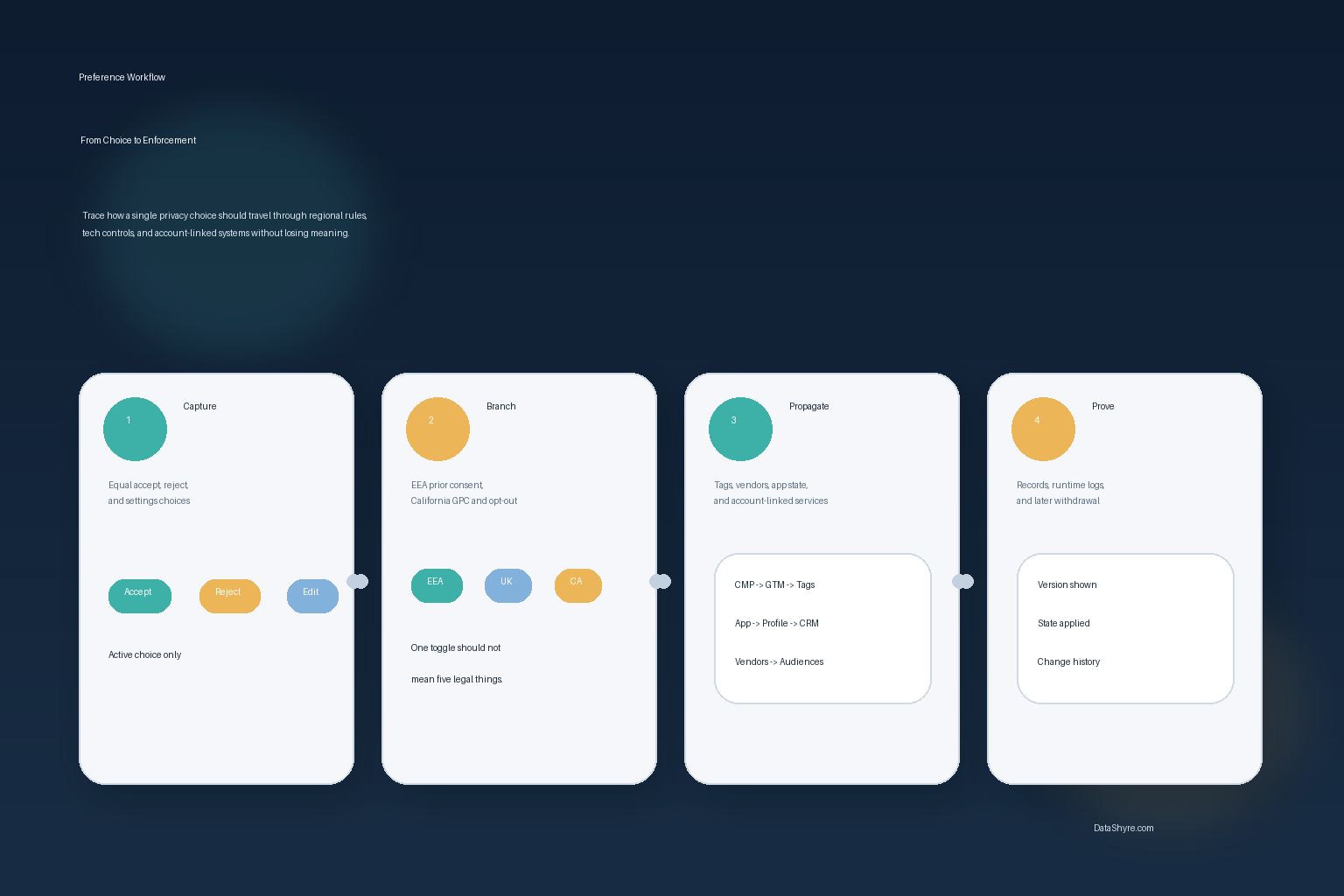
4. Check whether the preference actually propagates across systems and devices
This is where many polished dashboards still break.
The California Attorney General’s February 11, 2026 Disney settlement is a useful warning because it alleged that opt-out requests were not fully effectuated across all associated devices and streaming services tied to consumers’ accounts. In other words, the preference existed, but the effect did not reliably travel.
That is exactly the operational test for consent preferences.
I would check whether a user’s choice reaches:
- the CMP or banner layer;
- the tag manager and analytics tags;
- embedded tools and SDKs;
- marketing systems and audience syncing;
- account-linked experiences across browser, app, and logged-in states.
If the preference only governs one surface, then it is not a real preference program. It is a local UI event.
5. Make withdrawal and later changes as easy as the original choice
This is one of the clearest official standards available.
The European Commission says consent must be withdrawable in a way that is “as easy to use as giving consent.” The ICO’s cookie and consent guidance follows the same logic. For consent preferences, that means the hard part is not only collecting the first answer. The hard part is making the later change work.
So a strong review checks whether users can:
- reopen the preference center without hunting for it;
- change only the category or purpose they actually want to change;
- see that the technical behavior updates after the new choice;
- avoid being pushed into a full reset just to withdraw one permission.
If changing your mind is slower than giving consent, the preference center is doing compliance theater, not preference management.
6. Ask for fresh consent when the technology or purpose changes
Old preferences should not silently expand to cover new behavior.
The ICO’s current storage-and-access-technologies guidance says that if you introduce new technologies for a different purpose than the one originally stated when consent was granted, you must obtain fresh consent for the new technology or purpose. That matters because consent preferences often drift without anyone noticing.
In practice, this catches problems such as:
- a new pixel added through a tag manager publish;
- a vendor now using data for a broader purpose;
- a personalization feature turning into advertising logic;
- a mobile SDK update changing default behavior.
This is why the safest teams review preference logic whenever the stack changes, not only when legal text changes.
7. Keep records that explain both the promise and the effect
Saved preferences are only useful if another team member, auditor, or regulator can reconstruct what happened.
The European Commission says the controller must be able to demonstrate consent. The EDPB’s July 14, 2026 decision requiring the Belgian DPA to handle the merits of a NOYB cookie-banner complaint is another reminder that banner and preference disputes are still active enforcement territory.
For consent preferences, the most useful record set usually includes:
- the version of the banner or preference center shown;
- the categories or purposes presented;
- the timestamp and identifier for the user’s action;
- the region or rule set applied;
- the resulting technical state across tags or vendors;
- any later withdrawal or update.
Those records become far stronger when they match runtime evidence. A stored value that says rejected is weak proof if the browser still fired optional requests on first load.
A short weekly review sequence
If I were pressure-testing consent preferences today, I would use this order:
- map each preference to a specific purpose and legal rule;
- compare accept and reject paths for equal prominence and usability;
- test regional branching, including GPC where relevant;
- verify propagation across tags, vendors, apps, and account states;
- confirm later withdrawal is as easy as the original choice;
- check whether new technologies or new purposes trigger fresh consent;
- compare stored records with live browser behavior.
That sequence usually tells you more than another design refresh.
Bottom line
In 2026, strong consent preferences are not just saved settings.
They are preferences that mean the same thing in the interface, in the browser, across systems, across devices, and after the next release. If your stack can collect a real choice, branch it by region, propagate it reliably, let users change it easily, and prove the effect later, the preference layer is doing real work.
If not, the settings page may look complete while the privacy control plane is still unfinished.
Sources
- European Commission: Legal grounds for processing data
- European Commission: Information for individuals
- UK ICO: What is valid consent?
- UK ICO: How should we obtain, record and manage consent?
- UK ICO: Cookies and similar technologies
- UK ICO: How do we manage consent in practice?
- California Department of Justice: California Consumer Privacy Act (CCPA)
- California Department of Justice: Global Privacy Control
- California Privacy Protection Agency: Laws & Regulations
- California Attorney General: Disney settlement announcement
- CNIL: Dark Patterns in Cookie Banners
- European Data Protection Board: Belgian DPA must handle the merits of the NOYB cookie-banner complaint
—
Published: October 9, 2026. Updated using current official regulator and government materials available at publication time.