

GDPR Consent Requirements in 2026: 7 Checks Before You Rely on Consent
If you are reviewing gdpr consent requirements in 2026, the useful question is not whether your form, banner, or preference center contains a checkbox.
The useful question is whether consent is the right lawful basis at all, whether each purpose is explained clearly enough, whether the user takes a real affirmative step, and whether your systems can still prove what happened after the next release, vendor change, or regional rollout.
That is still the practical standard in current official materials. The European Commission says valid consent must be freely given, informed, specific, and based on a clear affirmative act, with requests written in “clear and plain language.” In April 2024, EDPB Chair Anu Talus said online platforms should give people “real choice” when relying on consent-based models. And on July 14, 2026, the EDPB required the Belgian DPA to handle the merits of a cookie-banner complaint against VRT rather than close it on a procedural theory. Consent design and consent proof are still live enforcement topics, not legacy cleanup work.
If you want the closest companion reads first, start with our guides to GDPR consent form, GDPR cookie consent requirements, and cookie consent requirements. This article is broader. It is the seven-check review I would use before trusting gdpr consent requirements on a live property this week.
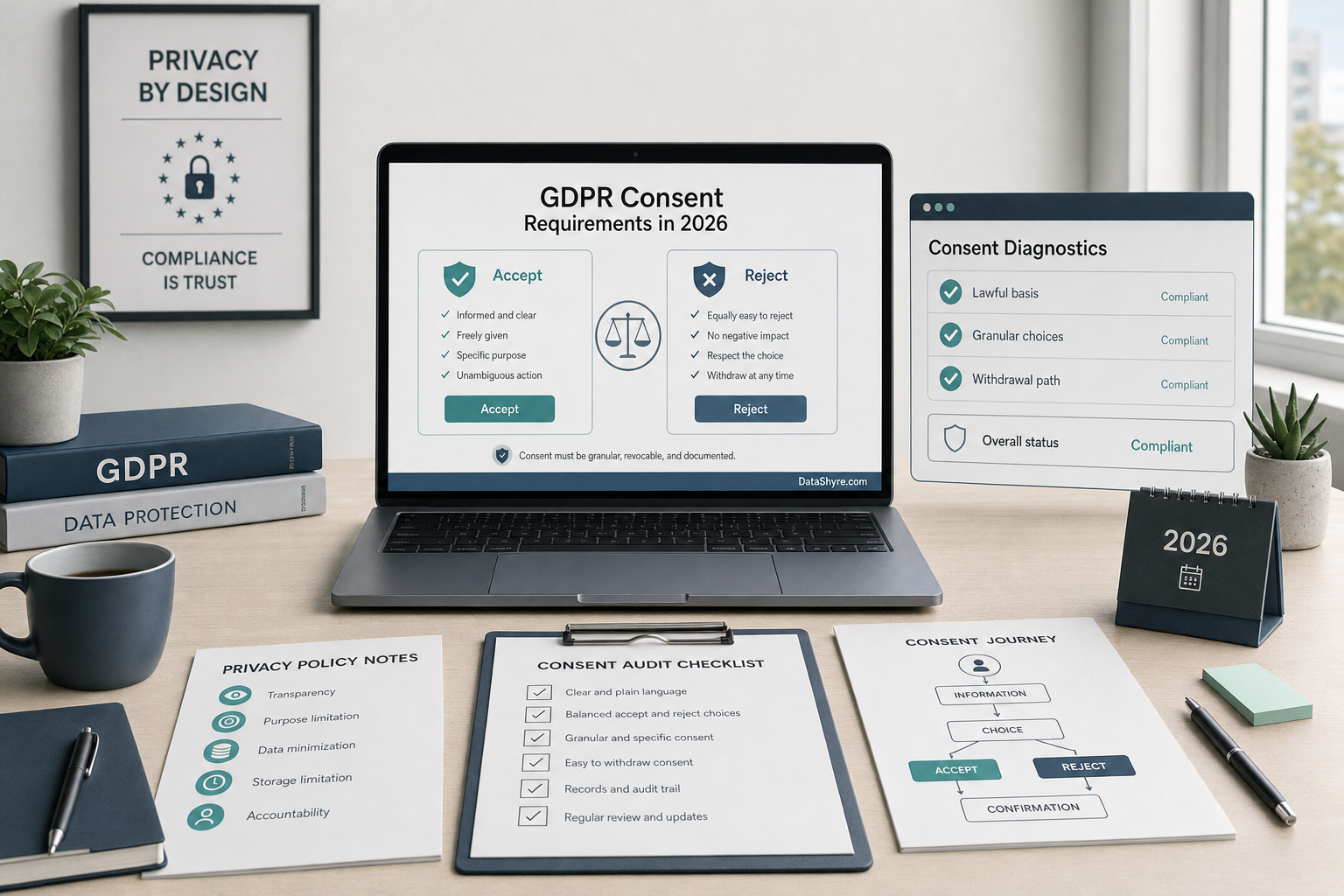
1. Start by asking whether consent is the right lawful basis
This is the first filter because many teams reach for consent as a comfort blanket.
The European Commission still presents consent as only one lawful basis among several. That matters because if a processing activity is really necessary to perform a contract, comply with a legal obligation, or pursue another lawful basis that actually fits, a consent request can make the explanation weaker rather than safer.
In other words, one of the most important gdpr consent requirements happens before any interface appears: do not label a workflow as consent-driven if the person cannot realistically say no without losing something the service actually depends on.
2. Split separate purposes instead of flattening everything into one yes
Weak consent often comes from over-bundling.
The Commission’s guidance says the request for consent should clearly state all the reasons for the processing and the specific purposes involved. The EDPB’s consent guidance also keeps pushing in the same direction: consent should be specific, not stretched across unrelated purposes just because that is easier operationally.
For gdpr consent requirements, the common separation points are usually familiar:
- service messages versus marketing;
- first-party analytics versus advertising;
- one communication channel versus another;
- internal personalization versus third-party sharing.
Granularity does not mean creating a maze. It means the person can understand what each yes actually covers.
3. Make the request clear, prominent, and separate from other terms
Consent language still fails when it is buried inside a broader legal block.
The European Commission says a consent request needs to be presented in a clear and concise way, using language that is easy to understand, and should be clearly distinguishable from other information such as terms and conditions. That is one of the clearest current answers to gdpr consent requirements because it turns a vague quality standard into something teams can actually inspect.
So a serious review should check whether the user can quickly identify:
- who is asking;
- what data will be used;
- why it will be used;
- whether anyone else will receive it;
- how it can later be withdrawn.
If those answers only appear after several clicks, hide inside boilerplate, or rely on vague phrases like improve your experience, the request is weaker than it looks.
4. Require a real affirmative act and avoid defaulted consent
This is still one of the cleanest bright lines in the GDPR consent standard.
The European Commission says valid consent must come through a clear affirmative act. The EDPB’s consent guidance remains equally direct: silence, pre-ticked boxes, or inactivity do not amount to valid consent. And where cookie banners are involved, CNIL’s current enforcement message is still blunt: “rejecting cookies should be just as easy as accepting them.”
In practice, that means gdpr consent requirements usually fail here when:
- boxes are preselected;
- continued browsing is treated as opt-in;
- one broad button covers several different purposes;
- refusal is visually weaker, linguistically softer, or harder to find than acceptance.
The person should be able to point to a deliberate act and say that was the choice.
5. Make refusal and withdrawal as easy as giving consent
Withdrawal is not an optional user-experience extra. It is part of the consent standard itself.
The European Commission’s current guidance says it should be as easy to withdraw as to give consent. That is one of the most operationally important gdpr consent requirements because it tests whether the system continues to respect the user after the first click.
For a live setup, that means checking whether withdrawal depends on:
- emailing support and waiting;
- hunting through several buried settings pages;
- repeating the same preference change across disconnected channels;
- losing access to something that never really required consent in the first place.
If consent can be given in one click but takes a support ticket to reverse, the program is weak no matter how polished the original prompt looked.
6. Keep records that reconstruct what the person actually saw and chose
Consent without proof gets fragile fast.
The Commission says the controller must be able to demonstrate that the individual consented to the processing. That sounds simple until someone asks six months later which version of the notice was shown, which purposes were selected, what regional logic was applied, and whether anything changed afterward.
So for gdpr consent requirements, the record should usually preserve:
- the exact request or banner version shown;
- the purpose or purposes tied to the choice;
- the timestamp and source of the interaction;
- the resulting technical or downstream state;
- any later withdrawal or change.
Those records become much stronger when they can be reconciled with actual runtime behavior. A database value that says consented or rejected is not enough if the browser, tag manager, or vendor logs tell a different story.
7. Re-check consent whenever purpose, recipient, or behavior changes
Consent does not quietly stretch to cover later decisions.
The Commission’s consent materials still tie validity to specific purposes, clear reasons for processing, and a usable withdrawal path. The EDPB’s July 2026 VRT decision also matters here as a reminder that banner and consent disputes are still being pushed back onto the merits, not treated as ancient implementation noise.
So the final gdpr consent requirements check is governance:
- if a new purpose is added, re-check the lawful basis;
- if a new recipient or vendor is added, re-check the disclosure;
- if the UX changes, re-check whether the choice is still genuinely free;
- if the runtime behavior changes, re-test whether consent still maps to the real system.
This is why mature teams handle consent as release work, not copywriting.
A short live review sequence for this week
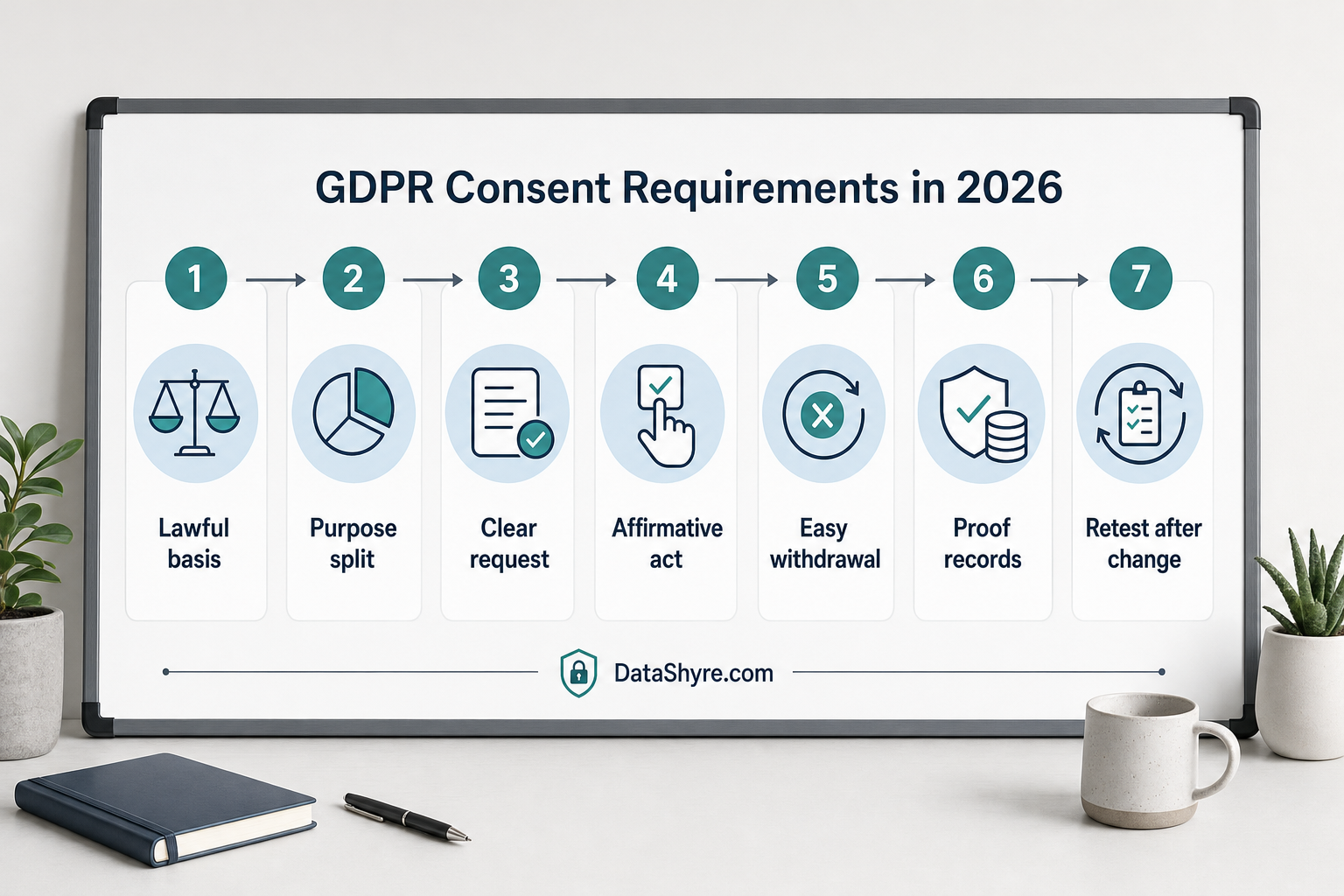
If I were checking gdpr consent requirements on a production workflow today, I would use this order:
- confirm consent is actually the right lawful basis;
- list every purpose, recipient, channel, and vendor relying on it;
- review the request for clarity, separation, and prominence;
- test that acceptance comes from a real affirmative act;
- test that refusal and withdrawal are just as usable;
- compare saved records with actual runtime behavior;
- rerun the checks after the latest release or vendor change.
That sequence usually reveals more truth than rewriting the checkbox copy one more time.
Bottom line
The real lesson of gdpr consent requirements in 2026 is that consent is not just a permission string.
It is a lawful-basis decision, a design decision, and an evidence decision all at once. If your team uses consent only where it fits, separates purposes honestly, asks in plain language, captures a real affirmative act, makes withdrawal easy, and keeps proof that still makes sense after the next release, you are in much stronger shape. If not, the checkbox may be finished while the consent program is not.
Sources
- European Commission: Legal grounds for processing data
- European Commission: Information for individuals
- European Data Protection Board: Guidelines 05/2020 on consent under Regulation 2016/679
- European Data Protection Board: Consent or pay models should offer real choice
- European Data Protection Board: Belgian DPA must handle the merits of the NOYB cookie-banner complaint
- CNIL: Dark Patterns in Cookie Banners: CNIL issues formal notice to website publishers
—
Published: October 9, 2026. Updated using current official European Commission, EDPB, and CNIL materials available at publication time.