

Cookies Consent Management in 2026: How to Control Banners, Tags, and Proof Across Regions
If you are searching cookies consent management in 2026, the real issue is rarely whether a banner appears. The real issue is whether optional tracking stays off when it should, whether refusal works as cleanly as acceptance, and whether your stack can still prove what happened after plugins, tags, embeds, and regional rules start interacting.
That is why cookies consent management should be treated as an operating control, not a design accessory. The UK’s ICO finalized storage-and-access technologies guidance on April 29, 2026, and made clear that the scope is wider than classic cookies alone. The guidance reaches cookies, pixels, scripts, fingerprinting, and similar technologies. California’s privacy enforcement has pushed in a different but equally practical direction: if a user opts out, the stop has to work across the business flow, not only on one device or one page.
If you want adjacent context first, start with our guides to what is consent management, cookie consent requirements, and consent management platform. This article stays narrower. It is the practical review I would use before trusting a cookies consent management setup on a live site.

What cookies consent management actually has to control
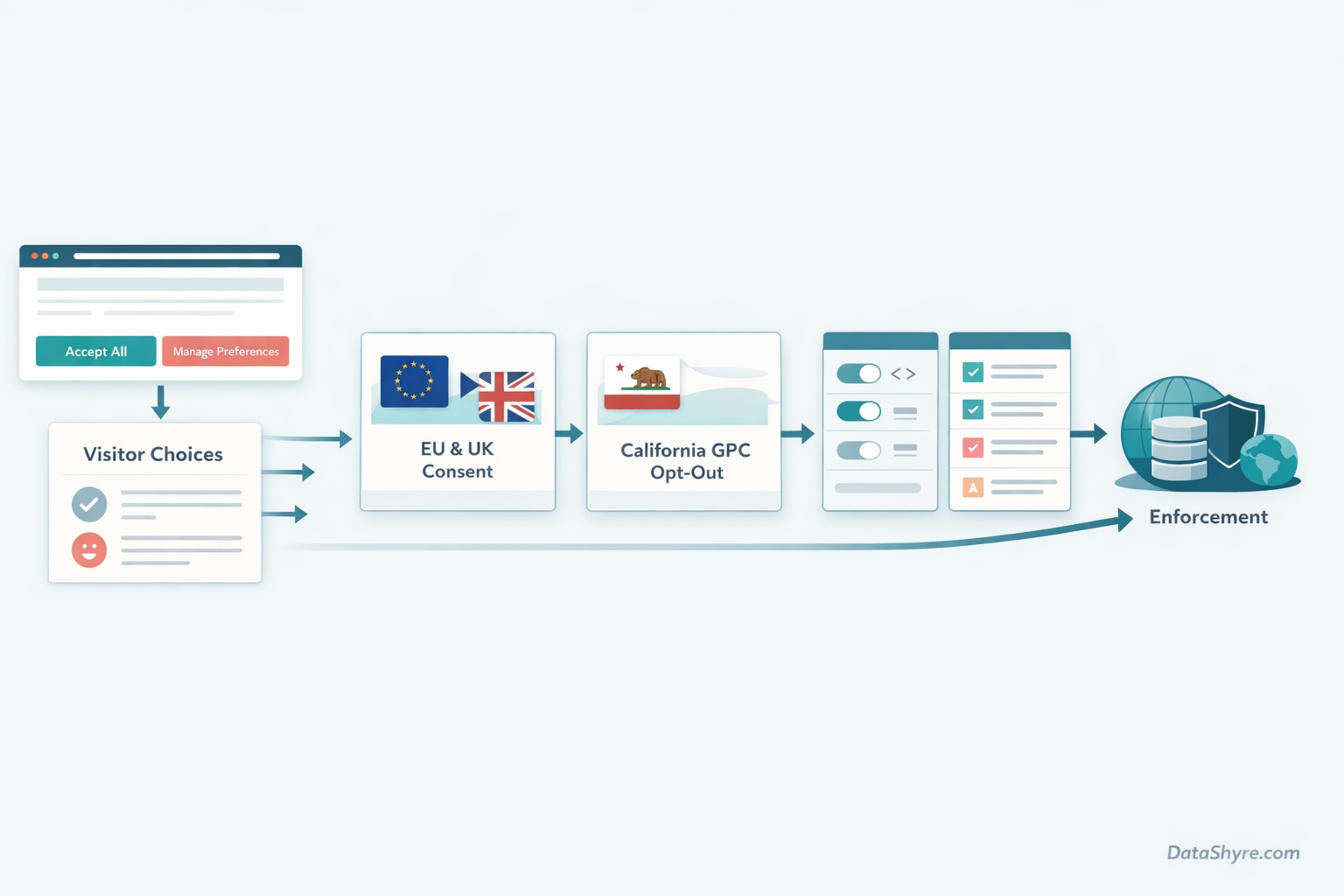
Good cookies consent management sits between policy and runtime behavior.
At minimum, it has to control:
- which technologies are truly necessary and which are optional;
- which regions require prior consent versus opt-out handling;
- how the first-layer choice is presented;
- when tags, pixels, and scripts are allowed to run;
- how withdrawal or later preference changes are enforced; and
- what records are kept to explain the event later.
That list matters because many teams still treat consent as a front-end copy problem. It is not. If the banner says one thing and the browser does another, the system is weak no matter how polished it looks.
1. Start with the rule split: EU and UK prior consent, California opt-out logic
The first job in cookies consent management is sorting the legal path before you sort the interface.
For EU and UK traffic, the practical baseline is still that non-essential cookies and similar technologies should not activate before valid consent where prior-consent rules apply. The European Commission’s business guidance still says consent must be freely given, informed, specific, and provided through a clear affirmative act. The same guidance also says withdrawal must be “as easy to use as giving consent.”
For the UK, the ICO’s final storage-and-access technologies guidance, published on April 29, 2026, explicitly covers cookies, tracking pixels, device fingerprinting, scripts, and similar technologies. In the related announcement, ICO Executive Director William Malcolm said people should have “meaningful control” over how their data is used online. That is a good test for cookies consent management because it pushes you to review the full stack rather than the banner alone.
California often changes the question. The California Department of Justice says the Global Privacy Control is a “stop selling or sharing my data switch” and that covered businesses must honor it as a valid request to stop sale or sharing. So for California traffic, cookies consent management is often less about forcing a blanket opt-in model and more about making opt-out, GPC, and downstream suppression work properly.
2. Treat timing as a first-class control
One of the most common failures in cookies consent management is timing.
The banner appears, but optional technologies have already loaded.
Google’s current consent-mode setup guidance says the default consent state should be set before any commands send measurement data, and updates should be tracked on the page where the interaction happens before any page transition. In practice, that means your CMP, tag manager, and site code all need to agree on sequence, not just intent.
Review whether:
- default consent states are set early enough;
- analytics and ad tags stay blocked or constrained before the relevant choice;
- preference changes update the state immediately;
- later page views keep the same choice; and
- embeds, plugins, or hardcoded scripts bypass the main consent logic.
If the browser writes or reads optional identifiers before the user has reached a valid choice in a prior-consent jurisdiction, your cookies consent management setup is not doing its main job.
3. Make rejection and withdrawal genuinely usable
This is still where many interfaces reveal what they are really optimized for.
CNIL’s December 12, 2024 enforcement note on cookie-banner dark patterns says rejecting cookies should be as easy as accepting them, and that the information on the banner must be clear and complete, including the means of rejecting cookies. That remains highly relevant in 2026 because the same patterns still show up: bright one-tap acceptance, vague rejection language, low-contrast links, and preference centers that are harder to use on mobile.
For cookies consent management, that means you should check whether:
Reject allis visible on the first layer where prior consent applies;- the wording of refusal is explicit rather than softened;
- users can reopen settings later without hunting for the link; and
- a withdrawal actually changes runtime behavior after the choice is updated.
If acceptance is easy but withdrawal is awkward, the workflow is incomplete.
4. Honor California signals across the whole account or service flow
California enforcement keeps stressing that a privacy choice cannot be trapped inside one surface.
On February 11, 2026, the California Attorney General announced a $2.75 million settlement with Disney over allegations that opt-out requests were not fully effectuated across Disney account-linked services. The announcement said businesses cannot force people to go service by service or device by device, and that asking a business to stop selling data should not be complicated or cumbersome.
That matters for cookies consent management because many teams still map California choices only to a browser-level banner while account-level sharing or downstream adtech flows continue elsewhere.
For California-facing traffic, review whether:
- GPC is detected and honored where it applies;
- the opt-out state propagates across linked products or logged-in experiences when it should;
- adtech or partner-sharing workflows actually change downstream; and
- the privacy notice and the real data flow still match.
5. Keep evidence strong enough for a later review
Working cookies consent management needs proof, not just collection.
A usable record usually includes:
- the notice or banner version shown;
- the categories or purposes involved;
- the timestamp and identifier;
- the region or rule set applied;
- the resulting consent state sent to your tools; and
- any later withdrawal or update.
Those details matter because logs alone are weak if they cannot be reconciled with what the browser actually did. A record that says rejected is not persuasive if optional requests still fired on first load.
A short live-site review for cookies consent management
If I were reviewing cookies consent management today, I would use this order:
- Inventory every optional cookie, pixel, script, embed, and SDK on the page.
- Split the workflows by region instead of assuming one universal banner logic.
- Confirm that reject and withdrawal are as usable as accept where prior consent applies.
- Test default-deny or constrained behavior before analytics and ad tools can run.
- Verify GPC and California opt-out handling separately from EU and UK prior-consent logic.
- Compare logs, notice text, and real network behavior for the same session.
That sequence surfaces more truth than a design review by itself.
FAQ
Is cookies consent management just another name for a CMP?
Not exactly. A CMP can be part of cookies consent management, but the broader job includes regional logic, runtime enforcement, downstream tag behavior, and evidence.
Does California require the same cookie banner pattern as Europe?
Not always. California often centers on opt-out rights, GPC handling, and whether selling or sharing actually stops. Europe and the UK more often center on prior consent for non-essential technologies.
Can one banner solve everything?
No. A single interface can support multiple workflows, but only if the underlying controls, routing, and enforcement logic are built to match the different obligations.
Bottom line
In 2026, strong cookies consent management means aligning three things at once: the rule set, the runtime behavior, and the proof. In the EU and UK, that usually means keeping optional technologies off until valid consent exists and making refusal and withdrawal usable. In California, it often means honoring GPC, propagating opt-out choices correctly, and making sure sale or sharing really stops where the law says it should.
If the system behaves the same before and after refusal, then the banner is only decoration. Real cookies consent management changes what the site actually does.
Sources
- European Commission, legal grounds for processing data: https://commission.europa.eu/law/law-topic/data-protection/information-business-and-organisations/legal-grounds-processing-data_en
- UK ICO, final storage and access technologies guidance announcement: https://ico.org.uk/about-the-ico/media-centre/news-and-blogs/2026/04/final-storage-and-access-technologies-guidance-published/
- UK ICO, guidance on the use of storage and access technologies: https://ico.org.uk/for-organisations/direct-marketing-and-privacy-and-electronic-communications/guidance-on-the-use-of-storage-and-access-technologies/
- California DOJ, CCPA overview: https://oag.ca.gov/privacy/ccpa
- California DOJ, Global Privacy Control: https://oag.ca.gov/privacy/ccpa/gpc
- California DOJ, Disney CCPA settlement announcement: https://oag.ca.gov/news/press-releases/california-wont-let-it-go-attorney-general-bonta-announces-275-million
- California DOJ, Healthline CCPA settlement announcement: https://oag.ca.gov/news/press-releases/attorney-general-bonta-announces-largest-ccpa-settlement-date-secures-155
- CNIL, dark patterns in cookie banners formal notice: https://www.cnil.fr/en/dark-patterns-cookie-banners-cnil-issues-formal-notice-website-publishers
- EDPB, Guidelines 05/2020 on consent under Regulation 2016/679: https://www.edpb.europa.eu/documents/guideline/guidelines-052020-on-consent-under-regulation-2016679_en
- Google for Developers, set up consent mode on websites: https://developers.google.com/tag-platform/security/guides/consent
—
Updated on October 8, 2026 using current official regulator, government, and platform materials available at publication time.