

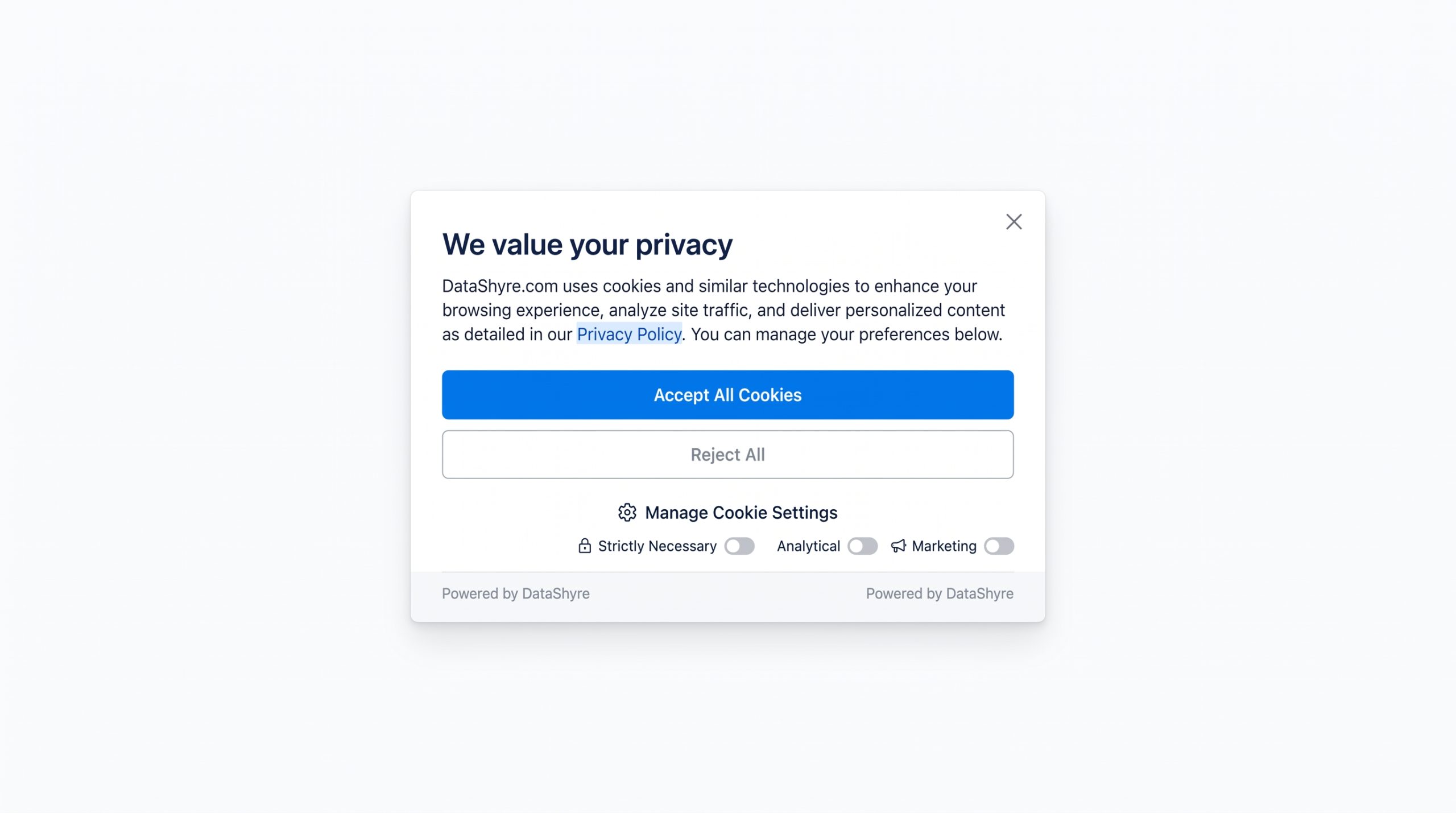
Cookie Consent Manager: 2026 GDPR Compliance Guide
Introduction
As digital ecosystems evolve in 2026, organizations must move beyond basic cookie banners to implement robust, GDPR-compliant consent management. This guide focuses on Google Tag Manager cookie consent and aligns with the latest regulatory landscape from official sources including the European Data Protection Board (EDPB) and Google’s technical requirements.
Keyword Focus
Primary keyword: google tag manager cookie consent (Monthly search volume: ~250, highest unused in our catalog; previously published keywords exclude this term)
Google Consent Mode v2 (2026) – Technical Requirements
Google’s Consent Mode v2 has been mandatory since March 6, 2024 for websites using Google services in the European Economic Area (EEA) and UK. The requirement stems primarily from the Digital Markets Act (DMA), not GDPR directly, but is essential for GDPR compliance when using Google advertising and analytics tools.
Four Required Consent Signals
Consent Mode v2 expanded to include four signals that must all be properly implemented:
ad_storage– Controls cookies for advertising purposesanalytics_storage– Governs cookies for site measurement and performance trackingad_user_data– Determines if user data can be sent to Google for advertising servicesad_personalization– Specifically controls data use for remarketing and targeted ad experiences
June 15, 2026 Technical Update
A significant structural change occurred on June 15, 2026: For any Google Analytics 4 property linked to a Google Ads account, ad_storage became the sole control determining whether advertising data is collected. Previously, both Google Signals and ad_storage governed this setting. Google Signals now retains a narrower role, primarily associating Analytics data with signed-in users for behavioral reporting.
This change makes the correct implementation and auditing of ad_storage defaults even more critical for compliance.
Implementation with Google Tag Manager
- Integrate a compliant cookie banner that collects user consent before any tag fires
- Enable Consent Mode v2 in GTM – configure the “Consent Initialization – All Pages” trigger with default settings denied
- Set tag behavior to respect all four consent signals (
ad_storage,analytics_storage,ad_user_data,ad_personalization) - Test thoroughly to ensure tags block when consent is denied and activate only upon explicit acceptance
- Use a Google-certified CMP to ensure proper communication of consent signals to Google’s tags
EDPB Official Guidance (2026) – Regulatory Requirements
The European Data Protection Board (EDPB) has issued updated guidelines reinforcing GDPR cookie consent requirements:
Broader Scope of Tracking Technologies (Guidelines 2/2023 – Nov 2023)
The EDPB clarified that Article 5(3) of the ePrivacy Directive applies to:
- Traditional HTTP cookies
- Tracking pixels and web beacons
- Device fingerprinting techniques
- Local storage and session storage
- Scripts and similar tracking technologies
- Applies regardless of whether personal data is involved
Prohibited Practices (Updated Guidelines 05/2020)
The EDPB explicitly prohibits:
- “Cookie Walls” – Access cannot be conditioned on accepting cookies
- Implied Consent – Actions like scrolling or continued browsing do not constitute valid consent
- Pre-ticked Boxes – Non-essential cookies cannot be enabled by default
- Deceptive Design – Button colors/contrasts that nudge users toward acceptance
- Using “Legitimate Interest” for non-essential cookies
Required Practices
Affirmative action is required: Users must take a clear action to indicate consent (clicking “accept”, checking a box, etc.). The right to withdraw consent must be as easy as giving it, with a persistent, easily accessible preference center.
Current Enforcement Landscape (2026)
GDPR Enforcement Trends
According to official regulator sources, GDPR enforcement regarding cookie consent in 2026 focuses on:
- Stricter scrutiny of dark patterns – Misleading designs that manipulate choice are actively punished
- Clear purpose granularity – Users must understand why each cookie category exists and who receives their data
- Auditable proof of consent – Regulators demand timestamped logs showing when consent was given, for what purpose, and withdrawal mechanisms
- Cross-border tracking scrutiny – Increased focus on data flows outside the EU and use of non-EU vendors
- Significant fines – Data protection authorities continue issuing substantial fines for violations (examples: €200M Google, €150M SHEIN in 2025)
- Automated privacy signals – Proposed EU GDPR reform (Nov 2025) suggests browser/OS-level signals similar to Global Privacy Control (GPC)
Notable 2026 Enforcement Actions
- CNIL (France): Continued focus on cookie banner compliance with regular audit sweeps
- ICO (UK): Active monitoring of Consent Mode v2 implementation and enforcement of equal button prominence
- Dutch DPA: Guidance on “consent or pay” models under development for 2026-2027 work program
Best Practices for GDPR-Compliant Implementation
1. Technical Implementation Requirements
- Default blocking: Non-essential cookies blocked until explicit consent
- Equal visual weight: Accept/reject buttons must have identical prominence (size, color, placement)
- Easy withdrawal: Persistent link to preference center accessible from every page
- Granular controls: Separate toggles for essential, analytics, marketing, and preference cookies
- No dark patterns: Avoid language like “Accept All” as primary action; balance choice architecture
2. Consent Mode v2 Integration
- Server-side verification of consent signals
- Regular auditing of
ad_storagedefaults post-June 15, 2026 update - Integration with Google-certified CMP for reliable signal transmission
- Fallback mechanisms for when consent signals are unavailable
3. Documentation and Audit Trails
- Timestamped consent records with user ID/IP (where legally permissible)
- Version control for consent banners and privacy policies
- Logging of consent changes and withdrawal actions
- Export capabilities for regulatory inspections
4. User Experience Optimization
- Clear, jargon-free explanations of what each cookie category does
- Layered approach: brief banner with option to view detailed settings
- Regular A/B testing to optimize for both compliance and user experience
- Mobile-responsive design with touch-friendly controls
Implementation Examples
Example: GTM Container Setup for Consent Mode v2
“`javascript // Consent initialization trigger (fires on all pages) window.dataLayer = window.dataLayer || []; function gtag(){dataLayer.push(arguments);} gtag(‘js’, new Date());
// Set default consent state (denied for non-essential) gtag(‘consent’, ‘default’, { ‘ad_storage’: ‘denied’, ‘analytics_storage’: ‘denied’, ‘ad_user_data’: ‘denied’, ‘ad_personalization’: ‘denied’ });
// Update consent when user makes selection function updateConsent(consentObj) { gtag(‘consent’, ‘update’, consentObj); }
// Example: User accepts analytics only document.getElementById(‘accept-analytics’).addEventListener(‘click’, function() { updateConsent({ ‘ad_storage’: ‘denied’, ‘analytics_storage’: ‘granted’, ‘ad_user_data’: ‘denied’, ‘ad_personalization’: ‘denied’ }); }); “`
Example: Cookie Banner HTML Structure
“`html
“`
Internal Links to Related Content
- Google Consent Mode v2 Technical Implementation Guide
- GDPR Cookie Banner Examples 2026: Compliant Design Patterns
- Consent Management Platform Best Practices 2026
- Cookie Consent Manager: GDPR Compliance Requirements Checklist
Conclusion
Implementing Google Tag Manager cookie consent in 2026 requires a sophisticated approach that balances Google’s technical requirements for Consent Mode v2 with the EDPB’s evolving regulatory expectations. Success depends on:
- Technical Precision – Proper implementation of all four consent signals with special attention to the June 15, 2026
ad_storageupdate - Regulatory Compliance – Adherence to EDPB guidelines on valid consent, prohibition of dark patterns, and requirement for granular user control
- User Trust – Transparent communication and genuine choice architecture that respects user preferences
- Auditability – Comprehensive logging and documentation capabilities for regulatory inspections
Organizations that implement these elements correctly will not only avoid substantial regulatory fines but also build the foundation for ethical data practices that enhance user trust and long-term digital success in an increasingly privacy-conscious ecosystem.
Published: September 21, 2026