

GDPR Compliant Privacy Notice in 2026: 7 Checks for Clear, Defensible Disclosures
If you are reviewing a gdpr compliant privacy notice on August 26, 2026, the first question is not whether the page exists. It is whether a real person can understand what data you collect, why you collect it, how long you keep it, who receives it, and what they can do next.
That is still the live legal baseline. The GDPR’s transparency rules sit mainly in Articles 12, 13, and 14. The UK ICO’s current guidance calls privacy information a “key transparency requirement” and says organizations must tell people their purposes, retention periods, and who data will be shared with. The same guidance also says you must provide that information at the time you collect personal data, or within a reasonable period and no later than one month if the data came from another source.
If you need the wider program context around consent and regional differences, our guides to GDPR vs. CCPA, California consumer privacy, and consent management provider are useful companions. This article stays narrower. It is the practical review I would run before signing off a gdpr compliant privacy notice this week.

Why the notice still fails in practice
Most notice failures are not caused by missing a page in the footer. They happen because the page is too vague, too late, too broad, or too disconnected from what the product actually does.
The ICO’s drafting guidance is useful here because it starts with operational reality: do an information audit or data mapping exercise first, then write for the intended audience in language that is concise, transparent, intelligible, easily accessible, and clear. That is a better workflow than copying another company’s policy and hoping it matches your stack.
The EDPB’s endorsed transparency guidance points in the same direction. A notice is supposed to help the data subject understand the processing and use their rights, not just protect the drafting team from awkward questions later.
7 checks for a GDPR compliant privacy notice
1. Separate Article 13 and Article 14 scenarios
This is one of the fastest ways to spot a weak notice.
When you collect personal data directly from the individual, Article 13 is the main branch. When you obtain the data from another source, Article 14 adds extra disclosure work, including telling people the categories of data and the source of the data unless an exception applies.
For a gdpr compliant privacy notice, that means your team should know which collection points are first-party and which are indirect. Newsletter forms, demos, and account registration are not the same as bought lists, enrichment, referral feeds, or partner imports.
2. Name the controller, contact routes, and any DPO clearly
Users should not have to hunt for who is responsible.
The ICO checklist still expects the organization’s name and contact details, the representative if applicable, and the DPO contact details if applicable. That sounds basic, but many notices bury the accountable entity inside legal boilerplate while presenting only a generic support form to the public.
If your products run across multiple brands or regions, make the controller structure explicit. If one entity runs the site and another provides the service, say that plainly.
3. State purposes, lawful bases, and recipients like they belong together
A strong notice maps each processing purpose to an intelligible explanation, the relevant lawful basis, and the likely recipients or categories of recipients.
Weak notices split those ideas into separate sections full of abstract language. The result is a user who can read every paragraph and still not know why their data is being used. If the purpose is fraud prevention, say that. If the lawful basis is legitimate interests, say that. If payment processors, analytics vendors, CRM tools, or cloud providers receive the data, say that too.
That pairing matters because a gdpr compliant privacy notice should explain the processing in a way a person can follow, not just list legal nouns in isolation.
4. Give real retention periods, or the criteria if you cannot
Retention language is one of the first places where vague drafting shows up.
The ICO’s current guidance says you should tell people how long you will keep personal data, and if you do not have a specific period, you should explain the criteria used to decide it. That means “we keep data only as long as necessary” is not enough by itself.
A better pattern is to break retention out by category or workflow, for example:
- account records for the life of the account and a defined wind-down period;
- billing records for the statutory accounting period that applies;
- support tickets for a defined service or legal retention window;
- marketing suppression records for as long as needed to honor the opt-out safely.
Even if some periods depend on disputes, tax rules, or sector obligations, the criteria should still be understandable.
5. Explain transfers outside the EU or UK with the actual safeguard
International transfers should not be hand-waved.
The European Commission’s current international data protection materials still point organizations toward the main safeguard routes, including adequacy decisions, Standard Contractual Clauses, and Binding Corporate Rules. If your notice says data may be processed globally but never explains the mechanism, the reader learns almost nothing useful.
For a gdpr compliant privacy notice, explain:
- whether data leaves the relevant jurisdiction;
- the countries or regions involved where feasible;
- the safeguard you rely on; and
- where the person can learn more or request a copy of the relevant safeguard information where applicable.
That is much better than broad phrases such as “we use trusted partners worldwide.”
6. Match the rights section to the lawful basis and show how to use it
Rights language should be functional, not decorative.
The ICO’s checklist still expects you to explain the rights available to individuals, the right to withdraw consent where applicable, and the right to complain to a supervisory authority. It also says the right to object must be brought to people’s attention clearly and separately from other information where relevant.
The European Commission’s current consent guidance adds another practical reminder: it should be “as easy to withdraw as to give consent.” If your notice relies on consent for some processing, the notice should point to a real withdrawal path, not just a generic mailbox and a hope that operations will sort it out later.
This is where many notices drift away from reality. They list access, erasure, objection, restriction, portability, and complaint rights, but never explain the intake route, identity checks, or expected timeline. A stronger notice makes the route clear and consistent with the actual request workflow.
7. Publish the notice where collection happens, then review it when processing changes
A privacy notice is not a one-time publishing task.
The ICO says privacy information must be given at the time data is collected from the individual, and its drafting guidance recommends regular reviews to keep the information accurate and up to date. It also says new uses of personal data should be brought to people’s attention before the processing starts.
That is why the best gdpr compliant privacy notice setups are layered:
- a concise just-in-time explanation at the collection point;
- a fuller notice linked from that flow;
- specific contextual disclosures for higher-risk features such as profiling, AI use, location data, or indirect collection;
- a review trigger whenever a new vendor, new purpose, or new regional rollout changes the processing story.
If the product changed last quarter and the notice still describes the old flow, the document is already behind the system it is supposed to explain.
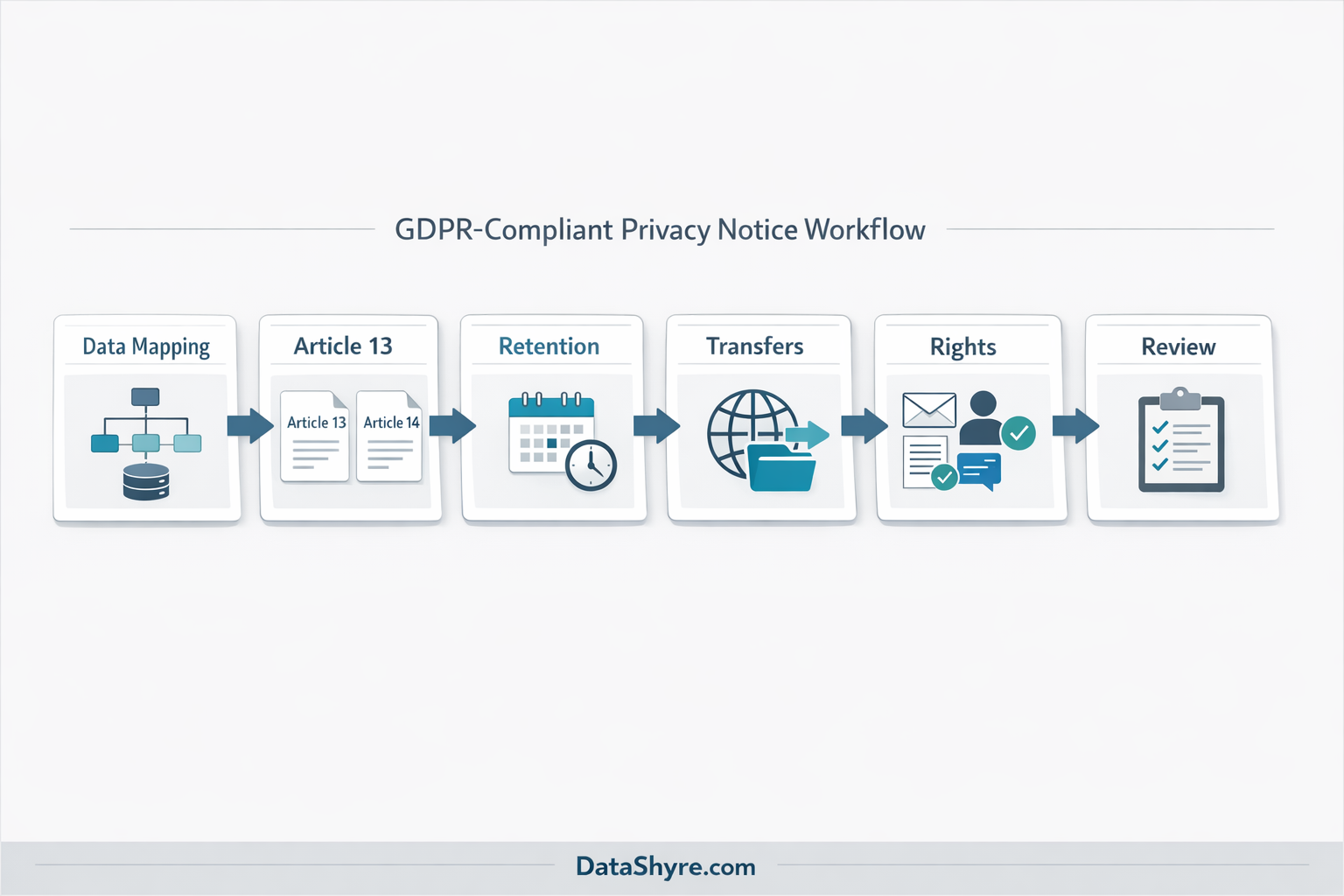
A short review sequence I would use this week
If I were checking a notice before release, I would do this in order:
- map the actual collection points and indirect data sources;
- split the required content into Article 13 and Article 14 branches;
- verify each purpose has a matching lawful basis and recipient explanation;
- replace vague retention wording with periods or usable criteria;
- confirm transfer language matches the real safeguard in use;
- test the rights and withdrawal paths as if I were a user; and
- compare the notice against the current product and vendor setup before publish.
That review catches more real defects than debating sentence style in the abstract.
Bottom line
A gdpr compliant privacy notice in 2026 is not just a long policy page. It is a working explanation layer between your processing reality and the person’s ability to understand and act on it.
If the notice is specific, well-timed, layered, and tied to your real workflows, it becomes much easier to defend. If it is vague, late, and detached from how the system actually uses data, the page may exist while the transparency duty is still failing underneath it.
Sources
- EUR-Lex: Regulation (EU) 2016/679 (GDPR)
- ICO: Right to be informed
- ICO: What privacy information should we provide?
- ICO: How should we draft our privacy information?
- European Commission: When is consent valid?
- European Commission: What if somebody withdraws their consent?
- European Commission: International dimension of data protection
- European Commission: Binding Corporate Rules (BCR)
- EDPB: Guidelines on transparency under Regulation 2016/679
This post was updated on August 26, 2026 using current official regulator, government, and legal-text materials available at publication time.