

OneTrust Consent Management Platform in 2026: 7 Checks Before You Sign Off
If you are evaluating the onetrust consent management platform on August 20, 2026, the useful question is not whether the banner looks polished. It is whether the platform is actually coordinating consent across the surfaces, rule paths, and downstream systems your business depends on now.
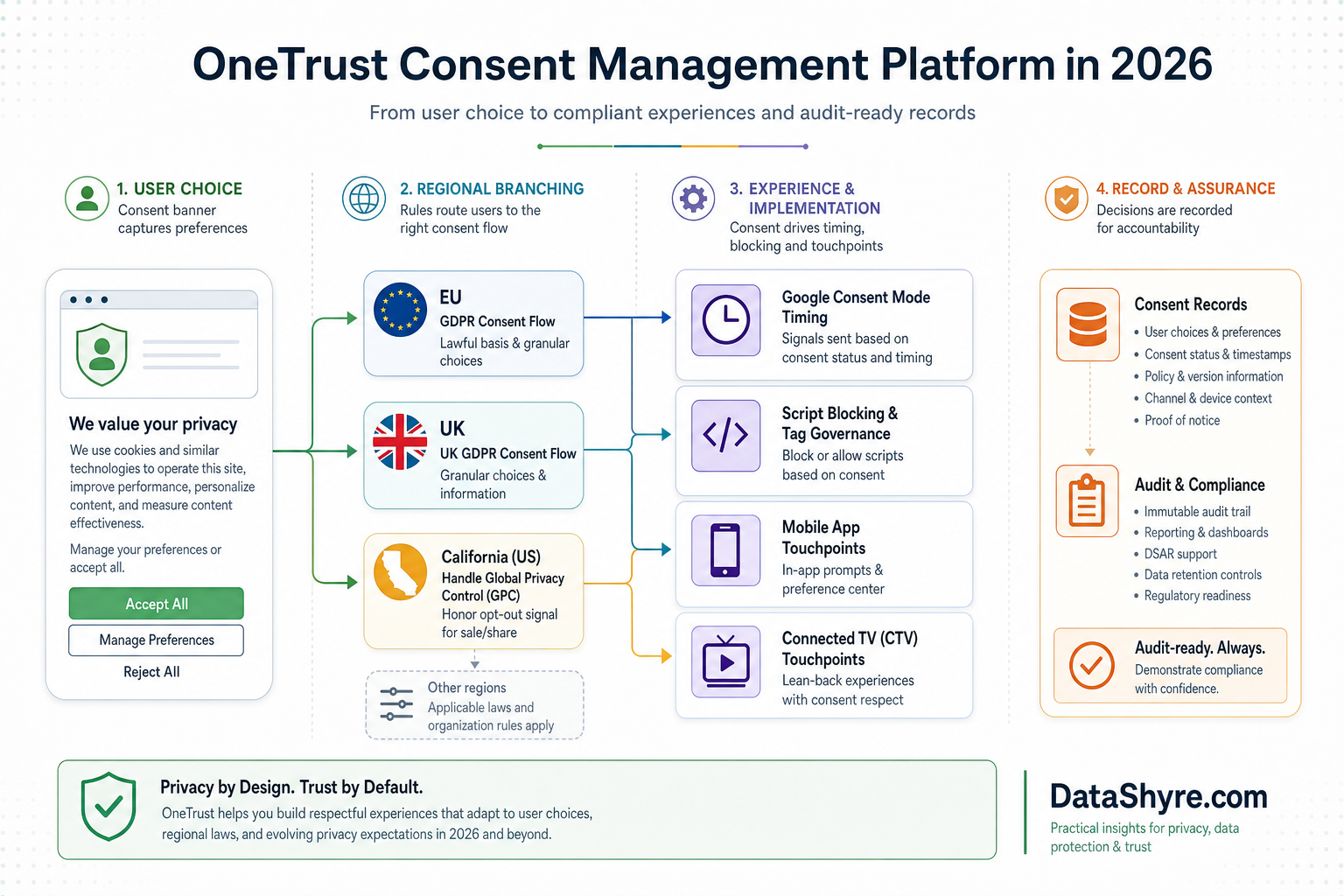
That is the right frame because OneTrust’s current public product materials position the platform as more than a web banner. The product page says it can collect consent across websites, mobile apps, and OTT or CTV environments, while the broader Consent & Preferences materials emphasize geolocation-based policies, multilingual templates, publishing change management, and centralized consent records. At the same time, the legal baseline is still active. The UK ICO finalized its storage-and-access technologies guidance on April 29, 2026 and made clear the review reaches cookies, tracking pixels, device fingerprinting, and similar tools. California’s Department of Justice still says Global Privacy Control is a “stop selling or sharing my data switch” that must be honored by covered businesses as a valid request. And for ad-supported publishers, Google’s current help still says a certified CMP integrated with the IAB Transparency and Consent Framework is required for serving personalized ads in the EEA, the UK, and Switzerland.
If you want the adjacent context first, start with our guides to OneTrust consent, OneTrust cookie consent, and what is a consent management platform CMP. This article is narrower. It is the deployment review I would run before signing off on the onetrust consent management platform in production.

Why the onetrust consent management platform should be reviewed as an operating layer
The easiest way to misunderstand the onetrust consent management platform is to review it as a design component.
OneTrust’s current public positioning is broader than that. It describes a system that can:
- capture and signal purpose-based consent;
- support websites, mobile apps, and OTT or CTV experiences;
- tailor interfaces by region, regulation, and language;
- block trackers until consent is received;
- store consent receipts with change history;
- synchronize consent across touchpoints.
That means the real review is operational. You are not only asking whether the first layer renders correctly. You are asking whether policy, geolocation rules, script and SDK behavior, downstream signal timing, withdrawal, and recordkeeping still line up after real deployment changes.
7 checks before you sign off on the onetrust consent management platform
1. Confirm the real scope before you review the experience
The phrase onetrust consent management platform can describe very different jobs:
- a web-only banner and preference center;
- web plus mobile-app consent;
- web plus OTT or connected TV workflows;
- cross-domain or cross-device synchronization;
- a broader consent-and-preferences layer tied into business systems.
OneTrust’s current product materials explicitly describe consent across web, mobile, and CTV, and its broader solution pages talk about syncing consent between domains, apps, and systems. If your team reviews only the website banner while the business expects app, TV, or cross-touchpoint consistency, you can approve the wrong deployment.
So before anything else, write down which surfaces the current build must control this quarter.
2. Split the regional rule paths before you polish the interface
A polished interface can still hide weak rule logic.
OneTrust’s public materials emphasize location-based policies and regulation-aware templates. That is useful because the practical obligations are not identical everywhere. The European Commission still says valid consent must be “freely given, specific, informed and unambiguous.” California’s DOJ, by contrast, still frames GPC as a browser-based opt-out signal for sale or sharing.
For the onetrust consent management platform, that means the right review is not one global happy path. It is at least:
- an EU or UK prior-consent path where non-essential technologies stay off until the right choice exists;
- a California path where opt-out and qualifying GPC behavior are tested where sale or sharing may apply;
- any separate language, industry, or publisher branch that materially changes the experience.
If the same default behavior is being stretched across all of those paths, stop and test more deeply.
3. Verify inventory and blocking on the surfaces that matter
This is where CMP projects usually succeed or fail.
OneTrust says the platform can discover and categorize cookies, SDKs, trackers, and third parties, and can enforce user choices with blocking and script control. The ICO’s finalized 2026 guidance matters here because it makes clear the review is broader than classic cookie-only audits.
For the onetrust consent management platform, verify:
- what loads before any choice on real templates, not just the homepage;
- whether optional trackers stay blocked until they should be allowed;
- whether embedded tools or SDKs bypass the central consent layer;
- whether the same result holds on mobile views and app surfaces if those are in scope.
If the inventory looks complete in the console but the runtime behavior still leaks optional activity early, the implementation is not ready.
4. Follow the signal into Google and publisher workflows only if they are actually in scope
This is the branch many teams either over-assume or forget completely.
Google’s current consent mode guidance still says the default consent state should be set before any measurement data is sent and that updates should be tracked on the page where they occur before any page transition. Separately, Google’s publisher help still says certified CMP plus TCF integration is required for serving personalized ads in the EEA, the UK, and Switzerland.
So for the onetrust consent management platform, separate these checks:
- does Google consent timing work correctly for your tags and page flows;
- does the publisher stack meet Google’s separate CMP requirement, if publisher monetization is relevant;
- are those two branches being tested independently instead of assumed to be identical.
That distinction matters because a site can pass a consent-mode implementation test and still miss a publisher-eligibility requirement, or the reverse.
5. Treat consent receipts and change history as production evidence, not admin trivia
This is one of the strongest reasons teams buy a full CMP instead of a lighter banner tool.
OneTrust’s product materials say the platform stores consent receipts in an audit-ready database and keeps change history over time. That promise is only useful if your team can actually explain what a user saw, chose, and changed later.
For the onetrust consent management platform, test whether:
- records are easy to retrieve;
- changes to preference state are visible and understandable;
- exported logs make sense to someone outside the implementation team;
- records reflect the same behavior you observed in runtime testing.
If the evidence trail is confusing, the deployment may look stronger in demos than it will during an internal review or regulator inquiry.
6. Reopen preferences and test withdrawal on later screens, not just the first click
Withdrawal is where many seemingly solid setups get thin.
The European Commission still states the principle clearly: consent should be as easy to withdraw as to give. In practice, the test is not whether the preference center exists. It is whether later behavior actually changes after a person updates the choice.
For the onetrust consent management platform, verify:
- the path back to preferences is easy to find;
- withdrawal works on desktop and mobile;
- later pages, screens, or sessions reflect the revised choice;
- the change is visible in the records your team keeps.
If the interface acknowledges the change but the underlying behavior barely moves, your control is weaker than it looks.
7. Tie OneTrust configuration changes to release control
This is what keeps a good setup from drifting.
OneTrust’s own solution materials refer to change management for publishing updates, and that is the right instinct. External scrutiny has not slowed down either. On July 14, 2026, the EDPB required the Belgian DPA to handle the merits of a NOYB cookie-banner complaint involving VRT instead of dismissing it on procedural grounds.
That is a useful reminder that the real issue is not whether a CMP has the right features on paper. It is whether the live deployment still behaves correctly after:
- new tags, pixels, or SDKs;
- category or policy changes;
- app releases or template updates;
- region-rule changes;
- GTM or ad-stack publishes;
- consent-layer copy or design changes.
If nobody owns that release review, the onetrust consent management platform can degrade quietly while still looking fine in the admin console.
A short review sequence I would run this week
If I had ten minutes to review the onetrust consent management platform before launch, I would do this in order:
- Confirm the actual surface scope: web only, web plus app, or web plus CTV and publisher flows.
- Force separate EU or UK and California tests instead of trusting one generic path.
- Check what fires before any choice on the highest-risk templates or screens.
- Verify Google signal timing only where Google tags are truly involved.
- Pull receipts or logs for one test subject and compare them with observed behavior.
- Reopen preferences later and confirm withdrawal changes what happens next.
- Write the release checkpoints that will trigger re-testing after deployment changes.
That sequence usually reveals more real risk than another round of banner copy edits.
Bottom line
The best way to think about the onetrust consent management platform in 2026 is as a live control system, not as a banner purchase.
OneTrust’s own concise promise is to “Capture and signal purpose-based consent.” That is the right standard. If the deployment really does that across regional logic, runtime blocking, Google or publisher branches, receipts, and later withdrawal, it is in much better shape. If it does not, the interface may be live while the control layer underneath is still fragile.
Sources
- OneTrust: Consent Management Platform
- OneTrust: Consent & Preferences
- European Commission: When is consent valid?
- European Commission: What if somebody withdraws their consent?
- UK ICO: Final storage and access technologies guidance published
- California Department of Justice: Global Privacy Control
- California Privacy Protection Agency: Law & Regulations
- Google for Developers: Set up consent mode on websites
- Google Ad Manager Help: Google consent management requirements for serving ads in the EEA, the UK, and Switzerland
- European Data Protection Board: Belgian DPA must handle the merits of a NOYB cookie-banner complaint
This post was updated on August 20, 2026 using current official regulator, government, Google, and OneTrust materials available at publication time.