

Transcend CMP Consent Management Platform in 2026: 7 Checks Before You Deploy It
If you are evaluating the transcend cmp consent management platform on August 13, 2026, the useful question is not whether the banner looks clean. It is whether Transcend’s current stack can actually control data flows, respect regional privacy logic, and leave behind proof your team can still understand later.
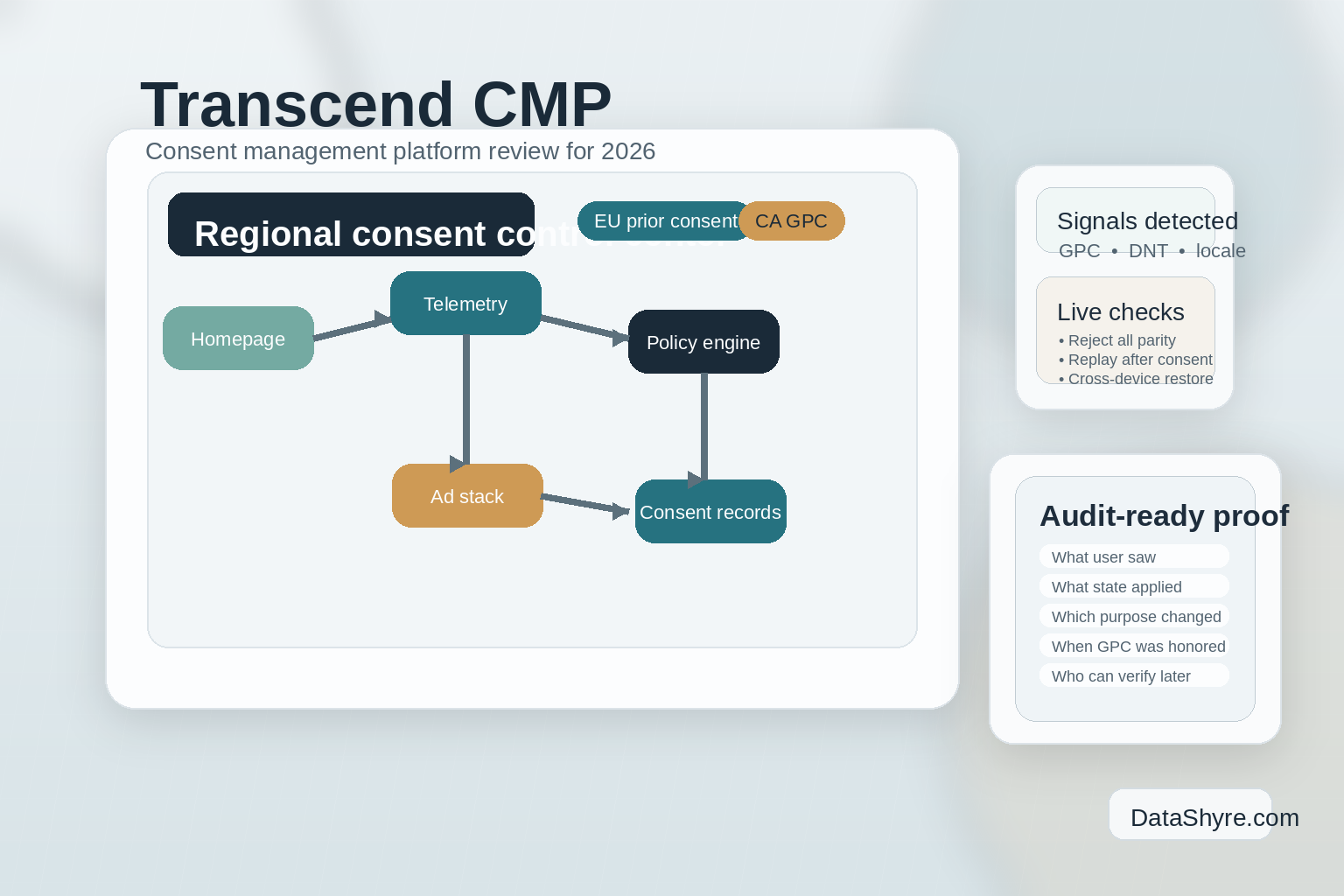
That is the right frame now because Transcend is positioning the product as more than a banner. Its current help docs describe Consent Management as a client-side CMP that can manage tracking events from third-party trackers, quarantine some requests until the user later consents, and block unwanted tracking events entirely. The same docs position the platform around websites and mobile apps, network-level regulation, telemetry-based discovery, regional experiences, and privacy-signal handling.
The legal baseline is still active too. The European Commission still says valid consent must be freely given, informed, specific, and easy to withdraw. The UK ICO said on April 29, 2026 that its final storage-and-access-technologies guidance is meant to drive an online tracking ecosystem that gives people “meaningful control over how their data is used.” And the California Department of Justice still describes Global Privacy Control as a “stop selling or sharing my data switch” that covered businesses must honor where the law applies.
If you want the surrounding category context first, start with our guides to consent management platform, best consent management platform, and consent management platform best practices. This article stays narrower. It is the seven-check review I would run before trusting a transcend cmp consent management platform rollout on a live property.
What Transcend says its CMP does now
Transcend’s current documentation gives a fairly specific product story:
- Consent Management collects consent and automates enforcement across websites and mobile apps.
- The platform regulates data flows at the network level, not only cookies.
- It can block, allow, or quarantine requests based on purpose and user choice.
- It starts in reporting-only mode by default so teams can collect telemetry before turning enforcement on.
- It detects privacy signals such as GPC and DNT.
- It also documents full-stack consent patterns for syncing preferences across web apps, mobile apps, backend databases, and third-party tools.
Those claims are useful, but they also define the real review. If the product is sold as a data-flow and full-stack control layer, then you should test it as a control layer rather than as a banner template.
1. Decide whether this is a browser-banner project or a full-stack consent problem
This is the first mistake to avoid.
Transcend’s current full-stack documentation says consent preferences may need to be synchronized across web applications, mobile applications, backend databases, and third-party tools. It also separates anonymous visitors from authenticated users and recommends deciding how consent should be reconciled when someone moves from one state to the other.
That means the first real question is not Do we like the demo? It is:
- are we only controlling one website on one browser;
- do we need cross-domain or cross-device consistency;
- do logged-in users need consent restored across sessions or devices;
- and do downstream systems need a durable record of what the user chose.
If your problem is actually full-stack, a simple banner review will miss too much.
2. Validate telemetry and classification before you assume you have coverage
Transcend’s quickstart is unusually clear about this part.
The product starts in reporting-only mode and uses telemetry to populate Data Flows and Cookies tables. The docs also say a critical part of implementation is labeling those data flows correctly, because the regulation engine depends on those classifications.
That matters because a transcend cmp consent management platform deployment can look complete while still missing meaningful requests or mislabeling them.
Before treating the rollout as production-ready, I would check:
- whether the telemetry phase actually saw the pages and journeys that matter;
- whether the high-risk services are classified under the right purposes;
- whether any custom or newly added vendors had to be entered manually;
- and whether first-party cookies, pixels, XHR, fetch calls, iframes, and beacons are represented the way the live site actually uses them.
If that inventory is thin, the enforcement story is probably thin too.
3. Test blocking and quarantine on real pages, not just in the dashboard
Transcend’s docs say the platform can quarantine tracking events and replay them only if and when the user later consents. They also say airgap.js regulates outgoing requests based on configured data flows and purposes.
That is promising. It is not the same thing as proof.
For a live transcend cmp consent management platform review, I would test:
- a clean first visit before any interaction;
- a
Reject allpath in a region that requires prior consent for non-essential technologies; - a later
Acceptpath to see what gets replayed and when; - category-level changes for analytics, advertising, or custom purposes;
- high-value templates such as homepage, pricing, article, signup, checkout, and any route with embedded third-party tools.
The fastest failure mode here is still simple: the banner changes state, but optional technologies keep acting too early or start acting from places the team forgot to classify.
4. Review regional logic and privacy-signal behavior together
Transcend’s current UI documentation says users with Global Privacy Control enabled in CPRA-like regimes will not be auto-prompted for consent. Its full-stack guide also says a first-time visitor with a GPC signal is treated as having made an explicit choice for the relevant purpose, while the broader purpose map can still vary by regime and configuration.
That is an important detail because regional logic and signal logic are not separate projects.
The European Commission still says:
“It should be as easy to withdraw as to give consent.”
>
European Commission
California adds a different layer. The DOJ still says GPC is a:
“stop selling or sharing my data switch”
>
California DOJ
So for this Transcend CMP, I would test:
- EU or UK flows where prior consent for non-essential technologies is the practical issue;
- California flows where sale-or-sharing opt-out handling matters;
- first-time visits carrying GPC;
- later manual preference changes after a signal was detected;
- and the return path for reopening settings or withdrawing choices.
This is where good-looking global rollouts often become messy.
5. Separate California SaleOfInfo logic from broader advertising or analytics consent
Transcend’s full-stack guide gives one of the clearest hints here. Its example purpose map recommends using Functional, Analytics, and Advertising for GDPR- or LGPD-like laws, and SaleOfInfo for CPRA and similar U.S. state opt-out laws.
That is a smart modeling clue because it helps prevent a common operational mistake: flattening European-style prior consent and California-style sale-or-sharing opt-out into one vague banner behavior.
For a transcend cmp consent management platform rollout, I would want to know:
- which purposes are mapped to EU or UK consent needs;
- which purpose or purposes map to California sale or sharing;
- whether GPC changes only the sale-or-sharing branch or also other purposes by design;
- and whether the privacy notice, banner language, and downstream enforcement all describe that split accurately.
If those answers are fuzzy, your user-facing choice model is probably fuzzy too.
6. If you are a publisher, run the Google branch separately
This is another place where teams blur two different reviews into one.
Google’s current publisher guidance still says that for personalized ads in the EEA, the UK, and Switzerland, a certified CMP integrated with the IAB TCF is required. Google’s current support materials also list Transcend CMP among certified CMPs. That is useful if ad monetization is in scope, but it is not the whole compliance answer.
The practical review for publishers is:
- does this Transcend deployment fit the Google publisher requirement where it applies;
- does the implementation still satisfy your broader consent and privacy obligations outside Google’s narrower program rules;
- and does the ad-tech path actually respond to the consent state at the right moment on the live page.
Those questions overlap, but they are not identical.
7. Demand proof that survives identity changes, devices, and later disputes
This is where Transcend’s broader architecture matters.
Its current docs explain that consent can be enforced entirely on the client for anonymous users, stored in local storage, timestamped, and then layered into backend storage for authenticated users so preferences can be restored across devices or browsers. The platform also says teams can monitor consent changes from a single admin dashboard across the stack.
That means a serious transcend cmp consent management platform review should end with recordkeeping questions:
- can we tell what the user saw;
- can we tell which purposes were inferred by defaults and which were explicitly confirmed;
- can we see when a GPC signal or manual action changed the state;
- can we reconcile anonymous-browser consent with authenticated-user consent where needed;
- and can legal, support, or engineering reconstruct the sequence later without guesswork.
If the answer is no, then the system may still be at the configuration stage rather than the proof stage.
A practical review sequence for this week
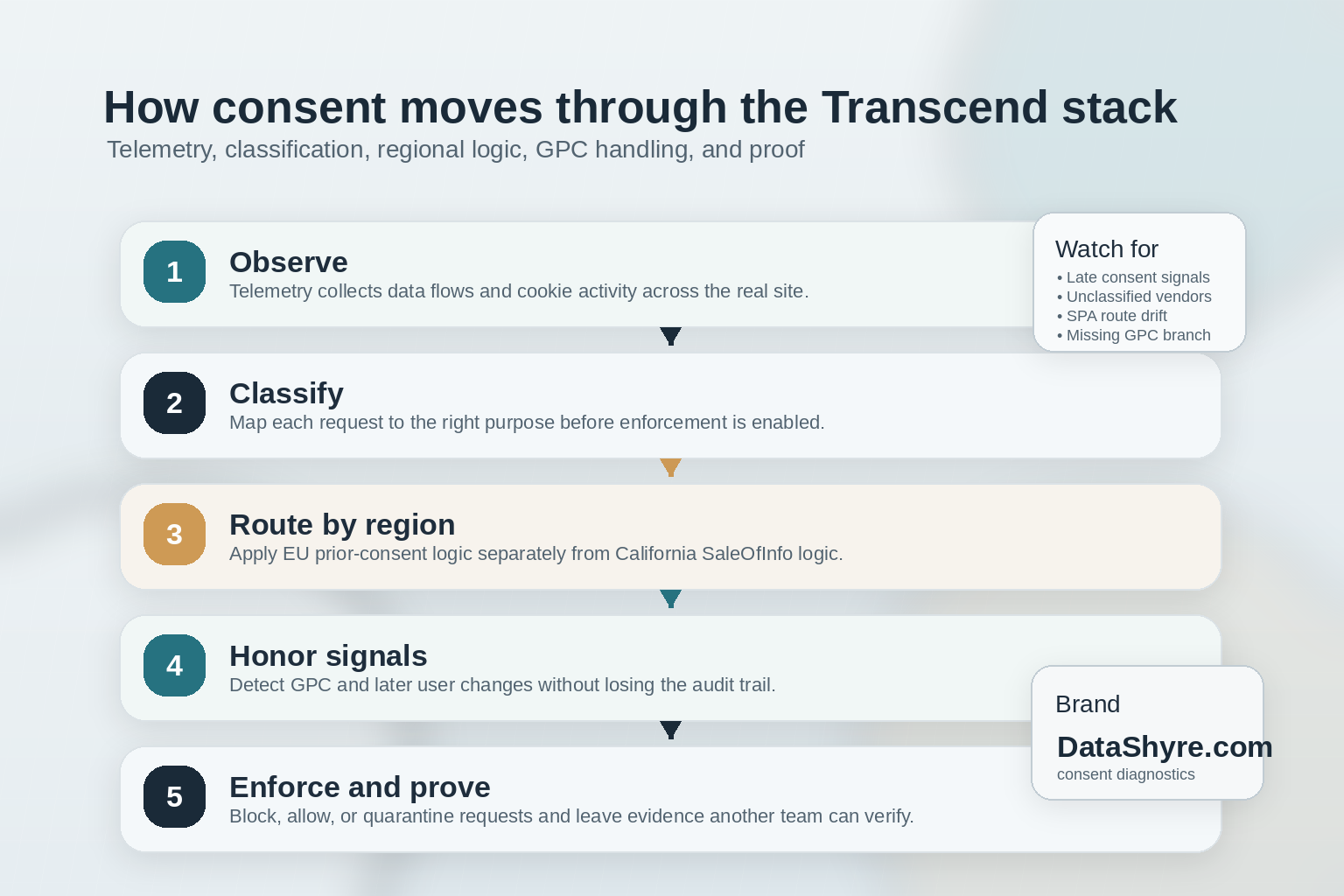
If I were validating a transcend cmp consent management platform rollout right now, I would do it in this order:
- define whether the job is browser-only, cross-domain, or full-stack;
- let telemetry run long enough to see the real site behavior;
- review and correct data-flow and cookie classifications;
- test first-visit, reject, accept, granular choice, and later withdrawal paths;
- test GPC behavior in California-facing flows;
- run a separate Google publisher check if ad monetization is relevant;
- inspect whether consent records remain understandable across devices, sessions, and logged-in states.
That sequence usually reveals more than a long feature matrix does.
Bottom line
The right transcend cmp consent management platform setup in 2026 is not the one with the smoothest banner animation. It is the one that turns user choice into real data-flow behavior, keeps regional logic coherent, handles browser signals predictably, and leaves behind evidence someone else can verify later.
Transcend’s current documentation suggests it can be a strong fit for teams that need more than cookie-level controls. But I would still require solid telemetry coverage, accurate purpose mapping, real runtime testing, a separate publisher branch where relevant, and proof that holds up after identity and device changes.
If your team can show those things on a live stack, the rollout is much closer to being trustworthy.
Sources
- Transcend Help Center: Consent Management
- Transcend Help Center: Consent Management Quickstart Guide
- Transcend Help Center: Full Stack Consent Management
- Transcend Help Center: Configuring the Pre-Built Consent Experience UI
- European Commission: Legal grounds for processing data
- UK ICO: Final storage and access technologies guidance published
- UK ICO: How do we comply with the PECR rules?
- California Department of Justice: Global Privacy Control
- Google AdSense Help: Google consent management requirements for serving ads in the EEA, the UK, and Switzerland
- Google AdSense Help: Google’s Additional Consent technical specification
This post was updated on August 13, 2026 using current official regulator, government, platform, and vendor materials available at publication time.