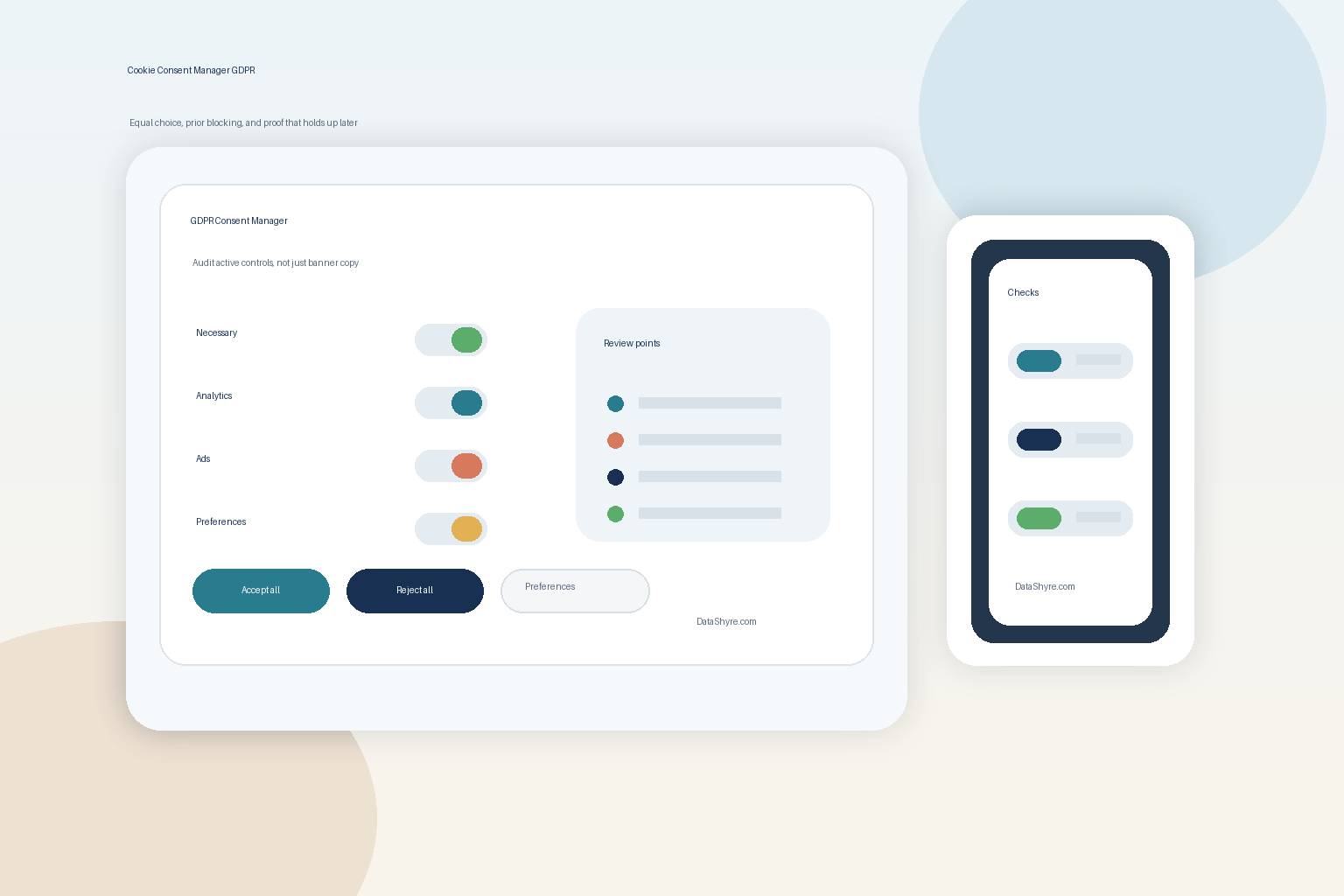
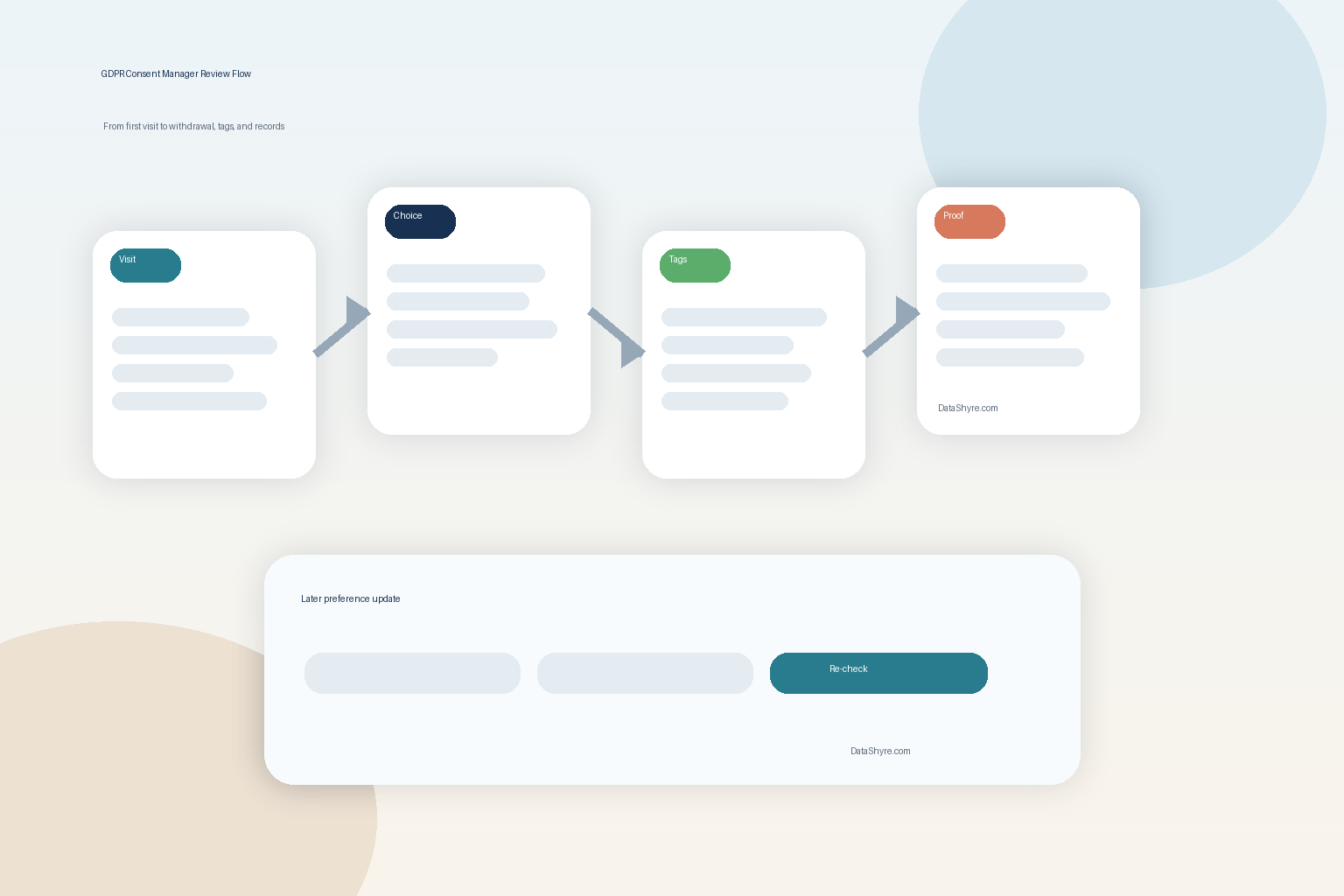
Cookie Consent Manager GDPR in 2026: 7 Checks Before You Trust the Setup
DataShyre StaffAug 6, 2026
7 min read
Cookie Consent Manager GDPR in 2026: 7 Checks Before You Trust the Setup
If you are searching cookie consent manager gdpr on August 6, 2026, you are probably not asking whether a banner can be made to look tidy. You are trying to work out whether the manager actually supports valid GDPR consent on a live site once scripts, tags, embeds, and later preference changes all start interacting.
That is still the right question. The official baseline is operational, not cosmetic. The European Commission still says valid consent must be freely given, specific, informed, and unambiguous, and that withdrawal should be easy. On April 29, 2026, the UK ICO published final storage-and-access technologies guidance that expressly reaches cookies, tracking pixels, device fingerprinting, and similar technologies. On July 14, 2026, the European Data Protection Board required the Belgian DPA to assess the merits of a cookie-banner complaint involving broadcaster VRT instead of dismissing it on procedural grounds.
If you want the adjacent context first, start with our guides to cookie consent manager, GDPR consent management platform, and cookie consent requirements. This article stays narrower. It is the seven-check review I would use before trusting a cookie consent manager gdpr setup this week.
What cookie consent manager gdpr has to control now
A serious cookie consent manager gdpr setup is not just a banner plugin or UI layer.
It is the control point between a person’s choice and the technologies that want to store, access, or activate data across the site, including:
analytics and advertising tags;
embedded video, chat, maps, or form tools;
personalization or testing scripts;
vendor or purpose categories in a preferences layer;
later withdrawal or revision of consent;
records your team may need to explain later.
That scope matters because many teams still review consent through a cookies-only lens. The ICO’s 2026 guidance makes that too narrow for modern sites.
7 checks before you trust a cookie consent manager gdpr setup
1. Make sure the initial choice is genuinely free
The European Commission remains the cleanest starting point. When consent is the legal basis, it must be freely given, specific, informed, and expressed through a clear affirmative act.
That means a cookie consent manager gdpr tool should help your team avoid:
bundled consent across unrelated purposes;
vague purpose labels that hide what the technology is doing;
interfaces that make acceptance simple and refusal difficult;
flows that treat unnecessary consent as the price of access.
If the manager nudges people toward one outcome, the rest of the implementation starts from a weaker foundation.
2. Check whether refusal is as usable as acceptance
This is still one of the fastest practical filters.
CNIL said it directly in its current dark-pattern enforcement note:
“rejecting cookies should be just as easy as accepting them.”
>
CNIL
For a cookie consent manager gdpr review, that means testing the real first layer on desktop and mobile, not just the admin preview. If Reject all is visually downgraded, hidden behind another step, or absent where your design relies on consent, the manager is not collecting the clean signal it appears to collect.
3. Test prior blocking on the live page, not in the setup wizard
This is where many consent managers stop being impressive.
The ICO’s final guidance matters because it explicitly covers storage and access technologies beyond classic browser cookies. In practice, that means your cookie consent manager gdpr review should inspect whether optional analytics, advertising, profiling, or personalization technologies stay off before consent where prior consent is required.
Run this on templates that matter:
the homepage;
campaign or landing pages;
pages with embeds;
checkout or logged-in areas if optional technologies appear there.
If the banner looks compliant while optional tools still initialize early, the visible layer is not the real control.
4. Verify purpose mapping and category behavior
Granularity is where many managers become hard to trust.
Your team should be able to understand:
which purposes or categories exist;
which vendors or scripts depend on each one;
what changes technically when one category is refused;
how that decision is recorded and enforced later.
If a cookie consent manager gdpr setup cannot explain those relationships clearly, legal review, engineering review, and incident debugging all get harder than they should be.
5. Follow the consent state into Google tags and other downstream tools
Banner copy is only the first layer.
Google’s current consent mode guidance says to set the default consent state before a user grants consent, update the state based on the user’s interaction, and make sure those updates are tracked on the page where they occur before any page transition.
That makes cookie consent manager gdpr a timing problem as well as a legal one. Review whether:
default-denied states are set early enough where required;
updates reach GTM, GA4, ads, or other dependent tools at the right moment;
granular choices behave differently from Accept all;
later withdrawal changes those same downstream systems cleanly.
If the manager stores a preference but the tags keep behaving the same way, you have a record of a choice, not enforcement of a choice.
6. Make withdrawal as easy as the original action
The European Commission still gives the right standard here:
“It should be as easy to withdraw as to give consent.”
>
European Commission
That means a cookie consent manager gdpr setup should let users reopen preferences without hunting, change categories without friction, and trigger a real behavior change after the update. A revisit link that works as a visual prop but does not change runtime behavior is not enough.
7. Demand proof that still makes sense later
Sooner or later, someone asks what happened under a specific configuration on a specific date.
Your cookie consent manager gdpr records should help the team answer:
what the visitor was shown;
which purposes or categories were available;
what they accepted or refused, and when;
whether they later changed that choice;
what the live page behavior looked like at that time.
The ICO’s April 2026 launch note used a useful phrase for the broader goal: people should have “meaningful control over how their data is used.” If your records cannot support that story later, the manager is still missing part of the job.
A short review sequence I would run this week
If I were validating a cookie consent manager gdpr setup today, I would do this in order:
Open the site in a clean browser session.
Check what loads before any banner interaction on key templates.
Use Reject all and confirm optional technologies stay off where they should.
Allow only one optional category and verify the downstream behavior changes accordingly.
Reopen preferences and test withdrawal on the same visit.
Review the consent records and decide whether legal, support, and engineering could all understand them later.
If publisher monetization matters, run Google’s current certified-CMP and TCF checks separately from the general GDPR review.
That sequence usually reveals more truth than a feature matrix or product demo.
Why this still matters in 2026
The official signals are still active.
The European Commission continues to frame valid consent around freedom, specificity, clear information, and easy withdrawal. The ICO’s final 2026 guidance broadened the review beyond old cookie-only thinking into a wider storage-and-access technology model. The EDPB’s July 14, 2026 VRT decision shows cookie-banner disputes are still live at the supervisory level, not settled history.
That is why cookie consent manager gdpr should be reviewed as an operating control, not a styling choice.
Bottom line
The best cookie consent manager gdpr setup in 2026 is not the one with the nicest banner preview. It is the one that gives people a fair first choice, keeps optional technologies aligned with that choice, makes later withdrawal easy, and leaves behind proof your team can actually use.
If your current setup cannot do that on a live page, it is time to re-test the manager, not just redesign the banner.