Consent Management Platforms (CMP) in 2026: 7 Checks Before You Shortlist One
DataShyre StaffAug 5, 2026
9 min read
Consent Management Platforms (CMP) in 2026: 7 Checks Before You Shortlist One
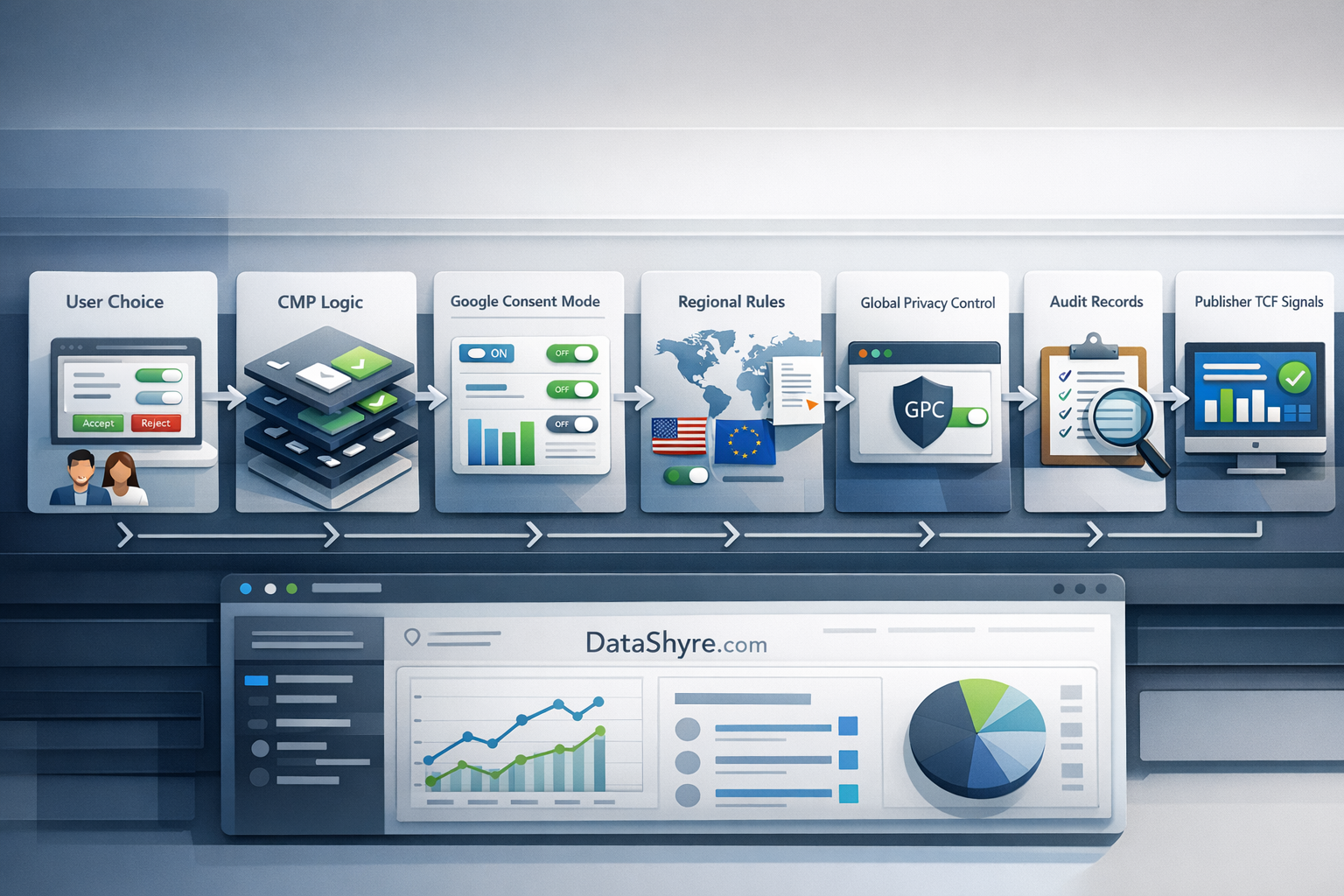
If you are comparing consent management platforms (cmp) on August 5, 2026, the wrong question is which vendor has the cleanest demo banner. The useful question is which platform can actually enforce region-specific choices, block the right technologies before consent, pass the right signals into your tag stack, honor opt-out signals where they matter, and leave proof behind when someone asks what happened.
That framing matters more now because the official guidance is sharper than it was a year ago. The European Commission still says valid consent must be freely given, informed, specific, and given through a clear affirmative act, with withdrawal as easy as giving consent. The ICO’s current cookies guidance still says users should have the means to enable or disable non-essential cookies and that this should be easy to do. Google has also tightened the operational side for publishers and tag teams, while California’s current law-and-regulations page shows the CCPA statute and regulations both effective as of January 1, 2026.
If you want companion reads before the shortlist discussion, start with our guides to best consent management platform, cookie consent banner examples, and privacy consent management. This article stays narrower. It is the seven-check screen I would use before trusting any group of consent management platforms (cmp) on a live site.
Why this comparison changed in 2026
The old CMP buying test was too visual.
Teams compared banner styles, language options, layout controls, and CMS integrations. Those things still matter. But they do not tell you whether the platform can support the legal model you actually need, or whether it can hold up once Google tags, advertising flows, embedded tools, analytics scripts, preference centers, and multiple jurisdictions all start interacting at once.
That is why consent management platforms (cmp) are now better judged as runtime control systems with a user-facing layer, not as banner builders with a compliance marketing page.
1. Start with the legal model, not the feature grid
Before comparing vendors, decide what the platform must actually support.
The European Commission’s current guidance says valid consent must be freely given, informed, given for a specific purpose, expressed through a clear affirmative act, and withdrawable as easily as it was given. That means a CMP is not enough if it only captures one broad yes-or-no action while your real operating model needs different rules for analytics, advertising, personalization, embedded media, or communications preferences.
This is also where teams confuse consent with other legal bases. If one vendor demo assumes consent for everything, but your real stack uses a mix of consent, contract, and legal obligation, the prettier demo may create the weaker rollout.
So the first shortlist question is simple: can the platform model your actual purposes, regions, and downstream consequences without forcing everything into one crude toggle?
2. Treat first-layer fairness as product functionality
This is not only a UX question anymore. It is a buying question.
The CNIL’s current dark-pattern notice says:
“rejecting cookies should be just as easy as accepting them.”
>
CNIL
California pushes in the same direction from a different angle. The current CCPA statute says agreement obtained through dark patterns does not constitute consent, and the current California framework also requires opt-out methods that do not use dark patterns.
So when comparing consent management platforms (cmp), ask to see the first layer in a live environment, not just in a design preview:
Is reject visible immediately?
Is it comparable in effort to accept?
Can you keep wording clear without pushing users toward agreement?
Can the same fairness survive mobile layouts, multiple languages, and A/B-tested templates?
If the vendor needs design gymnastics to make refusal usable, that is a product signal, not just a style issue.
3. Verify blocking and signal timing before you compare dashboards
A CMP should not be judged by how it stores consent alone. It should be judged by what it prevents before consent and what it changes after the choice.
Google’s current consent-mode setup guide says you should set the default consent state before a user grants consent and ensure updates are tracked on the page where they occur before any page transition. Google’s current consent-mode overview is also blunt:
“Consent mode does not provide a consent banner or widget.”
>
Google
That matters because many vendor comparisons quietly assume the platform will “integrate with Google” and leave it there.
The more useful questions are:
Does the CMP block non-essential technologies before consent where opt-in is required?
Does it update consent state early enough for the tags that depend on it?
Does it cover direct tags, GTM, hard-coded scripts, embeds, SDKs, and third-party loaders?
Does it keep working on SPAs, cached pages, and cross-domain journeys?
If the answer is “the banner saves the preference but engineering must handle the rest,” then the CMP may be only part of the control layer you thought you were buying.
4. Make sure the platform review covers more than classic cookies
The ICO’s current guide still frames this area as cookies and similar technologies, not only one browser storage mechanism. That is a useful reminder for vendor reviews. A CMP that inventories cookie names but ignores tags, third-party scripts, pixels, local storage, or fingerprinting-related behavior can produce a very flattering but incomplete result.
This is where shortlists often get distorted. One platform looks cheaper because it controls the visible banner well, while another looks more expensive because it helps with scanning, classification, blocking logic, and change governance across the rest of the page.
If your environment includes multiple trackers, embedded media, session-replay tools, or marketing scripts outside the core tag manager, that difference is not feature bloat. It is the difference between partial visibility and operational control.
5. Keep Google publisher fit separate from general legal sufficiency
For ad-supported businesses, this is one of the most important current comparison checks.
Google’s current publisher guidance says partners using AdSense, Ad Manager, or AdMob for personalized ads in the EEA, UK, or Switzerland must use a CMP certified by Google and integrated with the IAB Transparency and Consent Framework. Google’s current Ad Manager help also says the IAB deadline for full TCF v2.3 implementation was March 1, 2026, and new TC strings generated on or after that date must use v2.3.
Google also says something buyers regularly miss: its CMP assessments focus on TCF-related certification criteria and do not confirm full compliance with the TCF or applicable privacy laws.
So the practical buying question is not “Is this CMP certified?” Full stop.
It is:
Does the platform fit your legal requirements?
Does it fit your publisher monetization path?
Can it produce the consent signals Google currently expects?
Can it keep doing that after template, vendor, or framework changes?
That separation helps prevent a common mistake: treating platform interoperability as if it were the same thing as broader privacy compliance.
6. Check the California path, not only the EU path
Many CMP reviews still do a good Europe demo and a weak California demo.
That is not enough in 2026. The California Department of Justice still says a valid Global Privacy Control signal must be honored by covered businesses as a valid request to stop the sale or sharing of personal information. The CPPA’s current regulations page also shows the current CCPA statute and regulations in force as of January 1, 2026, including the newer regulatory package adopted in 2025.
So a real shortlist review should test whether the platform can:
detect and honor GPC where required;
support opt-out flows without dark patterns;
keep website behavior aligned with the opt-out state;
manage state changes across connected properties or tools where relevant; and
help document what happened after the signal arrived.
If the California path is treated like a separate afterthought, the stack usually ends up with split logic and weaker proof.
7. Buy the evidence model, not just the banner
The strongest CMP is not always the one with the most polished preference center. It is often the one that makes post-launch questions easy to answer.
When someone asks what a user saw, what they chose, what region logic applied, which tags were blocked, whether consent was later withdrawn, and which version of the template was live, can the platform produce a coherent answer?
That is why I would compare consent management platforms (cmp) on evidence and change control:
consent receipts and timestamps;
template and policy versioning;
region-detection logic;
audit logs for consent changes;
integrations with tag managers and downstream systems;
re-testing workflows after site or vendor changes.
The banner is the visible part. The proof model is the part that saves time when legal, privacy, engineering, marketing, or procurement start asking harder questions.
A practical shortlist sequence
If I were reducing a long vendor list this week, I would do it in this order:
Eliminate platforms that cannot model your real regional and purpose-based logic.
Remove any platform whose reject path is visibly weaker than its accept path.
Test pre-consent blocking and post-choice signaling on a live page, not a slide.
Separate general legal fit from Google publisher compatibility.
Test GPC and California opt-out behavior, not just EU opt-in behavior.
Score the evidence model: logs, receipts, versioning, and re-test support.
Only then compare admin usability, implementation effort, and price.
That sequence usually leads to a better answer than starting with the nicest interface or the loudest compliance claims.
Bottom line
The useful way to compare consent management platforms (cmp) in 2026 is to assume the banner is the easiest part and judge the shortlist on everything underneath it.
If a platform can support valid consent where needed, keep refusal genuinely usable, block or signal correctly before tags run, honor California opt-out expectations, fit current Google publisher requirements where relevant, and produce evidence your team can actually use, it deserves a serious look.
If it mostly gives you attractive templates and vague assurances, keep looking.