

Consent Management Platform Admiral: What to Verify Before You Rely on It in 2026
If you are searching for consent management platform admiral, the first useful question on August 1, 2026 is not whether the banner looks modern. It is whether Admiral’s current product claims still line up with your publisher workflow, your regional obligations, and the actual behavior of your tags and vendors after a user clicks.
That matters because the legal baseline is still active and current. On April 29, 2026, the UK ICO finalized guidance saying storage-and-access technology review reaches cookies, tracking pixels, device fingerprinting, and similar tools. On July 14, 2026, the European Data Protection Board required the Belgian DPA to handle the merits of a cookie-banner complaint involving broadcaster VRT instead of closing it procedurally. And in California, the Department of Justice still says a valid Global Privacy Control signal must be honored by covered businesses as an opt-out of sale or sharing.
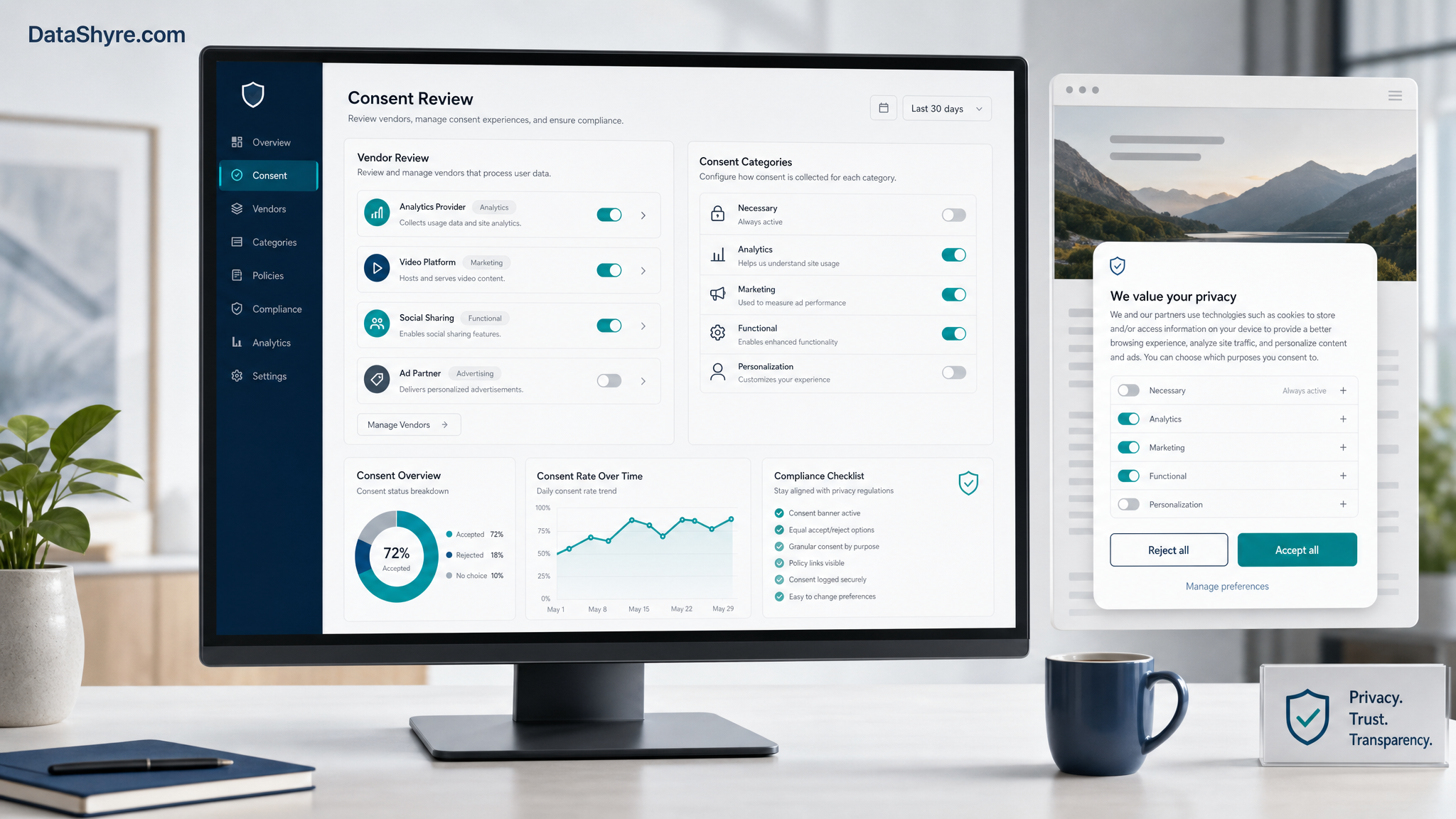
Admiral’s current privacy-consent page adds a product-specific layer. Admiral says its CMP supports GDPR compliance, leverages GPP and TCF frameworks, supports both IAB and non-IAB vendors, offers consent-state reporting, and is a Google-approved CMP provider for sites serving EU visitors. Those claims may be useful, but they should be the start of the review, not the end of it.
If you want wider context before a vendor-specific read, start with our guides to consent management platform, cookie consent manager, and Quantcast consent management platform. This article is narrower. It is the review I would run before trusting consent management platform admiral on a live site.
What Admiral says it does now
On Admiral’s current product page, the company describes its CMP as a publisher-oriented privacy consent platform. The page highlights:
- GDPR compliance support;
- use of GPP and TCF frameworks;
- support for both IAB and non-IAB vendors;
- full visitor-consent state reporting;
- California opt-out support; and
- one-tag installation.
Those are practical claims, especially for ad-supported sites. They also suggest the right review lens. You are not only testing banner copy. You are testing whether the product can control the technologies that matter on a live publisher stack and leave behind evidence your team can use later.
6 checks before you rely on consent management platform admiral
1. Separate vendor positioning from your legal baseline
A CMP page can tell you what a product is designed to support. It cannot settle whether your implementation is compliant.
The ICO’s final 2026 guidance is useful here because it makes the scope explicit: review should cover cookies, tracking pixels, device fingerprinting, and similar storage-or-access technologies. That means the Admiral setup should be evaluated against the real tracking layer, not just the visible banner or admin controls.
The same goes for European consent standards. The European Commission still says consent must be freely given, specific, informed, and unambiguous, and it still says withdrawal should be as easy as giving consent. Product fit matters. Legal fit still matters more.
2. Check whether reject is truly as easy as accept
This remains one of the fastest ways to spot a weak implementation.
CNIL put it plainly in its December 12, 2024 notice on dark patterns in cookie banners:
“Rejecting cookies should be just as easy as accepting them.”
>
CNIL
If an Admiral deployment makes Reject all slower, less visible, or harder to understand than Accept all, the interface is already creating risk. Test that on desktop and mobile. Then reopen the control later and make sure refusal or withdrawal still works cleanly.
3. Follow the signal into the actual publisher stack
This is the implementation test that matters more than feature grids.
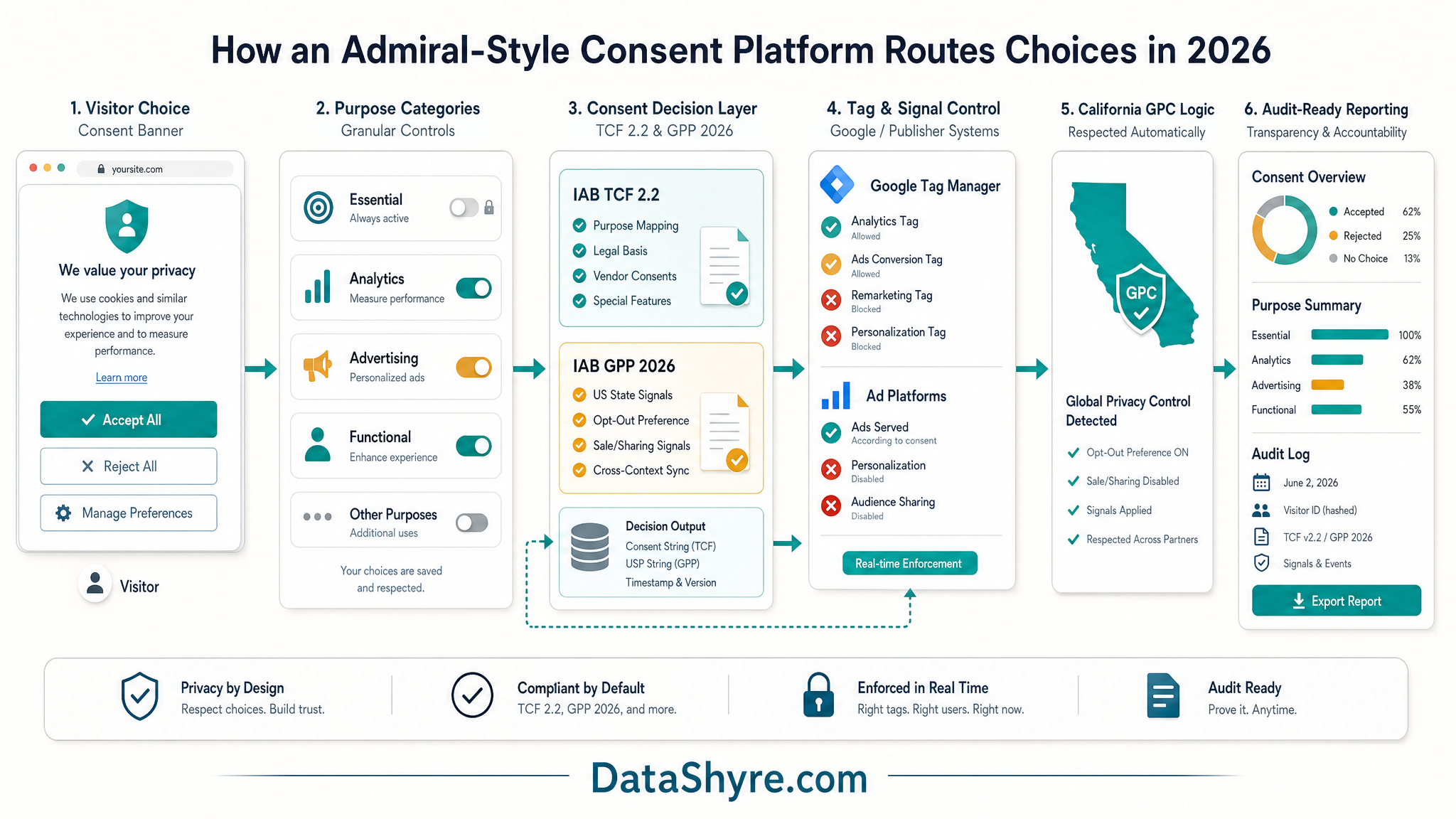
Admiral says it supports both IAB and non-IAB vendors and offers consent-state reporting. That is promising if your site uses a mixed stack of ad tech, analytics, video, or embedded tools. But the real question is whether the signal reaches the systems that act on data before they fire.
For this Admiral CMP, I would test:
- homepage and article templates;
- pages with extra ad or video components;
- tag-manager behavior before any choice;
- vendor behavior after
Reject all; - later withdrawal or category-level changes.
If optional technologies still load before consent where prior consent is required, the setup is weaker than the admin screen suggests.
4. Verify Google publisher fit separately
This is a distinct check, not a shortcut to broader compliance.
Admiral’s page says it is a Google-approved CMP provider for sites serving EU visitors. Separately, Google’s own publisher guidance says personalized ads for users in the EEA, the UK, and Switzerland require a certified CMP integrated with the TCF. If your monetization model depends on personalized ads, confirm that your live workflow satisfies Google’s current requirement rather than assuming the vendor claim alone answers it.
This is also where consent-mode wiring should be tested. A useful CMP setup is not only collecting a choice. It is passing consent state early enough to affect ad and measurement behavior downstream.
5. Separate EU or UK prior-consent logic from California opt-out logic
One interface can support multiple regions, but one compliance story rarely covers all of them.
In the EU and UK, the question is often whether non-essential technologies remain off until valid consent exists. In California, the review often shifts toward sale-or-sharing opt-out handling and preference signals. The California Department of Justice says a user-enabled Global Privacy Control must be honored by covered businesses as a valid request to stop sale or sharing, and the CPPA’s current CCPA law-and-regulations page lists the governing CCPA materials as effective on January 1, 2026.
For this review, that means checking whether regional logic changes real downstream behavior, not only the wording shown on the first layer.
6. Demand proof that a non-technical team can actually use
Admiral says its CMP provides full visitor-consent state reporting. That is helpful only if your team can translate the records into a usable timeline later.
I would want to know:
- which banner version was live;
- which purposes or vendors were disclosed;
- what the user chose and when;
- whether a later withdrawal or revision was captured; and
- whether the site’s actual behavior matched the recorded preference.
That is where a stronger Admiral CMP setup separates itself from a decorative banner tool.
A short review sequence I would use this week
If I were reviewing this Admiral CMP right now, I would do this in order:
- Read Admiral’s current product page and list the exact promises the team thinks it relies on.
- Open a clean browser session and inspect what fires before any choice is made.
- Click
Reject alland retest templates that carry ads, analytics, or embedded tools. - Check whether the implementation passes usable consent state into the tools that matter.
- Test later withdrawal or preference edits from the normal return path.
- For California-facing traffic, verify how the site handles Global Privacy Control and sale-or-sharing opt-out logic.
- Export or inspect the records to see whether a stakeholder outside engineering could reconstruct what happened.
That sequence is usually more valuable than a long vendor scorecard.
Bottom line
In 2026, the right Admiral CMP setup is not the one with the cleanest marketing page. It is the one your team can test, explain, and defend on a live site.
If Admiral’s current framework support, reporting, and publisher orientation match your stack, that may make it a strong candidate. But I would still require equal rejection, real prior blocking where needed, separate California logic where applicable, verified Google publisher fit, and records that hold up after the fact.
If you cannot verify those points cleanly, the review is not finished yet.
Sources
- Admiral: Privacy Consent Management Platform
- UK ICO: Guidance on the use of storage and access technologies
- UK ICO: Final storage and access technologies guidance published
- European Commission: When is consent valid?
- European Commission: Legal grounds for processing data
- European Data Protection Board: Belgian DPA must handle the merits of a NOYB cookie-banner complaint
- CNIL: Dark Patterns in Cookie Banners: CNIL issues formal notice to website publishers
- California Department of Justice: Global Privacy Control
- California Privacy Protection Agency: Laws & Regulations
- Google AdSense Help: Google consent management requirements for serving ads in the EEA, the UK, and Switzerland
This post was updated on August 1, 2026 using current official regulator, government, platform, and vendor materials available at publication time.