

Consent for Data Collection in 2026: When You Actually Need It
If you are reviewing consent for data collection, the first question is not how to word the checkbox. It is whether consent is the right basis at all.
That still matters on July 31, 2026. The European Commission continues to frame valid consent as something that is freely given, informed, specific, and expressed through a clear affirmative act. The UK ICO is just as direct: if consent is hard to make valid, “another lawful basis is more appropriate.” California often takes a different path again, focusing on notice at collection, opt-out rights, and Global Privacy Control rather than blanket opt-in consent for every use.
If you want the surrounding context first, start with our guides to Data Consent in 2026: When You Need It, When You Don’t, and What to Record, GDPR Consent Form: What to Include, What to Avoid, and a 2026 Example, and California Consumer Privacy: 6 Business Changes to Make in 2026. This article is narrower. It is the practical check I would run before asking anyone for consent for data collection in a live product, form, or website flow.
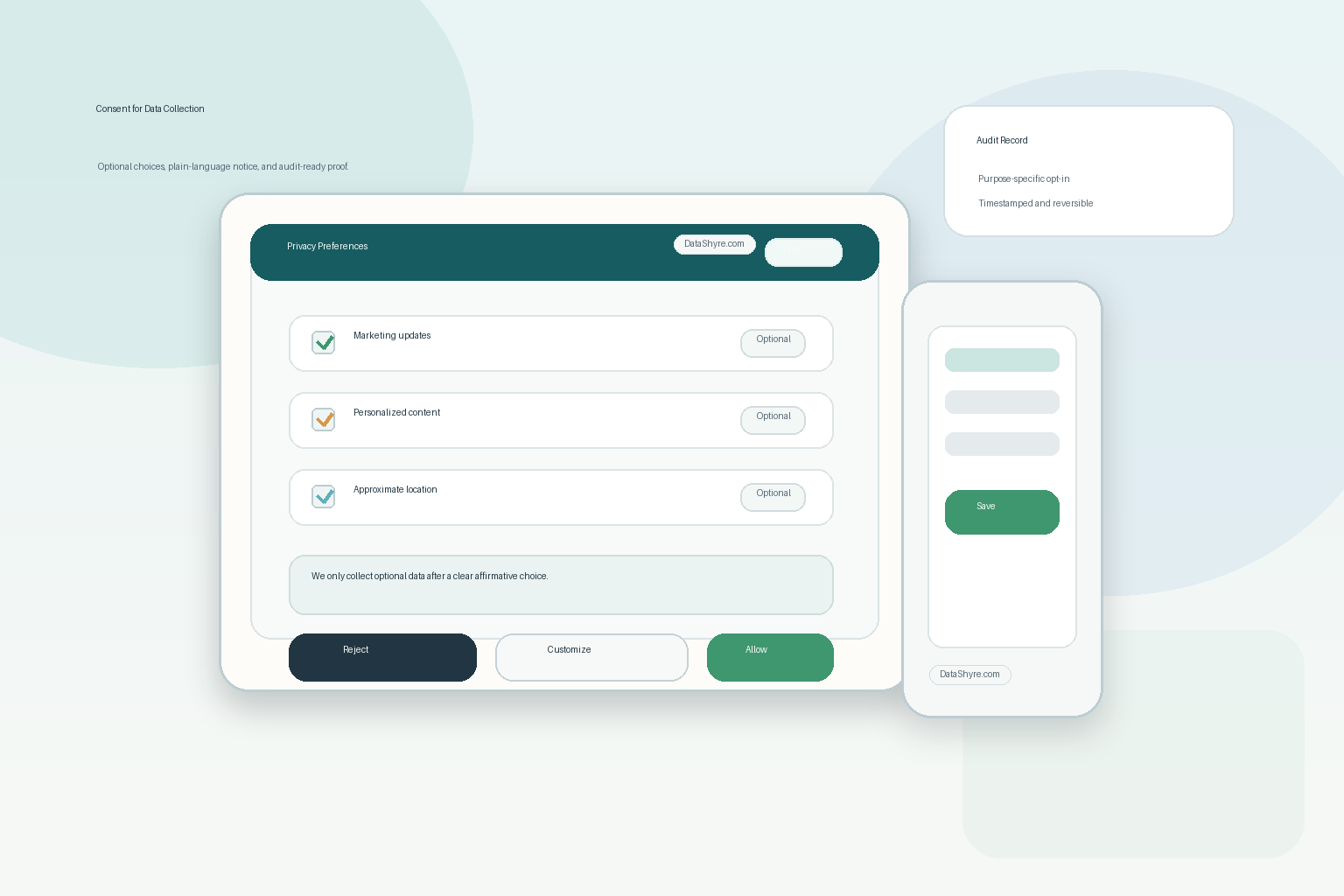
When consent for data collection is actually the right choice
Consent works best when the person can say yes or no without losing the core service.
That usually fits situations like:
- an optional marketing signup;
- optional profiling for personalization;
- optional location collection for a convenience feature;
- optional sharing with third parties for a separate purpose;
- certain sensitive-data scenarios where explicit consent is the condition you intend to rely on.
The pattern is simple: if the data collection is genuinely optional and the person can refuse without detriment, consent may be a strong fit. If the data is necessary to ship an order, provide an account, detect fraud, or meet a legal duty, consent is often the wrong starting point.
When consent is the wrong default
This is where teams overuse consent.
The European Commission says consent is not freely given when an organization requires unnecessary personal data as a condition of providing a contracted service. The same source also points to imbalance problems, such as employer and employee relationships, where the person may not have real freedom to refuse.
The ICO takes the same practical position. You should choose the lawful basis that reflects the real nature of the relationship and purpose. If the processing is necessary for a contract, required by law, or better justified by legitimate interests after a proper balancing test, asking for consent can make your privacy position weaker rather than safer.
A good rule of thumb is this:
- If the service cannot work without the data, assess contract or another lawful basis first.
- If the organization must collect the data to comply with law, assess legal obligation first.
- If the collection is genuinely optional, then consent may fit.
That is why consent for data collection should be treated as a specific tool, not a universal answer.
What valid consent for data collection must prove
When consent is the right basis, the quality bar is higher than many forms suggest.
1. The purpose has to be specific
People should understand what data you want, why you want it, and what will happen next. Vague lines like to improve your experience are usually too thin on their own. If the real purpose is marketing, profiling, audience measurement, or third-party sharing, say that plainly.
2. The action has to be affirmative
Pre-ticked boxes, passive browsing, or consent buried inside general terms are weak territory. The European Commission continues to use the same standard: consent should be clear and given through an affirmative act.
3. Refusal cannot create an unfair penalty
If the person loses access to the core service for refusing an optional use, the choice may not be freely given. This is one of the fastest ways for a flow to fall apart under review.
4. Withdrawal has to be easy later
The European Commission’s wording is still the cleanest operational test:
“It should be as easy to withdraw as to give consent.”
>
European Commission GDPR guidance
For a real implementation, that means the withdrawal path should not require contacting support, sending a paper form, or hunting through a policy page. A visible account setting, footer link, or preference center is usually a much stronger pattern.
5. You need records that explain what happened
The ICO’s consent guidance still expects organizations to obtain, record, and manage consent in a way they can prove later. In practice, that means keeping:
- the wording shown at the time;
- the purpose attached to the choice;
- the method of consent;
- the timestamp;
- any later withdrawal or change.
Without that trail, consent for data collection becomes hard to defend after the fact.
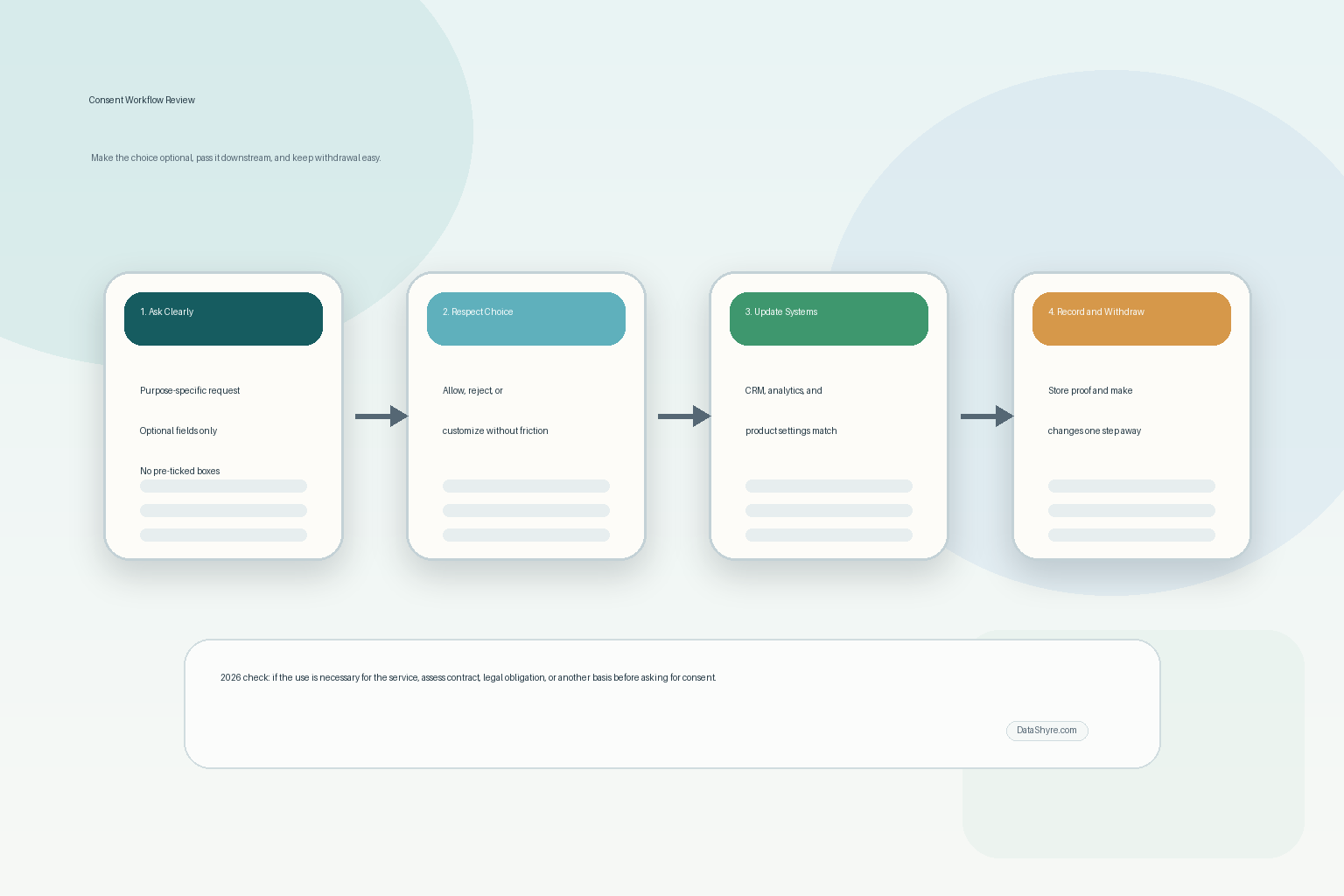
Website tracking is a separate consent check
Many teams mix form consent and tracking consent together. That is risky.
If your data collection relies on non-essential cookies or similar tracking technologies in the EU or UK, the review is broader than a form field. The UK ICO’s final storage-and-access technologies guidance, published on April 29, 2026, makes clear that compliance review can reach pixels, scripts, fingerprinting techniques, web storage, and similar technologies, not just classic browser cookies.
So a newsletter form may be compliant on its own while the surrounding page still fails because analytics or advertising tags fire before any valid choice. Consent language only helps if the underlying technical behavior matches it.
California often requires notice and opt-out, not blanket opt-in
This is where US teams often get turned around.
California’s current CCPA framework does not turn every instance of data collection into an opt-in consent question. The CPPA’s regulations and statute instead emphasize notice at or before collection, purpose limits, and consumer rights. The statute says businesses that control collection must tell consumers the categories of personal information collected, the purposes, whether the information is sold or shared, and the retention period or criteria used to set it.
The CPPA FAQ also says businesses must honor opt-out preference signals such as Global Privacy Control when those signals qualify under the rules. If sensitive personal information is used or disclosed beyond the allowed statutory purposes, the business may also need a clear way to limit that use.
That means a California-facing flow often needs:
- a clear notice at collection;
- a privacy policy that matches the real data uses;
- working sale/share opt-out logic;
- GPC handling where applicable;
- a limit-use path for sensitive personal information where required.
So if you are asking about consent for data collection in California, the right answer may be “not for this step.” The stronger answer may be better notice, working rights mechanisms, and tighter purpose control.
A fast review sequence before you launch
If I were reviewing consent for data collection before release, I would do this in order:
- Name the exact purpose and ask whether the collection is truly optional.
- Check whether another lawful basis fits the activity better than consent.
- Remove any unnecessary data fields that are bundled into the same flow.
- Make the consent request separate, plain-language, and purpose-specific.
- Test the refusal path and confirm the core service still works when it should.
- Test withdrawal and confirm downstream systems actually stop the optional use.
- Verify that the records show what was presented, chosen, and later changed.
That short sequence catches most weak implementations faster than a long policy workshop.
Bottom line
In 2026, strong consent for data collection still comes down to a simple question: is the person making a real optional choice, or is the business labeling a required data use as consent?
If the use is optional, specific, clearly explained, easy to refuse, and easy to withdraw, consent can work well. If the use is necessary for the service, required by law, or governed mainly by notice and opt-out rules, a different legal and operational path is usually stronger.
Sources
- European Commission: Legal grounds for processing data
- European Commission: When is consent valid?
- ICO: A guide to lawful basis
- ICO: Consent
- ICO: How should we obtain, record and manage consent?
- ICO: Final storage and access technologies guidance published
- California Privacy Protection Agency: Law & Regulations
- California Privacy Protection Agency: California Consumer Privacy Act of 2018
- California Privacy Protection Agency: Frequently Asked Questions
This post was updated on July 31, 2026 using current official regulator guidance available at publication time.