

Quantcast Consent Management Platform: What to Verify Before You Rely on It in 2026
If you are searching for a quantcast consent management platform, the first useful question in July 2026 is not banner color or button text. It is whether you are evaluating a live, supportable consent workflow that still fits your ad stack, your regional rules, and your proof requirements today.
That matters because the legal baseline is clearer, not looser. The European Commission still says valid consent must be freely given, specific, informed, and expressed through a clear affirmative act. The UK ICO’s final storage-and-access technologies guidance, published on April 29, 2026, also makes clear that the compliance review is broader than browser cookies alone. It reaches tracking pixels, scripts, fingerprinting techniques, and similar storage or access technologies.
The Quantcast angle adds one more layer: ownership and product-path clarity. Quantcast announced in August 2023 that InMobi acquired Quantcast Choice. At the same time, Quantcast’s own legal center still includes publisher terms, effective January 12, 2026, that reference the need for a transparency and consent solution compatible with the IAB Europe Transparency and Consent Framework and say publishers should not permit calls to Quantcast servers where required consent has not been obtained.
If you want the wider CMP baseline first, start with our guides to consent management platform, cookie consent manager, and Google Tag Manager cookie consent. This article is narrower. It is the review I would run before relying on a quantcast consent management platform in production.
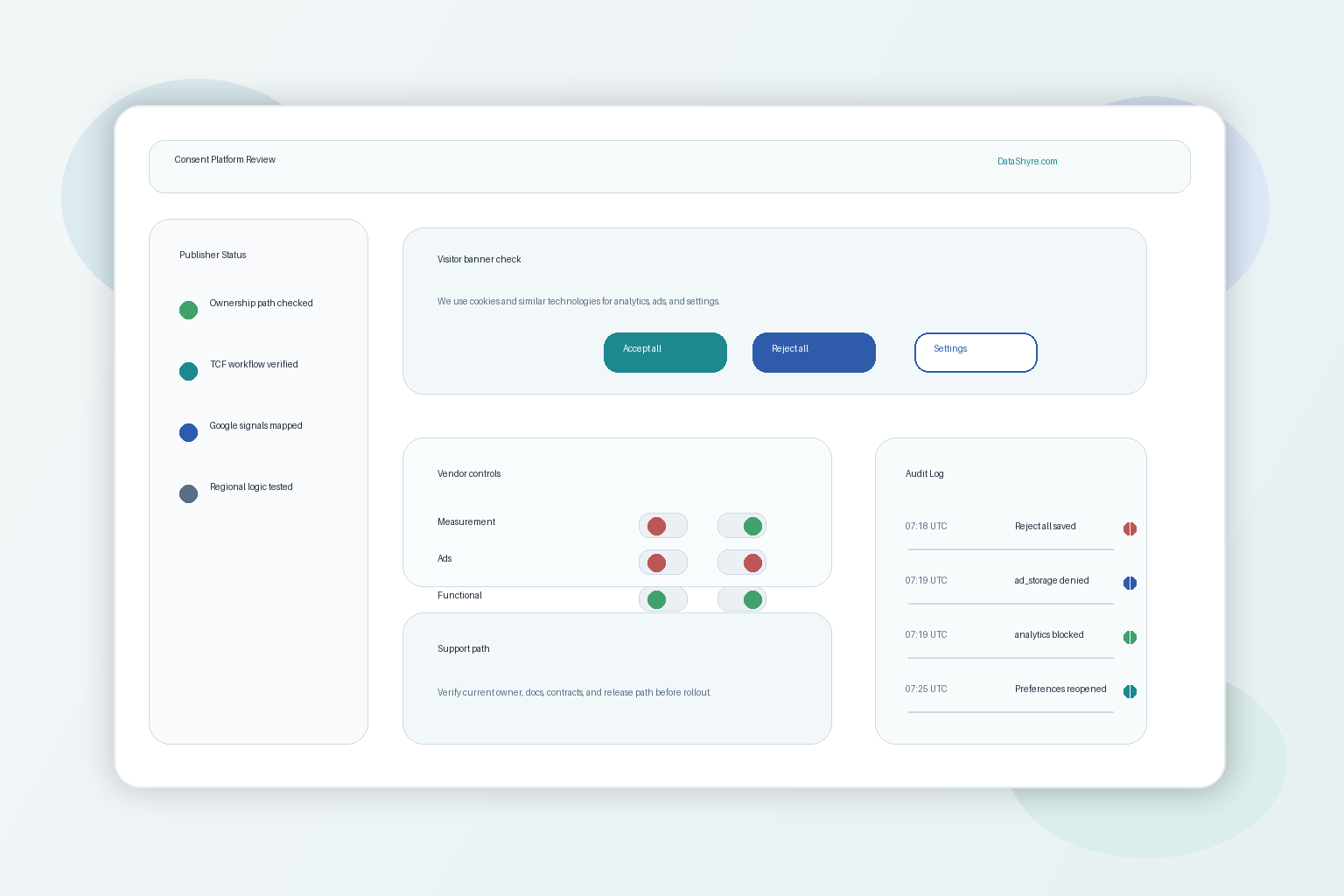
Why this review starts with ownership and implementation reality
For a general CMP, you can often start with features. For a quantcast consent management platform, I would start with product reality instead:
- which organization owns and supports the consent product now;
- whether your current implementation still maps to the current support path;
- whether your ad and measurement tags still respect consent before they call out;
- whether your publisher requirements and regional workflows still line up.
That first point is not cosmetic. If teams still speak loosely about “Quantcast Choice” while operational ownership or support lives elsewhere, handoffs can get messy fast. Documentation, certification status, release notes, and escalation paths are all harder to trust when the ownership story is fuzzy inside the team.
6 checks before you rely on a quantcast consent management platform
1. Confirm who owns the product path you are actually using
This is the first check because it changes how you verify everything else.
Quantcast’s August 16, 2023 press release says InMobi acquired Quantcast Choice. Quantcast’s public site in 2026 mainly emphasizes its advertising platform, while its legal center still references Quantcast Choice in historical and current legal materials tied to publisher use. I would treat that as a prompt to verify your current admin path, contract path, and support path before you assume the implementation you inherited is straightforward.
In practice, that means confirming:
- who provides the current admin console or support desk;
- which documentation your team treats as authoritative;
- whether the live CMP instance is still on the product path you think it is;
- whether current release or certification assumptions are based on live evidence rather than memory.
If your team cannot answer those questions quickly, that is already part of the operational risk.
2. Check whether reject is as easy as accept
This is still the fastest design test.
France’s CNIL put it plainly in its December 12, 2024 formal notice on dark patterns in cookie banners:
“Rejecting cookies should be just as easy as accepting them.”
That sentence still does a lot of work in 2026. If a quantcast consent management platform setup makes refusal slower, less visible, or harder to understand than acceptance, the banner is creating risk before you even get to tag behavior.
Do not stop at the first layer screenshot. Test the live interaction. Refuse optional purposes, reopen settings later, and confirm the system behaves as though refusal actually matters.
3. Test prior blocking on the real pages that make money
The CMP is not doing its job if optional technologies fire before the visitor makes a choice in regions where prior consent is required.
This is where the ICO’s 2026 guidance matters. The review should not stop at classic cookie files. Check what happens with scripts, pixels, fingerprinting-related tools, embedded media, tag-manager calls, and measurement tags too.
For publisher and ad-supported properties, I would test:
- the homepage;
- article pages;
- pages with ad slots or embedded video;
- any template that loads extra measurement or audience tools.
If the banner looks neat but ad or analytics tools have already fired, the implementation is weak no matter how polished the interface appears.
4. Follow the consent signal into Google tags and publisher requirements
A consent choice stored inside the CMP UI is not enough. It has to reach the systems that actually act on data.
Google’s current consent-mode guidance for websites says implementations need to set and update consent states such as ad_storage, analytics_storage, ad_user_data, and ad_personalization. Google’s publisher help also says a certified CMP integrated with the TCF is required for publishers serving personalized ads to users in the EEA, the UK, and Switzerland.
That means a quantcast consent management platform review should include two separate checks:
- Does the implementation update Google consent states early enough to matter?
- If personalized ads are in scope, has the team separately verified current Google-certified CMP fit for the live publisher workflow?
Those are related checks, not the same check. A setup can send some consent signals and still fail a publisher-specific requirement. It can also satisfy a platform requirement while still being weak on broader legal or technical behavior.
5. Separate EU and UK prior-consent logic from California opt-out logic
One global banner pattern is rarely enough.
In EU and UK flows, the operational question is often whether non-essential technologies remain off until valid consent exists. In California, the workflow is different. The California Department of Justice says a user-enabled Global Privacy Control is one acceptable method for consumers to submit an opt-out of sale or sharing online, and covered businesses must honor it as a valid request. The CPPA’s current CCPA regulations and updates are also effective as of January 1, 2026.
That means your review should confirm:
- opt-in logic where prior consent is required;
- opt-out handling where sale or sharing rules apply;
- GPC handling where relevant;
- region-specific copy and behavior that stay aligned.
If a vendor or implementer describes the setup as “global,” ask what changes in actual live behavior by region, not only in translated text.
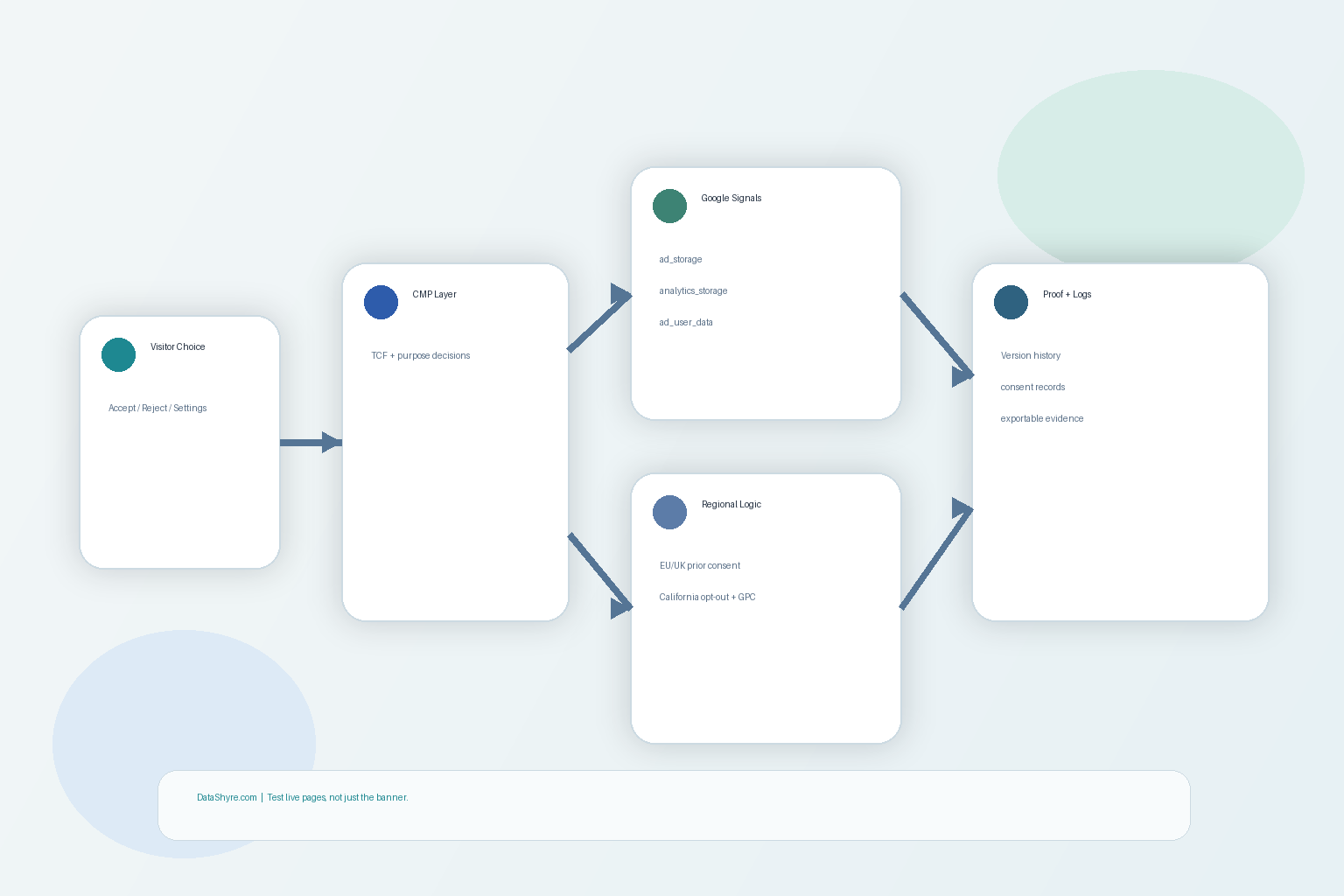
6. Demand evidence you can export and understand later
Sooner or later, someone will ask what happened on a specific date.
You should be able to answer:
- What did the first layer say?
- Which choices were available by purpose or vendor?
- What happened after rejection or later withdrawal?
- Which rule set applied by region?
- Which implementation version was live?
That is where a stronger CMP setup separates itself from a decorative banner tool. You need records that help support teams, legal teams, and ad-ops teams reconstruct what actually happened without guesswork.
A short review sequence I would use this week
If I were reviewing a quantcast consent management platform setup right now, I would run this sequence:
- Confirm the current product ownership, admin path, and support path.
- Load a clean browser session and inspect what fires before any click.
- Test
Reject alland confirm optional technologies stay off where they should. - Verify whether Google consent signals are set by default and updated after choice changes.
- Test California-facing behavior for GPC or opt-out handling where relevant.
- Export the records and decide whether a non-technical stakeholder could understand them.
That usually reveals more than a long feature comparison.
Common mistakes
The same mistakes keep coming up:
- assuming the product name still tells you who owns support;
- treating banner appearance as the main test;
- checking only one page template;
- assuming Google publisher requirements equal full compliance;
- using the same operational flow for the EU, UK, and California;
- skipping export and audit-log review.
None of those mistakes are unusual. They are just expensive.
Bottom line
The right quantcast consent management platform setup in 2026 is the one your team can still identify, test, and defend. That means a clear current support path, equal refusal and acceptance, real prior blocking where required, working consent-signal handoffs, region-specific logic, and records you can actually use later.
If your team cannot verify those things cleanly, the safer conclusion is not that the banner looks fine. It is that the review is unfinished.
Sources
- European Commission: When is consent valid?
- UK ICO: Guidance on the use of storage and access technologies
- UK ICO: Final storage and access technologies guidance published
- CNIL: Dark Patterns in Cookie Banners: CNIL issues formal notice to website publishers
- Google for Developers: Set up consent mode on websites
- Google Ad Manager Help: Google consent management requirements for serving ads in the EEA, the UK, and Switzerland (for publishers)
- California Department of Justice: Global Privacy Control (GPC)
- California Privacy Protection Agency: CCPA Updates, Cybersecurity Audits, Risk Assessments, Automated Decisionmaking Technology, and Insurance Companies
- Quantcast: InMobi Acquires Quantcast Choice to Enhance Frictionless Consent Management for Publishers
- Quantcast Legal Center: Quantcast Measure Terms of Service