

Consent Management Platform of Sorts: Why a Banner Tool Is Not a Real CMP in 2026
If you are searching for a consent management platform of sorts, you probably already have a banner, a few settings, and a nagging sense that the setup is only half-finished. That instinct is usually right. A tool can look like a CMP and still fail at the parts that matter most in production.
In July 2026, the compliance baseline is not just about showing a notice. The European Commission still says valid consent must be freely given, specific, informed, and expressed through a clear affirmative act. The UK ICO’s final storage-and-access technologies guidance, published on April 29, 2026, also makes clear that the review is broader than classic browser cookies. It can reach tracking pixels, scripts, device fingerprinting, and similar technologies too.
If you want the broader buying checklist first, start with our guides to consent management platform, cookie consent manager, and cookie consent. This article is narrower. It is about the awkward middle state many teams live with: a setup that looks like a CMP from the outside, but behaves more like a banner widget with extra menus.
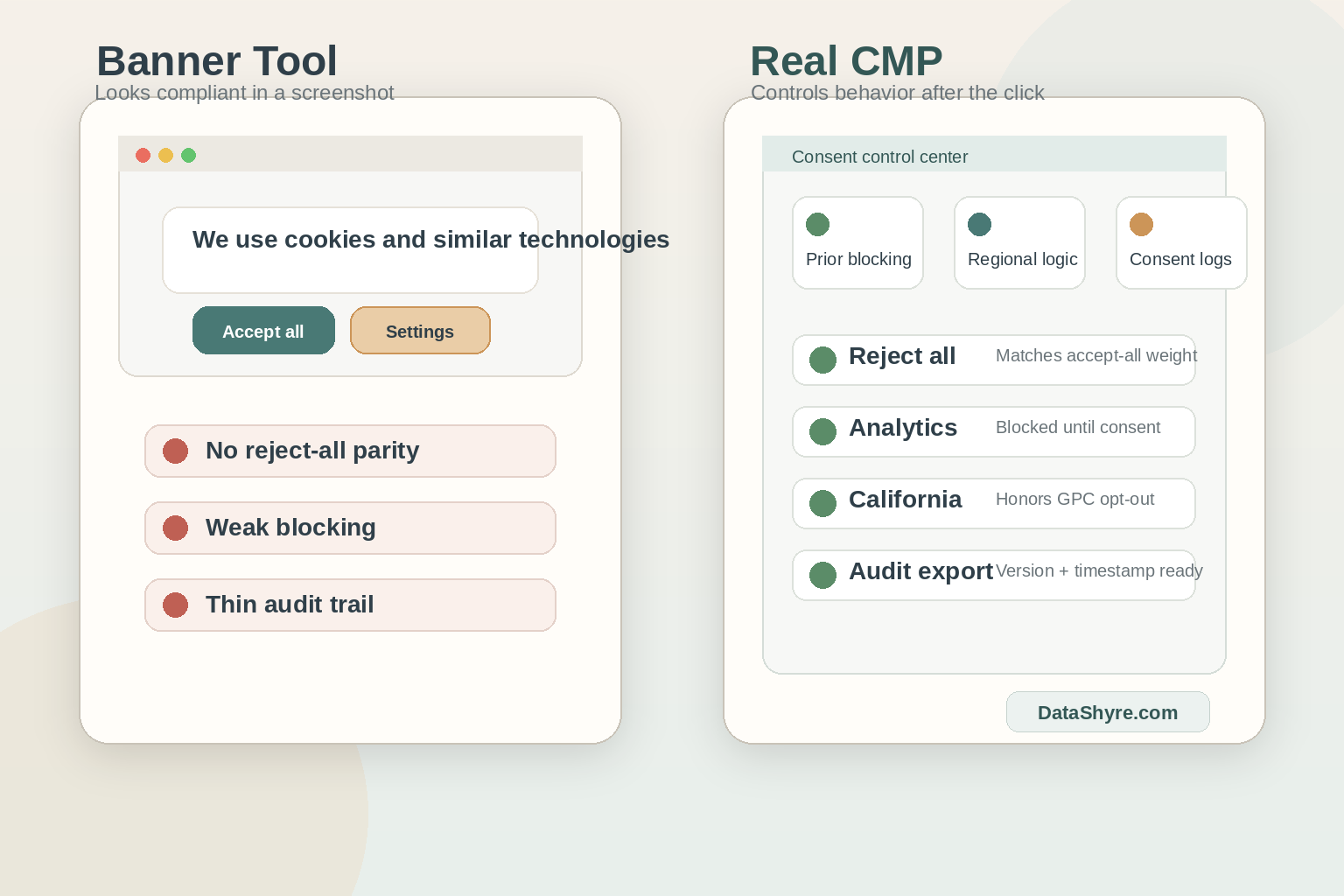
What a consent management platform of sorts usually looks like
Most CMP-ish setups share the same pattern:
- a polished first-layer banner;
- category toggles that seem detailed enough for design review;
- weak or inconsistent script blocking;
- little proof of what happened after a user refused;
- no clean handling for regional differences.
That is why the phrase consent management platform of sorts fits so many implementations. The interface exists, but the control layer is thin.
5 tests that separate a real CMP from a banner tool
1. Check whether refusal is as workable as acceptance
France’s CNIL still gives the fastest design test. In its December 12, 2024 notice on dark patterns in cookie banners, it said:
“Rejecting cookies should be just as easy as accepting them.”
>
CNIL, dark patterns in cookie banners, 12 December 2024
That is not just copy advice. It is a control test. If Accept all is immediate while refusal is smaller, slower, or hidden in another layer, the product is shaping the outcome before the rest of the stack even enters the conversation.
2. Test what fires before the click
This is where a consent management platform of sorts usually falls apart. The banner appears, but optional analytics, advertising, or personalization tools still start loading before the user acts.
The ICO’s 2026 storage-and-access guidance matters because it pushes teams to test more than cookies alone. If your review stops at a cookie table and ignores pixels, third-party scripts, fingerprinting logic, or embedded tools, you can miss the real behavior that regulators care about.
3. Follow the consent signal into the rest of the stack
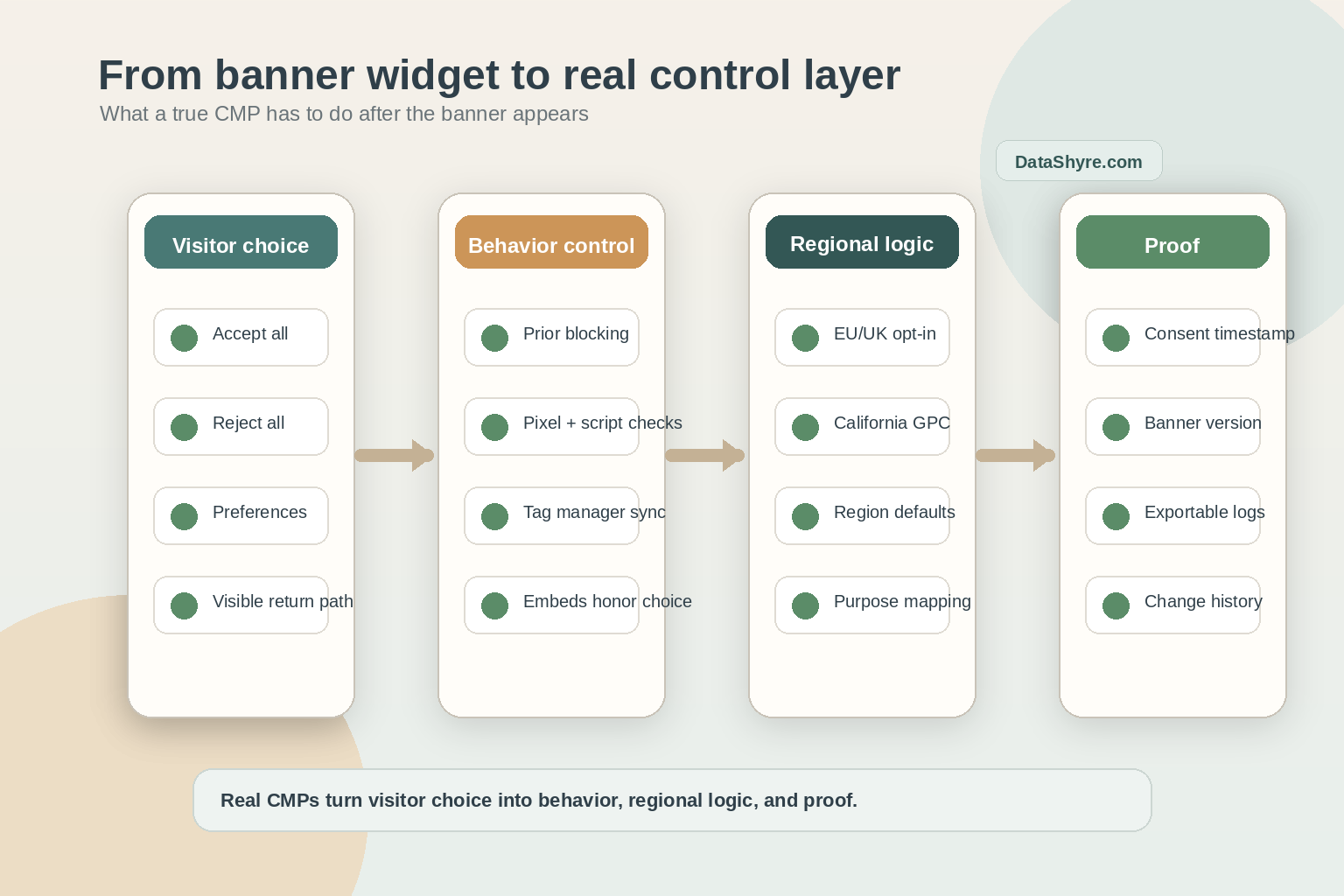
A real CMP does not end at the banner UI. It has to carry the user’s choice into the systems that actually collect or process data.
For most teams, that means checking:
- tag managers;
- analytics tools;
- advertising pixels;
- embedded video, chat, or social widgets;
- later preference changes after the first visit.
If the platform stores a preference in its own panel but your tools keep behaving as if consent exists anyway, you do not have a finished CMP. You have a consent-shaped gap.
4. Separate EU and UK consent logic from California opt-out logic
This is another place where banner tools get over-credited. EU and UK flows often turn on prior consent for non-essential tracking. California logic can require a different operational path.
The California Department of Justice still says a user-enabled Global Privacy Control must be honored by covered businesses as a valid request to stop the sale or sharing of personal information. The CPPA’s current CCPA regulations also became effective on January 1, 2026. That is a reminder that regional privacy logic should not be treated as a text-translation problem.
If the product gives you one global banner but weak control over opt-in, opt-out, GPC, or region-specific defaults, it is still a consent management platform of sorts, not a fully reliable one.
5. Demand evidence you can export later
Sooner or later, someone asks what happened on a specific date. That might be a customer, a legal team, an internal audit, or a regulator.
You should be able to answer:
- What did the visitor see on the first layer?
- Which categories were enabled or refused?
- What changed after the user’s action?
- Could the user reopen settings later and change the choice?
- Which version of the banner or preference center was live at the time?
The absence of those answers is one reason banner-only tools create so much false confidence.
Why this still matters in 2026
Cookie-banner enforcement is not a closed chapter. On July 14, 2026, the EDPB required the Belgian DPA to handle the merits of a NOYB cookie-banner complaint involving broadcaster VRT rather than ending the case on procedural grounds. The point is simple: banner design and consent mechanics are still active enforcement subjects.
That is why “good enough” is a poor standard here. A banner tool may satisfy a launch checklist, but it can still leave the live site exposed if optional tracking starts too early, refusal is weakened, or regional logic is missing.
A short review sequence to run this week
If your current setup feels like a consent management platform of sorts, run this sequence:
- Open a clean browser session and inspect what loads before any action.
- Click
Reject alland confirm optional tags stay off where they should. - Test granular choices and verify the right categories turn on and off.
- Reopen settings later and confirm withdrawal works cleanly.
- For California-facing traffic, test how GPC and sale/share opt-out logic are handled.
- Export the records and decide whether a non-technical stakeholder could understand them.
That sequence usually tells you very quickly whether the product is a real control layer or just a banner with aspirations.
Bottom line
A consent management platform of sorts may be fine for a mockup, a design review, or a temporary launch patch. It is not enough if you need real prior blocking, regional decision logic, durable consent signals, and usable evidence.
In 2026, the safer standard is straightforward: the platform should turn user choice into live behavior and leave behind proof your team can actually use.
Sources
- European Commission: When is consent valid?
- UK ICO: Final storage and access technologies guidance published
- UK ICO: What are storage and access technologies?
- CNIL: Dark Patterns in Cookie Banners: CNIL issues formal notice to website publishers
- European Data Protection Board: EDPB requires Belgian DPA to handle the merits of NOYB cookie banner complaint
- California Department of Justice: Global Privacy Control
- California Privacy Protection Agency: CCPA Updates, Cybersecurity Audits, Risk Assessments, Automated Decisionmaking Technology, and Insurance Companies