

Consent Management Platform (CMP) in 2026: What It Is and 7 Checks Before You Buy
If you are searching for a consent management platform (CMP) on August 2, 2026, the useful question is not whether the banner looks polished. It is whether the platform can collect a fair choice, turn that choice into live technical behavior, and leave behind records your team can still use later.
That is the right lens because the official baseline is still active. On April 29, 2026, the UK ICO published final guidance on storage and access technologies that expressly reaches cookies, tracking pixels, device fingerprinting, and similar tools. On July 14, 2026, the European Data Protection Board required the Belgian DPA to assess the merits of a cookie-banner complaint involving broadcaster VRT instead of dismissing it on procedural grounds. In California, the Department of Justice still says a valid Global Privacy Control signal must be honored by covered businesses as a request to stop sale or sharing, while the CPPA’s current laws-and-regulations page lists both the CCPA and the CCPA Regulations as effective on January 1, 2026.
If you want adjacent context first, start with our guides to consent management platform, consent manager, and cookie consent manager. This article is narrower. It answers what a CMP actually is and what I would verify before buying one this week.
What a consent management platform actually does
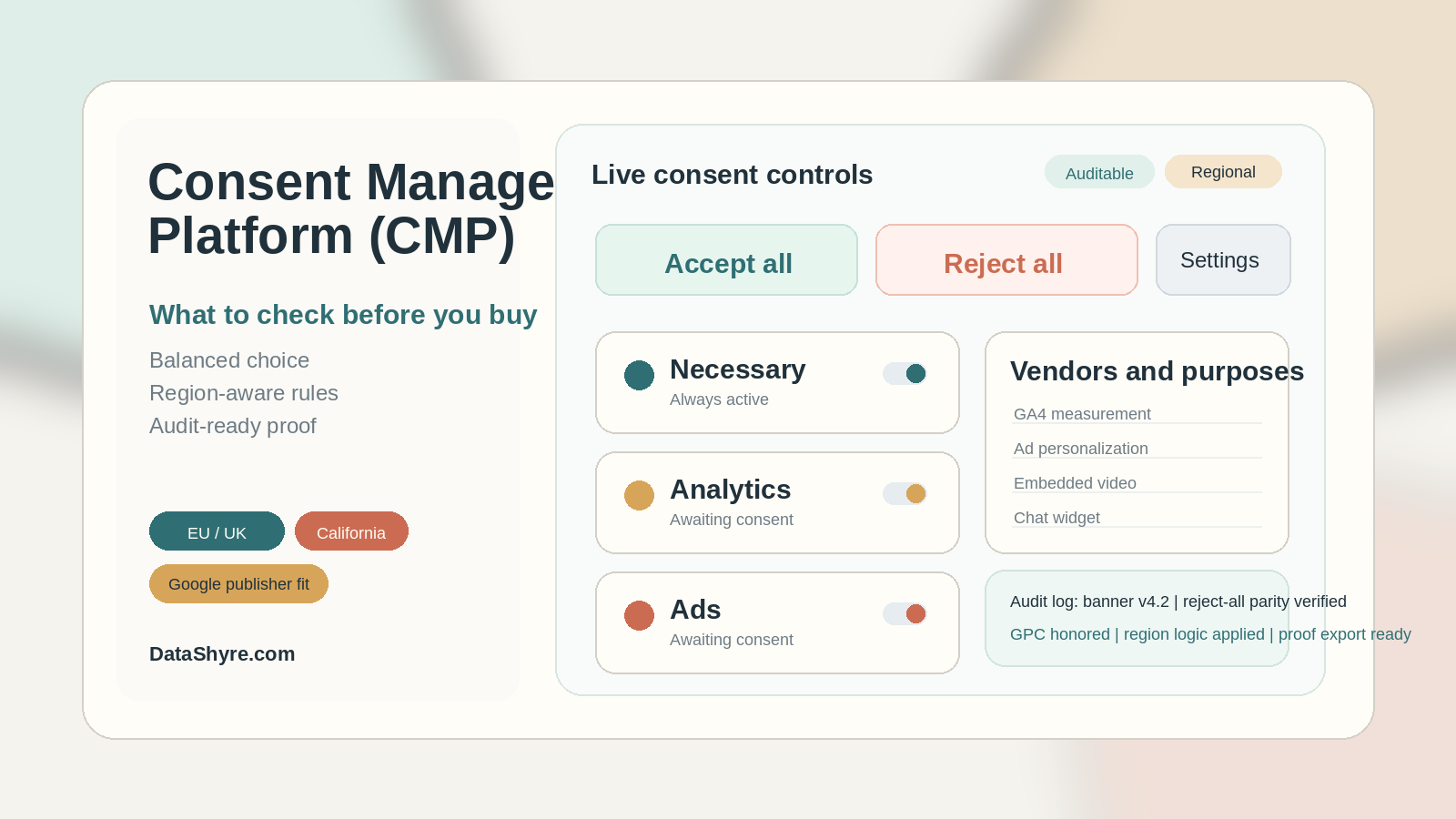
A real consent management platform (CMP) is not just a banner widget. It is the control layer between a user’s privacy choice and the technologies that want to store, access, or activate data across your site or app.
That scope matters more in 2026 because the ICO’s current storage-and-access guidance is not limited to classic cookies. It expressly reaches tracking pixels, device fingerprinting, and similar technologies. In practice, that means a CMP review has to follow the signal into tags, embeds, analytics, advertising tools, and downstream systems that depend on consent state.
The European Commission’s consent guidance is the second anchor. When consent is the legal basis, it must be freely given, specific, informed, and unambiguous, and people must be able to withdraw it. That is why interface design, runtime behavior, and proof all belong in the same CMP review.
7 checks before you buy a consent management platform
1. Check whether refusal is as easy as acceptance
This is still the fastest filter.
In its December 12, 2024 notice on dark patterns in cookie banners, France’s CNIL said:
“Rejecting cookies should be just as easy as accepting them.”
>
CNIL
If Accept all is immediate but Reject all is hidden, visually downgraded, or pushed behind another layer, the product is already weakening the fairness of the choice it collects.
2. Test prior blocking on a real page, not in a vendor demo
For regions where prior consent is required for non-essential technologies, optional analytics, advertising, personalization, and similar tracking should not start before the user acts.
This is where a lot of CMP buying decisions go wrong. The demo looks clean, the categories look organized, and the dashboard feels mature. Then the real site loads tags before any click. A good consent management platform (CMP) changes live runtime behavior, not just banner copy.
3. Separate EU and UK consent logic from California opt-out logic
One privacy flow is rarely enough.
In the EU and UK, the operational question is often whether non-essential storage or access technologies stay off until valid consent exists. In California, the workflow often shifts toward sale-or-sharing opt-out handling and browser-level preference signals. The California DOJ says GPC must be honored by covered businesses, which means a platform built only around European-style opt-in banners can still leave a California gap.
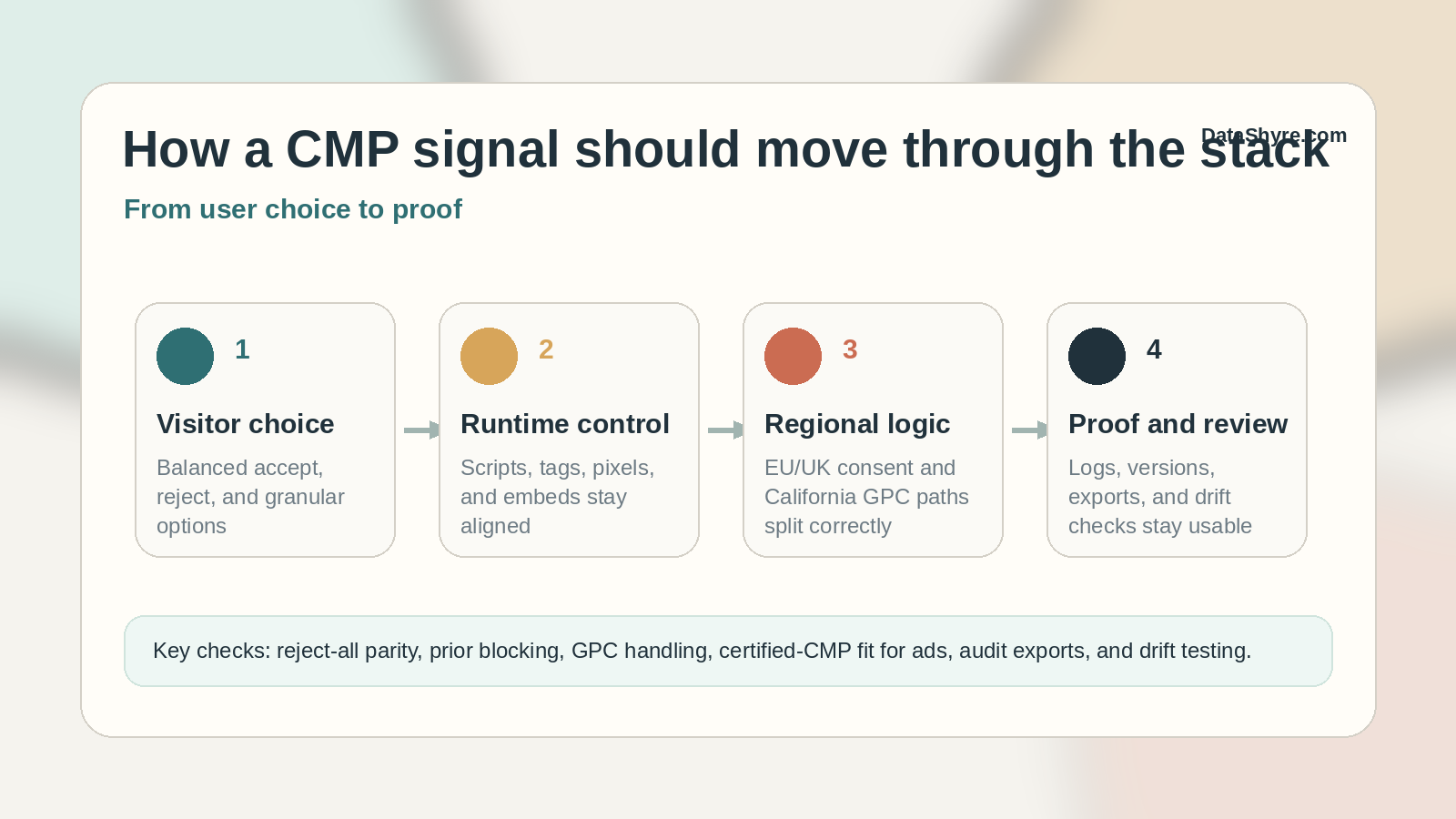
4. Follow the consent signal into the real stack
A CMP is only useful if its signal reaches the systems that matter.
For most teams, that means checking how the platform passes state into:
- tag managers;
- analytics tools;
- advertising pixels;
- chat, video, and embedded tools;
- experimentation systems;
- CRM or marketing automations that rely on downstream consent state.
If those handoffs are brittle, you still have operational risk even if the front-end experience looks finished.
5. Treat Google publisher requirements as a separate checkpoint
If your site depends on personalized ads, there is another layer to verify.
Google’s current publisher guidance says partners using AdSense, Ad Manager, or AdMob must use a Google-certified CMP integrated with the IAB Transparency and Consent Framework when serving personalized ads to users in the EEA, the UK, or Switzerland. Google also says its certification does not verify full compliance with the TCF or applicable privacy laws.
That matters because a platform can pass a publisher requirement and still need a broader legal and implementation review. The reverse is true too: a privacy team can like the product while ad operations still has a certification gap.
6. Demand records another team can understand later
Sooner or later, someone asks what happened on a specific date, under a specific banner version, for a specific journey.
Your team should be able to answer:
- What did the user see?
- What categories, purposes, or vendors were enabled?
- What did the user choose and when?
- Which scripts or partners were allowed after that choice?
- Could the user later return and change the decision?
If the platform cannot help legal, support, and engineering answer those questions without detective work, it is too thin for a serious rollout.
7. Plan for drift after launch
Implementation drift is usually the long-tail risk.
New vendors get added. A plugin changes behavior. Marketing introduces a new embed. A developer publishes a new tag outside the approved path. The banner still looks fine while the stack under it quietly changes.
The better consent management platform (CMP) setups make re-testing easier, surface new technologies, and help teams spot drift before it becomes an enforcement or trust problem.
A practical CMP review sequence
If I were reviewing a consent management platform (CMP) today, I would do this in order:
- Load the site in a clean browser session and inspect what fires before any click.
- Click
Reject alland verify optional technologies stay off where prior consent is required. - Test granular choices and confirm only the expected tags or vendors activate.
- Reopen settings later and confirm withdrawal or revision works cleanly.
- For California-facing flows, verify how the site handles GPC and sale-or-sharing opt-out logic.
- Export logs and decide whether support, legal, and engineering could all understand them.
- If ads matter, run the Google-certified CMP check separately from the broader legal review.
That sequence usually reveals more than a feature matrix or a polished procurement demo.
Why the acronym still matters in 2026
The term CMP gets used casually, but the category still deserves careful review.
The ICO’s final 2026 guidance makes clear that storage-and-access compliance is broader than old cookie-only thinking. The EDPB’s July 2026 VRT decision shows that cookie-banner complaints are still live at the supervisory level. California’s current GPC guidance and the CPPA’s effective-2026 laws and regulations both reinforce that privacy choices have to work in practice, not just in theory.
That combination is why a consent management platform (CMP) should be evaluated as both a compliance layer and an operating system for privacy choices.
Bottom line
The right consent management platform (CMP) in 2026 is not the one with the prettiest banner template. It is the one that gives people a fair choice, enforces that choice technically, adapts by region, and leaves behind evidence your team can actually use.
The ICO’s April 2026 launch note captured the larger objective well when William Malcolm said people need:
“meaningful control over how their data is used.”
>
William Malcolm, ICO
If your current setup cannot deliver that in the live stack, it is time to re-test the category instead of only redesigning the banner.
Sources
- UK ICO: Final storage and access technologies guidance published
- European Commission: When is consent valid?
- European Commission: What if somebody withdraws their consent?
- European Data Protection Board: Belgian DPA must handle the merits of a NOYB cookie-banner complaint
- CNIL: Dark Patterns in Cookie Banners: CNIL issues formal notice to website publishers
- California Department of Justice: Global Privacy Control
- California Privacy Protection Agency: Laws & Regulations
- Google AdSense Help: Google consent management requirements for serving ads in the EEA, the UK, and Switzerland (for publishers)
This post was updated on August 2, 2026 using current official regulator, government, and platform materials available at publication time.