

DPA Consent in 2026: What Counts as Valid Permission and What Fails
If you searched for dpa consent, you probably do not need another abstract definition. You need to know whether your checkbox, form, banner, signup flow, or marketing list would still hold up if a regulator or customer asked basic questions about it tomorrow.
The practical answer in 2026 is stricter than many teams want. The ICO says consent must be freely given, specific, informed, and unambiguous. It also says people must be able to withdraw it as easily as they gave it. That matters across web forms, email capture, SMS programs, cookie banners, and preference centers.
If you want adjacent reading, our guides to GDPR consent form, cookie consent requirements, and user consent cover the neighboring mechanics around wording, banner behavior, and proof.
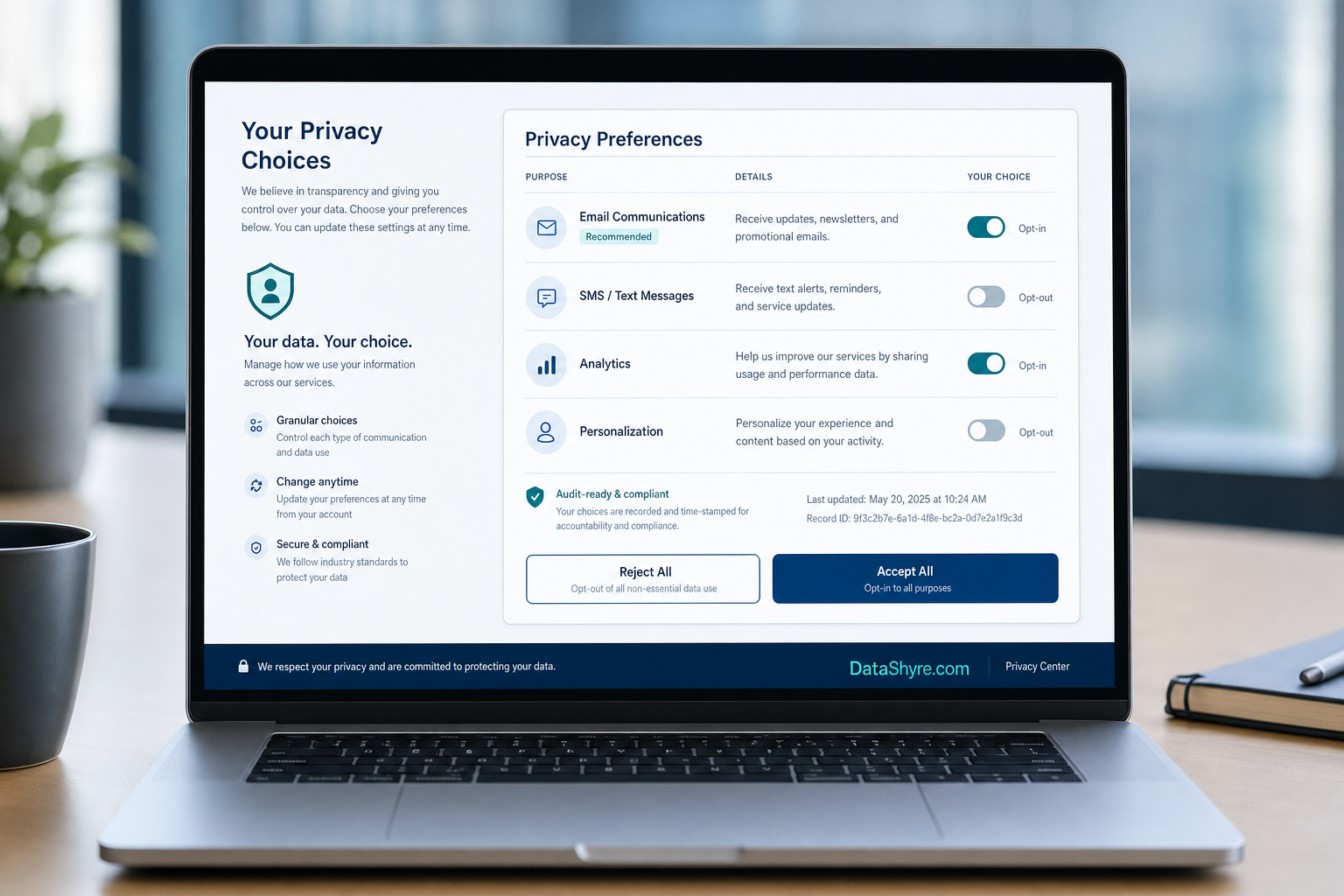
What valid DPA consent actually requires
The core test is not complicated, but it is easy to fail in production.
First, the person needs a real choice. The ICO’s current guidance says consent is invalid if the individual cannot refuse without detriment, or if the request is bundled into something unnecessary for the service. That is why pre-ticked boxes, default-on toggles, and “accept to continue” patterns keep causing trouble.
Second, the request has to be specific. If you want email marketing consent, say that. If you want SMS, say that separately. If multiple controllers will rely on the permission, name them. The ICO is blunt here too: a broad request that tries to cover too many purposes, tools, or third parties stops being readable long before it becomes compliant.
Third, it has to be informed and clearly presented. William Malcolm of the ICO described the regulator’s 2026 storage and access guidance as “clear, practical guidance.” That is the right standard for operators as well. If an ordinary person cannot tell who is asking, what happens next, and how to change their mind later, the request is not ready.
Fourth, you need evidence. Consent is not something you remember having. It is something you can show. The ICO says records should let you prove who consented, when, what they were told, how they acted, and whether they later withdrew.
When dpa consent is the right basis
A common mistake is reaching for consent when another lawful basis would fit better.
For example, if you need an address to ship an order, contract is usually the cleaner basis. If you must keep certain records for tax or employment reasons, a legal obligation may do the work. Consent becomes more appropriate when the person has a genuine option, especially for things like optional marketing, non-essential cookies, some preference-driven personalization, or special category processing where explicit permission is needed.
That distinction matters because weak consent is worse than no consent strategy. The ICO’s current PECR guidance still says you must not send marketing emails or texts to individuals without specific consent unless the narrow soft opt-in exception applies. Meanwhile, Ireland’s Data Protection Commission said on June 30, 2026 that it concluded 275 electronic direct marketing investigations in 2025 and issued 50 warning letters tied to unsolicited marketing communications. Regulators are still looking at the boring operational stuff, because that is where businesses still slip.
Three places businesses still fail
1. Consent is bundled into another step
Teams still hide permission inside account creation, checkout, downloads, or gated content. That is exactly where consent quality starts to collapse. EDPB chair Anu Talus put the wider principle well when she said users should have “real choice.” If saying no blocks a person from something unrelated, or if every purpose is forced into one yes/no moment, choice is not real.
2. The wording is broad but the behavior is specific
This is a quiet risk. A form might say “we may contact you with relevant offers and updates,” while the business actually plans to run segmented email campaigns, SMS reminders, audience syncing, and partner promotions. The processing becomes more detailed than the promise. That gap is exactly why regulators expect granular wording and records tied to the version the person saw.
3. Withdrawal works on paper, not in systems
This is where a lot of dpa consent programs break. The privacy notice says people can opt out at any time, but the CRM, email platform, CDP, website scripts, and suppression lists do not update together. California’s enforcement around Global Privacy Control made the same operational point from a different angle. Rob Bonta called technologies like GPC a “game changer for consumers.” He was right about the larger lesson too: preference signals only matter when your stack actually honors them.
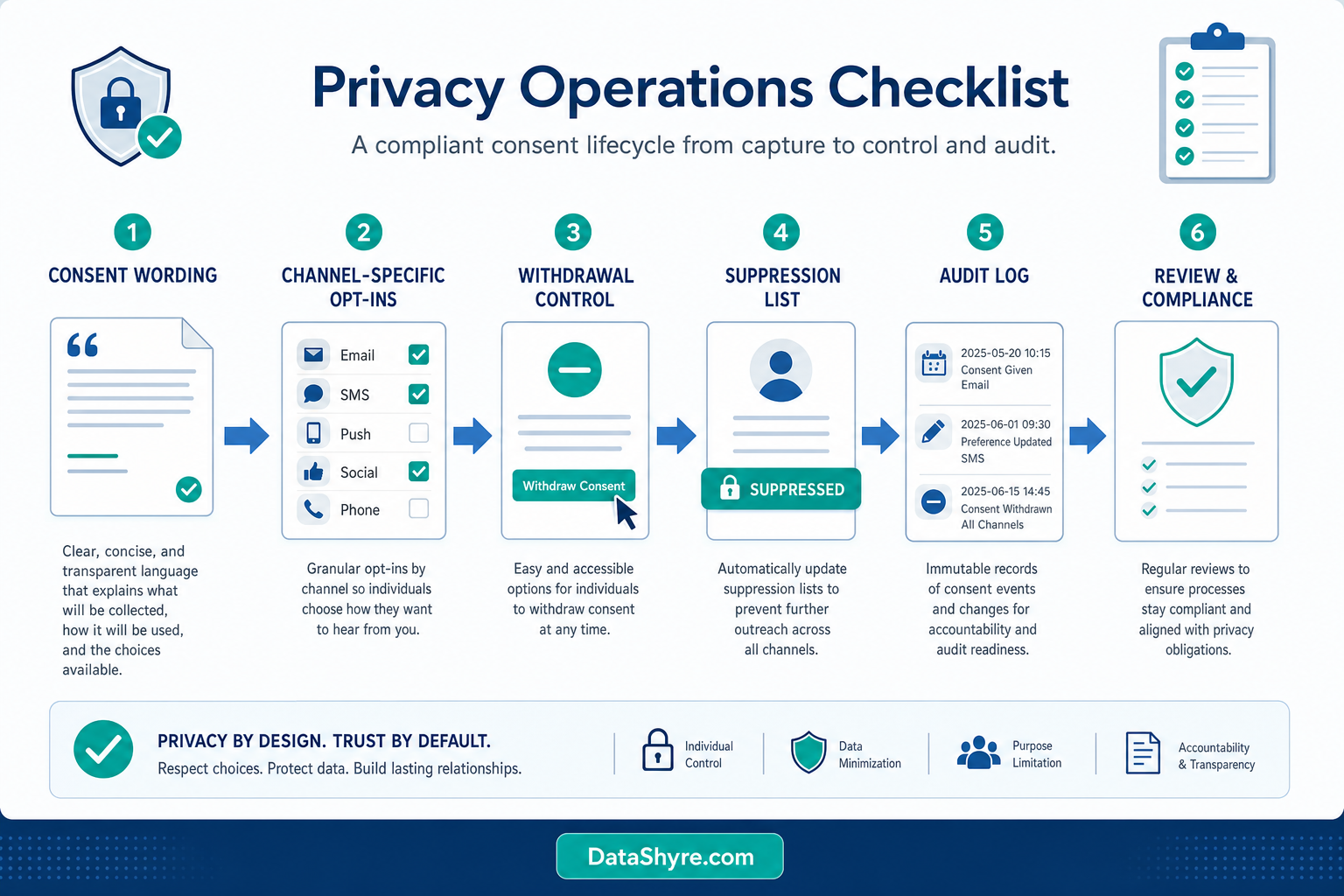
A short 2026 checklist
Before you rely on consent as your basis, test these five questions:
- Can the person refuse without losing access to something unrelated?
- Is each purpose split clearly enough that a reasonable person could say yes to one and no to another?
- Does the wording identify the organization, the channels, and the actual use of the data?
- Can the person withdraw in one obvious step?
- Can your team produce a timestamped record and the exact wording shown at that moment?
If the answer is no to any of those, the safer move is usually to redesign the experience before launch.
Treat consent as an operating control, not a copywriting exercise. The best programs make the request clear, keep it narrow, wire the choice into real systems, and preserve evidence that another human can review later.
A light note: this is a practical compliance and implementation guide, not legal advice.
Sources
- UK Information Commissioner’s Office
- Ireland Data Protection Commission
- European Data Protection Board
- California Department of Justice