

GDPR Cookies Requirements in 2026: The Checklist Regulators Still Expect
The fastest way to understand gdpr cookies requirements in 2026 is this: if a cookie or similar tracking tool is not strictly necessary, it stays off until the user makes a real choice. That is still the baseline across EU guidance and regulator enforcement. What changed is not the core rule. What changed is how thoroughly authorities now test whether the banner, scripts, tags, and withdrawal flow line up with the promise on the screen.
If you want the broader backdrop first, our guides to cookie consent requirements, GDPR consent requirements, and what cookie consent actually means fill in the surrounding rule set. This article stays narrow on the website layer: what regulators still expect a business site to do before analytics, ad tech, or other optional trackers begin.
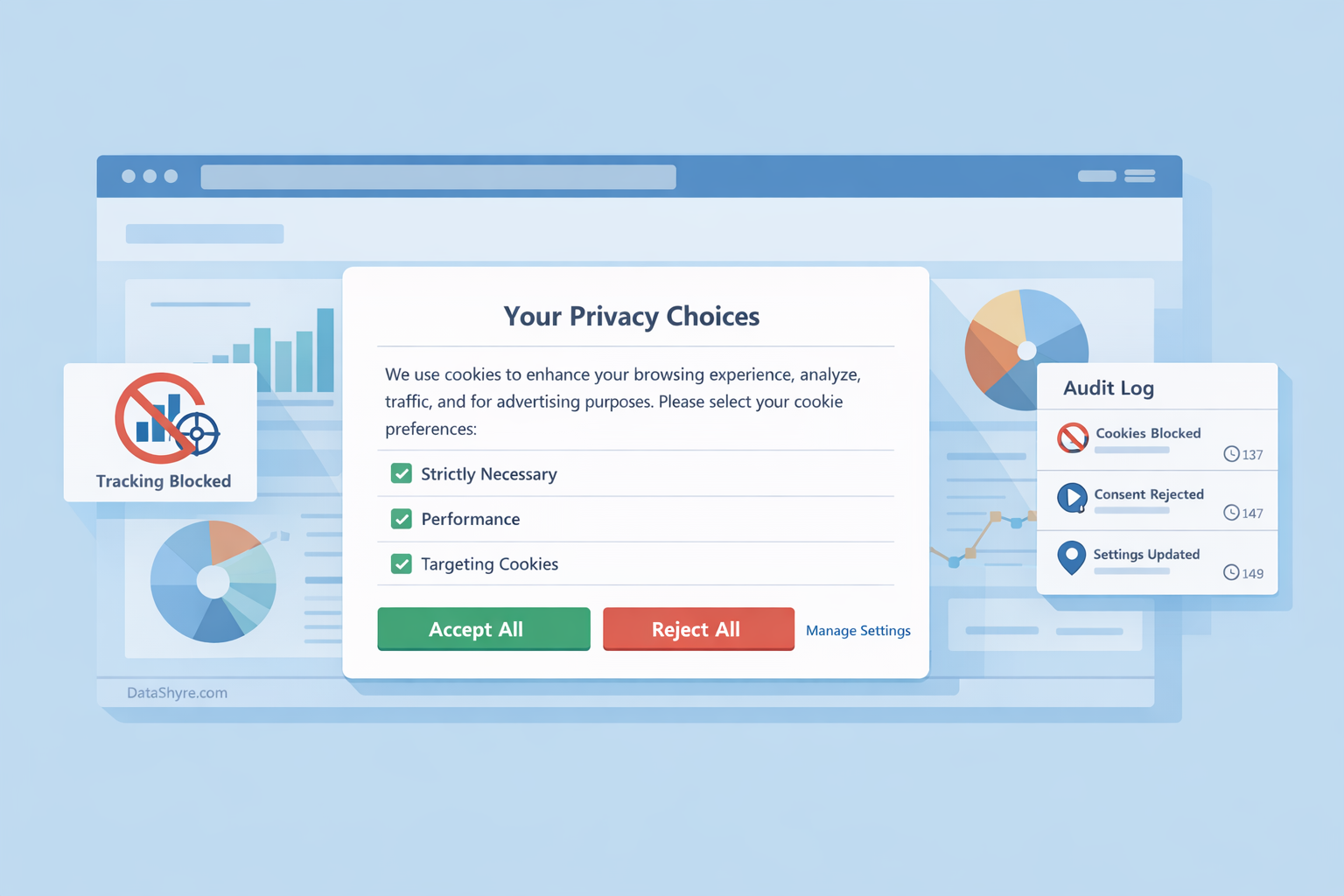
GDPR cookies requirements: the 2026 baseline
The European Commission’s business guidance is still a clean starting point. Cookies that require consent cannot be set when the page first opens. Users should get clear information about purpose, should be able to consent by purpose, and should be able to withdraw just as easily later.
That sounds simple, but it has real implementation consequences:
- non-essential cookies and similar technologies stay blocked on first load
- the banner explains purpose in plain language, not just vendor names
- analytics, advertising, and similar optional purposes are separated instead of bundled
- rejecting is as easy as accepting
- a later withdrawal actually stops future reading or writing of optional trackers
The ICO’s final Storage and Access Technologies guidance, published on April 29, 2026, is useful here because it makes the technical scope harder to dodge. It does not stop at cookies. It expressly covers tracking pixels, web storage, fingerprinting, and scripts or tags. So swapping a cookie for local storage, a pixel, or a tag manager trick does not move you outside the rule.
European regulators have also become much less patient with manipulative choice design. Anu Talus, Chair of the European Data Protection Board, put it well: “Options related to privacy should be provided in an objective and neutral way.” That was said in a different privacy-design context, but it maps directly to cookie interfaces. If your “accept” button is the big obvious path and “reject” is buried or visually downgraded, you are taking a risk.
What regulators are actually checking now
The EDPB’s cookie banner taskforce report remains one of the clearest summaries of enforcement thinking. It says no cookies that require consent should be set without consent, and a large majority of authorities viewed banners without a refuse or reject option on any layer that contains a consent button as not aligned with valid-consent requirements.
That position shows up in later enforcement. In its 2024 annual report, the EDPB highlighted Belgian DPA action against Mediahuis over unlawful cookie banners, including the view that “accept all” should not be more prominent than the alternative and that “accept all” and “reject all” should appear in an equivalent manner. In France, the CNIL announced a EUR 325 million fine against Google in September 2025 that included findings about invalid advertising-cookie consent during account creation. The EDPB also published the CNIL’s September 2025 case against SHEIN, which described several cookies being placed as soon as users arrived and said new cookies were still being placed even after a user hit “Refuse all” or later withdrew consent.
Those examples matter because they show the pattern regulators care about most: not whether a team has a banner, but whether the site’s behavior changes when the user says no.
Where businesses still get this wrong
Most failures are boring, which is exactly why they survive launch.
The first is premature firing. A tag manager, analytics library, or embedded vendor still runs on first page load before the consent state is settled. The second is fake granularity: the UI shows categories, but the scripts behind the scenes still read or write more than the selected purpose allows. The third is weak withdrawal. A banner lets someone refuse, yet old identifiers keep being read or fresh ones keep getting written on later pages. The fourth is poor records. Teams cannot show what the user saw, what they chose, and what technically happened after that choice.
William Malcolm of the ICO recently said people should have “meaningful control over how their data is used.” That is a practical test, not a slogan. If a user cannot refuse in one clear step, cannot reopen preferences easily, or cannot trust the site to honor a refusal on the next page, the control is not meaningful.
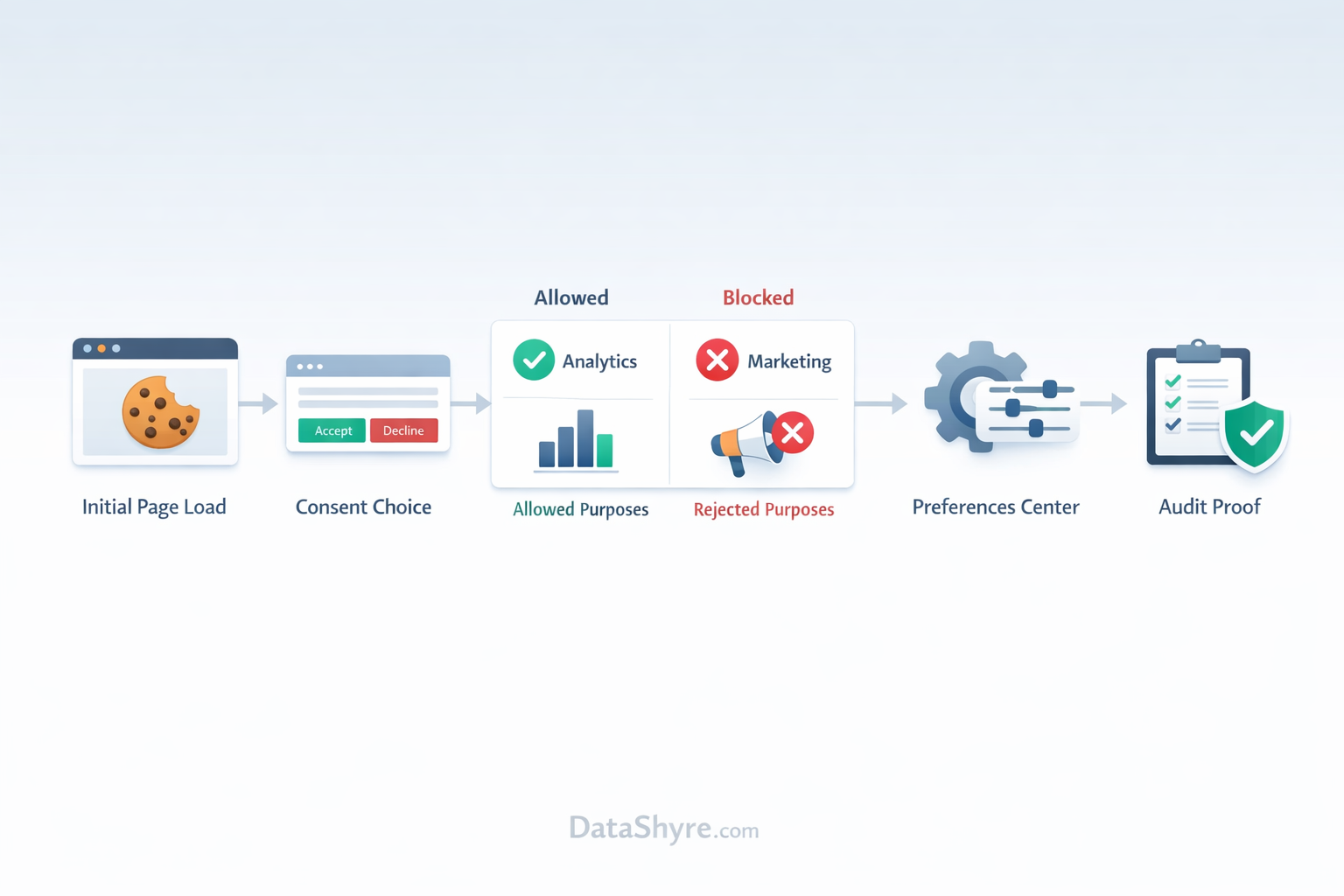
A practical checklist before you call the banner compliant
The easiest way to think about gdpr cookies requirements today is as a test plan:
- Load the site in a clean browser and confirm no optional cookies, pixels, or marketing tags fire before choice.
- Check that each optional purpose is described clearly and separately enough for a user to make a real selection.
- Compare the first-layer controls. Accept and reject should be equally obvious in placement, wording, and visual weight.
- Reject all, then keep browsing. Make sure no optional identifiers continue to be written or read on later pages.
- Reopen preferences and withdraw a prior opt-in. Confirm the site respects the updated choice and that your records show the change.
If you use a CMP, do not assume the default template gets you there. Test the browser storage, the network requests, and the tag behavior. Regulators are increasingly describing real technical failures, not just weak copy.
That is also why 2026 is a good year to clean up governance around consent logs. You do not need theatrical documentation. You do need enough evidence to show the version of the banner that ran, the categories presented, the user’s action, and the downstream result.
gdpr cookies requirements are still manageable for most teams. The rule is not mysterious. Block optional tracking first, explain purpose clearly, make refusal straightforward, and prove your site did what it said it would do.
Sources
- Your Europe
- European Data Protection Board
- UK Information Commissioner’s Office
- CNIL