

California Data Privacy Protection Act in 2026: What Businesses Actually Need to Recheck Now
If you are searching california data privacy protection act on August 7, 2026, you are probably not looking for a naming debate. You are trying to work out which California privacy rules are live now, what regulators are actually enforcing, and what a business should re-test this quarter.
That is the right framing. In practice, california data privacy protection act usually points to California’s active privacy stack: the CCPA, the CPRA amendments that changed it, the regulations effective January 1, 2026, the state’s current Global Privacy Control expectations, and, for data brokers, the Delete Act workflow that became operational on August 1, 2026.
If you want the wider California baseline first, start with our guides to California consumer privacy, CCPA who does it apply to, and GDPR vs. CCPA. This article stays practical. It is the seven-check review I would run before telling a team its California privacy program is current.

What businesses usually mean by California data privacy protection act
The most useful reading of california data privacy protection act in 2026 is not as the formal title of one separate law.
The CPPA’s current FAQ says the CPRA amended the CCPA and did not create a separate, new law. The agency therefore usually refers to the law as the CCPA or the CCPA, as amended.
So when teams search this keyword, they usually mean a bundle of connected California duties:
- the CCPA rights and scope baseline;
- the CPRA amendments already folded into that law;
- the regulations and updates now effective;
- the opt-out and GPC handling California expects in practice;
- current enforcement around friction, apps, connected services, and minors;
- and the Delete Act plus DROP workflow for data brokers.
That distinction matters because businesses often search with one broad label while the real compliance work lives in several connected places.
Why the 2026 version matters more than the old summary
California has made the current picture harder to ignore.
The CPPA’s laws-and-regulations page lists both the California Consumer Privacy Act and the CCPA Regulations as effective on January 1, 2026. Its September 23, 2025 announcement about the final regulations said the package would “provide clarity for businesses” while also strengthening protections for Californians.
At the same time, the enforcement picture kept getting more operational. CalPrivacy’s March 5, 2026 Ford decision emphasized that “Opting out is supposed to be easy.” The Attorney General’s Disney settlement on February 11, 2026 said businesses cannot force consumers to go “device-by-device or service-by-service.” And as of August 1, 2026, data brokers must start pulling and processing deletion requests through DROP on a recurring timetable.
So for california data privacy protection act, the useful question in August 2026 is no longer “Do we have a privacy page?” It is “Can we show that rights, opt-outs, notices, and downstream system behavior still line up with the live California standard?”
The 7 checks I would re-run this week
1. Reconfirm whether the business is actually in scope
The CPPA FAQ still gives the clearest scope test.
It says the CCPA applies to for-profit businesses that do business in California, collect personal information or have it collected for them, determine why and how it will be processed, and meet at least one threshold. The same FAQ currently lists those thresholds as:
- $26.625 million or more in annual gross revenue for the preceding calendar year;
- buying, selling, or sharing the personal information of 100,000 or more California residents or households;
- or deriving 50% or more of annual revenue from selling or sharing California residents’ personal information.
The FAQ also says California residents under the CCPA include employees, job applicants, and contacts for vendors, customers, or independent contractors. That means a california data privacy protection act review should not stop at consumer website traffic alone.
2. Re-test your request timelines and intake methods
Many teams know the rights language and still miss the workflow timing behind it.
The CPPA FAQ says businesses must confirm delete, correct, or know requests within 10 business days and must substantively respond within 45 calendar days, with a possible extension to 90 days if the consumer is notified. The same FAQ says opt-out of sale or sharing requests and requests to limit certain sensitive-data uses must be honored as soon as feasibly possible, up to 15 business days.
For california data privacy protection act, I would test the workflow end to end:
- intake on the website;
- intake in the app, if there is one;
- identity-verification handoff where needed;
- routing into vendors or downstream systems;
- suppression, deletion, correction, or limitation behavior;
- proof that the request was actually completed.
If those steps do not line up, the privacy policy may be current while the operating system behind it is not.
3. Treat GPC as a live product control, not a legal footnote
California’s DOJ still describes Global Privacy Control as a “stop selling or sharing my data switch.”
Its current GPC page also says that for businesses collecting personal information online, a user-enabled GPC is an acceptable way for consumers to opt out of sale or sharing, and that covered businesses must honor it as a valid request.
That pushes california data privacy protection act work into product and engineering, not just policy. The questions this week should be:
- where is the signal detected;
- which systems receive it;
- does the opt-out apply only in one browser state or across linked account surfaces;
- and can the business later show the signal was honored.
4. Make sure opt-outs work across apps, services, and connected accounts
This is one of the clearest California enforcement themes right now.
The Disney settlement said California alleged Disney failed to fully effectuate requests to opt out across all devices and streaming services associated with consumers’ accounts. The Ford decision focused on email verification friction in the opt-out path. Both are reminders that an opt-out method can exist on paper and still fail in practice.
For california data privacy protection act, that means testing more than one surface:
- the website flow;
- the mobile app flow;
- connected TV or streaming surfaces, if they exist;
- logged-in account behavior across services;
- support-assisted request handling when a consumer cannot use self-service tools.
The fastest way to fail a California review is to make privacy rights look unified in the footer while keeping them fragmented in the real product.
5. Reconcile your notices with your actual data uses
The scope of the review should not stop at requests and opt-outs.
The CPPA FAQ says businesses must follow purpose-limitation and data-minimization rules. It says collection, use, and retention should be limited to purposes a consumer would reasonably expect, purposes compatible with those expectations and disclosed to the consumer, or purposes the consumer agreed to without dark patterns.
The Attorney General’s January 27, 2026 surveillance-pricing sweep turned that into a live enforcement signal by saying those practices may trigger obligations under, and even violate, the CCPA’s purpose-limitation principle.
That makes california data privacy protection act a use-governance question as much as a notice question. This week I would compare:
- the notice shown at collection;
- the categories of data actually flowing into analytics, advertising, pricing, or CRM systems;
- the purposes attached to those uses;
- the rights path available when a consumer objects.
If the notices describe one thing while the live stack does something broader, the problem is operational, not cosmetic.
6. Prepare for California’s browser-level opt-out future now
The next California change is already dated.
CalPrivacy’s January 15, 2026 Opt Me Out Act explainer says the California Opt Me Out Act requires browsers to offer opt-out preference signals and that, no later than January 1, 2027, all web browsers accessed on desktop or mobile must include them.
Businesses already have to honor valid signals today. The new law matters because it makes broad signal availability more likely, which should increase the number of consumers sending browser-level opt-out requests.
So for california data privacy protection act, I would not wait for 2027. I would test now whether:
- browser-level signals are detected consistently;
- they map cleanly to account-linked data where appropriate;
- the opt-out path survives app, web, and vendor handoffs;
- logs can distinguish a signal-based opt-out from other request types.
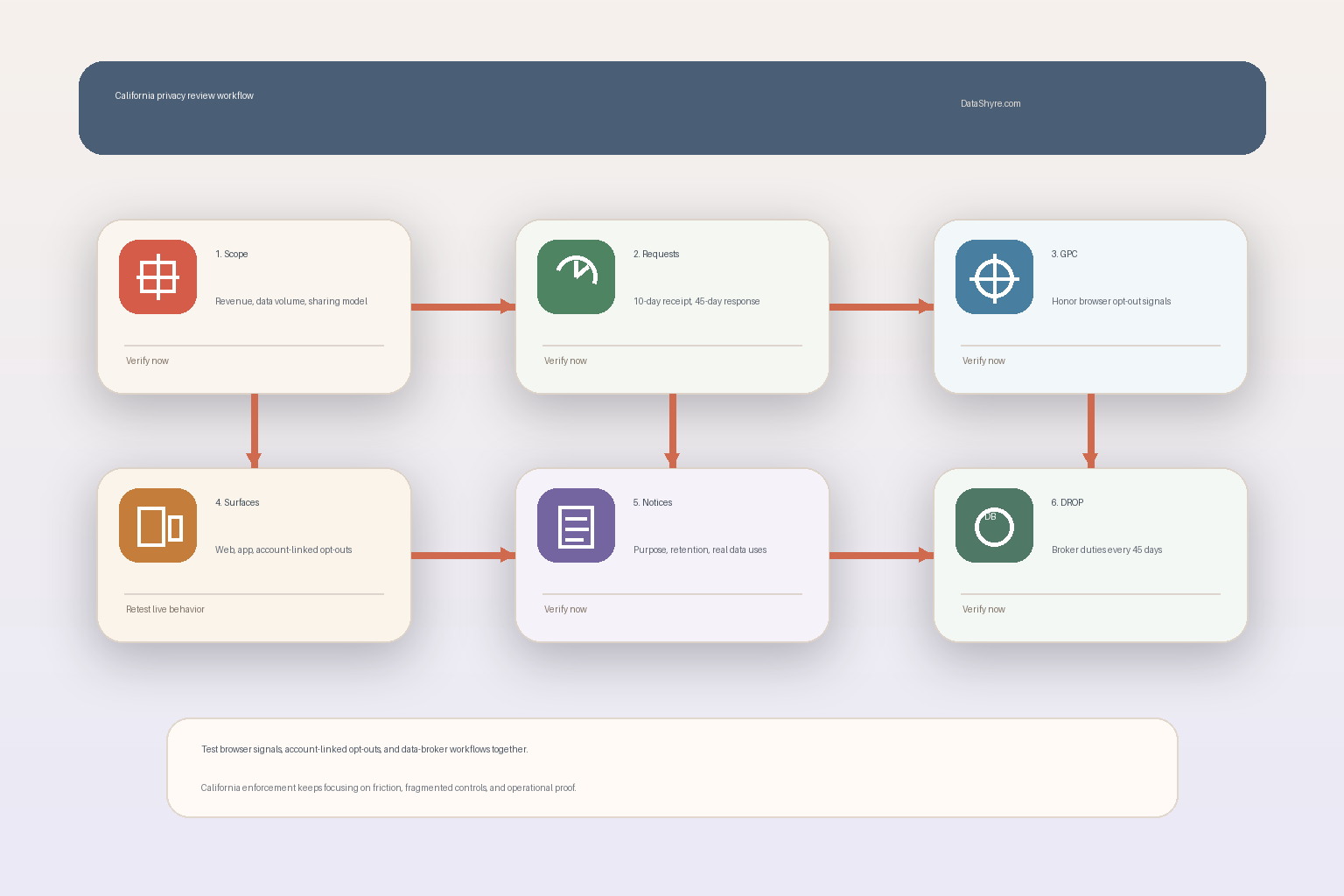
7. If data brokers are anywhere in the picture, operationalize DROP now
This is the most date-sensitive California checkpoint in the stack today.
CalPrivacy’s DROP materials say the Delete Act expanded California privacy rights and that, in 2026, DROP became available for consumers to submit deletion requests. The same materials say data brokers will start processing deletion requests August 1, 2026. The CPPA’s current data-broker page adds the practical deadline: starting August 1, data brokers have 45 days to access DROP and process their first batch of deletion requests.
If california data privacy protection act is the phrase circulating inside your company and there is any data-broker activity, broker-fed enrichment, or uncertainty about the business model, the review should immediately ask:
- are we a data broker under California’s definition;
- have we registered correctly;
- who owns DROP access;
- who owns the recurring retrieval and deletion cycle;
- do our disclosures still match the real business.
That is no longer roadmap material. It is live operations.
A short operating sequence for this week
If I had to turn california data privacy protection act into a short action list for a real business this week, it would be:
- Recheck scope using the current thresholds and the full data-sharing footprint.
- Test one delete, correct, or know request end to end.
- Test one GPC-based opt-out in a clean browser session.
- Test one app or logged-in account opt-out where relevant.
- Compare notices to actual advertising, analytics, pricing, and vendor behavior.
- Confirm whether any data-broker registration or DROP workflow now applies.
That short sequence usually exposes more truth than another round of privacy-policy edits.
Bottom line
The best way to understand california data privacy protection act in 2026 is as a practical search term for California’s live privacy obligations, not as one neat label you can satisfy with one document.
If your team can show current scope logic, working request timing, GPC recognition, cross-surface opt-outs, accurate notices, and a real DROP process where required, you are much closer to a California privacy program that can hold up in practice. If you cannot show those things, the label itself does not help much yet.
Sources
- California Privacy Protection Agency: Frequently Asked Questions
- California Privacy Protection Agency: Law & Regulations
- California Privacy Protection Agency: Updated Monetary Thresholds in CCPA
- California Privacy Protection Agency: California Finalizes Regulations to Strengthen Consumers’ Privacy
- California Privacy Protection Agency: Rights under the California Consumer Privacy Act
- California Department of Justice: Global Privacy Control (GPC)
- California Department of Justice: California Won’t Let It Go: Attorney General Bonta Announces $2.75 Million Settlement with Disney
- California Privacy Protection Agency: Ford to Change Practices, Pay Fine for Adding Unnecessary Friction to Opt-Out Process
- California Department of Justice: On Data Privacy Day, Attorney General Bonta Focuses on Surveillance Pricing, Compliance with California Consumer Privacy Act
- California Privacy Protection Agency: California’s Opt Me Out Act: Your Privacy Just Got Easier
- California Privacy Protection Agency: About DROP and the Delete Act
- California Privacy Protection Agency: Information for Data Brokers
This post was updated on August 7, 2026 using current official California regulator and government materials available at publication time.