

What Is Cookie Consent? When Websites Need It and What Valid Consent Looks Like in 2026
If you are asking what is cookie consent, the plain-English answer is simple: it is the permission a website asks for before it places or reads non-essential cookies and similar tracking technologies for analytics, advertising, or personalization. The banner is the visible piece. The harder part is making the site behave the way the user chose.
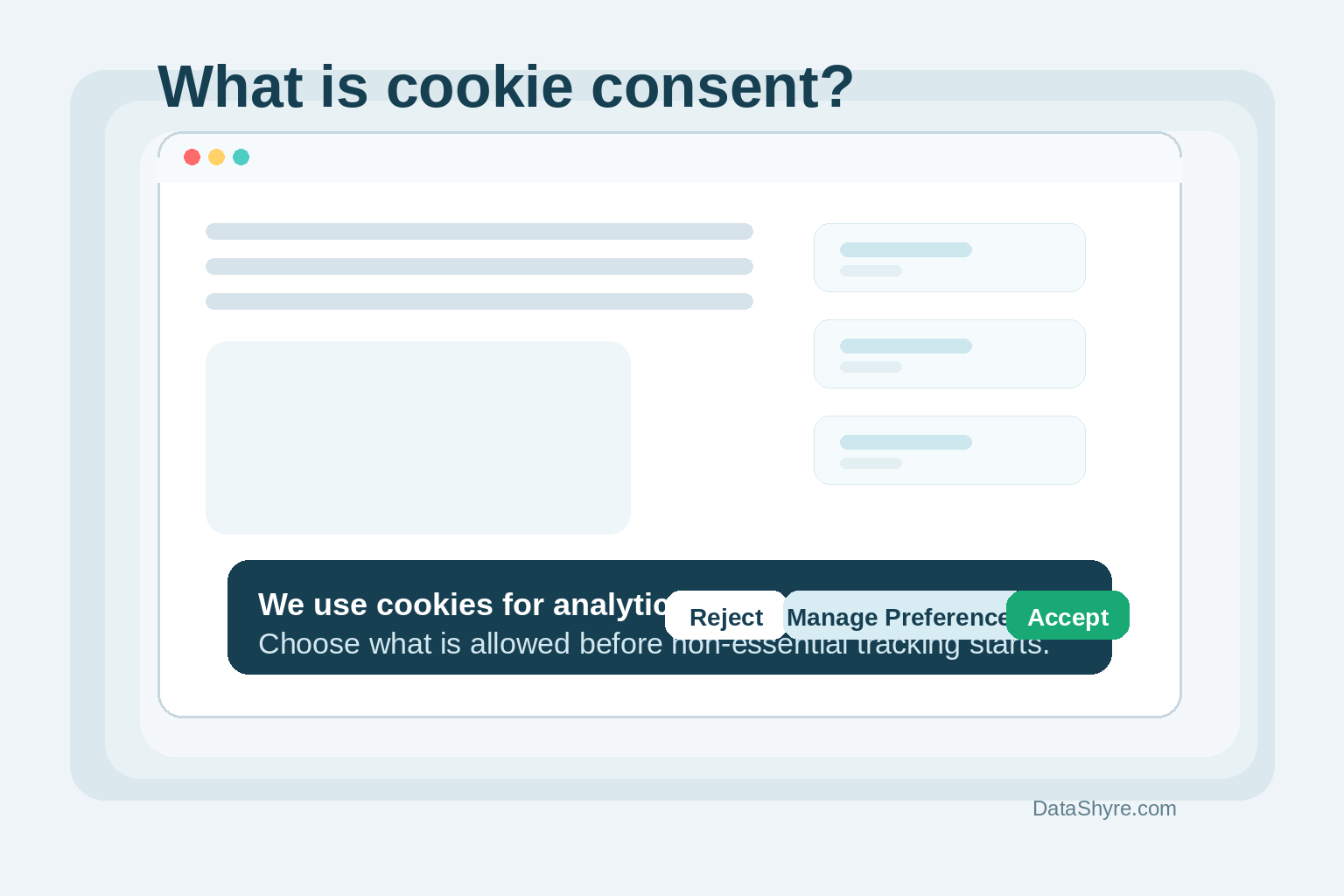
That is the line many teams still miss. A banner can look polished and still fail if non-essential tags fire too early, reject is buried, or preference changes do nothing. If you want the broader operating playbook, our cookie consent guide covers the basics. For the EU-specific standard, this GDPR cookie consent requirements guide goes deeper.
What is cookie consent in practice?
At a practical level, cookie consent has three parts:
- a clear explanation of what tracking is happening and why;
- a real user choice to accept, reject, or manage categories where required; and
- technical enforcement so the site actually follows that choice.
That last point matters. Consent is not just wording on a banner. It is notice, choice, and proof working together.
The European Data Protection Board still describes valid consent in familiar terms: it must be freely given, specific, informed, unambiguous, and easy to withdraw. That is still the right baseline for EU-facing teams.
When websites need cookie consent
The answer depends on where your visitors are and what your site is doing.
EU and UK: usually before non-essential tracking starts
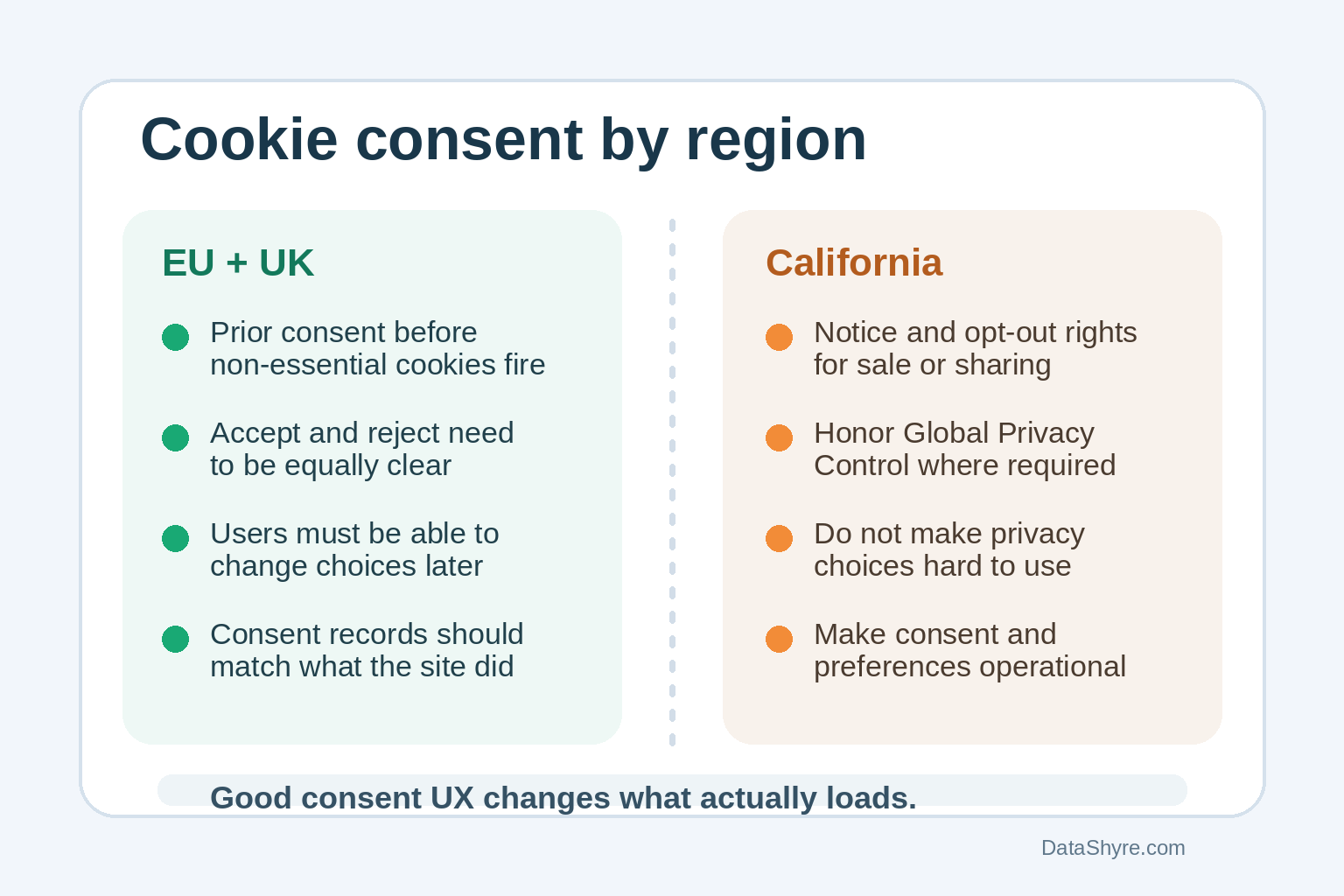
For EU and UK visitors, prior consent is still the core rule for non-essential cookies and similar technologies. Strictly necessary tools are treated differently, but analytics, ad tech, and many personalization tools usually need user permission first.
That is why what is cookie consent is partly a timing question. If a visitor lands on your site from the EU or UK, can analytics or ad tags run before that person says yes? If they can, you likely have a compliance problem.
The UK ICO’s final storage-and-access technologies guidance, published on April 29, 2026, made the point in more operational language. William Malcolm, the ICO’s Executive Director for Regulatory Risk, said people should have “meaningful control over how their data is used.” That is a better test than asking whether a banner merely appears.
Recent enforcement keeps backing that up. In September 2025, France’s CNIL fined Shein €150 million after finding that advertising cookies were written without user consent, user choices were not properly respected, and the information provided was not clear enough. That is the risk of treating consent as a surface-level design task instead of a real control.
California: often more about notice, opt-out rights, and sharing
California works differently. The CCPA, as amended, gives consumers rights to know, delete, correct, limit certain uses of sensitive personal information, and opt out of the sale or sharing of personal information. Businesses also need to treat Global Privacy Control signals as valid opt-out requests in many cases.
So the California question is often different from the EU question. Teams still need clear notices and workable controls, but the legal issue is often less about prior opt-in for cookies in general and more about whether the company gives consumers a usable way to exercise privacy rights tied to advertising and cross-context tracking.
Attorney General Rob Bonta made that usability point nicely in the February 11, 2026 Disney settlement announcement. He said asking a business to stop selling or sharing data “should not be complicated or cumbersome.” That idea travels well beyond one case. If the privacy control exists but ordinary people cannot use it, the interface itself becomes part of the problem.
For the California angle, our California consumer privacy post is the closest companion.
What valid cookie consent looks like in practice
A solid setup is usually less glamorous than vendors make it sound. It comes down to a few checks:
- non-essential tags do not fire before consent where prior consent is required;
- reject is as easy to find as accept;
- category choices are granular enough to mean something;
- users can change their minds later; and
- your logs or consent records match what the interface promised.
Google’s current consent mode documentation reinforces the same theme from the technical side. Developers are told to set a default consent state before measurement runs and then update that state when the user interacts with the consent controls. In plain English, your tag stack has to listen.
This is where what is cookie consent stops being a glossary question and becomes an implementation question. Which regions need prior consent? Which trackers sit in which categories? What happens on first page load, on reject, and after a preference change? If those answers are fuzzy, the banner is probably ahead of the underlying system.
A quick business test
If you need a fast internal check, ask four questions:
- Which technologies on our site are strictly necessary, and which are not?
- Do non-essential trackers stay off until the user makes a choice in regions that require prior consent?
- Can a user reject tracking as easily as they can accept it?
- Can we prove that the user’s choice changed what actually loaded?
If one of those answers is fuzzy, start there. Most cookie consent issues are not abstract. They are operational.
Bottom line
So, in practice, cookie consent is not just a pop-up. It is a working control that tells people what your site is doing, gives them a fair choice when the law requires it, and makes your trackers obey that choice. In 2026, that is the difference between a banner that looks fine in a screenshot and a setup that holds up when regulators, customers, or procurement teams take a closer look.
Sources
- European Data Protection Board
- UK Information Commissioner’s Office
- California Department of Justice
- CNIL
- Google for Developers